dream science
Do Blind People Dream? Sound, Touch, and Imagery
Do blind people dream with images, sounds, and touch? Research shows how blindness changes dream senses, nightmares, memory, and recall at night.

Yes, blind people dream, and their dreams can be as detailed, emotional, and strange as anyone else’s. The senses that appear depend strongly on when vision was lost: people blind from birth usually report more sound, touch, smell, taste, movement, and spatial knowing; people who became blind later may still dream visually.
Do blind people dream if they have never seen?
Yes, people blind from birth dream, though the dream is usually built from nonvisual senses rather than pictures.
This is the first correction to make in the morning: dreaming is not the same as watching a private film. REM sleep, the stage most associated with vivid dreaming, occurs in cycles of roughly 90 minutes, and most adults have 4 to 6 REM periods on an ordinary night. The dreaming brain uses memory, emotion, body maps, language, and expectation. Vision is common for sighted people, but it is not required.
In a 2014 Sleep Medicine study, Amani Meaidi and colleagues compared 50 blind adults with 50 sighted controls. The researchers found that people who were blind from birth reported fewer visual elements and more auditory, tactile, gustatory, and olfactory details. That is exactly what common sense would suggest, but it matters that the finding appears in structured dream reports rather than guesswork.
A dream image is not always a picture. It can be the known shape of a room, the pressure of a handrail, the sound of a person walking across tile, or the certainty that someone is standing nearby. Dream researchers often call this spatial imagery, and blind dreamers may describe it with remarkable precision. Dreams are not cinema; they are the mind rehearsing a world with whatever senses it trusts.
For symbol work, this matters. If you use a Dream dictionary (A–Z hub), read it as a set of possible meanings, not a command. A blind dreamer’s snake may be a sound in grass, a texture, a remembered warning, a childhood story, or a living animal encountered through smell and movement.
Do blind people see pictures in dreams?
Some blind people see pictures in dreams, mainly those who had usable sight earlier in life.
The timing of vision loss is the hinge. A person who became blind at 20 has stored visual memories: faces, rooms, traffic lights, handwriting, sky. Those memories can continue to appear in dreams. A person blind from birth has not stored visual perception in the same way, so ordinary visual dream scenes are usually absent or rare in self-report studies.
A 1999 paper in the journal Dreaming by Hurovitz and colleagues compared congenital, early, and late blindness in dream reports. The general pattern was clear: the earlier the blindness, the less visual content appeared, and the more prominent other senses became. The sample was not huge, as is common in this research area, but the pattern has been repeated often enough to take seriously.
| Dreamer group | Typical dream imagery | What changes most |
|---|---|---|
| Blind from birth | Sound, touch, smell, taste, movement, spatial knowing | Visual pictures are usually absent or minimal |
| Early blindness | Mixed reports, often limited visual memory | Nonvisual senses become more central |
| Later blindness | Visual memories may persist in dreams | Visual detail may fade for some people over years |
| Sighted dreamers | Mostly visual, with sound and movement | Smell and taste are less often reported |
There is one honest complication. In 2003, Bértolo and colleagues published a Cognitive Brain Research study suggesting that congenitally blind participants could show visual-like content or drawing ability after dreams. Other researchers have been cautious about how to interpret that finding. It may reflect spatial construction, language, touch-based shape knowledge, or brain activity that is not visual in the ordinary sense.
So the best answer is careful: some blind people see in dreams, some do not, and the word see can mean different things. The dreamer’s own description should lead. If they say, I knew where the table was, that is not a failed picture. It is a complete form of knowing.

What senses appear most in blind people’s dreams?
Sound, touch, smell, taste, movement, and spatial awareness tend to become more prominent when vision is absent or reduced.
In sighted dream reports, visual imagery dominates so strongly that people often forget to mention other senses unless asked. The DreamBank archive associated with Calvin Hall and later analyzed by G. William Domhoff contains more than 20,000 dream reports, and its coding tradition shows how often dream content is organized around characters, social interactions, settings, and emotions. Sensory balance is not always the first thing a dreamer notices.
Blind dreamers often notice it because their dreams are already working in another register. A door may be known by the click of the latch. A street may arrive as traffic flow and curb height. A person may be identified by breath, perfume, cane rhythm, or the warmth of a shoulder. The dream has a body. It is not missing the screen; it is using another instrument.
Commonly reported nonvisual details include:
- voices, accents, footsteps, music, alarms, and environmental sounds
- textures such as fabric, wall surfaces, animal fur, water, or pavement
- temperature, pressure, pain, balance, and bodily movement
- smells linked to people, kitchens, hospitals, weather, or travel
- taste, especially when the dream includes eating or childhood memory
- spatial certainty, such as knowing a room’s layout without seeing it
Meaidi et al. found that blind participants, especially those blind from birth, reported more smell and taste than sighted participants. Those two senses are relatively rare in many sighted dream reports. In one way, blind dreaming reminds researchers that the sleeping mind is broader than the visual habits of the people most often studied.
This also explains why a visual-first interpretation can be clumsy. If a sighted person dreams of a red door, red may carry symbolic weight. If a blind person dreams of a door that hums, sticks, smells of rain, and opens into a crowded hall, those are not decorative details. They are the dream’s grammar.
Are nightmares more common for blind dreamers?
Some studies have found more nightmares among congenitally blind dreamers, but the pattern should be read calmly.
The 2014 Sleep Medicine study reported that congenitally blind participants had a higher proportion of nightmares than sighted controls. The often-cited figures are about 25 percent of dream reports for congenitally blind participants compared with about 7 percent for sighted controls. The themes were ordinary human threats: being lost, falling, being struck by a vehicle, social danger, or losing orientation.
One explanation is threat rehearsal theory, associated with Finnish cognitive neuroscientist Antti Revonsuo. The theory argues that dreams may simulate dangers so the mind can practice response. You do not have to accept the whole theory to see why navigation threats might appear more often for a blind dreamer. Daily life asks more attention from the body in streets, stations, unfamiliar rooms, and crowds.
But a statistic is not a prophecy. Many blind people do not have frequent nightmares, and many sighted people do. Nightmares are shaped by stress, trauma history, medication, sleep disruption, fever, alcohol, and ordinary worry. The American Academy of Sleep Medicine notes that recurrent nightmares are worth clinical attention when they cause significant distress or impair daytime life.
The morning question is simple: what threat did the dream rehearse, and does it resemble anything from yesterday? For many people, writing down 3 details is enough: the danger, the attempted response, and the feeling on waking. If you want help noticing patterns without forcing meaning, the AI dream interpreter tool can give you a first pass, but your own sensory memory remains the authority.
How does blindness change lucid dreaming and dream control?
Blindness changes the sensory material of lucid dreaming, but it does not remove the possibility of becoming aware inside a dream.
Lucid dreaming means knowing you are dreaming while the dream is happening. It is not a visual skill. Sighted beginners often use visual oddities as dream signs, such as unreadable text or changing clocks, but blind dreamers can use other signs: impossible acoustics, a voice of someone who has died, a room layout that keeps shifting, or the sudden absence of a cane or guide dog.
Laboratory lucid dream research goes back at least to the late 1970s and early 1980s, when Keith Hearne and Stephen LaBerge used prearranged eye signals during REM sleep. That method depends on eye movement, but the mental act does not depend on sight. The dreamer recognizes the dream state and communicates from within it. A blind lucid dreamer may have fewer visual cues, yet strong body and sound cues can serve the same function.
For practice, I would keep it plain. The fastest route to a lucid dream is often 2 boring weeks of recall, not a clever technique. The Lucid dreaming pillar gives the larger map, but a blind dreamer can adapt the basics this way:
- Record one dream every morning, even if it is only a sound or a mood.
- Underline recurring sensory signs, such as echoing halls, lost routes, or voices.
- During the day, ask: am I dreaming, and what tells me this is waking life?
- Use nonvisual checks, such as reading with a screen reader twice, testing a familiar object, or noticing whether a room obeys memory.
- Keep sleep regular for 14 days before judging the method.
In my own notebooks, the engine is not drama. It is repetition. A dream sign becomes useful only after it has been noticed more than once.
How should you interpret a blind person’s dream fairly?
Interpret the dream through the dreamer’s sensory world first, then consider psychology, culture, and symbol tradition.
The mistake is to translate every dream into sighted imagery. A blind person dreaming of a mountain may not be dreaming of a postcard shape. The mountain may be steepness, altitude, thin air, thigh strain, gravel under shoes, a story from family, or the word mountain as a symbol of difficulty. Jung wrote about symbols as living forms rather than fixed definitions, but even Jungian reading has to begin with the actual report.
A fair interpretation usually moves in 4 passes:
- Name the felt event: what happened, and what sense carried it?
- Name the emotion: fear, tenderness, irritation, grief, desire, relief.
- Name the waking link: where did this sound, texture, place, or tension appear recently?
- Name the old layer: does family, religion, folklore, or childhood story give it another meaning?
Cultural readings can be useful when they are labeled honestly. In some folk traditions, dreaming of losing the path suggests social confusion or spiritual testing. That is folklore, not evidence. In clinical dream work, getting lost more often points to uncertainty, overload, or a real navigation problem. Both readings can sit at the table if neither pretends to be the whole truth.
This is also where a broader practice can help, late in the process rather than as a replacement for the dream. The AYA Method is a daily audio manifestation practice. Each day you listen to a short personalized recording, your Dream-Self Moment, narrated from the version of you who has already manifested the life you intend. Listening is the practice. Repetition is the work. The audio is the method. A recurring dream shows where attention keeps returning; the waking audio gives attention a chosen direction.
If you want to compare a symbol’s traditional meanings with your own notes, move between your journal and the Dream dictionary (A–Z hub), not away from your journal. The dictionary is a shelf. The dream is the room you woke from.
What should you write down the morning after?
Write down the senses first, because sensory details vanish faster than the plot.
Dream recall is fragile. Sleep researchers often ask participants to report dreams immediately after waking because even a few minutes can change the account. In ordinary life, breakfast is enough to erase half the dream. For blind and sighted dreamers alike, the first note should catch what the body still knows: the voice, the floor, the air, the distance, the fear, the hand on the rail.
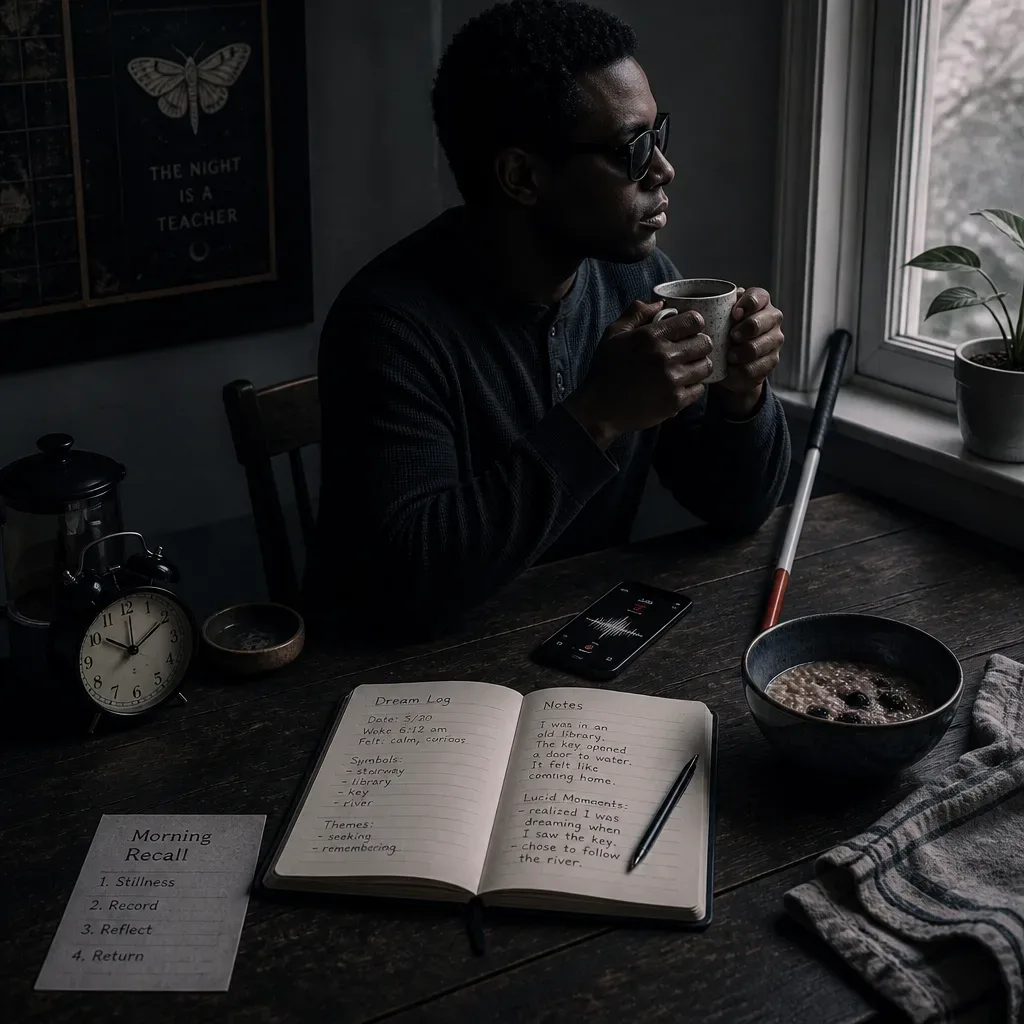
A simple morning template works better than an elaborate one. I have used nearly the same format since 2006: date, one-line summary, dream signs underlined, lucidity noted in the margin. For this topic, I would add one sensory line.
Use this:
- Date and wake time
- One-line dream summary
- Main senses: sound, touch, smell, taste, movement, spatial knowing, visual image if present
- Strongest emotion
- One waking-life link from the last 48 hours
- One sentence the dream seems to be asking
The World Health Organization estimates that at least 2.2 billion people globally have some form of near or distance vision impairment, so there is no single blind dreamer. There are people blind from birth, people with light perception, people with changing sight, people who lost vision in adulthood, and people whose dreams keep older visual memories alive. The honest answer must leave room for all of them.
If a dream is troubling, write it plainly before interpreting it. If it is beautiful, do the same. The dream does not need to be made visual to be complete.
Write the first sound down before the kettle boils.