dream science
Third Person Dreams: Why You Watch Yourself
Third person dreams often show emotional distance, self-observation, or identity change. Learn what this dream view may mean and what to write down.
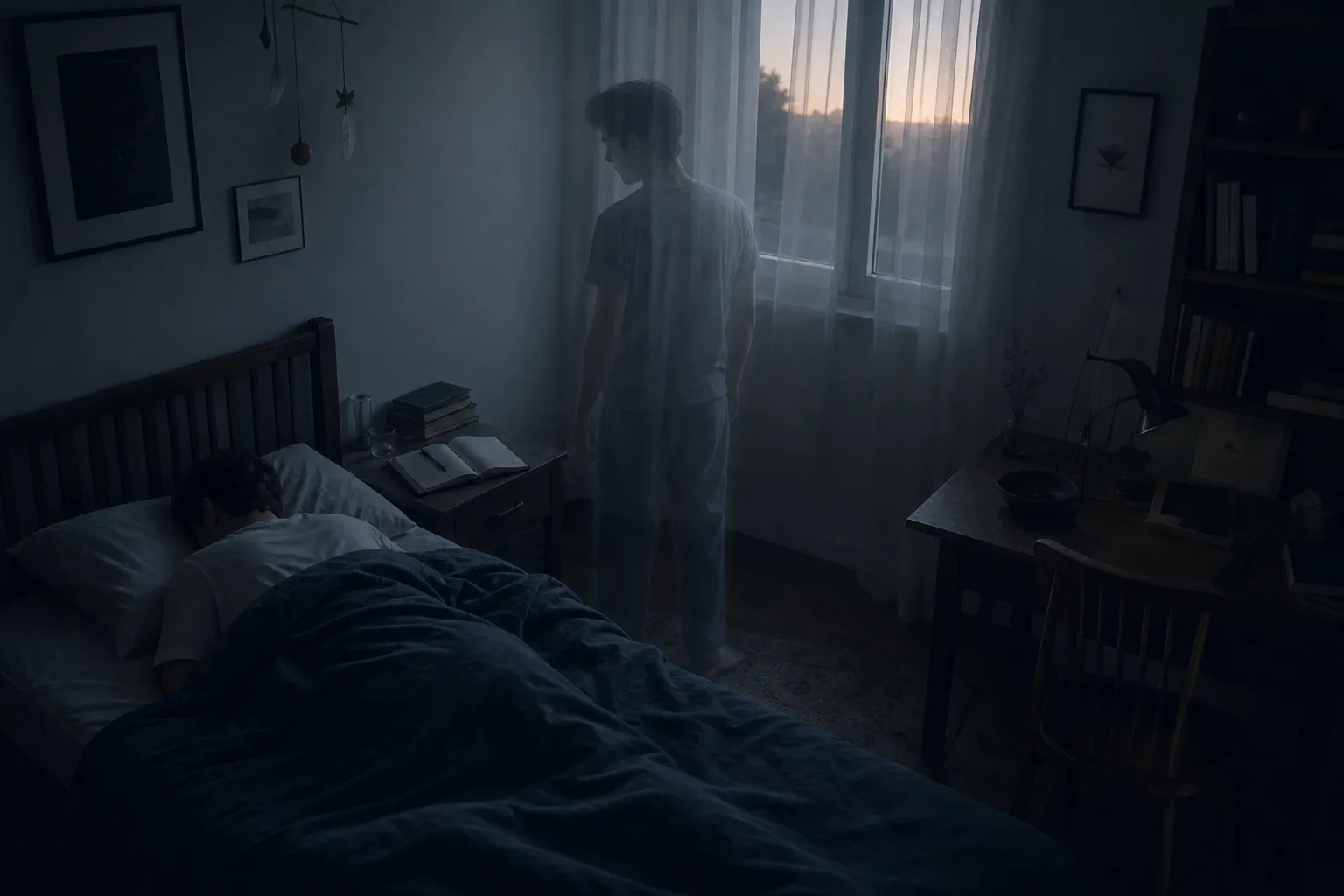
Third person dreams usually mean your sleeping mind is giving you distance from a feeling, choice, or version of yourself. You are not predicting anything or leaving your body. Most often, you are watching yourself because the dream is asking you to notice how you appear from the outside.
What are third person dreams?
Third person dreams are dreams in which you see yourself as a character rather than seeing only through your own eyes.
In ordinary waking life, vision feels first-person. You look out from behind your face. In a third-person dream, the view may hover near the ceiling, trail behind your body, or place you across the room from yourself. Some people describe it like a film shot. Others see a still scene, almost like a photograph. The important feature is simple: you are both the one being dreamed and the one watching.
Dream science has a useful word for this: perspective. Researchers such as G. William Domhoff, who has analyzed thousands of dream reports through the Hall and Van de Castle system, treat dreams as narratives with settings, characters, actions, and emotions. In large dream content studies, social interaction appears in a high share of remembered dreams, often above 70 percent depending on the sample. That matters because third-person dreams are frequently social. You see yourself being seen.
A third-person dream is not a sign you have left yourself; it is a sign the dream has made you visible.
Many people remember only fragments, and those fragments can exaggerate the strangeness. The dream may have shifted between first and third person several times. Film does this without bothering us. Dreams do it too. A 2018 review in Frontiers in Psychology noted that dream imagery often combines memory, emotion, and imagined perception without following waking rules of space. The mind edits while it sleeps.
If you woke at 7 a.m. unsettled because you watched yourself cry, walk away, marry someone, or lie in bed, begin with the frame. Where was the dream-camera? Near your body, far away, above you, or inside another person’s gaze? The distance is often the clue.
Why does the sleeping mind show me from outside my body?
The mind may use an outside view when direct feeling is too charged, too complex, or too familiar to notice from within.
Psychologists have studied self-distancing for more than 20 years, especially in waking reflection. Ethan Kross and colleagues found in experimental work that viewing painful events from a distanced perspective can reduce emotional flooding and support clearer reasoning. Dreams are not therapy sessions, but they often borrow the same human trick: step back, and the scene becomes legible.
This is why third person dreams often arrive around ordinary pressure points. A job interview. A breakup. A family meal. A room where you are expected to behave. You may watch yourself performing competence, apologizing, hiding anger, or smiling when you do not want to smile. The dream shows the social mask because the mask has become part of the problem.
Distance is not coldness. Sometimes distance is the mind’s way of being kind.
Neuroscientist Mark Solms and dream researchers in the Hobson tradition disagree on some mechanisms of dreaming, but both treat dreams as produced by the brain, not delivered from elsewhere. REM sleep, where many vivid dreams occur, appears in cycles about every 90 minutes across a typical night, with longer REM periods toward morning. That timing is one reason emotionally vivid dreams are often remembered after waking.
Third-person viewpoints may also come from memory. Autobiographical memories are not always first-person. Studies of visual perspective in memory, including work by Georgia Nigro and Ulric Neisser in 1983, found that people often recall events either from their original viewpoint or from an observer viewpoint. Observer memories are common when people evaluate themselves. Dreams can reuse that memory style.
So if you watched yourself from across the room, ask: was I being evaluated, protected, mourned, admired, or judged? The camera angle may be the emotional grammar.
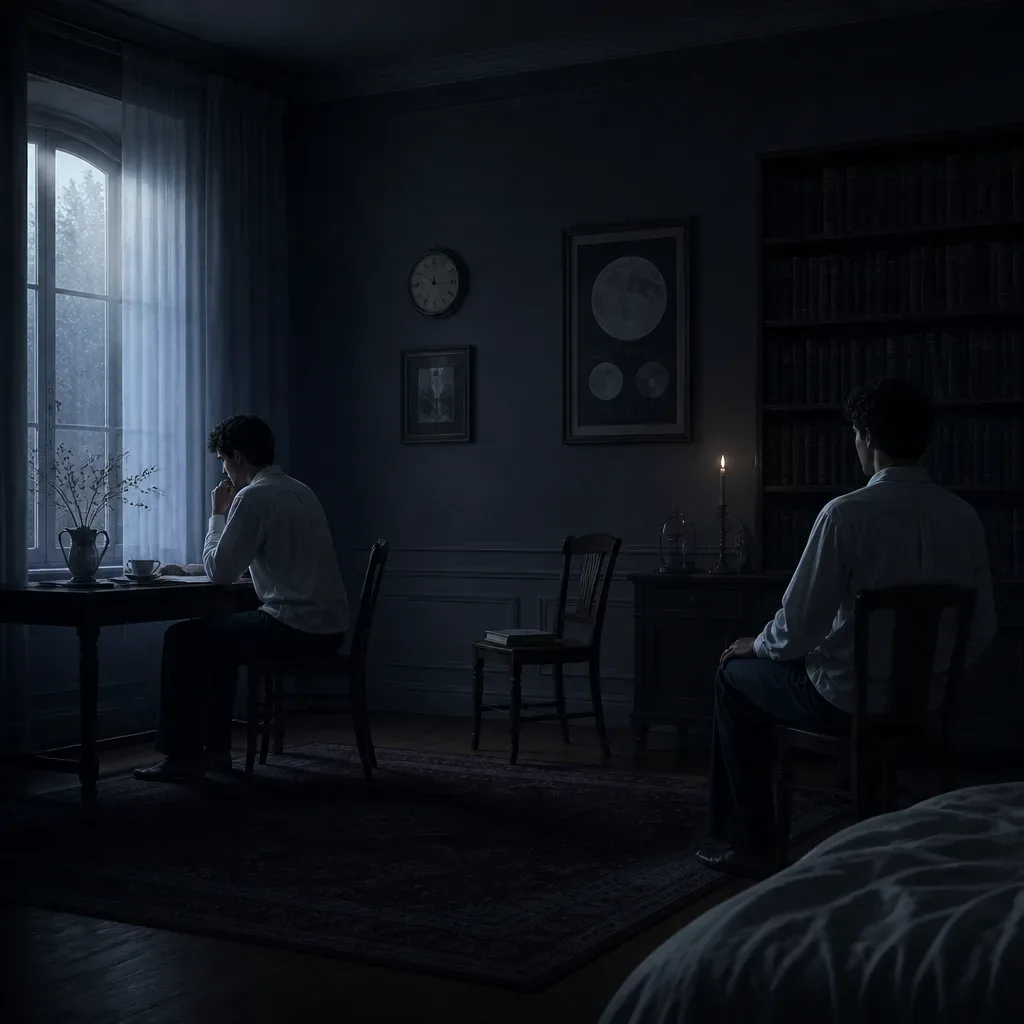
Are third person dreams linked to lucid dreaming or dissociation?
Third person dreams can overlap with lucid dreaming or dissociative feelings, but most are ordinary dream variations.
Lucid dreaming means you know you are dreaming while the dream continues. It is about awareness, not viewpoint. A lucid dream can be first-person, third-person, or both. In a 2009 study in Sleep, Ursula Voss and colleagues reported increased gamma-band activity during lucid dreaming compared with typical REM sleep, suggesting a hybrid state with more reflective awareness. That does not mean every third-person dream is lucid. Many are not.
The confusion is understandable. Watching yourself sleep, float, speak, or die in a dream can feel close to an out-of-body report. Folklore often treats such dreams as soul travel. Science is more cautious. Sleep paralysis, vestibular sensations, and body-map changes can make the self feel displaced. The body is still in bed. The image is moving.
A dream can borrow the shape of dissociation without being a diagnosis.
Dissociation, in clinical language, involves disruptions in memory, identity, perception, or bodily ownership during waking life. The DSM-5-TR discusses it in relation to several conditions, especially when distress and impairment are present. A single dream viewpoint does not meet that standard. Pattern and waking distress matter.
Here is a plain comparison:
| Dream feature | Usually points toward | What to notice |
|---|---|---|
| Watching yourself from above | Emotional distance or overview | What feeling was easier to see from there |
| Seeing yourself on a screen | Self-judgment, memory, or rehearsal | Who seemed to be watching with you |
| Moving between first and third person | Shifting identification | When the shift happened |
| Knowing it is a dream | Lucidity | Whether you could choose anything |
| Feeling detached while awake too | Possible dissociative symptom | Frequency, distress, and safety |
If these dreams come with panic, lost time, trauma flashbacks, or a sense of being unreal during the day, talk with a doctor or mental health professional in one plain step. If not, treat the dream as a message from attention, not an emergency.
What do third person dreams mean psychologically?
Psychologically, third person dreams usually concern self-image, emotional distance, role conflict, or a change in identity.
The dream may be showing how you see yourself when you are under pressure. You might watch yourself give a speech, fail an exam, care for a child, kiss an ex, or stand silently while others argue. These scenes are rarely random in the morning sense of the word. They tend to gather around what waking life has made important. Calvin Hall’s mid-20th-century dream research argued that dreams reflect personal conceptions: how we see ourselves, others, conflict, and fortune.
Modern dream researchers are careful not to claim one symbol always means one thing. Still, patterns help. Ernest Hartmann’s work on emotion and dreaming suggested that dreams often picture a dominant emotional concern. Third-person dreams can picture that concern by turning the dreamer into an object of attention. You become visible because the issue is partly about being seen.
The dream-self is often the sentence you haven’t admitted yet.
A practical reading depends on the scene:
- If you watch yourself being calm during chaos, the dream may be rehearsing steadiness.
- If you watch yourself being cruel, the dream may be asking for honest accountability, not shame.
- If you watch yourself as a child, memory and present need may be touching.
- If you watch yourself die, the dream often concerns an ending or identity shift, not literal death.
- If you watch yourself sleep, the dream may be showing vulnerability or fatigue.
For symbols inside the scene, use a broad reference like the Dream dictionary (A–Z hub), but do not let any dictionary overrule the felt situation. A snake in the corner matters differently from a snake in your hand. A wedding dress matters differently if your dream-self is smiling, hiding, or unable to move.
Third-person dreams are especially useful when they show behavior you would rather explain away. Write it down before you defend yourself. The first record is usually more honest than the tenth interpretation.
What do folklore and spiritual traditions say about watching yourself?
Folklore often reads seeing yourself from outside as a sign of soul movement, double-sight, or social fate, but these are traditions rather than proof.
In parts of European folk belief, the double or fetch could appear as a second self. In Irish and Scottish materials recorded by 19th-century folklorists, seeing a double was sometimes treated as a warning, though the details vary sharply by county and collector. In Polish household superstition, which I heard often as a child, seeing oneself dressed for a wedding could be read darkly, while seeing oneself from afar might mean gossip or judgment. That is folklore speaking in the language of the village.
Folklore is not failed science. It is a record of what a community learned to fear out loud.
Many Islamic dream manuals, shaped by medieval texts attributed in popular tradition to Ibn Sirin though often compiled later, take the dream-self seriously as a moral and social figure. The dreamer may see their own body, clothing, face, or actions as signs of reputation, duty, or spiritual condition. In Chinese dream traditions, older manuals such as the Zhougong dream book often link bodily images with fortune, family, and office, though modern readers should treat these as cultural documents, not predictions.
Across traditions, one theme repeats: to see yourself is to become accountable to a wider gaze. The village sees you. The ancestors see you. God sees you. Your family name sees you. The modern psychological version is quieter but related: your observing mind sees the self you have been performing.
If you carry more than one cultural inheritance, let both speak. A Danish grandmother may hear warning. A Brazilian aunt may hear envy or protection. A therapist may hear self-distancing. The dream can hold all three without needing one winner. It is ordinary for one image to have several honest histories.
How do common third-person dream variations change the meaning?
The variation matters because the camera angle, your dream-body’s action, and your watching emotion shape the meaning.
Use the dream like a scene report. In sleep laboratories, awakenings are often recorded immediately because detail fades fast. Dream recall studies commonly find that most memory loss happens within minutes after waking, especially if the person moves, checks a phone, or starts planning the day. That is why the first two minutes matter more than a long interpretation at lunch.
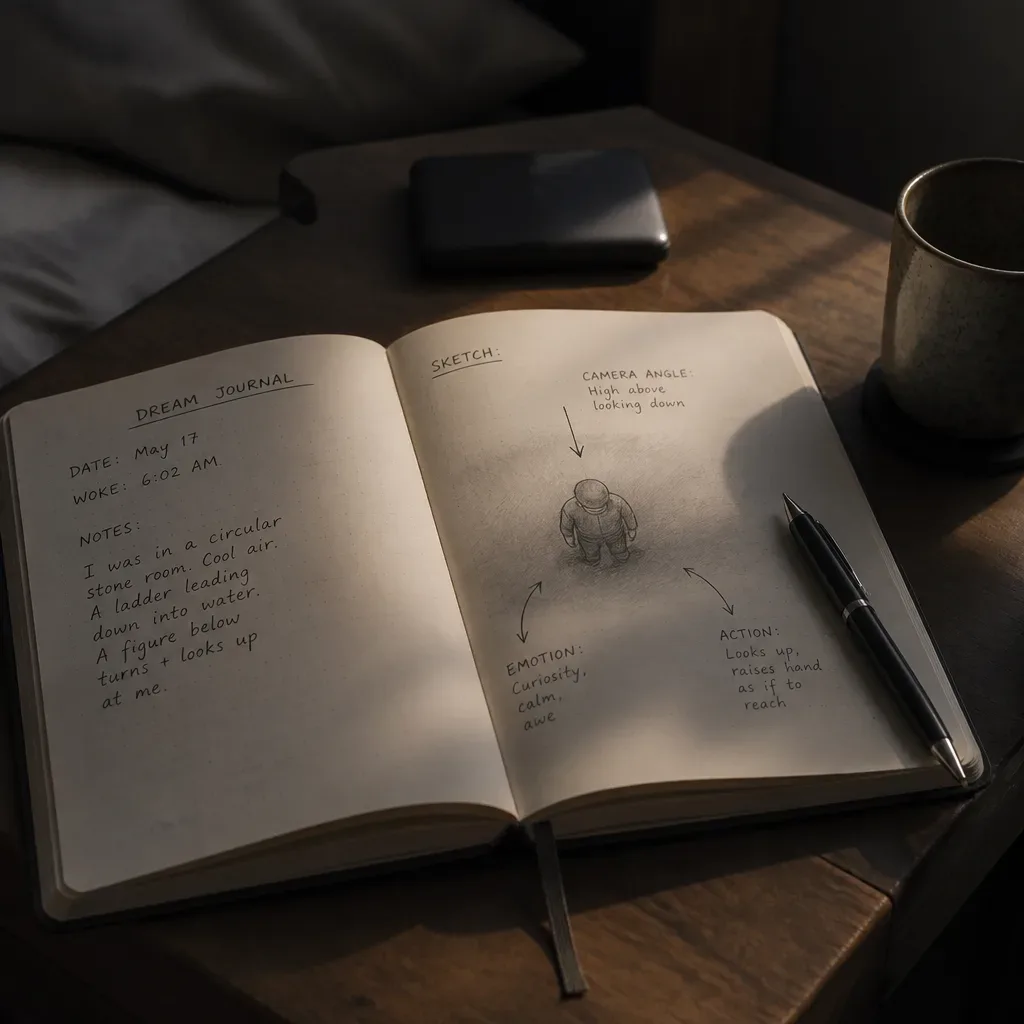
A simple numbered method helps:
- Name the viewpoint: above, behind, mirror, screen, crowd, doorway, or another person’s eyes.
- Name the dream-self’s action in one verb: running, waiting, lying, speaking, hiding, kissing, fighting.
- Name your watcher feeling: pity, fear, tenderness, disgust, pride, grief, calm.
- Name the audience, if any: family, strangers, an ex, a child, no one.
- Write one waking-life echo from the last 7 days.
Here are several common forms:
What if I watch myself from above?
An overhead view often suggests overview, vulnerability, or separation from the body’s emotion. People report this in dreams of hospitals, beds, funerals, accidents, and childhood rooms. Do not leap to the most dramatic reading. Ask whether you needed distance from fear or tenderness.
What if I see myself in a mirror?
Mirror dreams often concern identity, aging, shame, recognition, or misrecognition. The mirror has a long symbolic history, but the key is whether the face was familiar. If your reflection looked wrong, the dream may be showing a role that no longer fits.
What if I watch myself die?
Dreams of your own death are common enough to be ordinary, though frightening. In many clinical and Jung-adjacent readings, they tend to point toward endings, transitions, or fear of losing a known self. If you are grieving or depressed, be gentle and seek support when needed.
What if I watch myself as a child?
This often brings memory, protection, or old need into view. The child-self may not be literal. It may be the age of a feeling. Note the room, clothes, and who is absent. Absence is often the loudest character.
For recurring versions, compare notes over time. You can also place the central image into the AI dream interpreter tool to generate prompts, then keep only what feels accurate and sober. Tools can help organize a dream. They cannot know your kitchen, your mother, or the exact silence in the room.
What should I do the morning after a third person dream?
The morning after, record the viewpoint and ask what the distance allowed you to see.
Do this before interpretation grows elaborate. Keep a notebook within arm’s reach or use a notes app without opening messages first. Sleep researcher Michael Schredl has found across multiple studies that dream recall improves with intention and regular recording; even a short daily note can change recall frequency over several weeks. The habit matters because third-person dreams often repeat with small changes.
Write these four lines:
- I saw myself from…
- My dream-self was…
- I felt, as the watcher…
- In waking life, I may be watching myself…
Then ask one honest question: where am I living as if someone else is looking at me? That question catches many third-person dreams. It may point to a workplace performance, a family role, a body-image wound, a private pride, or a decision you keep rehearsing from the outside.
If the dream becomes lucid, or if you are curious about changing dream awareness, read the Lucid dreaming pillar with caution and patience. Lucidity is a skill for some people and a disturbance for others. More control is not always more wisdom. Sometimes the best dream work is to notice without trying to steer.
This is also where waking practice can help, but lightly. The AYA Method is a daily audio manifestation practice. Each day you listen to a short personalized recording, your Dream-Self Moment, narrated from the version of you who has already manifested the life you intend. Listening is the practice. Repetition is the work. The audio is the method. For a recurring third-person dream, that can be a useful counterpart: instead of waiting for the night to show you a distant self, you give your waking attention a steady voice.
If you want a wider map of symbols around the scene, return to the Dream dictionary (A–Z hub). If you want the science of dream awareness, return to lucid dreaming. But keep the first record simple. The dream has already chosen its grammar.
Write the scene as if you’re returning a borrowed photograph.