dream science
Can Dreams Predict Future Events? Déjà Rêvé Explained
Can dreams predict future events, or is déjà rêvé a memory effect? A calm guide to coincidence, sleep research, and what to write down.

Dreams don’t reliably predict the future, but they can feel as if they do because memory is flexible, coincidence is common, and the sleeping mind is good at rehearsing likely emotional situations. Déjà rêvé, the feeling that you already dreamed this moment, is usually a memory phenomenon, not a prophecy.
Can dreams predict future events in any scientific sense?
There is no good evidence that dreams predict future events under controlled conditions.
That answer may feel too dry if you woke at 7 a.m. with a dream that later seemed to happen. The honest distinction is this: dreams can anticipate ordinary possibilities, but anticipation isn’t the same as prediction. If you’re worried about a job interview, your dream may stage a difficult conversation. If a difficult conversation happens the next day, the dream didn’t bend time. It practiced a likely scene.
Dream research has been collecting this kind of material for more than a century. Calvin Hall and Robert Van de Castle coded thousands of dream reports in their 1966 system, and later researchers such as G. William Domhoff found that dreams strongly reflect waking concerns, relationships, threats, and recurring social patterns. Continuity is not prophecy. It’s the mind using familiar ingredients.
A 2009 paper by Carey Morewedge and Michael Norton in the Journal of Personality and Social Psychology found that many people give dreams more weight than comparable waking thoughts. In one study, participants said a dream about a plane crash would affect their travel plans more than a government warning in some scenarios. That is a striking number, but it tells us about belief and meaning, not about accuracy.
A dream can be emotionally accurate without being factually predictive.
The useful question isn’t “Did the dream know?” It’s “What did the dream notice?” Often the dream noticed your fear before you admitted it, your wish before you named it, or a pattern in someone’s behavior that your waking mind kept politely ignoring.
Why do predictive dreams feel so convincing?
Predictive dreams feel convincing because memory edits the dream after the event, often without your permission.
Human memory is not a recording. It is a reconstruction. Frederic Bartlett showed this as early as 1932 in his work on remembering, and modern cognitive psychology has repeated the basic lesson many times: we preserve the shape, then rebuild the details. Dreams are especially vulnerable to this because most are forgotten quickly. Sleep researcher Ernest Hartmann estimated that dream recall varies widely, and lab studies often find that recall drops sharply within minutes of waking if the dream isn’t written down.
Here is the common sequence:
- You dream something broad: a phone call, water, a hospital, an old friend.
- Days later, something emotionally similar happens.
- Your mind searches backward for a match.
- The remembered dream becomes sharper, cleaner, and closer to the later event.
- The non-matching parts are forgotten.
This doesn’t mean you’re lying. It means memory is doing ordinary memory work. Daniel Schacter, a Harvard psychologist, wrote about the “seven sins of memory” in 1999, including bias and suggestibility. Dreams invite both because they arrive in fragments.
A dated notebook changes the question. If you write the dream before anything happens, you can compare the original report with the later event. Researchers who study dream content rely on written reports for exactly this reason. The dream as first told matters more than the dream as later polished by surprise.
For symbols that keep returning, the Dream dictionary (A–Z hub) can give you a starting grammar. It won’t tell you the future. It may help you notice whether the symbol tends to belong to fear, desire, shame, grief, or ordinary daily pressure.
What is déjà rêvé, and how is it different from déjà vu?
Déjà rêvé is the feeling that this moment was dreamed before; déjà vu is the feeling that this moment was lived before.
The phrase is French for “already dreamed.” It sounds romantic, but neurologists have studied it in sober rooms. In 2018, Bancaud and colleagues’ earlier observations were extended by researchers describing déjà rêvé-like states during electrical stimulation of the medial temporal lobe, a brain region involved in memory. A 2018 review in Brain Stimulation discussed reports of déjà rêvé in patients with epilepsy and during intracranial stimulation. The sample sizes are clinical and small, so we should be careful. Still, they show that the feeling can be produced by memory circuits.
Déjà rêvé has a few recognizable forms:
| Feeling | Plain description | Likely mechanism |
|---|---|---|
| Episodic déjà rêvé | “I dreamed this exact scene.” | A dream memory seems linked to the present moment |
| Familiarity-based déjà rêvé | “This has the mood of a dream.” | Familiarity without clear source |
| Associative déjà rêvé | “Something in this scene reminds me of a dream.” | A cue triggers a fragment |
That last type is common. A smell, hallway, sentence, or angle of light can call up a dream fragment and make the present feel prewritten. Marcel Proust made literature out of involuntary memory; cognitive science gives it a quieter name.
Déjà vu is reported by a large share of healthy people, especially younger adults. Surveys often place lifetime déjà vu reports somewhere between 60% and 80%, depending on age and wording. Déjà rêvé is less frequently studied, so exact population numbers are less certain. The thin evidence matters. It keeps us from making grand claims where the data are still modest.

Are there famous cases of dreams that seemed to come true?
Yes, but famous cases are usually stories collected after the fact, which makes them meaningful as folklore and weak as proof.
Abraham Lincoln’s reported dream of a funeral in the White House is one of the best-known examples in American culture. The story comes through later accounts by Ward Hill Lamon, who said Lincoln described a dream shortly before his assassination. It is a haunting story. It is also historically tangled, filtered through memory, grief, and retelling.
The sinking of the Titanic produced many claimed premonitions. The Society for Psychical Research collected reports in the early 20th century, as it did with crisis apparitions and other unusual accounts. These archives are culturally important, but they face the same problem: reports often arrive after the event, when newspapers, fear, and public imagination have already shaped what people remember.
Folklore around the world treats certain dreams as warnings. Teeth falling out, snakes, floods, black birds, and weddings may carry predictive meanings in family traditions. We report those traditions with affection, not as evidence. The snake means one thing in sleep research and another thing in your grandmother’s kitchen. Both are worth knowing, but they are not the same kind of claim.
If you want to compare a dream symbol across psychological and cultural readings, start with the Dream dictionary (A–Z hub), then return to your own dream report. A symbol outside your life is a museum label. A symbol inside your life has fingerprints.
One practical test helps: ask whether the dream was specific before the event. “Something bad will happen near water” can match thousands of days. “My brother will call at 8:10 and say the basement pipe burst” is much harder to explain away. Most famous cases become less exact when read closely.
How can I tell coincidence from a meaningful dream pattern?
Look for repetition, specificity, and timing before you decide the dream is meaningful.
Coincidence is not rare. If you remember even two dreams a week, that is more than 100 remembered dreams a year. Each dream may contain several people, places, objects, and moods. Across a year, you may carry 500 or more dream details into waking life. Some will match later events by chance, especially if the details are common: phones, cars, schools, kitchens, arguments, rain.
The psychologist Ruma Falk wrote about coincidence and subjective probability in the 1980s, showing how easily people underestimate the odds of surprising matches. The birthday problem is the classroom version: in a group of only 23 people, there is about a 50% chance that two share a birthday. Our intuition is poor at this kind of counting.
Use this simple morning test:
- Was it recorded before the event? A dated note matters.
- Was it specific? Names, numbers, actions, and locations count more than mood.
- Was it unusual? Dreaming of your office before work is not rare.
- Did many details match? One matching image is weaker than five independent matches.
- Did you count misses? A true test includes dreams that didn’t match anything.
This is where tools can help without taking over the dream. The AI dream interpreter tool can help you organize symbols, emotions, and recurring themes, but the original dated report is still the anchor. Don’t let any tool make the dream neater than it was.
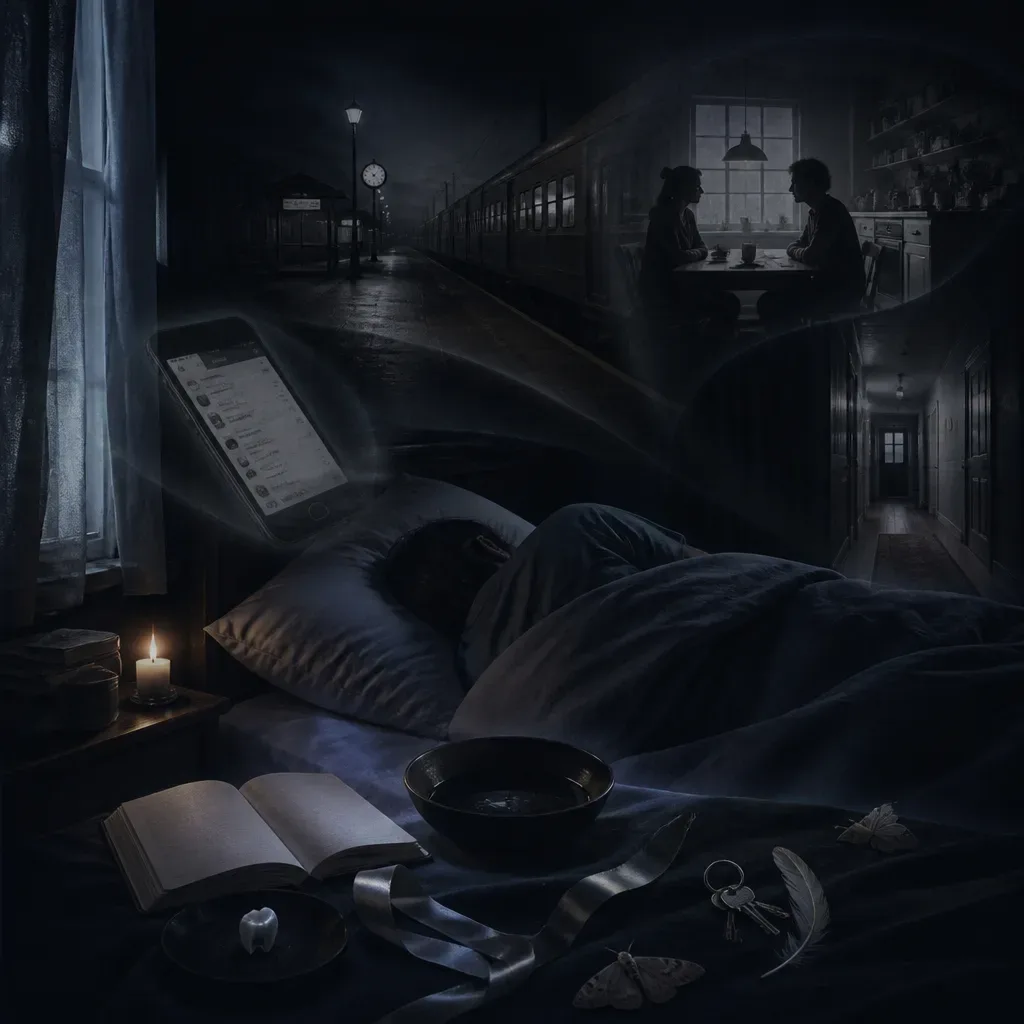
Recurring dream patterns deserve special attention. If you keep dreaming of being late, losing your voice, missing a train, or finding hidden rooms, the pattern may be more important than any single “hit.” The night repeats what the day has not yet heard.
What do lucid dreaming and dream control say about prediction?
Lucid dreaming shows that dreams are constructed in real time, which supports the idea that they reflect the mind’s activity rather than an outside forecast.
In lucid dreaming, the dreamer knows they are dreaming while the dream continues. Stephen LaBerge’s laboratory work in the 1980s used prearranged eye signals to show that lucid dreamers could communicate from REM sleep. Later reviews, including work by Ursula Voss and colleagues, suggest lucid dreaming is uncommon but trainable for some people, with rates varying by method and sample.
This matters for prediction because lucid dreams reveal the dream as a living simulation. Characters answer, rooms change, and plots bend as attention shifts. The dream is not a fixed telegram from tomorrow. It is closer to a stage where memory, fear, wish, and expectation take turns moving the furniture.
If you’re curious about dream awareness, the Lucid dreaming pillar explains the practice more fully. Keep the same caution there: lucid dreaming is not a way to force the future to reveal itself. It is a way to notice the mind while it is making a dream.
Some people use lucid dreaming to rehearse conversations, reduce nightmare fear, or ask dream figures questions. Small studies on imagery rehearsal therapy, including work discussed in the Journal of Behavioral Medicine, suggest that changing nightmare scripts while awake can reduce nightmare frequency for some people. That is a useful waking practice. It doesn’t require believing the dream predicts anything.
When a dream feels predictive, ask what part of you may have already known enough to rehearse it. A relationship strain, a work deadline, a health worry, a child leaving home: these are futures in the ordinary sense. You can see them coming because life has been putting them in front of you.
What should I do the morning after a dream that seems predictive?
Write it down before interpretation, then compare it with waking life gently and strictly.
The order matters. First, record. Then reflect. Then wait. If you interpret too soon, you may turn a vague dream into a claim it never made. Dream journals are useful because they preserve the first version. In sleep labs, reports are collected immediately after awakening for the same reason: the first telling is the cleanest available evidence.
Try this four-minute method:
- Write the date and time.
- Record the dream in plain past tense.
- List exact details: names, places, colors, numbers, objects, spoken lines.
- Name the strongest emotion in one word.
- Add one waking-life association, clearly labeled as an association.
If the dream later seems to match an event, return to the page. Don’t improve it. Underline only what truly matches. Circle what does not. This is not coldness. It is respect for the dream as it arrived.
This is also where waking intention can sit beside dream attention. If a recurring dream keeps pointing to the same fear or want, you don’t have to wait for the night to repeat itself. The AYA Method is a daily audio manifestation practice: each day you listen to a short personalized recording, your Dream-Self Moment, narrated from the version of you who has already manifested the life you intend. Listening is the practice. Repetition is the work. The audio is the method.
The complement is simple: the dream shows what your attention returns to when you’re asleep; the morning practice gives attention a chosen sentence while you’re awake. A daily affirmation or Manifestation Board can support that, but the audio is the practice.
Talk to a doctor or licensed therapist if dreams are violent, repetitive, trauma-linked, or disrupting sleep for several weeks. Otherwise, keep the notebook close. Most dreams don’t predict the future. Many do predict what you’ll need to face.
Write the first sentence before the day edits it.