lucid dreaming
WILD Lucid Dreaming: A Gentle Way to Try
WILD lucid dreaming can be tried gently: learn when to practice, what to notice, how to stay calm, and when to stop before effort turns into strain.

WILD lucid dreaming means staying gently aware as the body falls asleep, so the first dream begins with lucidity already present. The safest way to try is after several hours of sleep, with one soft anchor, a short time limit, and no forcing. If sleep matters tonight, sleep comes first.
What is WILD lucid dreaming, exactly?
WILD lucid dreaming is a wake-initiated lucid dream, where awareness carries from waking into dreaming without a full break.
The name comes from sleep research rather than folklore. Stephen LaBerge used the term in his lucid dream studies in the 1980s, alongside MILD, the mnemonic induction of lucid dreams. In plain words, WILD is not about making a dream appear by strain. It is about noticing the border between waking and sleep without frightening the body back awake.
A lucid dream is simply a dream in which you know you are dreaming while it is happening. A 2016 review by Saunders and colleagues in Consciousness and Cognition estimated that about 55% of people have had at least one lucid dream, while about 23% report them monthly or more. WILD is only one route into that state. It tends to suit people who can remain calm with subtle body sensations.
The border state often includes hypnagogic imagery: dots of light, half-heard words, brief faces, falling sensations, or the beginning of a room that is not your room. Sleep laboratories have studied these transitions for decades because REM sleep and waking awareness can overlap in odd ways. The ordinary fact is this: your brain changes state gradually, not like a lamp switching off.
A lucid dream is not a better dream. It is a dream with one extra sentence inside it: I know where I am.
If you are new, read the wider lucid dreaming pillar first, then return to WILD. The technique is delicate. It rewards patience, not heroics.
When should you try WILD lucid dreaming?
The best time to try WILD lucid dreaming is after 4.5 to 6 hours of sleep, when REM periods are usually longer.
Sleep moves in cycles of roughly 90 minutes, though the exact timing differs by person. Early in the night, slow-wave sleep tends to dominate. Later in the night, REM periods lengthen, and most vivid dreaming is reported from REM awakenings. That is why many lucid dreamers pair WILD with Wake Back to Bed, often shortened to WBTB.
The American Academy of Sleep Medicine and Sleep Research Society recommend at least 7 hours of sleep for most adults. That number matters here. If a technique regularly reduces your sleep below what you need, it is not a gentle practice anymore. It is sleep disruption wearing a clever hat.
A simple timing plan looks like this:
| Sleep pattern | Better WILD window | Why it helps |
|---|---|---|
| Bed at 10:30 p.m. | 3:30 to 4:30 a.m. | REM periods are more available |
| Bed at midnight | 5:00 to 6:00 a.m. | Dream recall is often stronger |
| Natural early waking | Stay awake 5 to 10 minutes | Less alarm-clock shock |
| Insomnia night | Skip WILD | Sleep is the priority |
Keep the waking period short. In small lucid dreaming studies, WBTB periods vary widely, from a few minutes to over an hour, but many home practitioners do best with 5 to 20 minutes. You want enough waking to remember your intention, not so much that the mind starts planning breakfast.
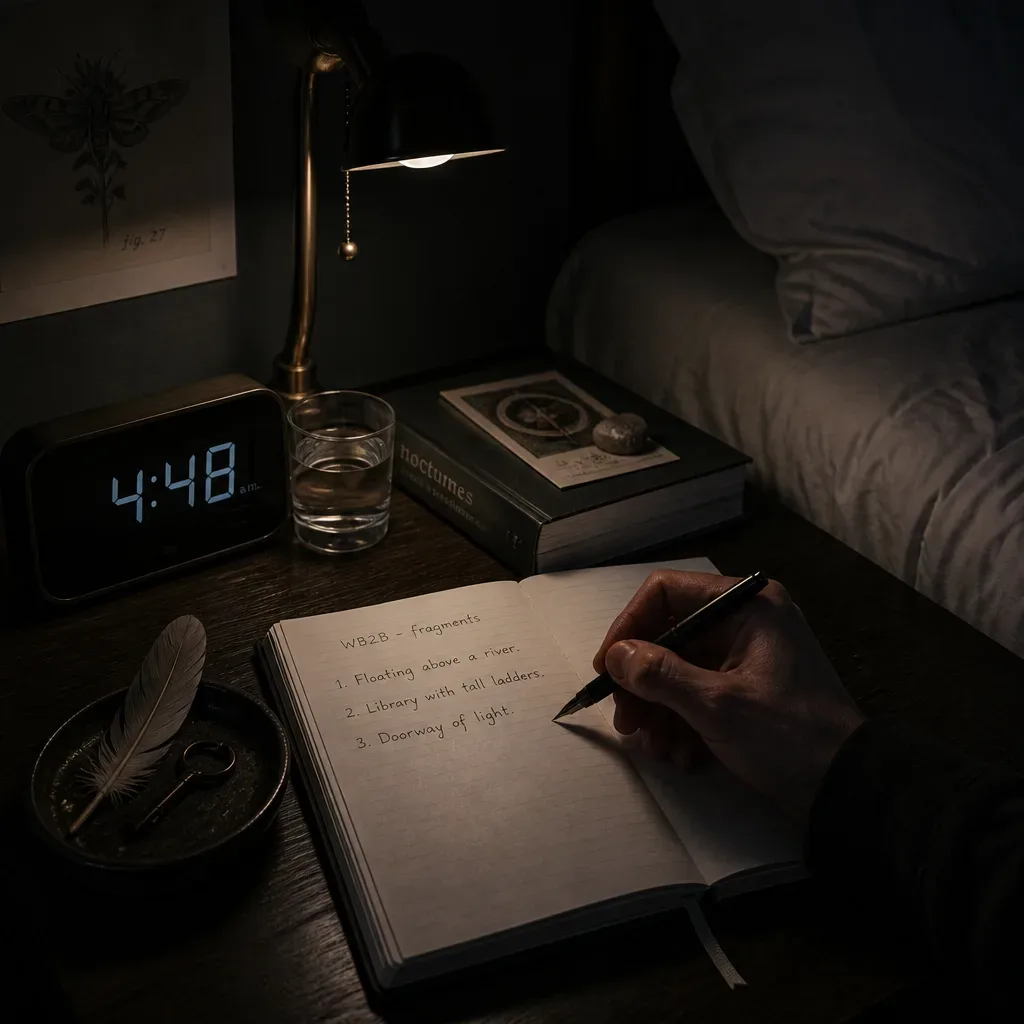
If you wake from a dream, write 3 to 5 words before lying back down. Those words can later go into the Dream dictionary A-Z hub if a symbol keeps returning. But at 4 a.m., do not research. The night is not a library shift.
How do you do WILD without forcing it?
You do WILD gently by making sleep the goal and lucidity the thing you agree to notice if it arrives.
Use this as a 10 to 20 minute practice, not an all-night vigil. Settle your body in a position you can actually sleep in. Many guides tell people not to move at all, but that advice can make beginners rigid and anxious. In the lab, comfort matters because arousal fragments sleep. At home, it matters even more.
Try the sequence below on a morning when you can afford a little softness.
- Sleep for 4.5 to 6 hours.
- Wake for 5 to 20 minutes, with dim light only.
- Write one dream fragment if you have one.
- Return to bed and choose one anchor: breath, counting, or a quiet phrase.
- Let the body fall asleep around the anchor.
- When images arise, observe them lightly.
- If a scene becomes stable, enter by touching something in it.
- If tension rises, stop and sleep.
Counting can be as simple as, one, I am dreaming; two, I am dreaming. Breath can be felt at the nostrils or belly. A phrase can be ordinary: I will notice the dream. In a 2012 review of lucid dream induction methods, Stumbrys and colleagues found the strongest evidence for techniques that combine intention, sleep timing, and mental rehearsal, though the evidence base is still modest.
The anchor is not a rope you pull yourself across with. It is a thread you keep between two fingers while sleep does its old work.
Some people enter through sound. Others notice a visual scene forming behind closed eyes. Others feel a roll, a drop, or a sense of standing up in another room. Do not chase any of it. Chasing wakes the system. Noticing lets the scene thicken.
What should you notice as the dream begins?
Notice signs of sleep arriving, but treat them as signals rather than achievements.
The common signs include heaviness, warmth, tiny muscle twitches, drifting thoughts, brief pictures, and the odd feeling that a sentence has continued without you writing it. Hypnagogic imagery can be vivid or almost absent. In sleep-onset research, these fragments are normal features of the transition from wakefulness toward stage N1 sleep, which is often brief and unstable.
Here is a useful distinction:
| What appears | Gentle response | What to avoid |
|---|---|---|
| Flickers or colors | Let them move | Staring hard |
| A face or room | Watch calmly | Demanding clarity |
| Buzzing or vibration | Breathe normally | Deciding it means danger |
| A dream scene | Touch the floor or wall | Flying immediately |
| Lost awareness | Sleep on | Calling it failure |
If a scene forms, stabilize it with ordinary dream actions. Look at your hands. Touch a wall. Read a sign twice. Ask, Am I dreaming? Reality testing has some research support, especially when paired with intention and dream journaling, though results vary across studies. The point is not to perform a trick; it is to confirm the state.
You can also use the AI dream interpreter tool in the morning if the dream leaves behind a strong image. Use it as a mirror, not a verdict. A tool can suggest patterns. Only the dreamer knows which sentence makes the stomach go quiet.
The first task in WILD is not control. It is recognition.
If you realize you are dreaming and get excited, the dream may thin or collapse. That is common. One study does not settle the matter, but many lucid dream reports describe brief first successes, sometimes only 5 to 30 seconds long. Count that as contact. The night noticed you noticing it.
What if you feel sleep paralysis, fear, or pressure?
If fear appears during WILD, stop the technique, return to ordinary breathing, and remind yourself that the body is entering sleep.
Sleep paralysis can happen when REM-related muscle atonia overlaps with waking awareness. It can include pressure on the chest, sensed presence, buzzing, or the feeling that you cannot move. A 2011 review by Sharpless and Barber estimated that about 7.6% of the general population reports at least one sleep paralysis episode, with higher rates in students and psychiatric samples. It is common enough to name calmly.
WILD does not require sleep paralysis. Some people pass through body heaviness without distress. Others never notice it. If you do notice it and dislike it, use a practical exit:
- Soften the breath rather than deepening it dramatically.
- Move one small muscle, such as a toe, finger, or tongue.
- Think a plain sentence: This is sleep physiology.
- Open your eyes if you can.
- Roll to another position when movement returns.
Talk with a doctor if sleep paralysis is frequent, frightening, paired with sudden daytime sleep attacks, or interfering with your sleep. That sentence is not meant to alarm you. It is just the honest line between a home practice and health care.
Folklore has filled sleep paralysis with night visitors for centuries: the old hag, the pressing spirit, the demon on the chest. Those stories are culturally important, but they are not proof that something outside the room has arrived. Dreams reflect; they do not foretell. The sleeping body can make a shadow feel like a person.

How can WILD fit with dream journaling and waking intention?
WILD works better when it is part of a quiet dream practice, especially recall, pattern-noticing, and a small morning note.
Dream recall is trainable for many people. Keeping a notebook by the bed increases the chance that fragments survive the first 5 minutes after waking. Researchers have long noted that recall depends on awakenings, attention, and interest; you remember more of what you make room for. Write the dream before you explain it. Explanation can wait until daylight is fully in the room.
A morning note can be very short:
- What was the last image?
- What emotion stayed in the body?
- Did I know I was dreaming?
- What happened just before I knew?
- What would I try differently next time?
Recurring images deserve special attention. If water, teeth, snakes, elevators, or childhood rooms keep appearing, compare your notes with entries in the Dream dictionary A-Z hub, then return to your own context. The snake means one thing in research and another thing in your grandmother’s kitchen. Both are worth knowing.
This is also where waking practice can meet night practice without pretending to control sleep. The AYA Method is a daily audio manifestation practice. Each day you listen to a short personalized recording, your Dream-Self Moment, narrated from the version of you who has already manifested the life you intend. Listening is the practice. Repetition is the work. The audio is the method.
Use that kind of waking rehearsal gently. A recurring dream shows what your attention keeps returning to. A daily recording gives attention a daytime shape. They are not the same practice, but they can speak to each other across the morning.
What should you do the morning after a WILD attempt?
The morning after WILD, write what happened in neutral language before judging whether it worked.
A failed WILD attempt often contains useful data. Maybe you woke too fully during WBTB. Maybe the room was too cold. Maybe counting made you alert, while breath made you sleepy. In behavioral research, small tracking changes outcomes because it makes patterns visible. You do not need a spreadsheet, though some lucid dreamers enjoy one. A notebook line is enough.
Use this 2-minute morning record:
| Prompt | Example |
|---|---|
| Time tried | 5:10 a.m. |
| Awake period | 12 minutes |
| Anchor | Breath at belly |
| Sensations | Warmth, drifting images |
| Dream entry | None, slept normally |
| Next adjustment | Shorter waking period |
If a dream did happen, separate the layers honestly. First, record the dream report as it occurred. Second, note the psychological reading: fear, desire, rehearsal, memory, conflict. Third, if you want, note cultural or spiritual associations as tradition, not certainty. The lucid dreaming pillar can help you place WILD beside MILD, reality checks, and dream signs without turning the night into a contest.
A dream practice becomes trustworthy when it tells the truth about ordinary nights.
Try WILD no more than 2 or 3 times a week at first. That gives you chances to learn without making sleep feel like homework. If you wake rested, curious, and a little more attentive to dreams, the practice is doing something useful even before lucidity arrives.
Tonight, write down one doorway and leave it slightly open.