lucid dreaming
Lucid Dreaming Mask: Do Light Cues Really Work?
A lucid dreaming mask can help some sleepers notice dream cues, but light signals work best with timing, recall, and reality checks, not alone.
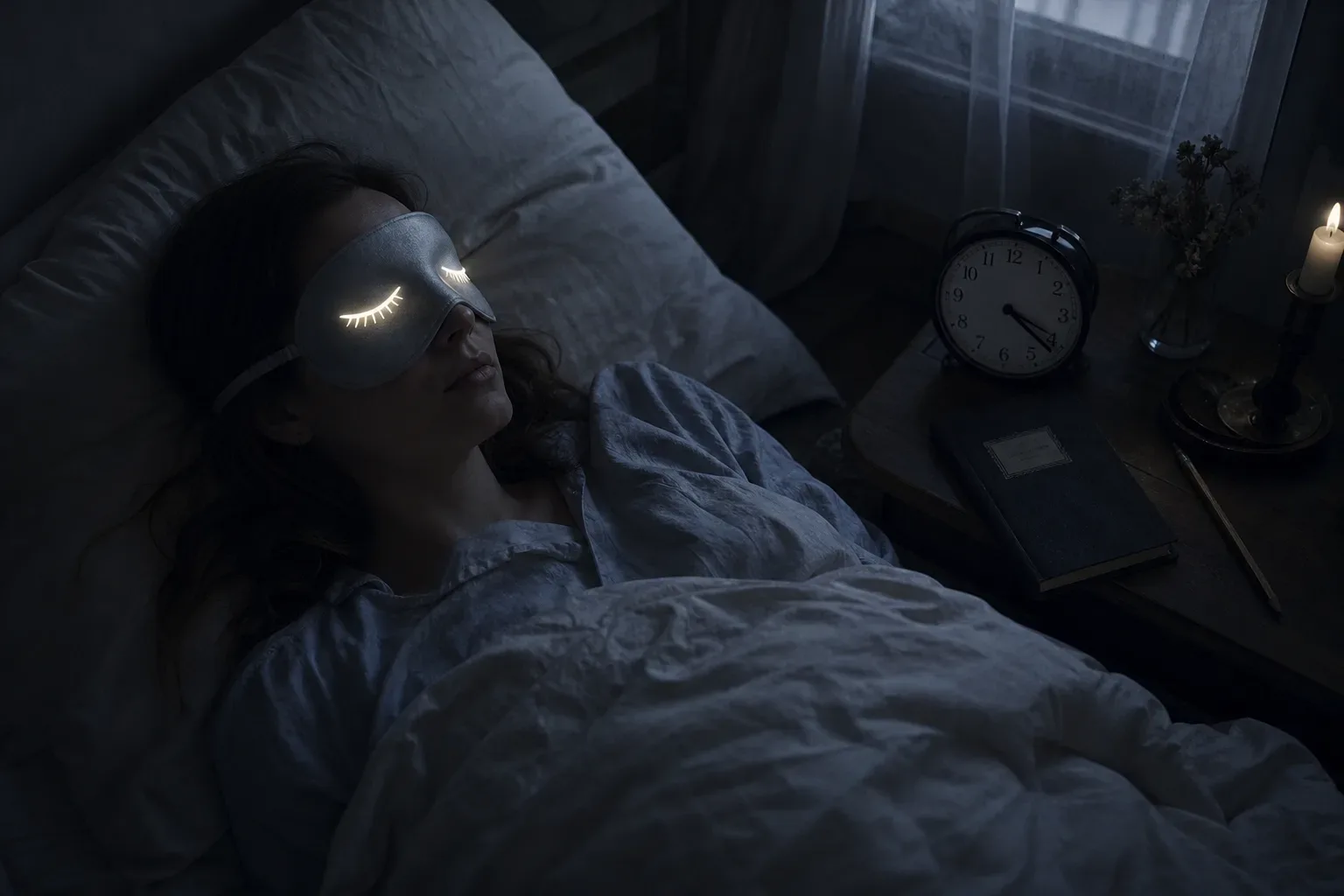
A lucid dreaming mask can help, but it doesn’t make lucid dreams happen on command. Light cues work best when they appear during REM sleep and you’ve trained yourself to notice them. Think of the mask as a bedside reminder, not a key. Your dream still has to answer.
What does a lucid dreaming mask actually do?
A lucid dreaming mask tries to send a small signal into REM sleep so you recognize you’re dreaming.
Most masks sit over the eyes and use sensors to guess when rapid eye movement is happening. During REM, the brain is active, the body is mostly still, and vivid dreaming is more likely. Sleep researchers have known since Aserinsky and Kleitman’s 1953 REM discovery that eye movement and dream reports often travel together, though not perfectly.
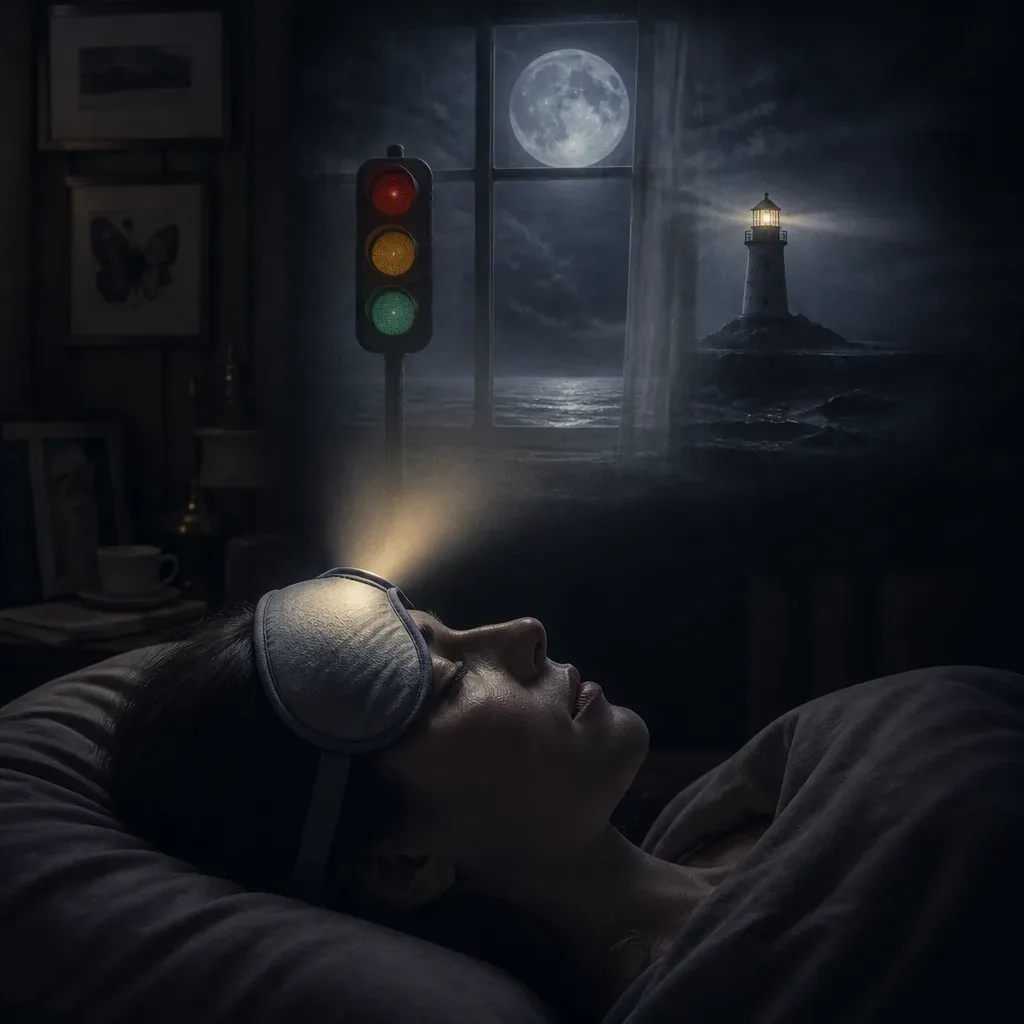
When the device thinks you’re in REM, it flashes soft lights or plays quiet tones. The hope is simple: the cue enters the dream without waking you. A red flicker might become a traffic light, a sunrise, a glowing window, or the moon pulsing in a strange way. If you notice the oddness, you may become lucid.
The old NovaDreamer, developed through Stephen LaBerge’s work at the Lucidity Institute in the 1990s, became the best-known model. LaBerge’s laboratory had already shown in 1981 that lucid dreamers could signal awareness from REM sleep by making prearranged left-right eye movements. That finding mattered because it gave lucid dreaming a measurable signature, not only a private story.
A mask can tap on the door of a dream; it can’t decide what you do when the door opens. The device supplies the interruption. Your waking practice supplies the interpretation.
For a wider map of what lucidity is and isn’t, start with our Lucid dreaming pillar. If your dream symbols feel more important than the technology, the Dream dictionary (A–Z hub) may be the better morning page.
Do light cues really make people lucid?
Light cues sometimes help, but research does not show that they reliably produce lucid dreams for most sleepers.
The strongest thing to say is the honest thing: external cues have promise, not certainty. In reviews of lucid dream induction, including Stumbrys and colleagues’ 2012 review in Consciousness and Cognition, techniques that combine intention, memory, and timed waking tend to look more dependable than simple stimulation. The review covered 35 studies and found that many methods had small samples, uneven protocols, or mixed results.
Light cues are also fragile because timing matters. REM periods lengthen across the night, often lasting only a few minutes early on and much longer near morning. If the mask flashes during non-REM sleep, you may not dream it in. If it flashes too strongly during REM, you may wake. If it flashes softly, you may sleep through it without noticing.
There’s a second problem: dream incorporation is strange. A 20-second cue doesn’t usually appear as a neat message saying, You are dreaming. It may become a lighthouse, a camera flash, or a lamp someone keeps turning on. The dreaming mind is a poet under pressure. It translates everything.
Here’s the plain comparison:
| Method | What it trains | Evidence tone | Main weakness |
|---|---|---|---|
| Light-cue mask | Noticing outside signals in dreams | Mixed, small studies | Timing and awakenings |
| MILD | Remembering to notice dreaming | Better supported | Requires practice |
| Wake-back-to-bed | REM timing and alertness | Commonly useful | Can disrupt sleep |
| Dream journal | Recall and pattern recognition | Indirect but steady | Slow results |
Aspy and colleagues’ 2017 study of 169 participants found the MILD technique especially useful when people fell asleep soon after practicing it. That doesn’t disprove masks. It says lucidity usually answers to trained attention more than equipment.
Why do some people see flashes in dreams while others wake up?
People respond differently because sleep depth, REM timing, light sensitivity, and expectation all vary from night to night.
A lucid dreaming mask is working with a moving target. Your REM sleep is not identical on Monday and Friday. Alcohol, stress, bedtime, medication, menstrual cycle changes, and sleep debt can all shift REM pressure. The American Academy of Sleep Medicine notes that adults usually need at least 7 hours of sleep; when that number drops, the architecture of the night changes.
Some dreamers are light sleepers. For them, a flash at 4:30 a.m. may be enough to end the dream. Others sleep deeply through the same setting and remember nothing. A few people find that the cue becomes part of the dream but doesn’t trigger lucidity. They wake and write, There were red lights everywhere, and I still didn’t know.
That sentence is not failure. It’s data. If the cue enters the dream, the bridge is there. The next task is to pair the cue with a habit. During the day, you see a bright light, reflection, phone screen, or traffic signal, and you ask: Am I dreaming? Do that 5 to 10 times daily for two weeks, and the cue has a better chance of meaning something at night.
Dreams use what we practice while awake. This is close to the continuity hypothesis of dreaming, associated with Calvin Hall and later dream researchers: dreams often draw from waking concerns, habits, and emotional residues. A mask may provide the light, but waking life teaches the light its name.
If you want help sorting whether a remembered cue was meaningful or just scenery, you can try the AI dream interpreter tool the morning after. Treat it as a mirror for associations, not a judge.
What should you look for before buying one?
Look for adjustable cues, comfortable sleep design, clear REM detection claims, and a return policy.
The first feature is not brightness. It’s control. A useful mask lets you change light intensity, cue length, cue color, and delay. Some people need a faint pulse; others need a brighter sequence. If the device offers only one setting, it’s asking every nervous system to behave the same way, which sleep never does.
Comfort matters more than marketing. A mask that presses on the eyes or slips off at 3 a.m. won’t teach you anything except irritation. In consumer sleep studies, adherence is often the hidden variable: a device can be clever and still fail because people stop wearing it. Look for soft edges, breathable material, and enough space for natural eye movement.
Be careful with claims. If a product promises lucid dreams every night, step back. Even skilled lucid dreamers rarely report that. In many surveys, frequent lucid dreamers are a minority. A 2016 meta-analysis by Saunders and colleagues estimated that about 55% of people have had at least one lucid dream in their lives, while about 23% report them once a month or more.
Use this buying checklist:
- Choose adjustable light intensity and timing.
- Check whether audio cues can be turned off.
- Read how the device estimates REM sleep.
- Confirm the mask can be cleaned easily.
- Use a return window if your sleep gets worse.
- Avoid it if flashing light is medically risky for you.
The best lucid dreaming tool is the one you’ll still use gently after the novelty fades. Novelty wakes people. Rhythm teaches them.
How do you use a lucid dreaming mask without ruining sleep?
Use it late in the night, start with low settings, and keep the practice boring enough for the body to trust.
Try it on nights when you don’t have to wake early. Many lucid dreamers pair devices with wake-back-to-bed: sleep for about 5 hours, wake for 10 to 30 minutes, then return to bed with an intention to notice the cue. This timing aims at longer REM periods. It also raises alertness, which is useful for lucidity but risky for insomnia.
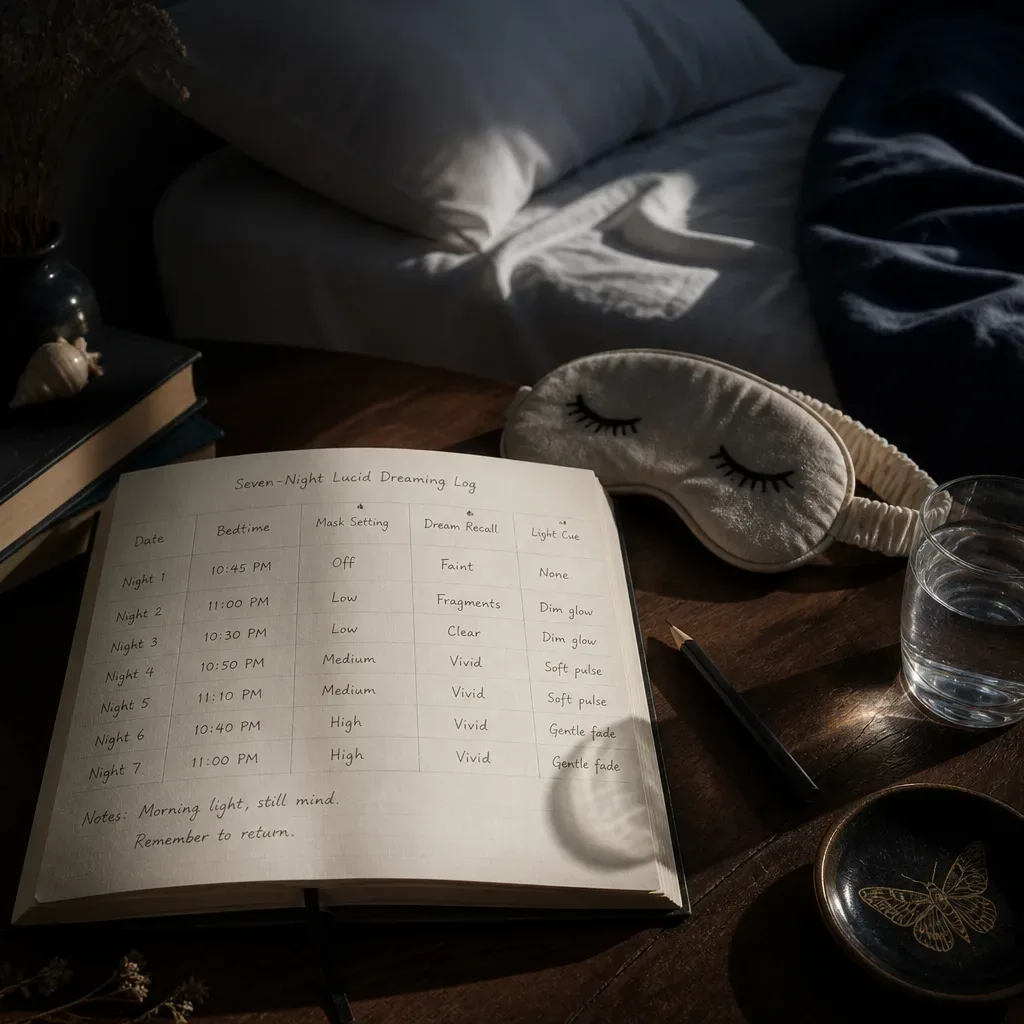
Keep a simple protocol for 7 nights before changing everything. If you adjust brightness, bedtime, wake time, and intention all at once, you won’t know what helped. Sleep science is full of this lesson: too many variables make a pretty mess. Write down bedtime, mask setting, wake time, dream recall, and whether a cue appeared.
A quiet 7-night plan:
- Nights 1–2: wear the mask with cues off to test comfort.
- Nights 3–4: use the lowest light cue in the last third of sleep.
- Nights 5–6: add one daytime reality check linked to bright lights.
- Night 7: review notes before changing settings.
If you wake repeatedly, lower the cue or stop for a few nights. Sleep is not the price you pay for lucidity; sleep is the ground it grows from. The Journal of Behavioral Medicine has published many studies connecting poor sleep with mood and stress measures, and you don’t need a lucid dream badly enough to make your mornings harsher.
This is also where a waking practice can sit beside dream work without pretending to be dream science. The AYA Method is a daily audio manifestation practice: each day you listen to a short personalized recording, your Dream-Self Moment, narrated from the version of you who has already manifested the life you intend. Listening is the practice. Repetition is the work. The audio is the method. For recurring dream themes, that kind of daytime repetition can give the mind a steadier sentence to return to.
What if the mask gives you strange dreams but no lucidity?
Strange dreams mean the cue may be entering sleep, but your mind hasn’t learned to question it yet.
This is common. You may dream of emergency lights, fireworks, a glowing animal, a theater marquee, or your childhood bedroom lit by a red lamp. The mask did its small job. The dream did its larger, stranger job. But lucidity requires one more movement: noticing that something doesn’t fit.
The morning after, don’t only ask whether you became lucid. Ask what form the cue took. Write one sentence in the present tense: Red light appears as a train signal. Then choose a matching daytime trigger. Every time you see a train crossing, brake light, notification dot, or red reflection, pause and test reality.
Good tests are simple:
- Read a line of text twice and see whether it changes.
- Look at your hands and count your fingers slowly.
- Ask how you got here in the last 10 minutes.
- Press one finger into the opposite palm and notice resistance.
Do not make the test theatrical. Make it ordinary. Lucidity likes ordinary doors because you actually use them.
If the dreams become frightening, scale back. Lucid dreaming can be tender for people with nightmares or grief dreams, but it can also make sleep feel too monitored. The International Classification of Sleep Disorders recognizes nightmare disorder when disturbing dreams cause repeated distress or daytime impairment. If nightmares, panic, or insomnia persist, talk to a doctor or qualified sleep clinician.
You can also compare the cue dream with related symbols in the Dream dictionary (A–Z hub), especially entries on light, houses, water, and being chased. Symbols are not instructions. They’re places to begin remembering.
So, is a lucid dreaming mask worth it?
A lucid dreaming mask is worth trying if you enjoy gentle experiments and already protect your sleep, but it’s not worth treating as a guarantee.
Buy one for curiosity, not rescue. If you’re hoping it will fix nightmares, force control, or prove something about your mind, begin with lower-tech practices first. Keep a dream journal for 14 days. Read one page on lucid dreaming. Do reality checks when odd things happen. Use the AI dream interpreter tool only after you’ve written your own first thought, so the machine doesn’t get the first word.
The better question is not, Does the mask work? The better question is, What kind of attention does it train? A mask can train anticipation, interruption, and recognition. A journal trains memory. MILD trains intention. Wake-back-to-bed trains timing. Together, they may help. Alone, the mask is just a small weather system over your eyes.
If you do try one, give it a fair but bounded test: 2 weeks, consistent settings, no use on exhausted nights, and no scorekeeping that turns sleep into homework. The Cleveland Clinic and similar sleep education sources often remind readers that fragmented sleep can affect mood, focus, and daytime functioning. Take that seriously.
The dream doesn’t owe you lucidity because you bought a device. But if a little red light appears in the night and you remember to ask where you are, that’s a beautiful piece of practice.
Write down the first strange light you remember.