lucid dreaming
Dream Journal Template for Lucid Dreaming: Night Log
Use this dream journal template to remember more dreams, spot lucid cues, and keep a one-page night log that takes under seven minutes.
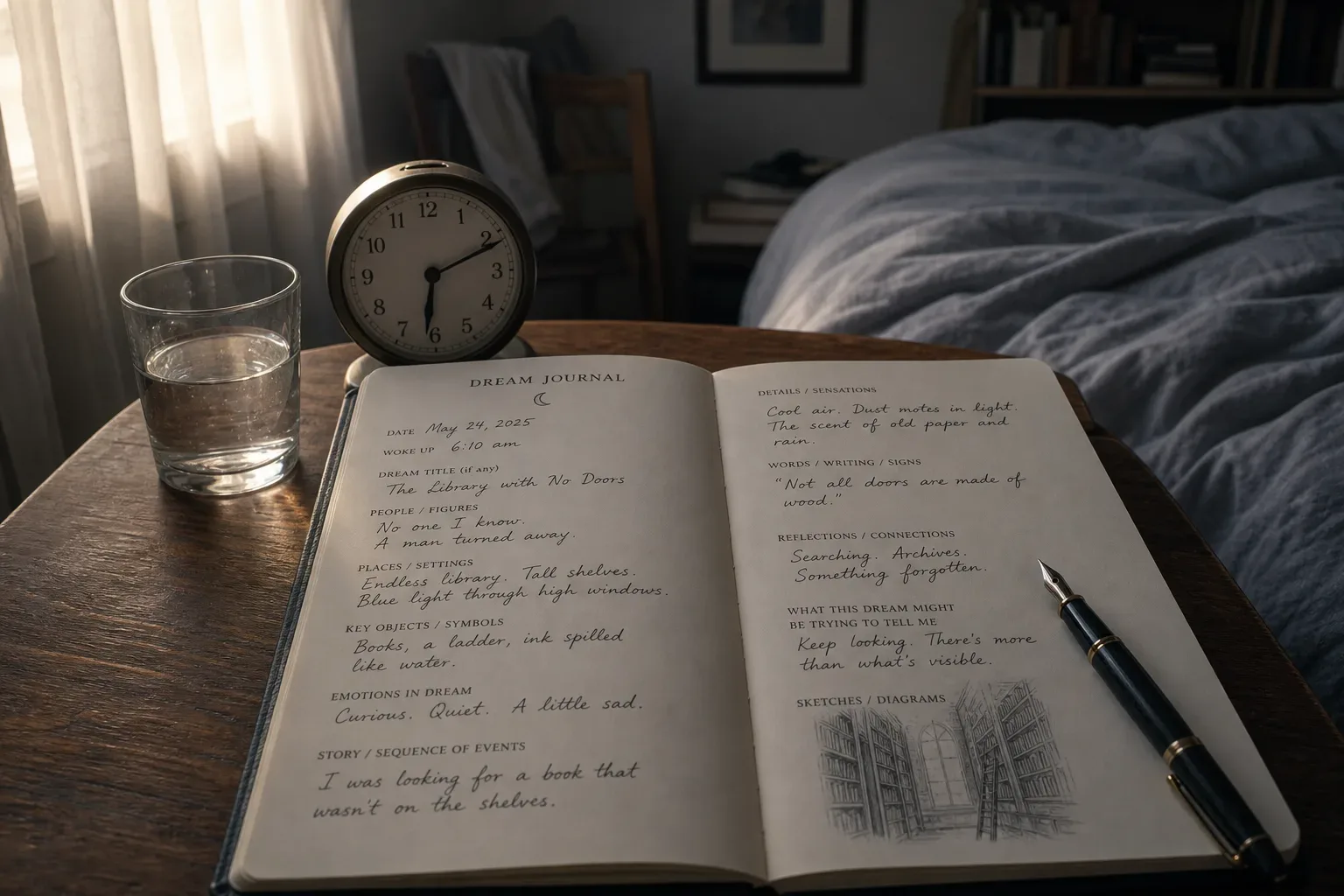
A dream journal template for lucid dreaming should be short, repeatable, and aimed at pattern recognition. Use one page to record the dream, the emotion, the impossible detail, and one dream sign to watch for during the day. The goal is not a perfect diary. It’s better recall and clearer lucidity cues.
What makes a dream journal template work for lucid dreaming?
A good template turns a fragile morning memory into a set of clues you can recognize the next time you’re asleep.
Lucid dreaming usually begins with one small recognition: something is off. The clock won’t hold a number. The room has two doors where yesterday it had one. Your dead grandfather is making tea in your first apartment. Stephen LaBerge’s early laboratory work in the 1980s helped show that some lucid dreamers could signal awareness from REM sleep with pre-arranged eye movements. The interesting part for a journal is ordinary: the dreamer had to notice the dream while inside it.
That’s why the template matters. A blank notebook can become too wide. You wake at 6:18, reach for language, and the dream starts withdrawing. A one-page night log gives your mind hooks: where, who, what felt strange, what did I feel. In research by Michael Schredl and others, dream recall frequency is often treated as a stable but trainable measure, with diary-keeping used in studies because it catches reports close to waking.
Your one-page template should do 4 jobs:
- preserve the dream before it thins out
- name the emotional center
- identify recurring symbols and settings
- convert one odd detail into a lucid dreaming cue
A dream that is remembered becomes material. A dream that is written becomes pattern.
If you’re new to lucidity, read this alongside our Lucid dreaming pillar, which explains the larger practice. The journal is not the whole method. It is the morning half of the method: the part that teaches you what your sleeping mind keeps repeating.
How do you use the one-page night log in under seven minutes?
Use the template in a fixed order: time, title, feeling, scene, figures, impossible detail, meaning, and daytime cue.
Keep the page beside the bed before you sleep. That small preparation matters. In sleep research, awakenings from REM sleep are more likely to produce dream reports than awakenings from non-REM sleep, and REM periods tend to lengthen in the second half of the night. If you wake near morning, you may be holding the clearest dream of the night. Don’t make yourself hunt for a pen.
Here is the 7-minute version:
- First 30 seconds: stay still and keep your eyes soft.
- Minute 1: write the date, bedtime, wake time, and alarm or natural waking.
- Minute 2: give the dream a blunt title.
- Minutes 3 to 4: write the plot in fragments, not sentences.
- Minute 5: name the strongest emotion.
- Minute 6: mark the impossible or unlikely detail.
- Minute 7: choose one reality-check cue for the day.
Don’t improve the dream while writing it. Don’t make it wise. If you dreamed of a red elevator, a wet dog, and your old chemistry teacher, write that. Jung warned against flattening a dream into a ready-made meaning, and he was right in at least this practical sense: a symbol loses usefulness when we rush to make it respectable.
The page should include one line for body state too. “Woke with jaw tight” or “heart racing” may matter, especially after nightmares. The American Academy of Sleep Medicine notes that recurring distressing dreams can be associated with stress and trauma; if nightmares are frequent, disruptive, or tied to panic, it’s reasonable to speak with a clinician. A journal can help you notice patterns, but it isn’t medical care.
What fields should your lucid dreaming night log include?
The best fields are the ones that help you compare dreams across nights without drowning the dream in categories.
Use this table as the core dream journal template. You can copy it into a notebook, notes app, or printable page. Keep it to one side of paper if you can. In a 2018 paper on dream recall and personality, Schredl noted that interest in dreams and recall frequency tend to be linked; the template quietly increases interest by making dreams easier to meet each morning.
| Field | What to write | Why it helps lucidity |
|---|---|---|
| Date and wake time | “Oct 26, woke 6:12, alarm” | Shows when recall is strongest |
| Dream title | “Glass staircase” | Makes the dream searchable later |
| Emotion | “Embarrassed, then relieved” | Emotion often repeats before images do |
| Setting | “School, but also my office” | Hybrid places are common dream signs |
| Main figures | “Brother, unknown woman, black cat” | Repeated figures can cue recognition |
| Impossible detail | “Cat spoke in my mother’s voice” | Best candidate for lucid noticing |
| Symbol or motif | “Stairs, tests, locked door” | Links to longer personal patterns |
| Daytime reality check | “Check hands when I see stairs” | Carries the dream sign into waking life |
For symbols, don’t force a single meaning. A snake can mean danger in one dream, healing in another, and someone’s grandmother’s kitchen in a third. Our Dream dictionary (A–Z hub) is useful when you want traditional and psychological associations, but your own repeated context matters most. A symbol is not a verdict. It’s a place to look twice.
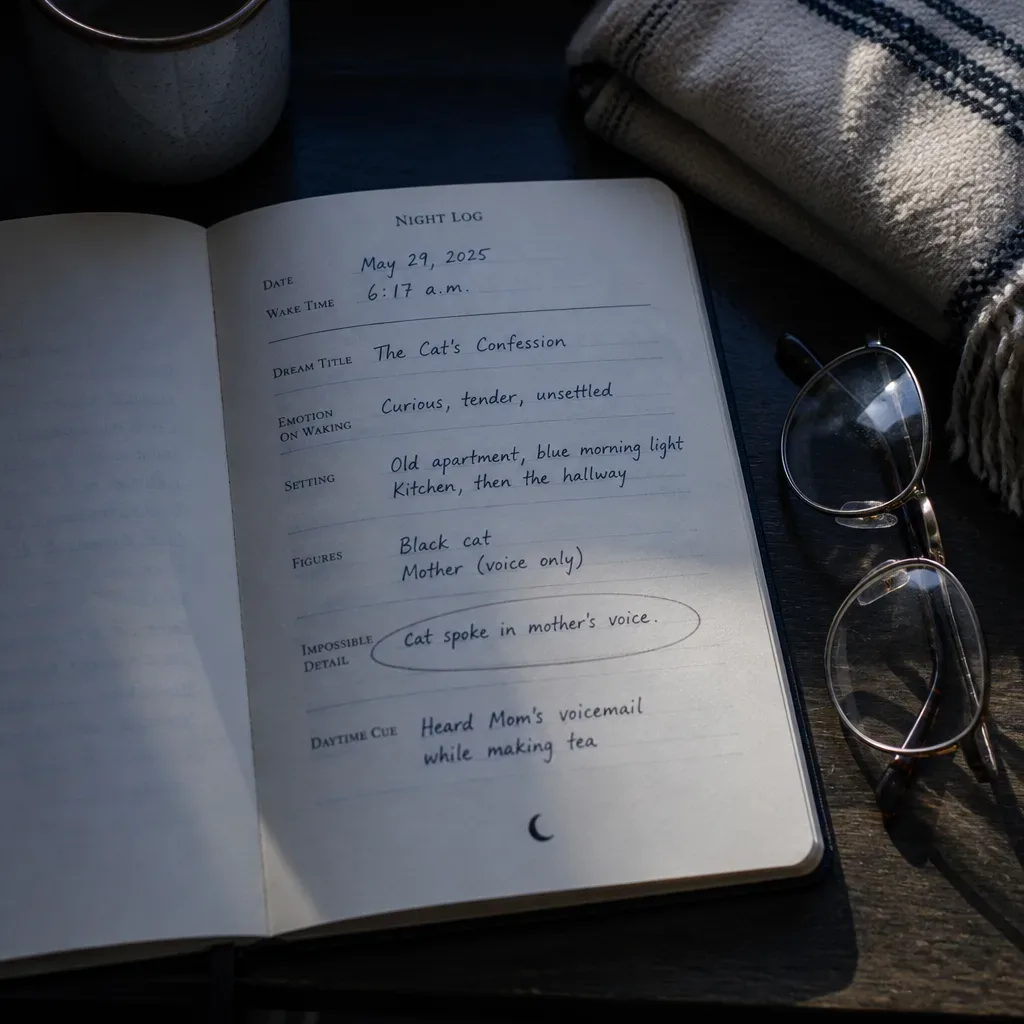
Add a small score at the bottom: recall clarity from 0 to 5. A 0 means no remembered dream. A 5 means scenes, dialogue, and emotion are intact. Specific numbers reduce drama. After 14 mornings, you may notice that natural waking gives you a 4, while a harsh alarm gives you a 1. That’s not mystical. It’s data from your own bed.
How do you find dream signs inside the template?
A dream sign is any repeated clue that could remind you you’re dreaming while the dream is still happening.
The phrase comes from lucid dreaming practice, especially the work of LaBerge, who taught dreamers to identify recurring oddities and test reality when they appeared. The dream sign may be dramatic, like flying, or ordinary, like being back in school at age 42. One survey-based paper by Daniel Erlacher and colleagues found that lucid dream frequency varies widely, with many people reporting lucidity rarely and a smaller group reporting it monthly or more. Pattern recognition is one reason that smaller group improves.
Look for dream signs in 4 categories:
- Place signs: childhood home, school hallway, hotel, airport, endless house
- Body signs: loose teeth, heavy legs, floating, changed hands
- Figure signs: deceased relatives, former partners, unknown children
- Logic signs: broken phones, unreadable text, rooms changing shape
Then choose one cue for the day. If last night’s impossible detail was a train arriving inside your kitchen, don’t tell yourself, “I’ll question reality all day.” That’s too vague. Try this: “Every time I hear a train or see a kitchen sink, I’ll look at my hands and ask, Am I dreaming?” A 2012 overview by Ursula Voss and colleagues notes that lucid dreaming involves metacognition during sleep: awareness of one’s mental state. Reality checks rehearse that awareness while awake.
The cue should be small enough to keep. Three careful checks are better than 30 theatrical ones. The night teaches in images; the morning turns one image into practice.
Should you interpret the dream before or after lucid practice?
Interpret lightly after you’ve recorded the dream and chosen the lucid cue.
This order protects the memory. Interpretation can pull you into story, and story can overwrite the actual dream. First write what happened. Then mark the dream sign. Only then ask what the dream may be showing you. Calvin Hall’s mid-20th-century content analysis treated dreams as reports that could be coded for characters, actions, emotions, and settings. You don’t need his full system at breakfast, but the spirit is useful: observe before explaining.
For interpretation, use 3 quiet questions:
- What feeling was strongest? Fear, shame, tenderness, disgust, relief.
- Where does this feeling appear in waking life? Be specific, not grand.
- What did the dream make visible that I’d rather keep vague?
If you want a second reading, try the AI dream interpreter tool after you’ve written your own first line. This matters. Your original note is closer to the dream than any later analysis. Tools can compare symbols and suggest angles, but they shouldn’t replace the first honest sentence from the morning.
Jungian work treats dreams as compensatory more often than flattering. The dream may show the ignored side of a choice, the cost of a persona, the child version of you still waiting in a room. That doesn’t mean every dream is solemn. A ridiculous dream can still carry exact information. The clown car may be your calendar.
Interpretation serves lucidity when it sharpens attention. If the same locked door appears 6 times in a month, it is both a symbol and a practical cue. In waking life, ask what you avoid. In dreaming, ask whether doors behave normally. The same image can carry meaning by day and lucidity by night.
How can the template support MILD, WBTB, and reality checks?
The template supports lucid techniques by giving each method fresh dream material instead of generic intention.
MILD, or Mnemonic Induction of Lucid Dreams, was developed by Stephen LaBerge. In simple terms, you wake from a dream, remember it, and rehearse the intention to notice you’re dreaming next time. A 2020 study by Denholm Aspy found that techniques including MILD showed promise, though lucid dreaming research still relies on mixed methods and modest sample sizes. The point for your journal is direct: MILD needs a remembered dream to work with.
WBTB, or Wake Back To Bed, usually means waking after about 5 to 6 hours of sleep, staying awake briefly, then returning to sleep with lucid intention. Your journal helps here too. If your log shows your clearest recall comes after 6:00 a.m., you can place the practice there. If it shows WBTB leaves you exhausted, stop or use it rarely. Sleep health comes first.
Here is how the one-page log connects to common practices:
| Practice | What the journal provides | Morning instruction |
|---|---|---|
| MILD | A recent dream scene | Rehearse noticing the impossible detail |
| Reality checks | Personal dream signs | Check when the sign appears by day |
| WBTB | Timing patterns | Choose a wake window that doesn’t harm sleep |
| Dream incubation | A clear question | Write one question before bed |
This is also where waking intention can be handled gently. Recurring dreams show what your attention keeps returning to, often before you admit it aloud. The AYA Method is a daily audio manifestation practice. Each day you listen to a short personalized recording, your Dream-Self Moment, narrated from the version of you who has already manifested the life you intend. Listening is the practice. Repetition is the work. The audio is the method. For dreamers, it can sit beside the journal as a waking counterpart: the night shows the pattern; the morning chooses the voice you’ll repeat.
What should you write when you remember almost nothing?
Write the fragment, the mood, and the conditions of waking, because “nothing” often becomes something after several mornings.
Most people dream multiple times a night. REM sleep makes up about 20 to 25 percent of adult sleep, according to standard sleep medicine summaries, and REM periods are longer toward morning. Not remembering a dream doesn’t mean nothing happened. It means the bridge between sleep and waking didn’t hold long enough.
Use a “no recall” entry like this:
- Date: Oct 26
- Wake time: 6:43, alarm
- Recall: 0/5
- Mood: irritated, hurried
- Body: dry mouth, tense shoulders
- Fragment: blue light, maybe a stairwell
- Day cue: check hands when using stairs
This keeps the habit alive without pretending. It also gives you useful comparisons. After 10 to 14 days, you may see that alcohol, late screens, stress, or irregular wake times change recall. The National Sleep Foundation and many sleep clinicians recommend consistent sleep and wake times for sleep quality; your journal may show the same lesson in your own handwriting.
Don’t punish the blank mornings. A dream journal is a listening practice, and listening includes the days when the room is quiet. Write one line. Leave the page open. Try again tomorrow.
If you wake with only an emotion, treat it as valid. “I woke feeling accused” is a dream remnant. “I woke relieved, as if I’d found something” is also a remnant. Sometimes the feeling is the last surviving animal from the dream. Feed it a sentence before it disappears.
How do you review the template after two weeks?
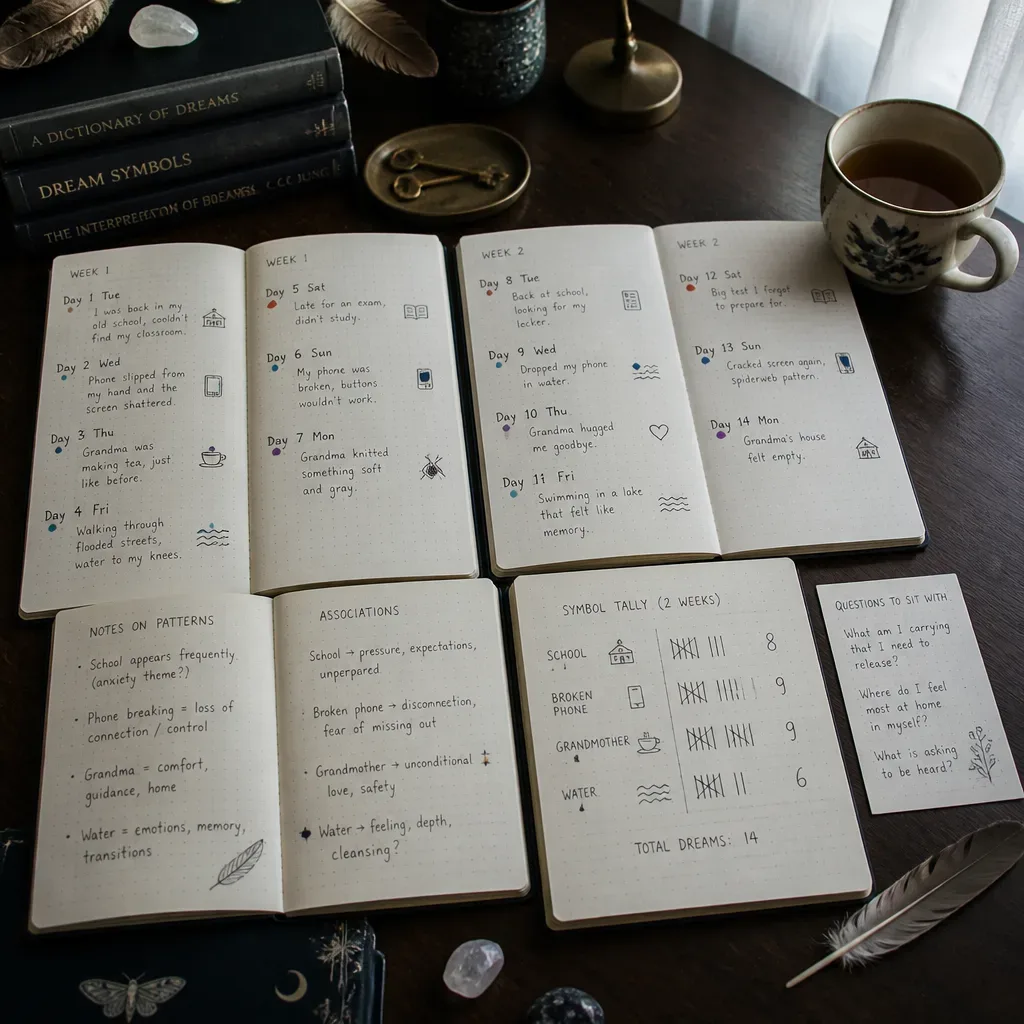
Review 14 entries by counting repeated signs, emotions, places, and wake conditions, then choose one lucid focus for the next week.
Two weeks is long enough to reveal patterns and short enough to remember the season of your life. Don’t reread like a critic. Read like a tracker. Put a small mark beside every school, elevator, dead relative, animal, broken phone, chase, flood, test, or missing bag. In dream content research, repeated themes are common across large samples; falling, being chased, and school-related scenes appear often in published dream theme studies, including work by Nielsen and others.
Make a simple review table:
| Pattern | Count in 14 days | What to do next |
|---|---|---|
| School or exam scenes | 4 | Reality check when seeing desks or forms |
| Dead grandmother | 2 | Ask what care or judgment she carries |
| Broken phone | 5 | Check text twice during the day |
| Embarrassment | 6 | Note where you feel watched while awake |
| Natural waking recall 4/5 | 3 | Protect one slow morning each week |
Then choose only one focus. If broken phones appeared 5 times, make phones your reality-check cue for 7 days. Look at the screen, look away, look back, and ask whether the text stays stable. In dreams, written text often shifts or refuses to settle, which is why reading checks remain popular in lucid practice.
For symbols that keep returning, compare your notes with the Dream dictionary (A–Z hub), but don’t surrender your own evidence. If the dictionary says water often relates to emotion, and your water dreams always involve your father’s fishing boat, both facts belong on the page.
If you want to go deeper into techniques after the review, return to the Lucid dreaming pillar and choose one method rather than five. Lucidity grows best when the practice is narrow enough to remember inside sleep.
Tonight, leave the page open to the morning.