lucid dreaming
Reading in Dreams: Text, Clocks, and Lucid Cues
Reading in dreams can happen, but text and clocks often shift. Learn why lucid dreamers use words, watches, and cues as morning evidence with calm practice.
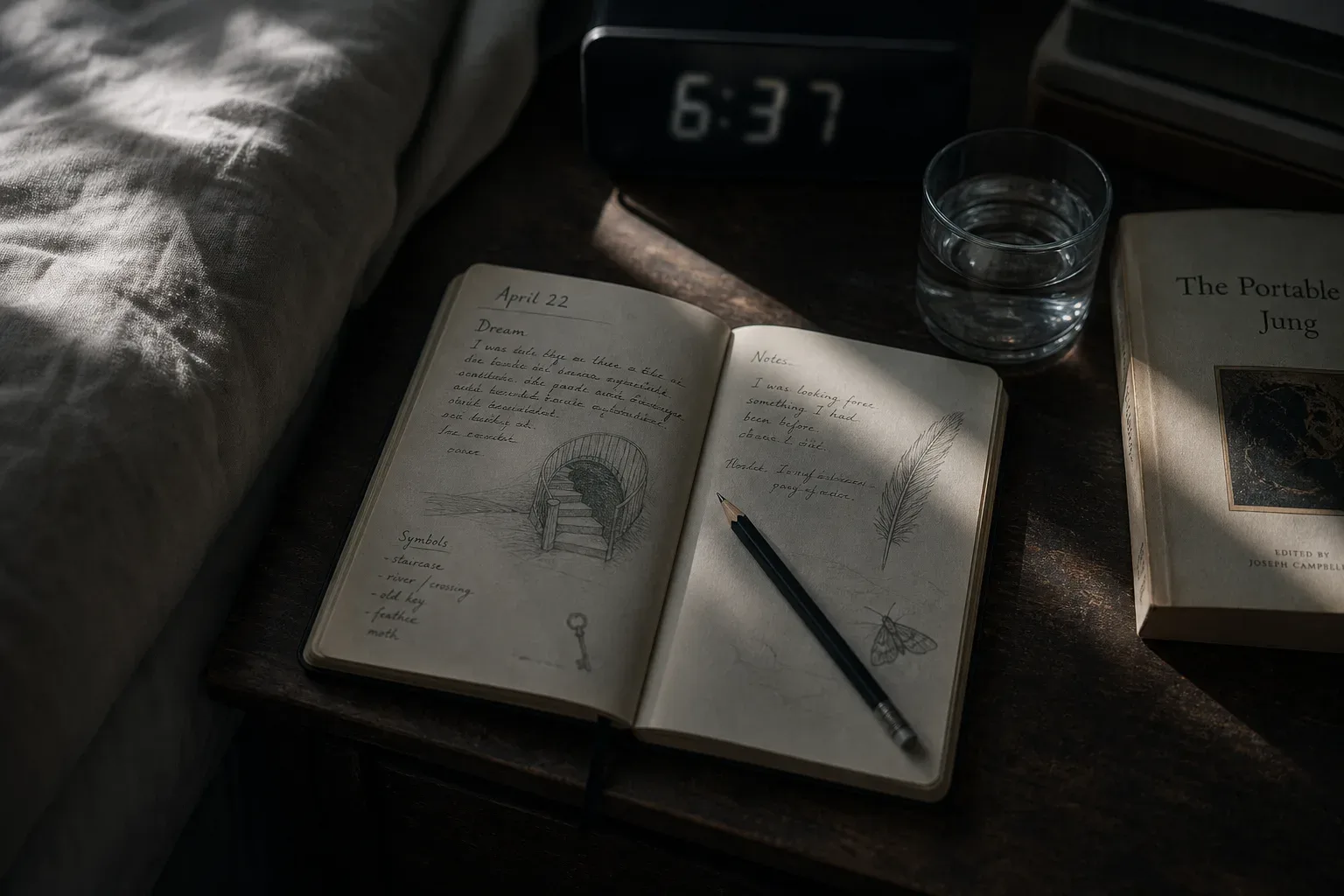
Yes, reading in dreams is possible, but dream text is usually unstable: it blurs, rearranges, or says something different when you look back. In a lucid dream, trained attention can hold a word or clock face for a few seconds. The instability is also why text makes a reliable reality check.
Can you really read words inside a lucid dream?
Yes, you can read in a lucid dream, but the words usually behave more like living dream material than printed ink.
Beginners are often told that reading in dreams is impossible. That isn’t quite honest. People report signs, names, text messages, subtitles, book titles, and classroom boards all the time. In lucid dreams, some can read a short phrase, remember it, and repeat it after waking. What fails most often is not the first glance. It’s the second glance. The word that said train becomes trial. The clock that said 6:20 becomes 88:41. A dream can print a sentence; it does not always keep a proofreader on staff.
The research on lucid dreaming gives us a useful frame. Stephen LaBerge and colleagues verified lucid dreaming in 1981 by having dreamers signal with deliberate eye movements during REM sleep. Later work, including Konkoly et al. in Current Biology in 2021, showed that some lucid dreamers can answer simple questions from within REM sleep. That doesn’t prove dreamers can read a page clearly, but it does show that focused cognition can operate during dreaming.
Still, ordinary reading is a demanding act. Stanislas Dehaene’s work on reading describes a learned network that must coordinate visual recognition, memory, language, and attention in fractions of a second. During REM sleep, parts of executive control are altered, while vivid imagery can be high. That mix helps explain the strangeness: a dream may generate the look of language before it sustains the grammar of language.
If you woke with a clear line from a dream, write it down exactly. Put uncertain words in brackets. In my notebooks, a sentence remembered at 7:04 is often gone by 7:11, and that seven-minute loss is not a moral failure. It’s normal sleep physiology meeting breakfast.
Lucidity is not the same as waking. It is a narrow lamp carried through weather.
Why does dream text change when you look twice?
Dream text changes because the sleeping brain often reconstructs the object at each glance instead of preserving a stable external page.
In waking life, the book on your table keeps existing while you blink. In a dream, the page is a mental event. When you look away, there may be no stored page, only the idea of one. When you look back, the brain rebuilds it, and the rebuilt version may borrow from memory, emotion, expectation, or the last sound you heard before sleep. That is why text checks work so well for lucid dreamers: they test continuity.
A useful comparison is visual detail in dreams. Siclari et al., writing in Science in 2017, identified a posterior cortical hot zone linked with dream reports. When that region showed certain activity patterns, sleepers were more likely to report dreaming after awakening. The finding doesn’t say dreams are fake pictures. It says dream imagery has neural conditions, and those conditions are not identical to waking perception.
Try this simple check while awake for 7 days: read a line, look away for 2 seconds, read it again, then ask, Am I dreaming? The waking answer will almost always be boring. That is the point. Lucid dreaming is built on boring repetition. Saunders et al. published a 2016 meta-analysis suggesting about 55 percent of people have had at least one lucid dream, while about 23 percent report them monthly or more. The gap between once and often is usually habit.
Here is the usual pattern:
| Dream object | First glance | Second glance | Lucid cue |
|---|---|---|---|
| Book page | A readable line | New sentence or blank space | Strong |
| Phone screen | Message preview | Nonsense letters or shifting app | Strong |
| Digital clock | Plausible time | Impossible time or symbols | Strong |
| Street sign | Familiar place name | Mixed letters or wrong language | Moderate |
| Handwriting | Your name or note | Melts, loops, or won’t finish | Moderate |
The second glance is where many dreams confess their instability.

Are clocks better than books for reality checks?
Clocks are often better than books because they require the dream to maintain exact numbers under repeated attention.
A digital clock is wonderfully unforgiving. It has to keep order: hours, minutes, and sometimes a blinking colon. In dreams, numbers often distort faster than pictures. Analog clocks add another weakness. The hands need geometry. They must point to a coherent time. Many dream clocks refuse that kind of discipline, so they become soft evidence that you’re asleep.
This is why a clock check should always be repeated. Don’t only ask, What time is it? Ask, Did it stay the same? In my own practice, clocks have been more reliable than finger counting, though not perfect. A dream once gave me 3:17 twice, with great politeness, before changing the wallpaper into rain. No cue is sacred. Good practice uses more than one cue.
Lucid dreaming studies tend to show uneven success rates across methods. A 2017 study by Aspy and colleagues found that a combined approach using reality testing, wake-back-to-bed, and the mnemonic induction of lucid dreams was associated with higher lucid dream frequency over one week, with MILD performing especially well when participants returned to sleep soon after setting intention. That study was modest in size, but it matches what teachers see: checks work better when sleep timing supports them.
Use clocks when you already check time often. Use books if you read often. Use screens if your dreams are full of phones. The best reality check is not the cleverest one. It’s the one you’ll actually remember when your grandmother is driving a bus through your old school.
A practical clock routine:
- Look at the time and read it silently.
- Look away for 2 to 5 seconds.
- Look back and read it again.
- Ask how you got here.
- Do one physical check, such as pinching your nose and trying to breathe.
For a fuller foundation, the Lucid dreaming pillar covers sleep timing, recall, and the habits that make any cue more likely to work.
What do phones, signs, and subtitles mean as dream cues?
Phones, signs, and subtitles are useful cues because they combine text with social meaning, urgency, and memory.
A phone in a dream is rarely just a phone. It may carry a message you don’t want to read, a name you miss, a missed call from someone dead, or a screen that refuses to obey. Psychologically, that makes the object sticky. It gets attention. Attention is the doorway to lucidity, though not a guarantee. If you often dream of trying to text and failing, that failure is a fine cue.
Dream dictionaries can be clumsy when they pretend every object has one fixed meaning. A phone can mean contact, avoidance, interruption, longing, or the ordinary fact that you spent 4 hours on one yesterday. The Dream dictionary (A–Z hub) is most useful when you treat symbols as prompts, not verdicts. Ask what the object was doing, who was involved, and what changed when you noticed it.
Subtitles are especially interesting because they translate sound into text inside the dream. I’ve seen dreamers report subtitles in films, foreign conversations, and even arguments. No large study gives us a clean percentage for subtitle dreams, so this remains report-based. But as a cue, it’s elegant: if words appear across the bottom of your vision, pause. Read them twice. If the line changes, ask whether you’re asleep.
Common text cues to track in a journal include:
- Names on phones, doors, badges, or mail.
- Receipts, menus, tickets, and calendars.
- Street signs and train boards.
- Classroom boards, slides, and exam papers.
- Subtitles, captions, and lyrics.
- Notes written by someone you know.
If you want a second set of eyes in the morning, the AI dream interpreter tool can help you organize recurring symbols without replacing your own judgment. Keep the raw dream first. Interpretation can wait 10 minutes.
A symbol is not a command. It is a place where attention has gathered.
How can you practice reading in dreams without forcing it?
Practice by training waking attention around text, then recording every dream fragment that contains words, numbers, or signs.
Do not start by trying to read a novel in a lucid dream. Start with one word. A sign. A clock. A name on a phone. The brain can often hold a small target longer than a page. This is the same principle I use with beginners in dream recall: don’t demand the whole dream by breakfast. Catch the handle. The rest may come.
For 14 days, choose one text cue and one clock cue. Do them during the day, especially when you change rooms, check your phone, enter a shop, or wake during the night. The number matters less than consistency, but 10 checks a day is a good ceiling for most people. More than that can become mechanical. Mechanical checks tend to fail inside dreams because you repeat the gesture without asking the question.
Dream journaling is the unglamorous engine here. Schredl has repeatedly found associations between dream recall frequency and attitudes or practices that increase attention to dreams, including keeping records. The causal details vary, but the practical result is plain: what you record, you begin to notice. After 2 weeks, many beginners don’t have a lucid dream yet, but they do have better maps of their common dream signs.
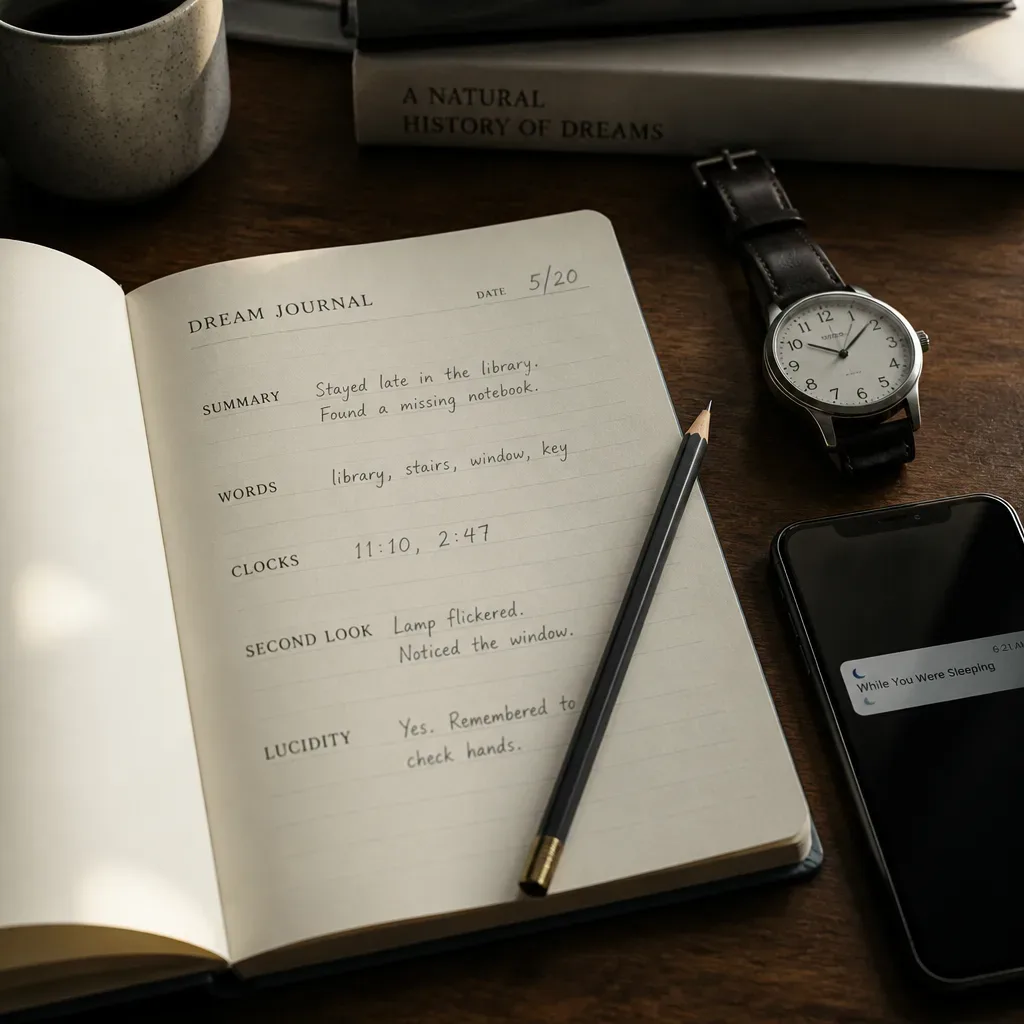
Use this morning format:
- Date and wake time.
- One-line dream summary.
- Exact words seen, if any.
- Clocks or numbers seen, if any.
- What changed on a second look.
- Lucidity noted in the margin.
Some nights will give you nothing. Write none remembered. That line still trains the habit. A dream practice that survives dry spells is worth more than a clever technique done twice.
What should you do the morning after a text dream?
Write the text down first, then ask what changed, what it was attached to, and whether it can become a waking cue.
Morning is when the dream is still soft. Don’t open messages yet. Don’t explain the whole dream before preserving the fragile part. If you saw a sign that said NORTH ROOM, write NORTH ROOM. If the second look turned it into MOTHER, write that too. The change may matter more than either word alone.
Separate three things: the cue, the feeling, and the life context. The cue is the object: clock, book, receipt, subtitle. The feeling is what happened in the body: dread, relief, embarrassment, curiosity. The life context is the ordinary question: where have I seen this lately? In clinical dream work, including the long tradition after Jung, symbols are usually treated as personal first and cultural second. Folklore may add color, but your morning evidence comes first.
If the dream was frightening, keep the method calm. Nightmares are common. The American Academy of Sleep Medicine notes that occasional nightmares happen to many people, while nightmare disorder is different because it causes repeated distress or daytime impairment. If dreams regularly disturb your sleep or you feel unsafe when awake, talk to a doctor or qualified clinician in one plain step.
This is also where waking intention can be useful, if it stays modest. The AYA Method is a daily audio manifestation practice: each day you listen to a short personalized recording, your Dream-Self Moment, narrated from the version of you who has already manifested the life you intend. Listening is the practice. Repetition is the work. The audio is the method. For lucid dreamers, that kind of repeated self-address can sit beside journaling, not replace it.
Before you get up, ask one question: What did the text do when I gave it attention?
Write the answer before the day edits it.