dream science
Why Do Nightmares Happen? Stress, REM, Audio
Why do nightmares happen? Learn how stress, REM sleep, memory, and bedtime audio shape frightening dreams, plus what to do the next morning.
Nightmares happen when the sleeping brain turns fear, stress, memory, or bodily alarm into dream imagery, most often during REM sleep. They’re common, usually harmless, and not predictions. A nightmare becomes worth extra attention when it repeats, disrupts sleep, follows trauma, or leaves you afraid of going back to bed.
Why do nightmares happen in the first place?
Nightmares happen because the brain keeps processing threat and emotion while the body is asleep.
A nightmare is not a random horror film pasted onto the night. It’s usually built from ordinary materials: recent stress, old memory, bodily discomfort, fear, guilt, grief, conflict, or anticipation. The American Academy of Sleep Medicine notes that nightmare disorder is defined not by one frightening dream, but by repeated nightmares that cause distress or impairment. Community estimates vary, but recurrent nightmare disorder is often placed around 2% to 8% of adults, depending on the sample and definition.
The sleeping brain is not off. In REM sleep, the stage most associated with vivid dreaming, emotional and memory-related networks remain active while some executive control is reduced. That mix can make a worry feel larger and stranger than it did at 2 p.m. A missed deadline becomes a collapsing house. A difficult conversation becomes a chase. The symbol is not a code; it’s a compression.
A nightmare is fear with a stage set.
Researchers such as Tore Nielsen and Ross Levin have argued that nightmares may reflect a failure or overload in the normal emotional regulation work of dreaming. Their 2007 neurocognitive model links nightmare distress to both arousal and negative emotion networks. That model is not the final word, but it has held up better than the idea that nightmares are meaningless noise.
Dream symbols still matter because your own history matters. If the dream includes snakes, teeth, water, or a childhood room, the Dream dictionary (A–Z hub) can give you common readings. But the best first question is simpler: what feeling did the dream leave in the body?
Why does stress make nightmares more likely?
Stress raises the brain’s threat setting, and that higher setting can carry into sleep.
People often report more nightmares during exams, breakups, illness, deadlines, caregiving strain, and periods of uncertainty. After major collective stress, researchers have seen shifts in dream content. During the early COVID-19 pandemic, several studies reported increased disturbing dreams and nightmares, though many relied on online surveys and self-report. One Finnish study published in 2020 analyzed pandemic dream reports and found repeated themes of contagion, distancing, and loss of control.
Stress affects sleep in at least 3 practical ways. First, it can delay sleep onset. Second, it can fragment sleep with more awakenings. Third, it can make late-night REM dreams easier to remember because you wake closer to them. The Centers for Disease Control and Prevention has reported that about 1 in 3 U.S. adults does not get enough sleep on a regular basis. Short sleep does not cause every nightmare, but tired brains regulate emotion less cleanly.
Here are common stress pathways that show up in nightmare reports:
- Threat rehearsal: being chased, trapped, watched, attacked, or unable to protect someone.
- Loss of control: brakes failing, teeth falling out, missing a train, losing a child in a crowd.
- Social exposure: arriving unprepared, being judged, speaking without words, appearing naked.
- Grief and separation: the dead appearing silent, unreachable, alive again, or leaving twice.
- Body alarm: suffocation, falling, pain, fever, racing heart, or medication effects.
The threat-simulation theory, associated with Antti Revonsuo, proposes that dreaming may rehearse danger. It is a serious hypothesis, not a settled fact. It helps explain why so many nightmares involve pursuit or helplessness, but it doesn’t explain every dream. A quiet dream of being ignored at a family table can hurt as much as a monster.
Stress doesn’t invent the nightmare from nothing; it turns the volume up on what was already asking for attention.
What does REM sleep have to do with nightmares?
REM sleep gives nightmares their vivid images, emotional force, and strange narrative logic.
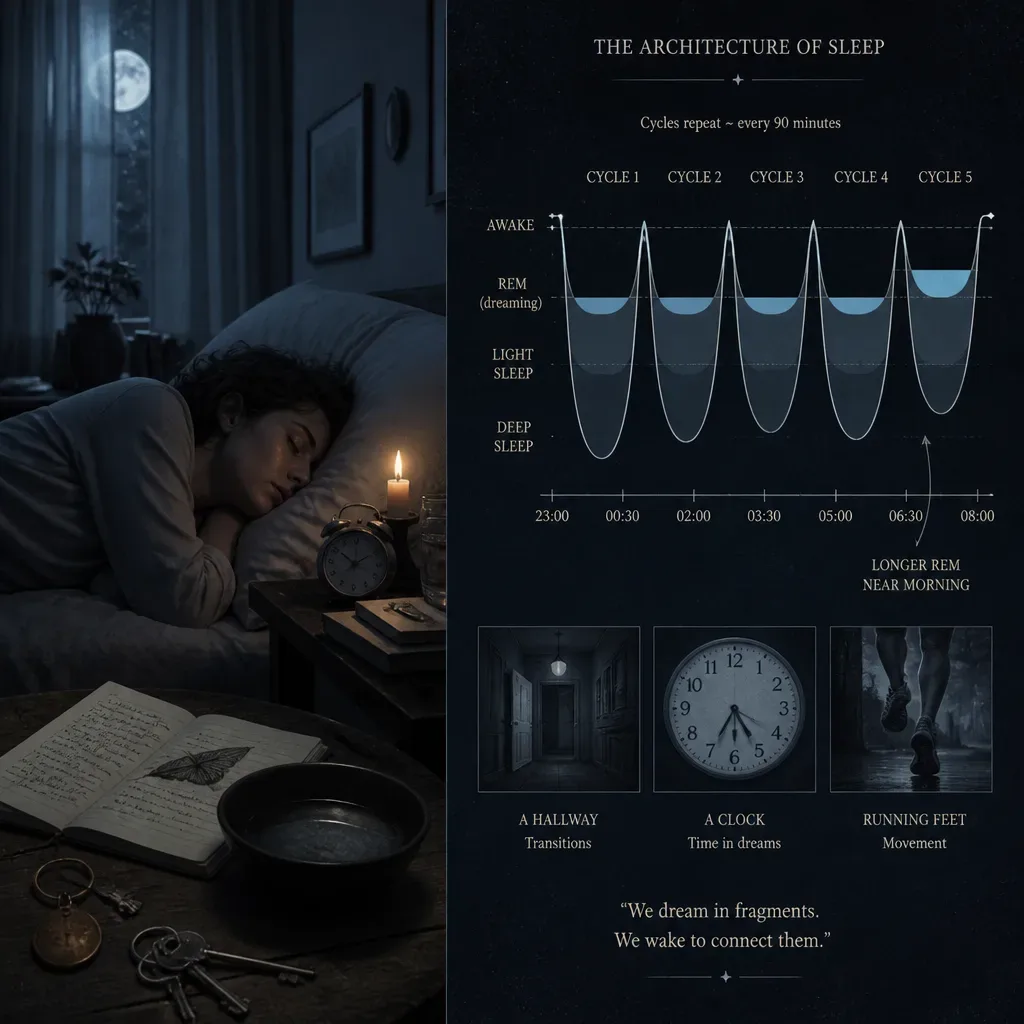
A typical adult cycles through sleep stages about every 90 minutes, with REM periods becoming longer toward morning. Across a full night, REM may account for roughly 20% to 25% of sleep in healthy adults. That is one reason nightmares are often remembered near dawn: there is simply more REM then, and awakenings from REM make dream recall more likely.
During REM, the body is largely immobilized through normal muscle atonia. The brain is active, the eyes move rapidly, and breathing and heart rate may become less regular. Neuroimaging studies, including work reviewed by Matthew Walker and Robert Stickgold, suggest that REM is involved in emotional memory processing. The amygdala, which helps detect threat, can be active, while parts of the prefrontal cortex that check logic and context are less dominant than during waking.
That combination can make a dream feel urgent and unquestionable. In the dream, you don’t say, this hallway is impossible. You run. You hide. You plead. Only later, in the morning, does the mind sort the scene into memory and metaphor.
| Sleep event | Usual timing | What it feels like | Memory afterward |
|---|---|---|---|
| REM nightmare | Later night, often near morning | Vivid fear, story, pursuit, threat | Often clear |
| Bad dream | Any dream period, often REM | Unpleasant but less awakening | Partial or clear |
| Night terror | First third of night, deep non-REM | Panic, confusion, shouting, movement | Often little or none |
| Sleep paralysis | On falling asleep or waking | Awake, unable to move, fear, presence | Usually clear |
Lucid dreaming is different again. In a lucid dream, you know you’re dreaming while the dream continues. Some small studies suggest lucid dreaming training may help certain nightmare sufferers, but the evidence is mixed and not a first-line treatment for everyone. If you’re curious, start with the Lucid dreaming pillar, especially if your nightmares are frequent but not trauma-linked.
Are nightmares different from bad dreams, night terrors, and sleep paralysis?
Yes, nightmares are remembered frightening dreams, while night terrors and sleep paralysis come from different sleep-state mechanics.
A bad dream can be unpleasant without fully waking you. A nightmare usually wakes you and leaves enough memory to tell a story: someone chased me, the room filled with water, I couldn’t call for help. The International Classification of Sleep Disorders distinguishes nightmare disorder by repeated well-remembered dysphoric dreams, quick orientation after waking, and daytime distress or sleep avoidance.
Night terrors, sometimes called sleep terrors, are different. They tend to occur from deep non-REM sleep, often in the first third of the night. A person may sit up, scream, sweat, or appear terrified, yet not remember a dream clearly in the morning. Sleep terrors are more common in children; estimates vary, but pediatric sleep terror rates are often reported in the low single digits to over 10% depending on age and method.
Sleep paralysis is different again. It happens when REM muscle atonia overlaps with waking awareness. You may feel awake but unable to move. Some people sense a presence, pressure on the chest, or danger in the room. It can be terrifying, but it is a known sleep phenomenon. Reviews suggest lifetime sleep paralysis may affect around 7% of the general population, with higher rates in students and psychiatric samples.
Use this simple sorting method the morning after:
- Did you wake from a story you can remember? That points toward a nightmare.
- Did someone else see panic you don’t recall? That may point toward a night terror.
- Were you awake but unable to move? That sounds like sleep paralysis.
- Did it happen after too little sleep, alcohol, fever, or jet lag? Note the trigger before interpreting the symbol.
If you want a second pass on the content itself, the AI dream interpreter tool can help you organize the imagery without treating it as prophecy.
Can bedtime audio reduce nightmares?
Bedtime audio may reduce nightmare risk for some people by lowering arousal before sleep, but it works best when it is quiet, predictable, and emotionally safe.
The stronger clinical evidence for nightmares belongs to therapies such as imagery rehearsal therapy, often used for recurrent nightmares. In IRT, a person writes a less distressing version of a recurring nightmare and rehearses it while awake. Several clinical trials and reviews have found benefit, especially for nightmare disorder and post-trauma nightmares, though results vary by population and study design. Cognitive behavioral therapy for insomnia can also help when nightmares are worsened by fragmented sleep.
Audio can support the same general principle: give the nervous system less threat to carry into the night. A 2015 review in the Journal of Music Therapy found that music interventions can improve sleep quality in some groups, though studies differ widely. Dr. Andrew Huberman often emphasizes reducing late-night physiological arousal; that advice is consistent with basic sleep science even when specific routines need individual testing.
Good bedtime audio has 4 traits:
- It is familiar enough not to demand attention.
- It is quiet enough to fade into the room.
- It does not contain sudden shifts, urgent speech, or upsetting themes.
- It ends without requiring you to tap, scroll, or choose another track.
This is where waking practice can meet dream practice without making claims the research can’t support. The AYA Method is a daily audio manifestation practice. Each day you listen to a short personalized recording, your Dream-Self Moment, narrated from the version of you who has already manifested the life you intend. Listening is the practice. Repetition is the work. The audio is the method. For nightmares, the useful point is not prediction or control. It is repetition: the mind learns what it hears often.
The last voice you give your attention to at night should not be the voice of alarm.

What should you do the morning after a nightmare?
The morning after a nightmare, write down the feeling first and the plot second.
The plot will tempt you. It’s bright, strange, and sometimes embarrassing. But the feeling is usually the better doorway. Was it helplessness, shame, pursuit, dread, grief, disgust, anger, or responsibility? A 2014 review by Nielsen noted that nightmare distress is not only about frequency; it is also about how the dream is appraised and how much waking distress it leaves behind.
Try a short morning record before you reach for a grand interpretation:
- Title the dream in 5 words or fewer. The locked hotel. The silent mother. The teeth in the sink.
- Name the strongest feeling. Use one word if you can.
- Name one waking echo. Where did that feeling appear this week?
- Check the body facts. Sleep length, alcohol, fever, late meal, new medication, stress level.
- Write one repair line. Something ordinary and true: I can answer the email today. I can call my sister. I can rest before deciding.
Dream dictionaries can help after that, not before it. If you start with the symbol, you may miss the life around it. The same image can mean different things. Water can be grief, cleansing, danger, birth, memory, or simply the fact that rain hit the window all night. The Dream dictionary (A–Z hub) is most useful when paired with your own morning notes.
A dream symbol without the dreamer is only half a sentence.
If a nightmare repeats, track it for 2 weeks. Patterns often appear faster than meanings. You may notice that it follows alcohol, conflict, late work, pain flares, or sleeping on your back. One repeated dream is not a diagnosis. A repeated pattern is information.
When should nightmares be taken seriously?
Nightmares should be taken seriously when they are frequent, linked with trauma, causing daytime distress, or making you afraid to sleep.
Occasional nightmares are part of ordinary sleep. Frequent nightmares are different because they can train the body to expect fear at bedtime. The DSM-5 describes nightmare disorder as repeated extended, dysphoric, well-remembered dreams involving threats to survival, security, or physical integrity, with distress or impairment. That definition matters because it separates a frightening night from a clinical pattern.
Talk with a clinician if nightmares happen several times a week, begin after trauma, include violent reenactments, come with panic or depression, or make you avoid sleep. Also mention them if they start after a new medication. Some antidepressants, beta blockers, nicotine patches, withdrawal from alcohol or sedatives, fever, and sleep apnea can affect dreaming or nighttime arousal. This is not medical advice; it is a plain reason to ask a qualified person.
Veterans and trauma survivors deserve particular care here. Post-trauma nightmares are common in PTSD, and the U.S. Department of Veterans Affairs discusses imagery rehearsal therapy, CBT-I, and medication options such as prazosin, though trial results for prazosin have been mixed. The honest sentence is this: there are treatments, but no single treatment works for everyone.
A calm checklist can help you decide what to do next:
- Once in a while: write it down, note triggers, return to sleep hygiene.
- Weekly with distress: track patterns for 2 to 4 weeks and consider support.
- Several times a week: talk with a clinician or sleep specialist.
- After trauma: seek trauma-informed care sooner rather than later.
- With breathing pauses, choking, or severe daytime sleepiness: ask about sleep apnea screening.
Nightmares reflect; they don’t foretell. They show the mind working with fear under unusual lighting. Sometimes that is all they are. Sometimes they are a flare sent up by a nervous system that has been carrying too much for too long.
Write the dream down, then let the morning be ordinary.