dream science
Why Can't I Remember Dreams? 7 Science-Backed Reasons
If you ask why can't I remember dreams, these 7 research-backed reasons explain why recall fades, from REM timing to stress and sleep habits.

You usually can’t remember dreams because dream memory is fragile: you wake at the wrong sleep stage, move too fast, sleep too little, use alcohol or certain medications, feel chronic stress, or simply haven’t trained attention toward dreams. Most adults dream nightly. Recall is the part that fails.
Is it because you woke up at the wrong moment?
Yes: dreams are easiest to remember when you wake during or just after REM sleep, not after a long stretch of deeper non-REM sleep.
REM sleep comes in cycles of roughly 90 minutes, and the longest REM periods tend to arrive in the last third of the night. That is why a dream can feel close at 6:40 a.m. and vanish after one snooze button. The dream was not stored like a document. It was still warm, still loose, and the waking brain had to catch it.
Sleep researchers have known for decades that awakenings from REM are more likely to produce dream reports than awakenings from non-REM sleep. A classic line of laboratory work beginning with Aserinsky and Kleitman in 1953 helped show the relationship between rapid eye movements and vivid dream recall. Later studies complicated the picture, because non-REM dreams exist too, but REM remains a strong recall window.
Siclari and colleagues reported in Science in 2017 that dream reports were linked to activity in a posterior cortical hot zone, even outside REM. That matters because it moves the question away from a simple yes-or-no. You are not asking whether you dreamed. You are asking whether the brain state at waking allowed a report to form.
| Waking moment | Recall tends to be | Why it matters |
|---|---|---|
| During late REM | High | Vivid imagery is close to waking awareness |
| Right after REM | Moderate to high | The memory trace is still available |
| During deep non-REM | Low | The mind wakes more slowly and less narratively |
| After repeated snoozing | Mixed | Each brief waking can overwrite the last fragment |
A dream is often lost in the doorway between sleep and speech.
If this is your pattern, notice the time of night. Waking naturally after 7 to 9 hours, the amount the National Sleep Foundation recommends for most adults, gives late REM more room. That alone can change the morning.
Are you moving, checking your phone, or talking too soon?
Yes: the first 30 to 90 seconds after waking can decide whether a dream becomes memory or disappears.
Dream recall behaves like a shy animal. If you sit up quickly, reach for the phone, answer a question, or start listing the day’s obligations, attention leaves the dream. Once attention leaves, ordinary memory systems begin filing the morning instead. The dream has not been rejected. It has been displaced.
In dream-lab settings, participants are often awakened and asked for a report immediately. That design is not an accident. It protects fragile recall from interference. Schredl’s work on dream recall has repeatedly found that interest in dreams and the habit of recording them are associated with higher recall frequency. The numbers vary by sample, but the direction is steady enough to be useful.
Try this small morning sequence for 7 days:
- Keep your eyes closed when you first wake.
- Stay in the same position for 30 seconds.
- Ask, what was just happening?
- Search for one image, one feeling, or one person.
- Write the fragment before you explain it.
A fragment is not a failed dream report; it is the dream report before it learns grammar.
This is also where interpretation should wait. First write the raw material. Only then compare symbols with a resource like the Dream dictionary A–Z hub. If you start with meaning too soon, you may replace the dream with an opinion about the dream.
Could short sleep be cutting off the dreams you would remember?
Yes: short sleep often reduces the late-night REM periods where vivid, memorable dreams are most common.
Most adults need about 7 to 9 hours of sleep, but the CDC has reported that roughly 1 in 3 U.S. adults sleep less than 7 hours on a typical night. The last hour you cut is often the hour richest in REM. So the problem may not be a mysterious inability to remember. It may be a schedule that ends the night just before recall gets easier.
REM sleep is not evenly spread across the night. Early sleep is weighted toward deep non-REM sleep, while later sleep contains longer REM episodes. If you sleep from midnight to 5:30 a.m., you may still dream, but you are giving yourself fewer late REM awakenings. Weekend catch-up sleep can bring more remembered dreams because the body finally reaches those longer morning cycles.
This is why people often report more dreams on vacations, during illness recovery, or after a rare slow morning. They did not suddenly become more symbolic. They woke later, softer, and with fewer demands pressing against the dream.
For people training lucid dreaming, sleep length matters too. Many lucid dream protocols use wake-back-to-bed timing because late REM is a more favorable window. You do not need to become lucid to benefit from the same science: protect the final part of sleep, and recall has more chances.
If you are sleeping 5 or 6 hours most nights, begin there before blaming your memory.

Can alcohol, cannabis, or medication affect dream recall?
Yes: substances that change sleep architecture can change how much REM you get, how often you wake, and what you remember.
Alcohol is the common one. A review by Ebrahim and colleagues in Alcoholism: Clinical and Experimental Research in 2013 found that alcohol can suppress REM sleep in the first half of the night and increase sleep disruption later. That late disruption can create vivid recall for some people and blank mornings for others. The pattern depends on dose, timing, and the person.
Cannabis is more complicated. THC has been associated in some studies with reduced REM sleep, and many regular users report fewer remembered dreams. When they stop, REM rebound and vivid dreams are commonly reported, though the evidence base is thinner than people online make it sound. The honest version is simple: cannabis can change dream recall, but the exact effect varies.
Medications matter as well. Some antidepressants, beta blockers, sleep aids, and medications affecting acetylcholine, serotonin, or norepinephrine can alter dreaming or recall. Selective serotonin reuptake inhibitors, for example, are often linked clinically with changes in dream vividness, though individual responses differ. Do not stop medication because of dreams. If a change is troubling, ask the prescriber.
A useful distinction:
- Less REM can mean fewer vivid dream memories.
- More awakenings can mean more chances to catch dreams.
- Heavier sedation can mean fewer remembered awakenings.
- Withdrawal from a REM-suppressing substance can bring intense recall.
The dream you remember is partly shaped by the chemistry of the night before.
If nightmares become frequent, if you act out dreams, or if sleep changes arrive suddenly with a medication change, talk to a doctor in one plain appointment.
Is stress making dreams vanish before morning?
Yes: stress can crowd the waking mind so quickly that dream material has no quiet place to settle.
Stress does not have one effect on dreams. Acute stress can make dreams emotionally intense and easier to remember. Chronic stress can fragment sleep, raise early-morning alertness, and send the mind straight into problem-solving. A 2019 American Psychological Association survey found that many adults report stress affecting sleep, and clinical sleep research has long linked insomnia symptoms with cognitive arousal at bedtime.
Cortisol rises naturally toward morning as part of the circadian rhythm. That rise helps you wake. But if you wake already braced for email, childcare, money, or conflict, the brain may prioritize planning over recall. The dream was there. The morning outranked it.
Nightmares add another layer. People with recurrent nightmares often remember them because the emotion is strong and the awakening is sharp. The Journal of Clinical Sleep Medicine has published practice guidance on nightmare disorder, including imagery rehearsal therapy as an evidence-based treatment for recurrent nightmares. If nightmares are frequent or tied to trauma, support is available. You do not have to turn every bad dream into a symbol.
When stress is high, do less interpretation, not more. Write:
- one image
- one feeling
- one waking concern it may be touching
- one thing you can do before noon
That is enough. If you want help holding the exact report before meaning hardens around it, the AI dream interpreter tool can be useful after you record the raw details. Use it as a mirror, not a verdict.
Could your brain simply not be treating dreams as important?
Yes: people who pay regular attention to dreams tend to remember more of them, and attention is a trainable habit.
High dream recallers are not necessarily more imaginative or more spiritual. Some are simply more wakeful during the night and more interested in what they find. Eichenlaub and colleagues reported in Neuropsychopharmacology in 2014 that high dream recallers showed more intra-sleep wakefulness than low recallers and stronger brain responses to auditory novelty. In plain language, they may wake slightly more and notice more.
This fits what dream researchers see in diaries. A person who writes dreams down 4 mornings a week usually recalls more than a person who waits for a dramatic dream once a month. The recording habit tells the brain that the material matters. Over time, the morning mind learns to check for it.
You can build recall without making the night strange:
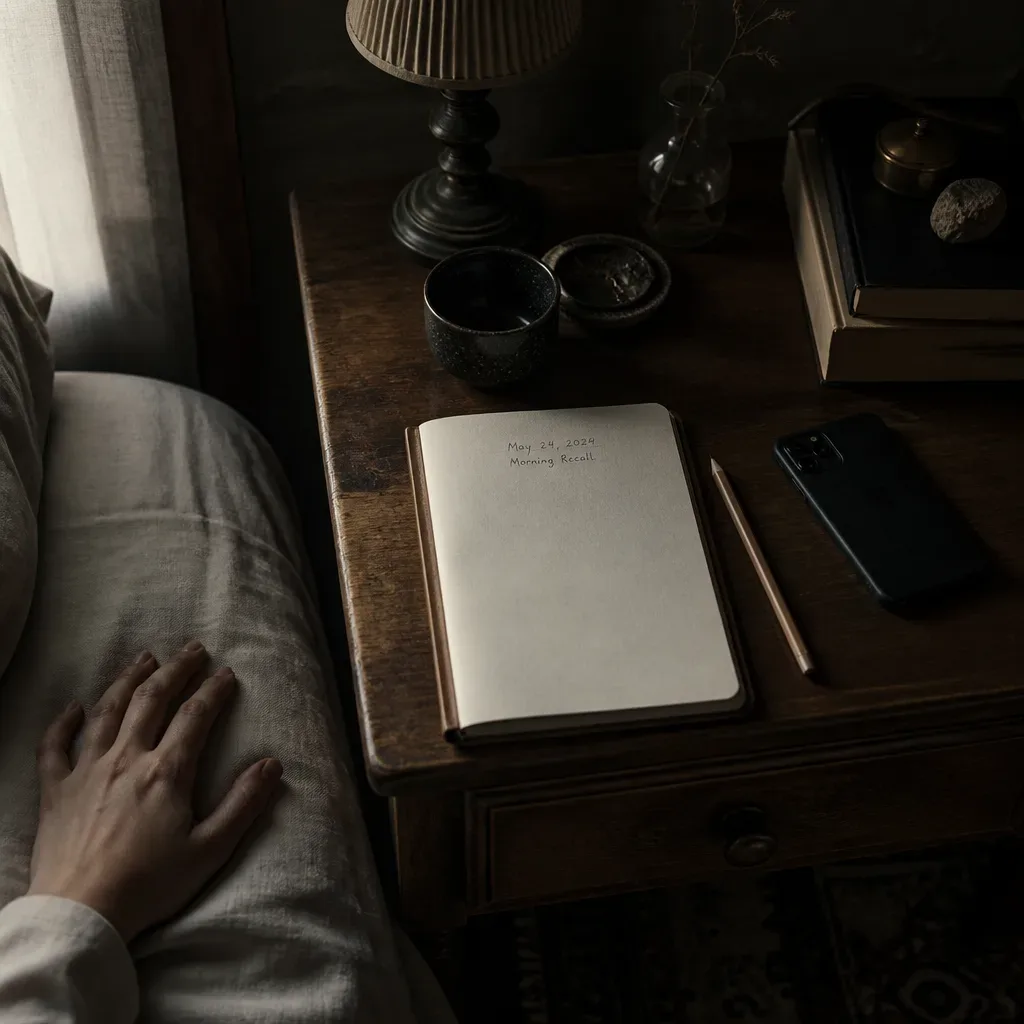
- Put a notebook where your hand can reach it without sitting up.
- Date the page before sleep.
- Write one sentence of intention: I’ll notice what remains in the morning.
- On waking, record fragments without grammar.
- Once a week, review repeated people, rooms, animals, or losses.
This is where waking practice can meet dream practice without confusing the two. The AYA Method is a daily audio manifestation practice: each day you listen to a short personalized recording, your Dream-Self Moment, narrated from the version of you who has already manifested the life you intend. Listening is the practice. Repetition is the work. The audio is the method.
Recurring dreams show what attention returns to at night. A chosen audio practice gives attention a morning form.
What are the 7 most likely reasons you can’t remember dreams?
The 7 most likely reasons are REM timing, fast waking, short sleep, substances, medication, stress, and low dream attention.
Here is the list in the order I’d check it with a dream-lab notebook beside me, not with folklore first. Folklore has its place, but recall is mostly physiology plus attention.
- You wake from the wrong sleep stage. REM awakenings produce more vivid reports than deep non-REM awakenings, a pattern observed since the 1950s.
- You move too quickly. Sitting up, speaking, or checking a phone can overwrite the fragile trace in under a minute.
- You sleep too little. Cutting sleep to 5 or 6 hours often cuts into late REM, when memorable dreams are more likely.
- Alcohol or cannabis changes REM. Effects vary, but both can alter dream frequency, vividness, or recall.
- Medication changes dreaming. Some antidepressants, sleep aids, and other prescriptions affect REM or awakenings.
- Stress takes the first waking minute. The brain chooses planning over remembering.
- You have not built a recall habit. Dream attention, like any attention, strengthens with repetition.
If a particular symbol keeps returning once recall improves, then interpretation becomes more useful. A snake, a flooded room, a lost child, or falling teeth should be read in context. The Dream dictionary A–Z hub can give you the grammar, while your own life supplies the accent. For unusual vividness, false awakenings, or awareness inside the dream, the lucid dreaming pillar may help you sort ordinary recall from lucidity.
There is no good evidence that forgotten dreams are warnings withheld from you. There is a long tradition, across many cultures, of treating dreams as messages from ancestors, saints, or the dead. That tradition deserves respect as folklore and family language. It should not be mistaken for prediction.
If you want a simple morning question, use this: what was the last feeling in the room of the dream? Then write one image. If you need a second pass, bring the fragment to the AI dream interpreter tool after breakfast, when the report is safe from invention.
Write one ordinary image before the kettle boils.