dream science
Night Terrors vs Nightmares: What Happens in Sleep
Night terrors vs nightmares differ by sleep stage, memory, and body response. Learn what each means, what helps, and when to seek care.
Night terrors vs nightmares are different events, not two names for the same bad dream. Nightmares are frightening dreams you usually remember after waking, most often from REM sleep. Night terrors are non-REM arousals where the body panics before the mind fully wakes, often leaving little or no memory.
What is the simplest difference between night terrors and nightmares?
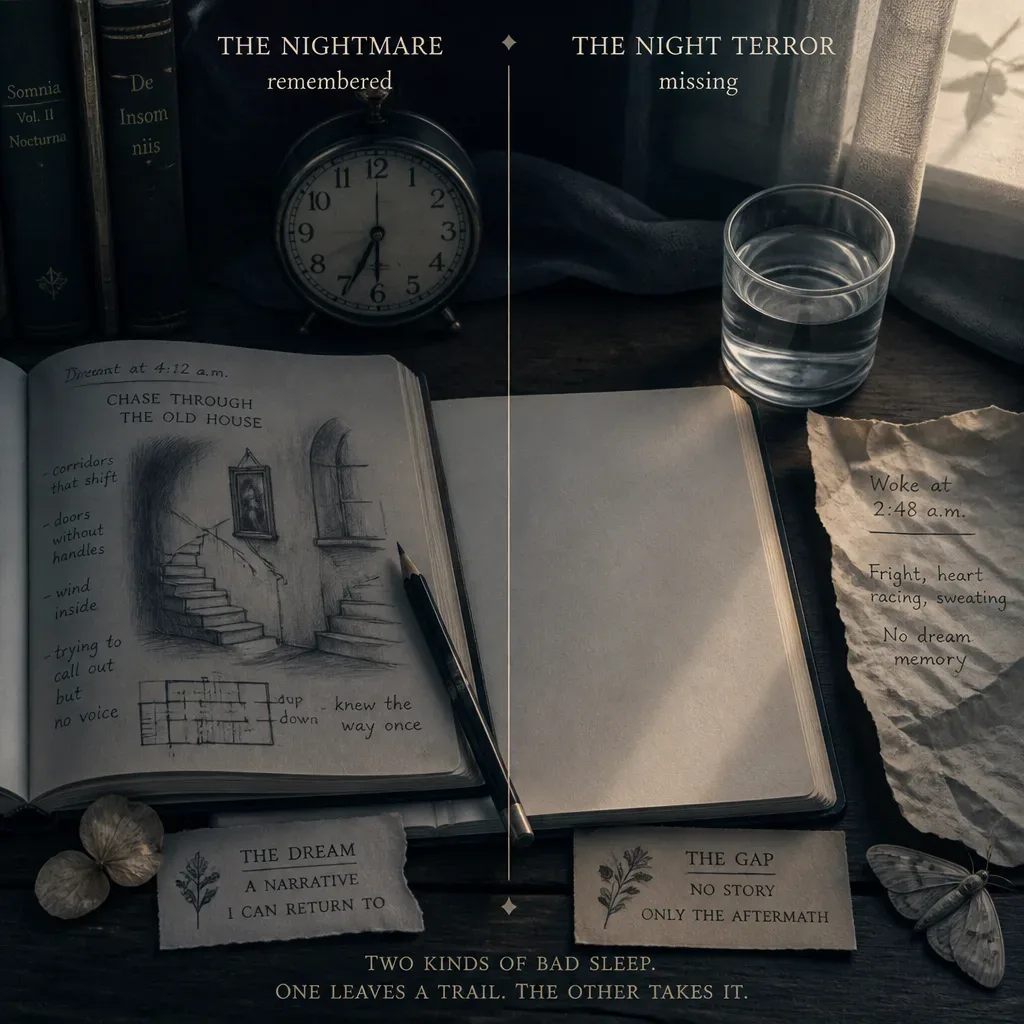
The simplest difference is this: a nightmare is a remembered story, while a night terror is usually a confused bodily alarm.
In a nightmare, you wake with images. There was a hallway, a dead phone, a person at the door, a car that would not stop. You may feel shaken, but you know you were dreaming within seconds or minutes. The American Academy of Sleep Medicine classifies nightmare disorder as a REM-related parasomnia, and REM periods lengthen toward morning in roughly 90-minute sleep cycles.
A night terror, or sleep terror, belongs to the non-REM parasomnia family. It tends to arise from slow-wave sleep, usually in the first third of the night. The person may scream, bolt upright, sweat, breathe fast, or seem unreachable. In the International Classification of Sleep Disorders, these events sit near confusional arousals and sleepwalking because consciousness is partial, not clear.
A nightmare is a remembered story; a night terror is a body caught in alarm before memory arrives.
Here is the plain comparison:
| Feature | Nightmares | Night terrors |
|---|---|---|
| Usual sleep stage | REM sleep | Deep non-REM sleep |
| Usual timing | Later night or early morning | First third of the night |
| Memory after waking | Often detailed | Little or none |
| Body response | Fear, racing heart, waking alert | Screaming, sweating, thrashing, confusion |
| Best immediate response | Reassure, write it down | Keep safe, speak softly, don’t force waking |
Population estimates vary. Reviews often place frequent adult nightmares around 2% to 8%, while sleep terrors are reported more often in children than adults, with some pediatric estimates near 1% to 6.5%. The numbers shift because families define frightening nights differently.
What is happening in the brain during each one?
Nightmares and night terrors differ because the sleeping brain is in different states when fear appears.
REM sleep is a strange and ordinary condition: the brain is active, the body is largely still, and emotion networks can be vivid. Studies using EEG and brain imaging have linked REM dreaming with strong limbic activity and reduced prefrontal control, which helps explain why dream logic feels convincing at 4 a.m. and odd at breakfast. REM usually takes about 20% to 25% of adult sleep, according to standard sleep medicine texts.
Night terrors begin in deep non-REM sleep, especially stage N3, when the brain is doing slow, synchronized work. The arousal is incomplete. Part of the nervous system wakes enough to sound an alarm, but the reflective mind does not fully come online. That is why a person can look awake and still not be reachable in the usual way.
This is also why the morning report differs. After a nightmare, a child may say, “There was a wolf under the bed.” After a night terror, they may say nothing at all, or they may be surprised to learn anything happened. Parents often remember more than the sleeper does.
A 2018 review in Sleep Medicine Reviews noted that non-REM parasomnias are often triggered by sleep fragmentation: fever, irregular sleep, noise, stress, alcohol, some medications, or untreated sleep apnea. The cause is not moral weakness. It is often a tired brain shifting badly between sleep stages.
If you want to compare these episodes with other boundary-state sleep events, our guide to sleep paralysis may help. Sleep paralysis is different again: the mind wakes before the body can move, usually near REM sleep.
Why do nightmares leave a story while night terrors often leave nothing?
Nightmares leave a story because REM dreaming is built for imagery, sequence, and emotional memory.
Dream researchers such as Calvin Hall, G. William Domhoff, and Tore Nielsen have spent decades showing that dreams often continue waking concerns. This is sometimes called the continuity hypothesis: the night does not invent from nothing; it rearranges the day, the decade, the ache. Nightmares tend to keep enough structure for recall because the sleeper wakes out of a dream-rich stage.
Night terrors, by contrast, are often remembered as a fragment if they are remembered at all. A flash of threat. A sense of something in the room. No plot. No ending. In clinical descriptions, amnesia for the event is common, which can make the witness feel more frightened than the sleeper the next day.
Memory depends on timing. REM sleep grows longer across the night, so a 5 a.m. nightmare is more likely to be caught and carried into morning. Deep non-REM sleep is heavier early, so a 10:30 p.m. night terror may vanish like a match in rain. The body burned bright. The mind did not write it down.
For symbolic reading, this matters. A nightmare can often be worked with as an image: teeth, water, a house, a stranger, a lost child. The Dream dictionary (A–Z hub) can give you language for those images, though no dictionary should outrank your own associations. A night terror asks a different question first: what is disturbing sleep itself?
How can you tell what happened when you wake up scared?
You can usually tell by asking what time it was, how alert you were, and whether there was a dream you could describe.
If you woke from a nightmare, you are often oriented quickly. You know your room. You may want a light on. You may remember a scene clearly enough to tell it or write it down. According to the Sleep Foundation’s summaries of clinical research, nightmares are more common during periods of stress and are especially common after trauma, though ordinary anxiety can also be enough.
If it was a night terror, someone else may be the main witness. They may say you shouted, stared past them, pushed them away, or seemed terrified without recognizing them. You may have no memory, or only a bodily aftertaste: sweat, sore throat, racing heart. Adults sometimes feel embarrassed when told. There is no need. Shame is a poor lamp for the bedroom.
Use this small checklist in the morning:
- What time did it happen: early night or near morning?
- Could I describe a plot, even a strange one?
- Was I fully awake within a minute or still confused?
- Did someone else see me sit up, scream, or move around?
- Was I sleep-deprived, feverish, drinking alcohol, or under unusual stress?
One number helps: adults often cycle through sleep stages every 90 to 110 minutes. Early cycles contain more deep non-REM sleep; later cycles contain more REM. Time is not proof, but it is a good clue.
You can also use our AI dream interpreter tool for remembered nightmares, especially if the image keeps returning. For night terrors with no dream content, the better record may be practical: bedtime, wake time, fever, medication, alcohol, noise, and stress level from 1 to 10.
What should you do during the episode itself?
During the episode, respond to the sleep state you are seeing rather than the fear you imagine.
For a nightmare, comfort is usually enough. Turn on a soft light. Name the room. Drink water. If it is a child, say the simple true thing: “You had a bad dream. You are safe in your bed.” Studies of imagery rehearsal therapy, including work summarized in the Journal of Clinical Sleep Medicine, show that recurring nightmares can sometimes improve when the dreamer rewrites the dream during the day and rehearses the new version for several minutes.
For a night terror, do less. Do not shake the person or demand that they explain. Make sure they cannot hit a wall, fall down stairs, or grab something sharp. Speak in a low voice. Wait. Most episodes last a few minutes, though they can feel much longer to the person watching.
Helpful responses include:
- Keep the path around the bed clear.
- Lock windows and outside doors if wandering happens.
- Avoid arguing with what the person seems to perceive.
- Note the time the event began and ended.
- Let the person return to sleep if they settle.
Scheduled awakenings can help some children with predictable sleep terrors. The usual method is waking the child gently 15 to 30 minutes before the typical episode time for several nights or weeks. This is a behavioral technique mentioned in pediatric sleep guidance, but it is best discussed with a clinician if events are frequent.
Talk to a doctor if episodes cause injury, happen often, begin suddenly in adulthood, involve dangerous behavior, include breathing pauses, or leave severe daytime sleepiness. That sentence is not meant to frighten you. It is simply the line where ordinary care should have company.
What do these dreams mean psychologically or symbolically?
Nightmares often carry psychological meaning, while night terrors more often point first to arousal, stress load, and sleep stability.
This does not make nightmares more important. It makes them more legible. A nightmare gives you characters and weather. It may show pursuit when you feel pressured, drowning when emotion is too much, a ruined house when identity or family life feels unstable. Jungian writers would call these symbolic forms; cognitive researchers might call them threat simulation, memory processing, or emotional continuity.
The Finnish researcher Antti Revonsuo proposed the threat simulation theory in 2000, arguing that dreaming may rehearse danger. Not every nightmare fits that theory neatly, but many do. During grief, for example, a dead person may appear sick, silent, alive again, or leaving again. In bereavement dream studies, including work by Joshua Black and colleagues, many mourners report dreams of the deceased, and a large portion describe them as emotionally significant.
Night terrors have folklore too. In older European traditions, terrifying sleep events were sometimes blamed on a night hag or pressing spirit. In parts of the world, sleep paralysis and night terrors were mixed together in household language. Folklore is a human attempt to give a face to fear. It is not medical evidence, but it is part of how families remember the night.
If you do remember images, compare them with our lucid dreaming pillar, especially the sections on reality testing and fear inside dreams. Lucidity is not a cure-all, but some nightmare sufferers learn to notice, “This is a dream,” and soften the scene.
The question is not, “What did the dream predict?” The better question is, “What did the dream faithfully exaggerate?”

How can you reduce the chances of either one returning?
You reduce both by protecting sleep, lowering stress before bed, and working gently with any dream that keeps repeating.
Start with sleep regularity. The Centers for Disease Control and Prevention reports that about 1 in 3 U.S. adults does not get enough sleep on a regular basis. Sleep deprivation deepens pressure for slow-wave sleep and can make arousals rougher; it also increases emotional reactivity, which can feed nightmares. Ordinary habits matter more than dramatic ones.
A practical plan looks like this:
- Keep wake time within the same 30 to 60 minutes most days.
- Reduce alcohol close to bed, since it fragments sleep later in the night.
- Treat fever, congestion, and pain when you can.
- Write recurring nightmare images in two or three plain sentences.
- If a nightmare repeats, change one element while awake and rehearse that version briefly.
- Ask for clinical help when safety, breathing, trauma, or daytime function is involved.
For remembered nightmares, writing is not decoration. It is a way of moving the image from the dark room into language. You might write: “I am running through the school. I cannot find the door. I wake before anyone catches me.” Then add one morning question: “Where do I feel unable to leave?”
If a recurring dream keeps pointing to the same fear or want, waking practice can meet it without waiting for sleep to speak first. The AYA Method is a daily audio manifestation practice. Each day you listen to a short personalized recording — your Dream-Self Moment — narrated from the version of you who has already manifested the life you intend. Listening is the practice. Repetition is the work. The audio is the method. The daily affirmation and Manifestation Board can support the practice, but the recording is the center.
For more pattern-tracking, our page on recurring dreams pairs well with a simple sleep log. Three columns are enough: date, what happened, what the day was carrying. After 14 days, patterns often become less mysterious.
Morning line: write what the night did, then write what your waking life can do gently today.