dream science
Why Dreams Feel Real: REM, Emotion, and Memory
Why dreams feel real comes down to REM sleep, emotion, memory, and reduced reality-testing. Here is the science without the superstition.
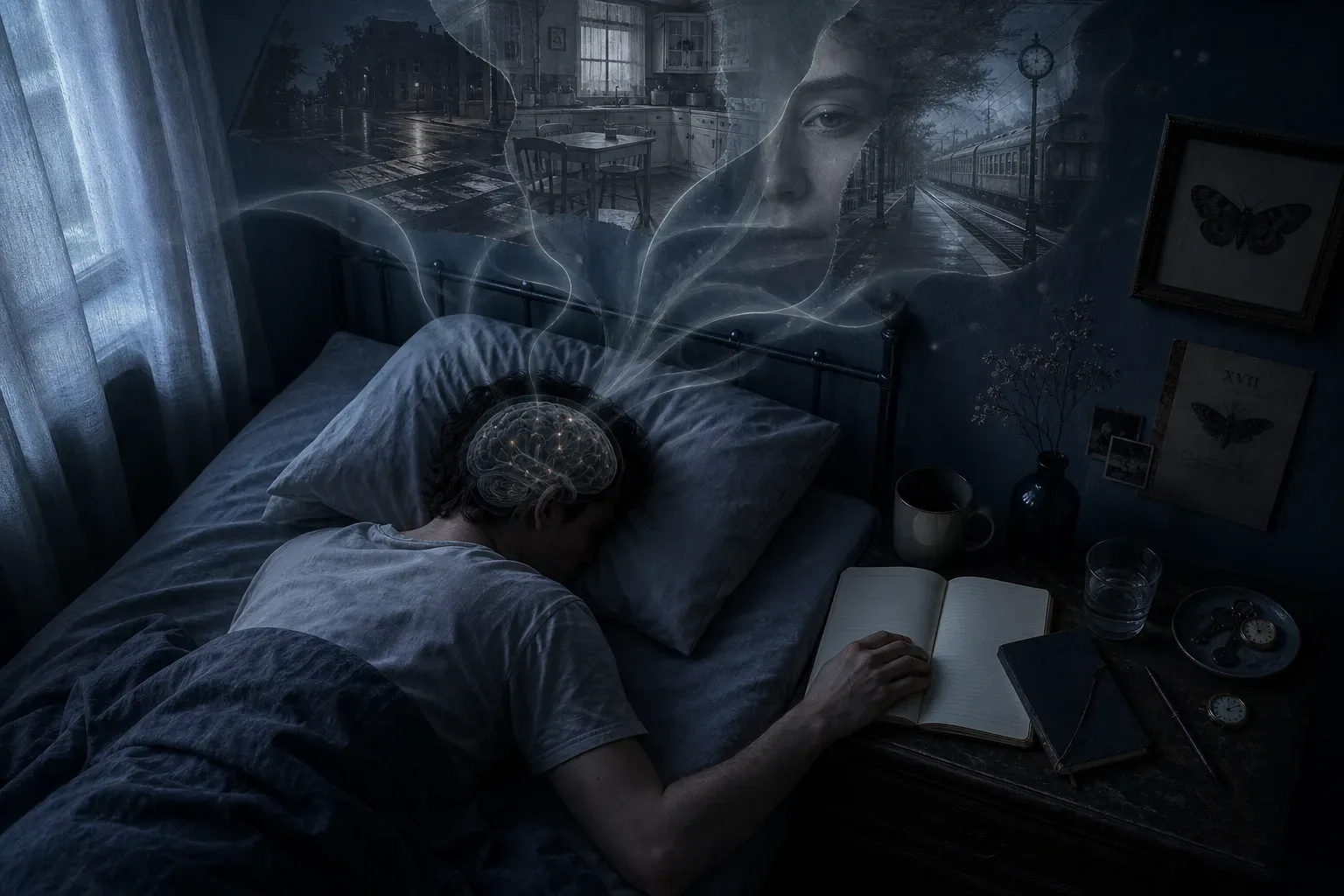
Dreams feel real because your brain is not switched off at night. In REM sleep, visual, emotional, and memory systems can be active while reality-checking is reduced. The scene may be impossible, but the feeling is built from ordinary brain processes: perception, emotion, memory, and a body that briefly believes the story.
Why do dreams feel real while you’re inside them?
Dreams feel real because the sleeping brain generates a convincing model before it asks whether the model makes sense.
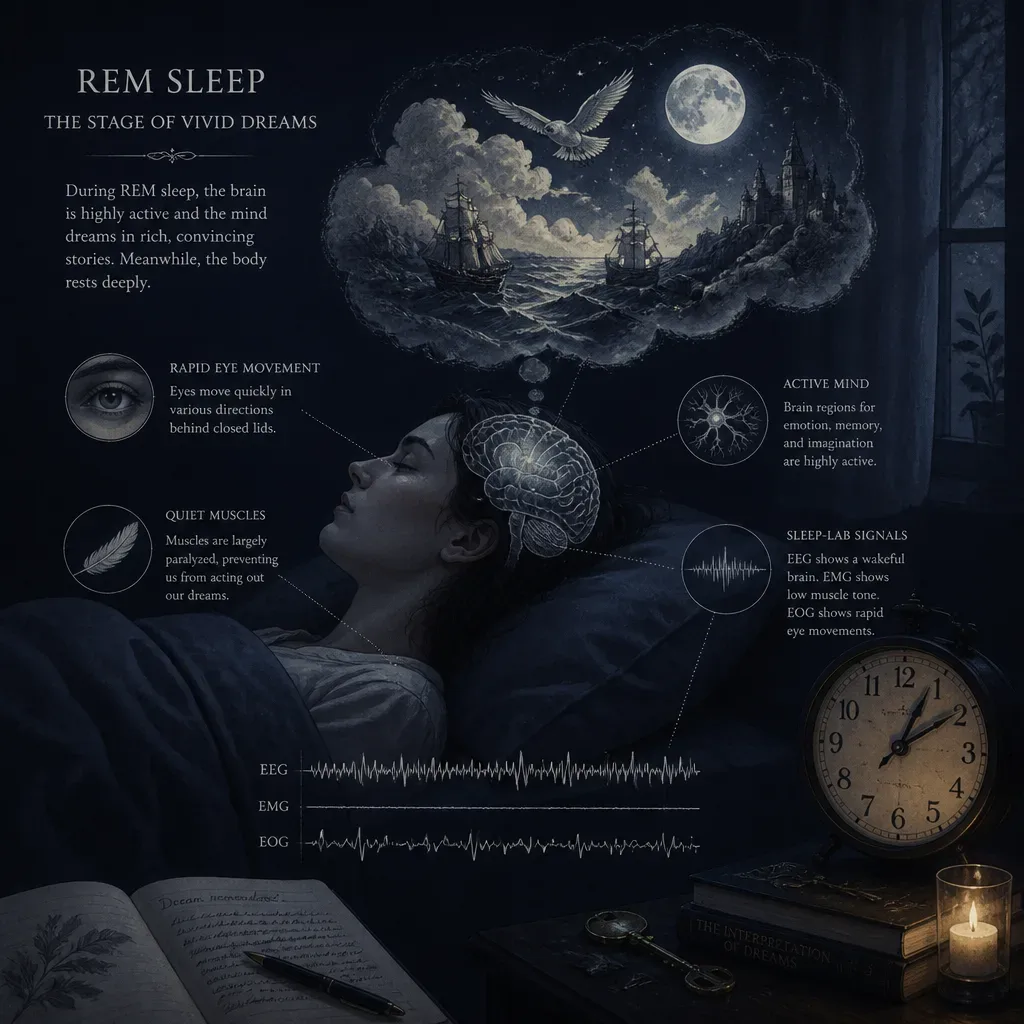
During REM sleep, the brain shows fast, wake-like electrical activity even though the body is largely still. In a classic 1953 paper, Eugene Aserinsky and Nathaniel Kleitman described rapid eye movements and linked them to vivid dream reports in sleeping subjects. Later sleep-lab work found that people awakened from REM often report dreams more frequently than people awakened from non-REM sleep, although non-REM dreams are real too. The exact percentages vary by study, but REM awakenings have often produced dream reports in about 70 to 90 percent of trials.
The realism comes partly from perception. Your visual cortex can build faces, rooms, roads, water, phones, and animals without light entering the eyes. The brain does something similar while awake: it doesn’t record the world like a camera; it predicts, corrects, and fills in. At night, with fewer outside signals, the inner model has less competition. A dream is not a movie projected at you. It’s more like a temporary world made by the same organ that makes waking life coherent.
Emotion also gives the dream weight. Neuroimaging studies, including work by Allan Hobson and later PET studies from the 1990s, suggest that limbic and paralimbic regions involved in emotion can be active in REM. Meanwhile, parts of the dorsolateral prefrontal cortex, associated with critical reasoning and working memory, tend to be less active. That’s one reason you can accept a dead relative at the breakfast table or a childhood school attached to your current apartment.
The dream feels real because the brain is using real materials, not because the event is real.
If you want symbol work after the science, the Dream dictionary (A–Z hub) is a calmer place to start than a prediction chart. First notice the mechanism. Then ask what the dream borrowed from your life.
What does REM sleep do to make a dream convincing?
REM sleep makes dreams convincing by combining vivid imagery, emotion, body stillness, and reduced outside input.
REM usually arrives in cycles across the night. A typical adult sleep cycle lasts about 90 minutes, though it can range from roughly 70 to 120 minutes. REM periods often lengthen toward morning, which is one reason the dream you remember at 6:40 a.m. may be elaborate. The National Institute of Neurological Disorders and Stroke notes that adults spend about 20 to 25 percent of sleep in REM. That is a large nightly window for the brain to rehearse, remix, and remember.
In REM, the body enters muscle atonia, a normal paralysis that keeps most people from acting out dreams. The system is not perfect; people may twitch, speak, or move slightly. But the broad pattern matters: the dream body can run, fall, fight, kiss, or hide while the physical body stays in bed. That separation lets the dream feel embodied without being fully enacted.
The brain’s sensory gates are also different. External sound and touch can enter dreams, but they don’t always correct the story. A car alarm may become a siren in a dream city. A tight blanket may become a trapped arm. One small laboratory study may show one version of this, another study another; the general finding is less controversial than the details. Sleep is responsive, but selectively so.
Here’s the plain difference:
| Feature | Waking perception | REM dreaming |
|---|---|---|
| Outside input | Strong and continuous | Reduced, filtered, sometimes woven in |
| Visual imagery | Anchored to eyes and environment | Built mostly from memory and prediction |
| Reality testing | Usually available | Often weakened |
| Emotion | Regulated by waking context | Can rise quickly and dominate |
| Body movement | Voluntary movement possible | Large muscles mostly inhibited |
A realistic dream is not a failure of sleep. It’s sleep doing work with unusually persuasive materials.
Why do emotions make dreams feel more real?
Emotion makes dreams feel real because the brain treats feeling as evidence, even when the plot is absurd.
Fear, longing, shame, grief, and relief are not decorative in dreams. They are often the center. Ernest Hartmann, a psychiatrist who studied nightmares and emotion, argued that dreams connect new emotional concerns with older memory networks. Some of his work relied on clinical interpretation and small samples, so it shouldn’t be treated as settled law. Still, the broad point fits modern memory science: emotion affects what the brain tags as important.
The amygdala and hippocampus are central here. The amygdala helps detect emotionally important events; the hippocampus helps bind memory details into episodes. Research in emotional memory, including work by James McGaugh and many later investigators, has shown that emotionally arousing events are often remembered better than neutral ones. That doesn’t mean they are remembered accurately in every detail. It means they are harder to ignore.
This is why a dream about missing a train may stay with you all day, while a more logical dream disappears in the shower. The train may be ordinary. The panic is the signal. In the AI dream interpreter tool, a useful first step is not naming the symbol. It is naming the feeling.
A few common emotional engines behind realistic dreams:
- Threat: being chased, trapped, watched, late, or unprepared.
- Attachment: seeing a former partner, a dead parent, a child, or an old friend.
- Status: failing a test, losing a job, being exposed, speaking without clothes.
- Desire: finding a room, receiving a message, being chosen, returning home.
- Grief: the person appears ordinary, and that ordinariness hurts most.
The brain does not need a believable plot when it has a believable feeling.
If the emotion is intense and the dream repeats, write down the feeling before the images fade. A single word, written within 5 minutes of waking, may preserve more than a long interpretation written at noon.
How does memory build a dream that feels like waking life?
Memory builds realistic dreams by recombining fragments of real places, people, habits, and unfinished concerns.
Dreams rarely invent from nothing. They borrow. A hallway from one apartment joins a school from 20 years ago. Your current boss speaks with your brother’s voice. A city you visited once becomes the place you somehow know how to navigate. This is not random in the lazy sense. It is associative. Memory works through links, and sleep appears to strengthen, weaken, and reorganize some of those links.
Sleep and memory consolidation are among the better-supported areas of sleep science. A 2006 review by Matthew Walker and Robert Stickgold described evidence that sleep helps stabilize and integrate memories. Later studies refined the picture: slow-wave sleep seems especially important for some declarative memories, while REM may contribute to emotional memory and creative association. The boundaries are not clean, and researchers still argue over the details. But the old idea that sleep is passive has not survived the data.
Dream realism often depends on what researchers call the continuity hypothesis: dreams reflect waking-life concerns. Calvin Hall’s mid-20th-century dream reports and later content analyses found that dreams commonly include familiar people, social interactions, and everyday concerns. A large dream series is not a prophecy file. It is closer to a night record of attention.
Try this in the morning:
- Write the strongest image in one sentence.
- Write the strongest feeling in one word.
- Name one memory the dream may have borrowed from the last 48 hours.
- Name one older memory it may have touched.
- Leave one line blank for what you don’t know.
That last line matters. Certainty is often the least honest part of dream interpretation.
For recurring symbols, the Dream dictionary (A–Z hub) can help you compare common meanings with your own history. The symbol means one thing in the research and another thing in your grandmother’s kitchen. Both are worth knowing.
Why do some dreams feel real after you wake up?
Some dreams stay real after waking because emotional arousal and memory traces can outlast sleep.
Waking is not a hard border. Many people come out of REM with the dream still close to the surface. Sleep inertia, the grogginess after waking, can last from a few minutes to longer than 30 minutes in some studies, especially after sleep loss or awakening from deep sleep. During that interval, your body may be awake while your interpretation system is still catching up.
Nightmares show this clearly. The American Academy of Sleep Medicine estimates that nightmare disorder affects about 2 to 8 percent of adults, though occasional nightmares are much more common. A bad dream can raise heart rate, tighten the chest, and leave the room feeling unsafe for a minute. That doesn’t mean the dream predicted danger. It means the nervous system responded to an internally generated threat.
Grief dreams are another example. A dead person appears. They are cooking, driving, sitting at the end of the bed, or saying nothing at all. The dream may feel more real than memory because it gives the bereaved mind new sensory material. There is no good scientific evidence that such dreams prove contact with the dead. There is, however, a long human tradition of treating them with tenderness. You don’t have to choose between biology and love.
A dream can be unreal as an event and honest as a feeling.
If dreams cause frequent distress, disrupt sleep, or come with acting out movements, talk to a doctor or sleep specialist in one plain step. Most vivid dreams are ordinary. Some deserve care.
For readers interested in the border between knowing and dreaming, the Lucid dreaming pillar explains what changes when you realize you’re dreaming from inside the dream.

Are vivid dreams more meaningful than vague dreams?
Vivid dreams are not automatically more meaningful, but they are often easier to remember and examine.
The mind gives priority to clarity, color, movement, and emotion. A dream with all four will feel important before you’ve interpreted a single symbol. But intensity is not proof. Caffeine, alcohol withdrawal, fever, stress, irregular sleep, pregnancy, some antidepressants, and other medications can all affect dream vividness. REM rebound, which can happen after REM has been suppressed by sleep loss or substances, may also make dreams feel unusually intense. The mechanism is ordinary even when the dream is strange.
Dream recall varies widely. Studies often find that women report remembering dreams more often than men on average, though social expectations and reporting habits may influence that gap. Age matters too; dream recall tends to decline across adulthood in some surveys. Keeping a dream journal can raise recall within days for many people, not because it changes the night, but because it trains the morning to notice.
Meaning should be handled with a light grip. A vague dream about a gray staircase may matter more than a cinematic dream about a burning house if the staircase is where your mind placed the real tension. Ask what the dream returned to. Ask what it refused to resolve. Use tools carefully: the AI dream interpreter tool can suggest patterns, but it doesn’t know your private history unless you tell it.
A useful distinction:
| Question | Better than asking |
|---|---|
| What did I feel? | Was this a sign? |
| What did the dream repeat? | What will happen next? |
| What memory did it borrow? | What does every symbol always mean? |
| What should I write down? | What should I fear? |
A vivid dream asks for attention, not obedience.
What should you do the morning after a dream that felt real?
The morning after a realistic dream, record the feeling, check the facts, and let the dream become information rather than instruction.
Start with the body. Look around the room. Name the date, the place, and one ordinary object: lamp, glass, book, sock. Grounding is not dramatic. It tells the waking brain that the dream has ended. In clinical settings, similar orientation techniques are used for anxiety and trauma symptoms, though a single vivid dream is not the same as a disorder.
Then write briefly. Dream researcher G. William Domhoff has argued from large dream collections that dream content often reflects personal concerns more than hidden codes. The morning note should respect that. Don’t write a verdict. Write evidence.
Use this 3-minute format:
- Scene: Where was I?
- Feeling: What emotion was strongest?
- Borrowed detail: What from the last 2 days appeared?
- Old echo: What older person, place, or worry did it touch?
- Next small act: Is there one waking thing to tend?
If the dream points toward a fear or wish that keeps returning, waking practice may help more than another hour of interpretation. This is where the AYA Method belongs, lightly: it is a daily audio manifestation practice. Each day you listen to a short personalized recording, your Dream-Self Moment, narrated from the version of you who has already manifested the life you intend. Listening is the practice. Repetition is the work. The audio is the method.
For broader symbol reading, use the Dream dictionary (A–Z hub). For the science of becoming aware inside a dream, read the Lucid dreaming pillar. But don’t let any page outrank the morning fact of your own life.
Write the one sentence the dream left behind, then make coffee.