dream symbolism
Wedding Dream Meaning: Commitment, Pressure, or Future Self?
Wedding dream meaning usually points to commitment, social pressure, identity change, or a decision your waking life is asking you to name.
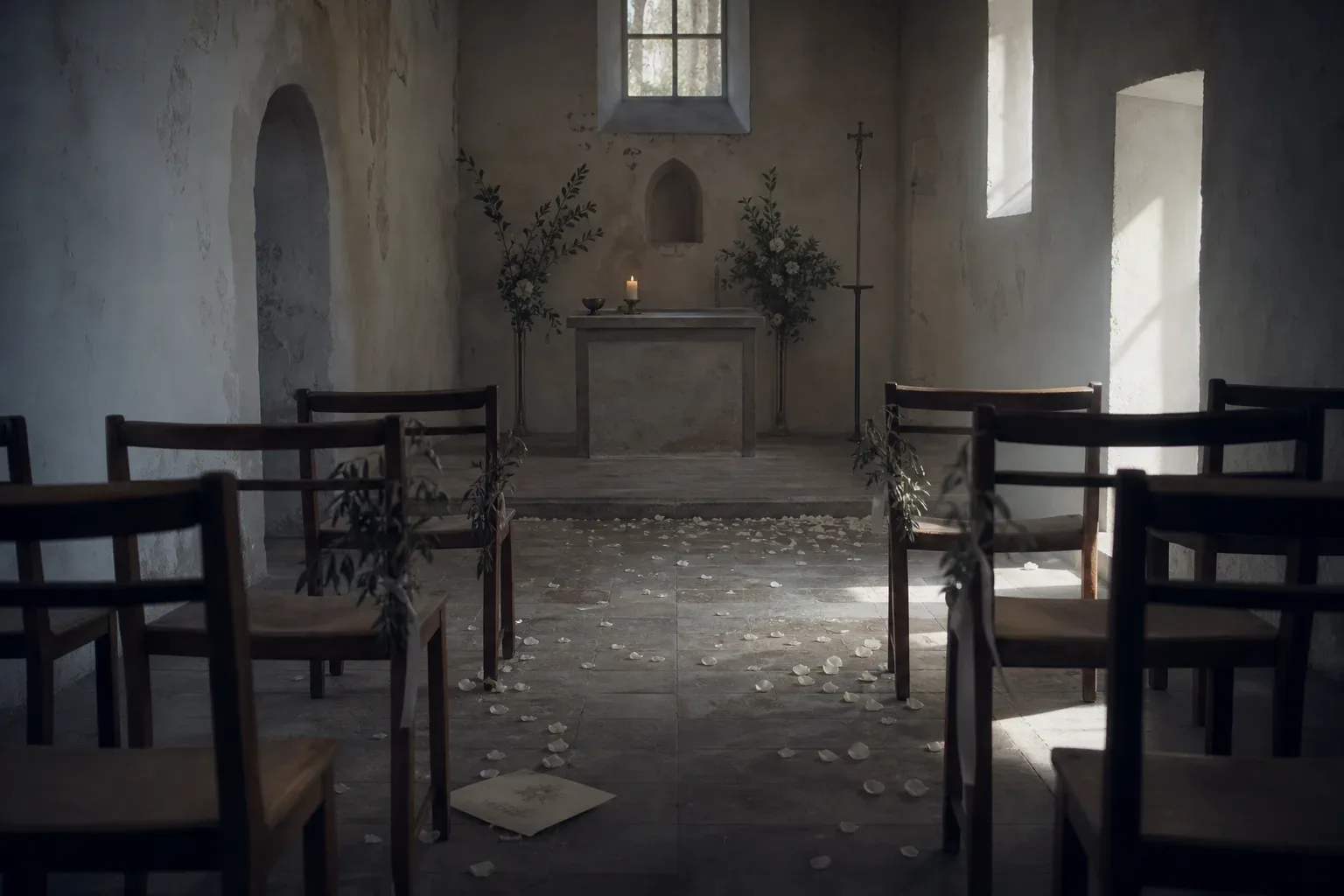
Wedding dream meaning usually centers on commitment: to a person, a promise, a role, a project, or a future version of yourself. If the dream felt warm, it may mark readiness. If it felt tense, it may show pressure, ambivalence, or fear of public expectations catching up with private uncertainty.
What does a wedding dream usually mean?
A wedding dream usually means your mind is staging commitment in a form everyone recognizes.
A wedding is not only romance. It is a ceremony, a witness, a threshold, and a promise made where other people can see it. That makes it useful dream material. Calvin Hall’s mid-20th-century dream-content work, later expanded through the Hall and Van de Castle coding system, treated dreams as continuous with waking concerns rather than random theater. In that frame, a wedding dream often borrows the ceremony to speak about a waking agreement.
The agreement may be obvious: an engagement, a partnership, a marriage under stress. It may also be indirect. A new job can feel like a wedding. So can parenthood, sobriety, caregiving, a lease, a move, or a decision to stop being available for an old role. Dreams tend to compress large emotional facts into ordinary images. A ring can stand in for a contract. A dress can stand in for visibility.
A wedding dream is rarely only about the wedding. It is about what part of you is being asked to say yes in public.
Research on dream continuity is modest but durable. Michael Schredl, a major dream researcher, has published repeated findings that waking-life concerns are often reflected in dream themes, though not as one-to-one translations. In one 2010 paper on dream content and waking life, the relationship was clearest when emotional intensity was high. That matters here because weddings are emotionally loaded even when no wedding is planned.
Use the mood as your first clue:
- Joyful wedding: readiness, integration, chosen commitment.
- Rushed wedding: pressure, deadlines, fear of being swept along.
- Wrong partner: conflict with a trait, role, or expectation.
- Empty wedding: loneliness, secrecy, or a commitment not yet witnessed.
- Interrupted wedding: uncertainty, resistance, or needed delay.
If you want to compare this symbol with others, the Dream dictionary (A–Z hub) is useful because wedding dreams often arrive with dresses, rings, churches, mothers, exes, and missing shoes.
Is the dream about love, pressure, or identity change?
The dream is about whichever feeling had the strongest claim on you when you woke.
Love dreams usually feel specific. You remember the face, the hand, the relief of being chosen. Pressure dreams feel procedural. You remember being late, underdressed, watched, corrected, or unable to find the room. Identity-change dreams feel stranger: you may marry someone unexpected, marry yourself, or discover that the ceremony has already happened.
A simple comparison helps:
| Dream detail | Likely waking question | Morning note to write |
|---|---|---|
| Happy ceremony | What am I ready to choose? | “I may be ready to commit to…” |
| Panic before vows | What feels too soon? | “The deadline I fear is…” |
| Wrong partner | What trait am I binding myself to? | “This person represents…” |
| Missing guests | Who is not witnessing my change? | “I wish this person knew…” |
| Wedding already over | What decision has quietly been made? | “I may have already chosen…” |
In sleep science, emotional memory is not a side issue. REM sleep, where vivid dreaming often occurs, appears to participate in emotional processing. Matthew Walker and Els van der Helm argued in a 2009 review that REM may help reduce the emotional charge of certain memories while preserving the memory itself. The phrase “sleep to remember, sleep to forget” is often attached to that model. It is debated, but the basic link between sleep, memory, and emotion is well supported.
That is why the wedding may not be literal. Your brain may be working on the feeling of irreversible choice. In waking life, irreversible choices are often wrapped in schedules, deposits, signatures, family opinions, and photographs. The sleeping mind strips away the spreadsheet and gives you an aisle.
The aisle is a line between identities: before I said yes, and after I was seen saying it.
Notice the pressure points. Was someone hurrying you? Was a parent choosing the flowers? Was the officiant waiting? Specific details matter more than generic dream-symbol lists. In G. William Domhoff’s work on dream content, characters and social interactions are central data, not decoration. Who stands near you in the dream may tell you which waking relationship has a vote in your inner court.
What if I dream of marrying the wrong person?
Marrying the wrong person in a dream usually means you feel bound to something that does not fully fit.
The wrong person may be an ex, a stranger, a coworker, a celebrity, a friend, or someone you actively dislike. This does not automatically reveal hidden desire. Dreams are associative. They use people as bundles of traits. Your ex may represent familiarity. A boss may represent evaluation. A stranger may represent a future you cannot yet picture. A celebrity may represent being watched.
Ask three questions before you panic:
- What is the first word I would use for this person?
- Where in my life do I feel married to that quality?
- Did the dream make me feel trapped, curious, relieved, or ashamed?
A 2012 review by Tore Nielsen and colleagues noted that nightmares and disturbing dreams often involve threat, social tension, or failed escape. Wedding anxiety dreams fit that pattern without needing to be nightmares in the clinical sense. If these dreams repeat often, harm your sleep, or arrive with waking panic, it is reasonable to talk with a doctor or licensed therapist. One plain rule: if sleep becomes a place you dread, get support.
There is also a common variation: you are already married in waking life, but the dream gives you a different spouse. This can feel disloyal in the morning. Usually, it is not a verdict on your marriage. It may be a symbolic pairing with a quality you need, fear, or resent. If the “wrong” spouse is calm and competent, perhaps you are marrying steadiness. If they are controlling, perhaps you are noticing how obligation has been speaking to you.
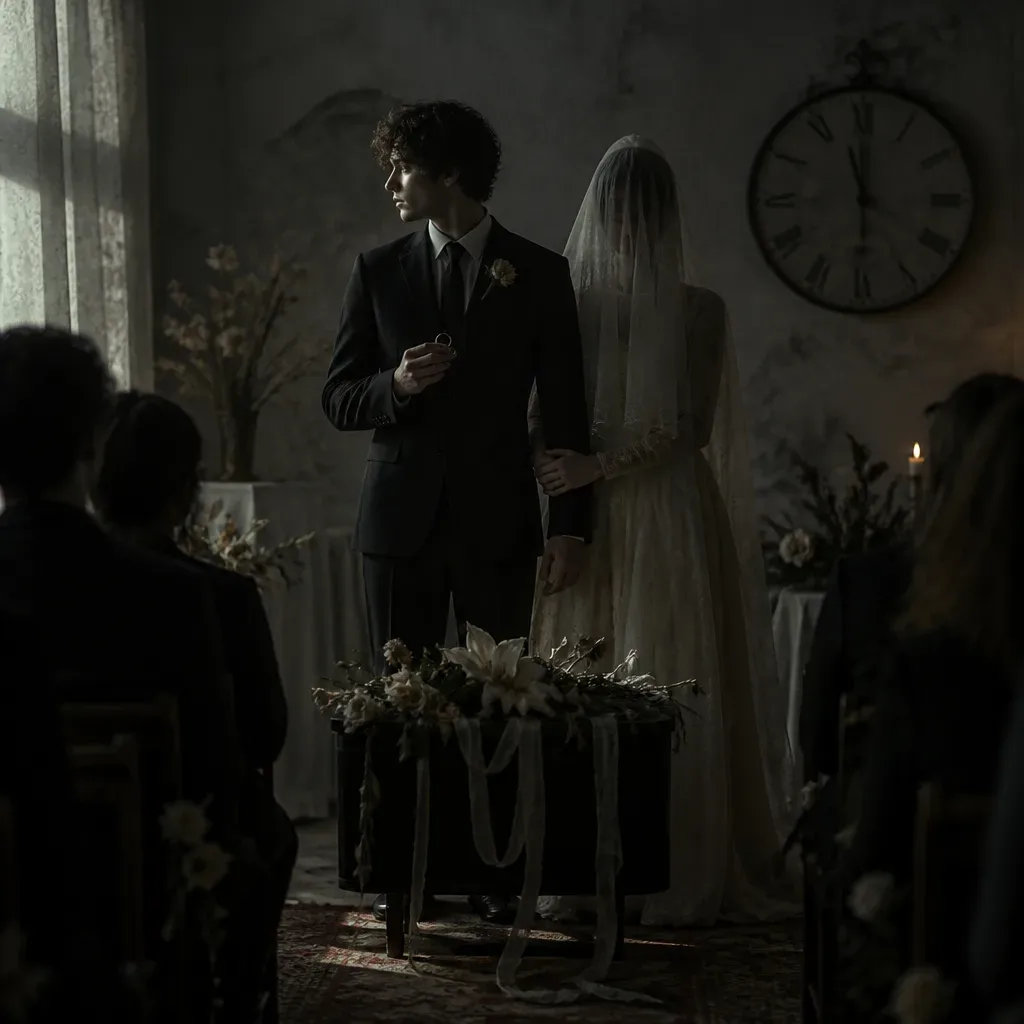
The same rule applies to single dreamers. A wedding dream may not be about wanting marriage. Pew Research Center reported in 2023 that marriage rates and attitudes toward marriage vary sharply by age, education, and culture in the United States. Your dream does not exist outside that social air. It may be testing what commitment means when the culture hands you one dominant costume for it.
A dream spouse can be a person, but just as often, it is a pattern wearing a face.
For symbols that appear beside the wrong partner, check related entries through the Dream dictionary (A–Z hub), then return to your own associations. The dictionary can name the room. Only you can say who was waiting there.
What do wedding disasters in dreams mean?
Wedding disasters in dreams usually point to fear of exposure, loss of control, or a commitment that feels underprepared.
The classic disaster list is familiar: you cannot find your dress, the venue is wrong, the guests are angry, the food is missing, the partner disappears, you are late, the vows are unreadable. These are performance dreams. Like exam dreams, they take a private fear and place it in public view. The stakes are not only “will I succeed?” but “who will see me fail?”
This matters because social evaluation is one of the most reliable human stressors. In the Trier Social Stress Test, developed in the 1990s, participants give a speech and do mental arithmetic in front of evaluators; it reliably raises cortisol in many subjects. A wedding disaster dream is not the same as a lab stress test, but the structure is similar: audience, judgment, time pressure, visible body.
Wedding disaster dreams often cluster around 4 themes:
- Preparation: missing clothes, lost rings, no vows.
- Consent: being pushed forward, unable to speak, wrong partner.
- Witness: absent family, hostile guests, strangers watching.
- Timing: late arrival, sudden ceremony, impossible schedule.
If you are planning an actual wedding, the dream may be ordinary rehearsal. Many people dream about upcoming tasks. Antti Revonsuo’s threat-simulation theory proposes that dreaming may rehearse dangers, though the theory is not settled fact. Under that lens, a ruined wedding dream is your brain rehearsing social and logistical threat: embarrassment, delay, disappointment, conflict.
If no wedding is planned, look for the visible promise in your waking life. Did you just announce a business, relationship, move, pregnancy, boundary, or creative work? The dream may be asking whether the public story has outrun the private readiness. That is not failure. It is information.
A useful morning sentence is: “The part that went wrong was…” Then finish it without interpreting. “The flowers were dead.” “My father would not sit down.” “I could not sign my name.” The symbol usually becomes clearer after the plain fact is on paper.
Are wedding dreams spiritual or cultural symbols?
Wedding dreams can carry spiritual meaning in folklore, but those readings are traditions, not proof of prediction.
Many cultures treat weddings as more than legal or romantic events. They mark family alliance, fertility, belonging, duty, blessing, and sometimes loss. Because of that, folklore around wedding dreams can be intense. In some traditions, dreaming of a wedding is read as good fortune or union. In others, especially where dream books have long circulated, it may be treated as a warning about illness, grief, or reversal. There is no good scientific evidence that wedding dreams predict these outcomes.
That said, folklore is not useless. It preserves what communities noticed and feared. A wedding is a threshold, and thresholds attract stories. Birth, death, marriage, and departure all ask the same human question: who will I be after this? Anthropologist Arnold van Gennep described rites of passage in 1909 as moving through separation, transition, and incorporation. A wedding dream often follows that old three-part rhythm even when the setting is modern.
Psychologically, Jungian readers might call the wedding a union of inner opposites: conscious and unconscious, masculine and feminine, duty and desire. That is a symbolic tradition, not a laboratory finding. It can still be useful if handled gently. The point is not to force the dream into a grand system. The point is to notice where two divided parts of your life may be asking to sit at the same table.
If you came here because a wedding dream had a lucid quality, you may also want the Lucid dreaming pillar. Lucidity changes the dreamer’s role: instead of only witnessing the ceremony, you may realize you can speak, pause, leave, or ask the dream figure a question. Studies of lucid dreaming are small compared with mainstream sleep research, but lab verification through eye-signal methods has existed since the 1980s.
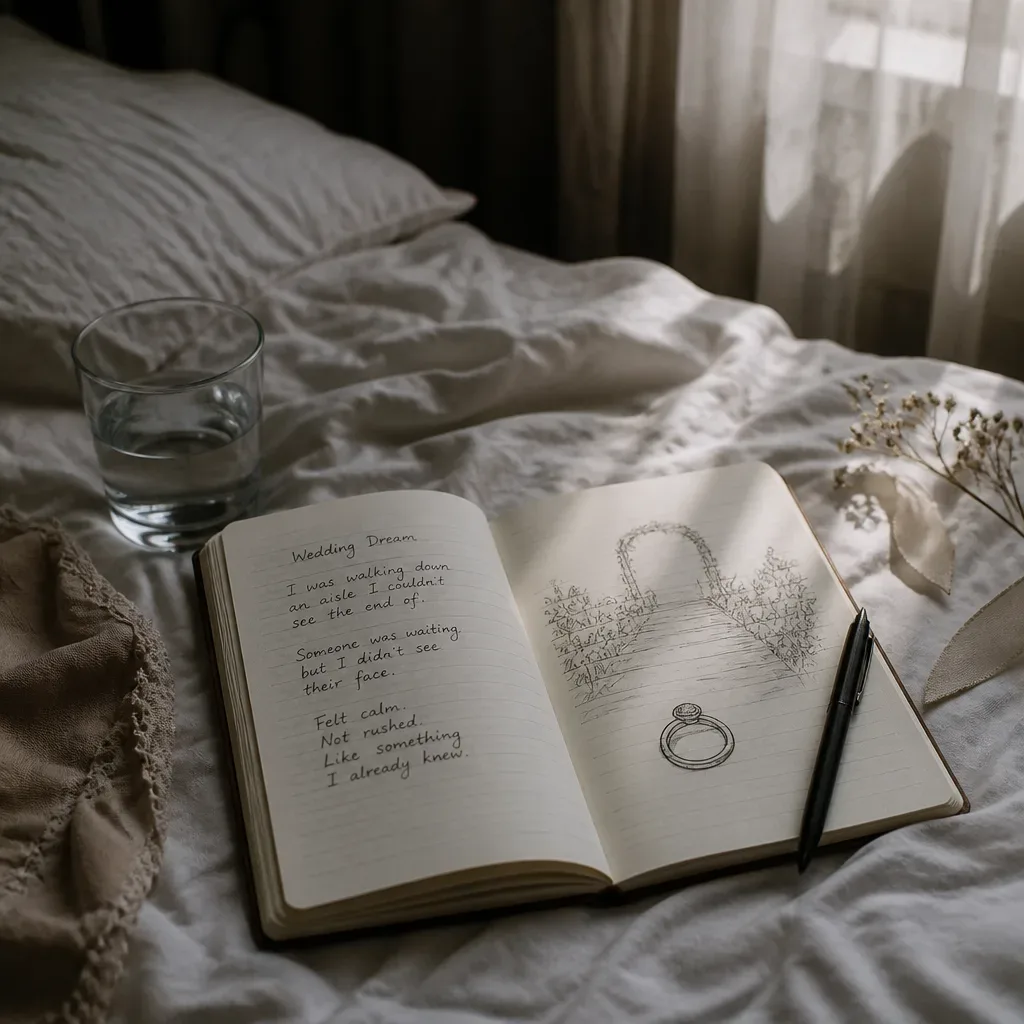
Keep the distinction clean. Spiritual language can help you honor the dream. Evidence helps you avoid handing the dream more authority than it has.
A dream can be meaningful without being a message from outside you.
What does a wedding dream say about my future self?
A wedding dream may show the future self you are beginning to rehearse, resist, or publicly claim.
“Future self” does not need to mean a mystical figure. In psychology, it often means your mental image of who you are becoming. Research by Hal Hershfield and colleagues has shown that people who feel more connected to their future selves tend to make more patient financial and health decisions. One 2011 study using age-progressed images found that seeing an older version of oneself increased retirement-saving behavior in experimental settings. The point is simple: the imagined self can influence present choice.
Wedding dreams fit this because weddings are identity rituals. After the ceremony, even if nothing physical changes in the room, language changes. Fiancé becomes spouse. Guest becomes family. Private affection becomes public bond. Your dream may be testing a similar sentence: “I am someone who…”
Try completing these lines:
- “I am becoming someone who says yes to…”
- “I am becoming someone who says no to…”
- “I am afraid others will expect me to…”
- “The vow I do not want to make is…”
- “The vow I already made quietly is…”
This is where a waking practice can meet the dream without crowding it. the AYA Method is a daily audio manifestation practice. Each day you listen to a short personalized recording, your Dream-Self Moment, narrated from the version of you who has already manifested the life you intend. Listening is the practice. Repetition is the work. The audio is the method.
For a wedding dream, that matters only if the dream has shown you a repeated question about identity. Night gives you the symbol. Morning gives you the chance to answer in your own voice. A daily affirmation or Manifestation Board can complement that, but the audio is the practice.
If you want another angle before writing, the AI dream interpreter tool can help sort the people, objects, and feelings into a first map. Use it as a notebook with a wider index, not as a judge.
What should I do the morning after a wedding dream?
Write the dream down, name the feeling, and ask what commitment is asking for your consent.
Dream recall fades quickly. Sleep researchers often use morning dream reports because even a short delay can change the content. You do not need a perfect transcript. You need the parts that still have heat. The face at the altar. The missing ring. The song. The person who refused to come. The feeling in your body when you woke.
Use this 5-minute method:
- Write the plain scene. “I was at a wedding in a school gym.”
- Name the strongest feeling. Choose one: joy, dread, shame, relief, grief, confusion.
- Identify the vow. Ask, “What was I being asked to agree to?”
- Find the witness. Ask, “Whose opinion mattered in the dream?”
- Write one honest line. “I am not ready to…” or “I think I already chose…”
Do not rush to a single meaning. Dream interpretation gets worse when it tries to be clever too early. A 2004 paper by Ernest Hartmann described dreams as making broad, emotionally guided connections, especially after stress or trauma. Whether or not every part of Hartmann’s model holds, the caution is good: dreams connect. They do not usually define.
If the wedding dream repeats, track it for 2 weeks. Put the date, mood, main person, and ending in a small table. Repetition is data. If the partner changes but the panic stays, the issue may be pressure. If the setting changes but the vow remains, the issue may be commitment. If the dream becomes calmer over time, your mind may be practicing consent.
One more internal check: search nearby symbols in the Dream dictionary (A–Z hub), especially rings, dresses, churches, mothers, exes, and being late. Symbols travel in families.
The morning question is quiet and exact: “What am I being asked to marry, and do I consent?”
Write that sentence before the day starts speaking over it.