dream symbolism
Money Dream Meaning: Security, Self-Worth, or Choice?
Money dream meaning often points to security, self-worth, or choice. Learn common variations, folklore, and what to write down at morning light.

Money dream meaning usually points to security, self-worth, or choice. The money may be literal, especially during financial stress, but it often stands in for time, attention, confidence, affection, or control. Notice what happened to the money and how you felt. The emotion is the first translation.
What is the most common money dream meaning?
The most common meaning is concern about what keeps you safe, valued, and able to choose.
Money is one of the most compact symbols the dreaming mind uses. A coin can mean rent. A wallet can mean identity. A bank account can mean adult competence. In the Hall and Van de Castle system of dream content analysis, developed from more than 1,000 dream reports in the mid-20th century, everyday social concerns appear far more often than rare mystical events. Dreams tend to borrow ordinary objects for ordinary pressures.
That does not make the dream small. If you woke at 7 a.m. with the sharp memory of losing a hundred-dollar bill, the nervous system may still be speaking in the body. The American Psychological Association’s 2023 Stress in America report found that about 63% of U.S. adults named money as a significant source of stress. It would be strange if the night never used money as a symbol.
A useful first split is this: was the dream about having money, needing money, hiding money, owing money, giving money, or being denied money? Each version carries a different charge. Having money may be relief, pride, temptation, or responsibility. Owing money may be guilt or obligation. Being denied money may be about worth, access, or rejection.
Money in dreams is rarely just money. It is the shape your nervous system gives to permission.
If you keep a dream record, place the money dream beside other symbols from the same week. The Dream dictionary (A-Z hub) can help you compare it with houses, teeth, bags, keys, and doors. A single dream is a sentence. A month of dreams is closer to a paragraph.
| Dream detail | Common psychological reading | Morning question |
|---|---|---|
| Finding money | Noticing a resource or chance | What did I not realize I had? |
| Losing money | Fear of loss or lowered confidence | What feels costly right now? |
| Stolen money | Boundary trouble or unfair exchange | Where do I feel taken from? |
| Counting money | Evaluation, control, comparison | What am I measuring too closely? |
| Giving money away | Care, guilt, generosity, obligation | Was the giving free or pressured? |
Does finding money in a dream mean good luck?
Finding money may feel lucky, but it more often means you are noticing a resource that was hidden from waking attention.
Folklore often reads found money as a sign of good fortune. That tradition is old and understandable. Coins appear in wells, graves, pockets, temple offerings, and children’s games across many cultures. But a dream is not a receipt from the future. It reflects. It does not foretell. The honest reading begins with the feeling: did you feel delighted, guilty, afraid someone would see, or calmly prepared?
In psychological terms, found money can represent a recovered capacity. You may have remembered that you know how to ask for help. You may have noticed a skill you have been underselling. You may have found an hour in the day. Calvin Hall’s continuity hypothesis, later developed by researchers such as G. William Domhoff, argues that dreams often continue waking concerns in altered form. The object changes, but the worry remains recognizable.
Specific amounts matter, but not as prophecy. A $1 coin differs from a suitcase of cash. A small coin may suggest a modest but real resource. A huge sum may point to fantasy, pressure, or fear of responsibility. In sleep research, people usually dream several times a night during REM-rich cycles of roughly 90 minutes, yet most details vanish by breakfast. The number you remember is worth writing down because memory selected it.
Ask three plain questions:
- Where did I find the money?
- Who, if anyone, was with me?
- Did I feel allowed to keep it?
A dream of finding money under your childhood bed is not the same as finding it in a stranger’s wallet. One points toward old resources or old shame. The other points toward ownership and ethics. The location is part of the symbol.
What does losing money, wasting it, or being robbed mean?
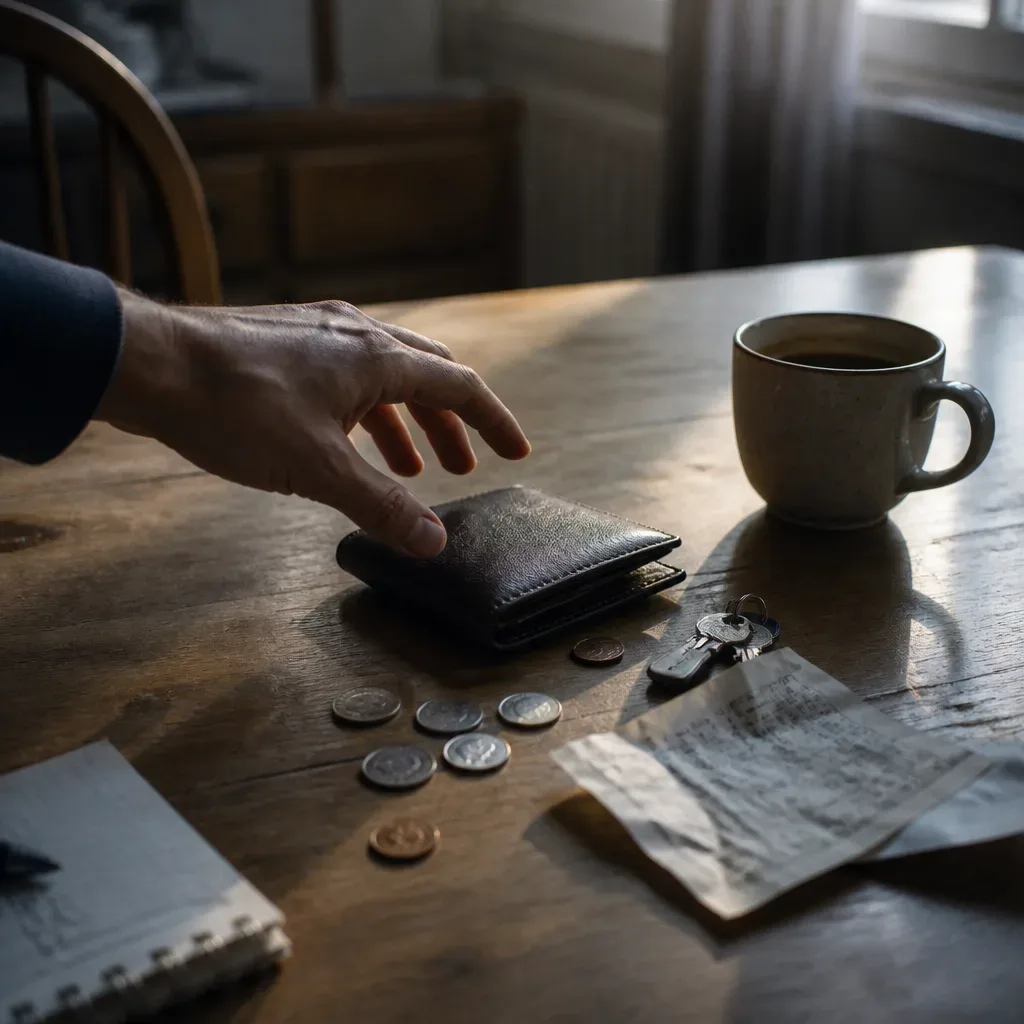
Losing money in a dream usually reflects fear that something valuable is slipping away.
The lost value may be financial. If you are behind on bills, waiting on a job offer, or trying to understand debt, the dream may be direct. The Federal Reserve’s 2023 report on household well-being found that 37% of adults would not cover a $400 emergency expense entirely with cash or its equivalent. That kind of pressure easily enters the night.
But dream money often stands for non-money value. You may feel you are wasting time. You may worry you spent too much attention on the wrong person. You may feel you have lost social standing, youth, beauty, health, patience, or nerve. Dreams are blunt accountants. They ask what went out and what came back.
Robbery dreams add a boundary. If someone steals your wallet, purse, phone, or bank card, the dream may be less about poverty and more about access. Someone has a way into you. Someone knows the password. Someone can spend what you earned. In waking life, that might mean a real practical concern, but it may also mean unpaid emotional labor or a relationship where credit is not shared.
Some common variations:
- Losing a wallet: identity, access, and proof of self are under pressure.
- Dropping coins: small leaks of time, care, or attention.
- Being overcharged: resentment about unfair exchange.
- A card declined: fear of public shame or not being accepted.
- Someone stealing cash: a boundary or trust issue.
Nightmares about theft can leave a hard residue. If money dreams become frequent, distressing, or tied to panic on waking, it is reasonable to talk with a clinician, especially if sleep is being interrupted often. The International Classification of Sleep Disorders distinguishes occasional nightmares from nightmare disorder partly by frequency and daytime impairment.
What does counting, hiding, or hoarding money suggest?
Counting or hiding money suggests that control, privacy, and self-measurement are central to the dream.
Counting is a careful gesture. In dreams, it can mean you are assessing what you have before a decision. It can also mean you are reducing your worth to a number. People do this in waking life with salaries, likes, grades, age, weight, savings, and productivity. The dream does not need to invent a new wound; it can simply put a stack of bills in your hands.
Research on dreaming often supports this ordinary continuity. Michael Schredl and colleagues have repeatedly found that waking concerns, especially emotionally charged ones, are reflected in dream content. The relationship is not one-to-one, but it is regular enough to matter. If you spent yesterday comparing yourself, the night may give you a ledger.
Hiding money carries a different question: from whom? If you hide cash from a parent, partner, boss, or stranger, the figure matters. Jungian tradition might call that figure a carrier of a complex, meaning a charged pattern of feeling and memory. You do not need to accept every Jungian term to use the observation. Dream characters are often less about the person and more about the role they play inside you.
Hoarding money can appear in people who feel unsafe even when life is stable. It can also appear when generosity has become performative and some part of you wants to keep something back. There is nothing shameful about that. A dream of guarding treasure may be the psyche saying: not everything in me is available for use.
Here is the clean distinction I use in my own notebooks:
| Action in the dream | If it felt calm | If it felt tense |
|---|---|---|
| Counting money | Planning, readiness | Comparison, fear of scarcity |
| Hiding money | Privacy, autonomy | Shame, secrecy, mistrust |
| Hoarding money | Self-protection | Fear that nothing will be enough |
| Giving money | Care, blessing | Obligation, guilt, depletion |
A dream about hoarding is not always greed. Sometimes it is the first honest boundary you have drawn in weeks.
What do cultural and spiritual traditions say about money dreams?
Cultural traditions often treat money dreams as signs of fortune, debt, blessing, or moral testing, but these are folklore readings rather than evidence.
In many households, a dream of coins is taken as lucky. In others, paper money is treated with suspicion, as if it can burn away or leave as quickly as it arrived. Some European folk traditions connect finding coins with small blessings. Some Chinese New Year customs treat money gifts as protection and good wishes, though a dream about money should not be confused with the waking ritual. In Islamic dream interpretation traditions, older manuals sometimes connect coins, charity, and speech, but interpretations vary widely by text and teacher.
The important word is tradition. There is no good scientific evidence that dreaming of money predicts income, inheritance, debt, or business success. A Pew Research Center survey from 2009 found that 41% of U.S. adults said they believed dreams can reveal hidden truths about the future or the self. Belief is common. Prediction is another matter.
Still, folklore has emotional intelligence. It preserves the fact that money is never only practical. It carries blessing, shame, obligation, status, family memory, survival, and fairness. Your grandmother’s kitchen may know something a lab cannot measure cleanly. The lab can tell us dreams continue waking concerns. The kitchen can tell us which concerns people have been carrying for generations.
If you use spiritual language, keep it honest. A money dream may be a call to gratitude, repair, generosity, or restraint. It may ask whether you are taking more than you give, or giving more than you can afford. But it is not a command to gamble, quit your job, or distrust someone without waking evidence.
The best cultural reading is specific. A coin from your childhood country, a banknote with a dead ruler, a church donation box, a red envelope, a dowry chest, a lottery ticket, and a paycheck all speak differently. Use the AI dream interpreter tool if you want a second pass, but keep your own associations in charge.
Is a money dream about self-worth or relationships?
A money dream is often about self-worth when the central feeling is shame, pride, comparison, or being judged.
The clue is social exposure. If your card is declined in front of a line of people, the dream may be about public worth. If a parent inspects your bank account, it may be about approval. If a partner controls the money, it may be about dependence, trust, or power. In a 2019 survey by the American Institute of CPAs, money was reported as a common source of relationship tension among couples, though exact rates vary by study and age group.
Dreams use money to stage fairness. Who pays? Who owes? Who gets to choose the restaurant? Who has the key to the safe? These are not only financial questions. They are questions about power. A person can have enough money and still dream of poverty if they feel unseen. A person can have little money and dream of generosity if they feel connected and capable.
Watch for salary dreams, tip dreams, and price-tag dreams. A dream in which your work is underpaid may name resentment you have politely swallowed. A dream in which you are tipped beautifully may show a wish to be recognized. A dream in which every object has an absurd price may suggest that life feels too expensive in time, nerve, or tenderness.
The price tag in a dream often belongs on a choice, not an object.
Relationships are also full of invisible currencies:
- attention
- forgiveness
- sex
- childcare
- emotional steadiness
- status
- silence
- loyalty
If you dream that you are always paying, ask where you are always smoothing things over. If you dream that someone else pays and you feel small, ask where receiving help has become tangled with shame. A useful companion page is our Lucid dreaming pillar, because lucidity often begins with noticing repeated dream signs. Money can be one of them.
Can money dreams become lucid dream signs?
Yes, repeated money dreams can become dream signs if you train yourself to notice their pattern while awake.
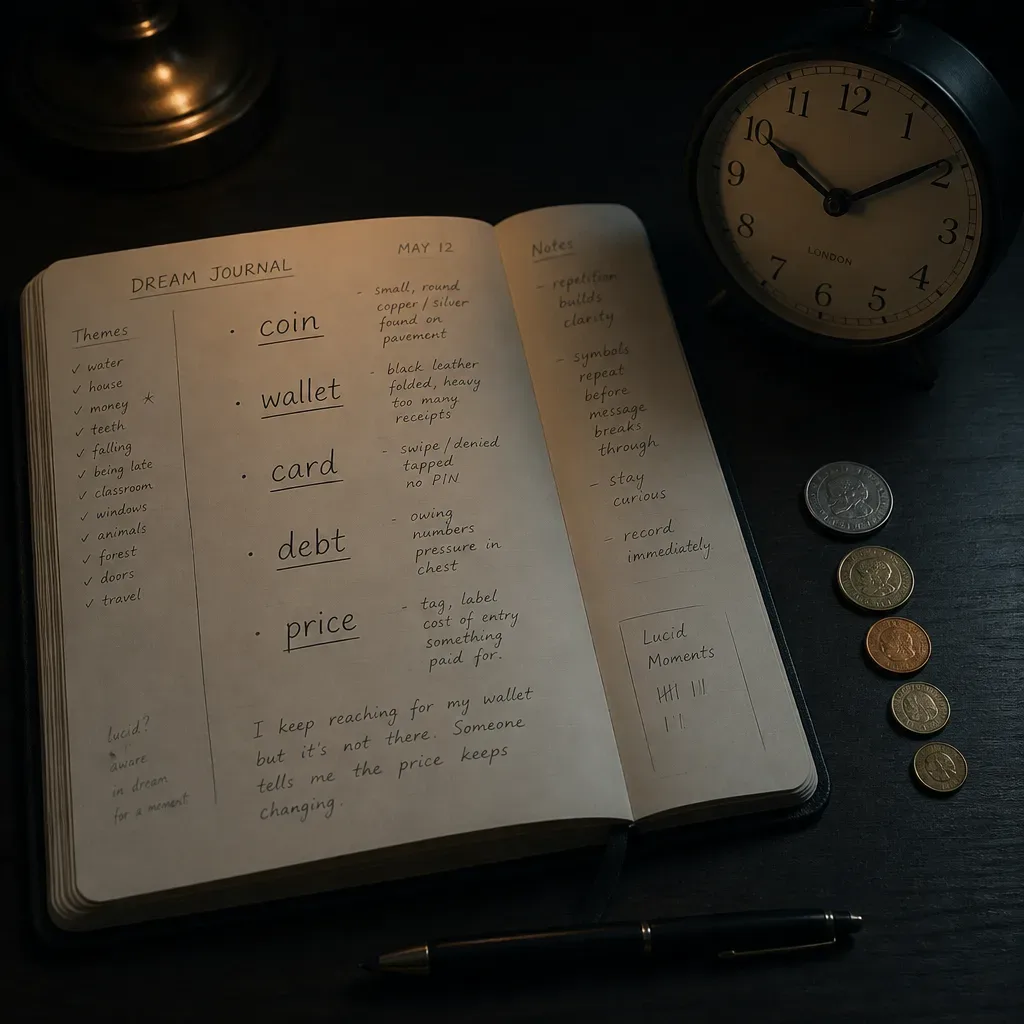
I teach beginners to look for repeat symbols before they chase dramatic techniques. If money appears in your dreams three or four times in a month, underline it in your journal. That is data. In my own practice, I use date, one-line summary, underlined dream signs, and lucidity in the margin. The format has not changed since 2006 because boring formats survive tired mornings.
A dream sign is simply a recurring clue that you may be dreaming. Some people see old schools. Some see dead relatives. Some lose teeth. Some find impossible money. Stephen LaBerge’s work at Stanford in the 1980s helped establish lucid dreaming as a measurable sleep phenomenon, using eye-signal verification during REM sleep. The romantic part is flying. The useful part is noticing.
Try this for two weeks:
- Each morning, write any money detail in one line.
- Underline the object: coin, wallet, card, safe, bill, salary, debt.
- During the day, when you handle money or open a banking app, ask: am I dreaming?
- Look twice at a number or text. In dreams, stable reading is often unreliable.
- Go back to sleep with one sentence: if money appears, I will notice.
Do not expect instant results. In small lucid dreaming studies, techniques that combine intention, waking after sleep, and reality testing tend to work better than intention alone, but success rates vary sharply. A 2017 study on Mnemonic Induction of Lucid Dreams reported higher success after brief awakenings and intention practice, yet not everyone became lucid.
If the recurring money dream points toward a waking desire as much as a fear, this is where the AYA Method can sit quietly beside dream work. The AYA Method is a daily audio manifestation practice. Each day you listen to a short personalized recording, your Dream-Self Moment, narrated from the version of you who has already manifested the life you intend. Listening is the practice. Repetition is the work. The audio is the method.
What should you write down after a money dream?
Write down the amount, action, feeling, and waking pressure before breakfast edits the dream into a story.
Most dream recall is fragile. Studies of dream reporting show that people who record dreams immediately remember more detail than those who wait, and any regular dream journal tends to increase recall over time. You do not need a beautiful notebook. You need a pen that works at 7 a.m. and a format short enough to use when you are annoyed.
Use this four-line note:
- Money object: cash, coin, card, check, debt, safe, price tag.
- Action: found, lost, counted, hid, gave, stole, owed, refused.
- Feeling: relief, shame, fear, pride, greed, generosity, confusion.
- Waking echo: the bill, choice, relationship, comparison, or deadline it resembles.
Then add one sentence: The money stood for _____. Do not try to be impressive. Write the ordinary answer first. If you cannot find one, use the Dream dictionary (A-Z hub) to compare nearby symbols, or bring the whole scene to the AI dream interpreter tool for a second reading.
A small warning belongs here. If the dream gives you financial instructions, treat them as dream material, not advice. Sleep can help with emotional processing and memory consolidation, but it does not audit your investments. Matthew Walker and other sleep researchers have written about REM sleep’s role in emotion and memory; that is not the same as market wisdom.
The morning after a dream, the question is not what will happen. The question is what already feels true.
Write the number down, then write what it seemed to cost.