dream symbolism
Driving Dream Meaning: Control or Autopilot?
Driving dream meaning usually points to control, direction, pressure, or autopilot habits. Learn what the driver, road, brakes, and crash suggest.
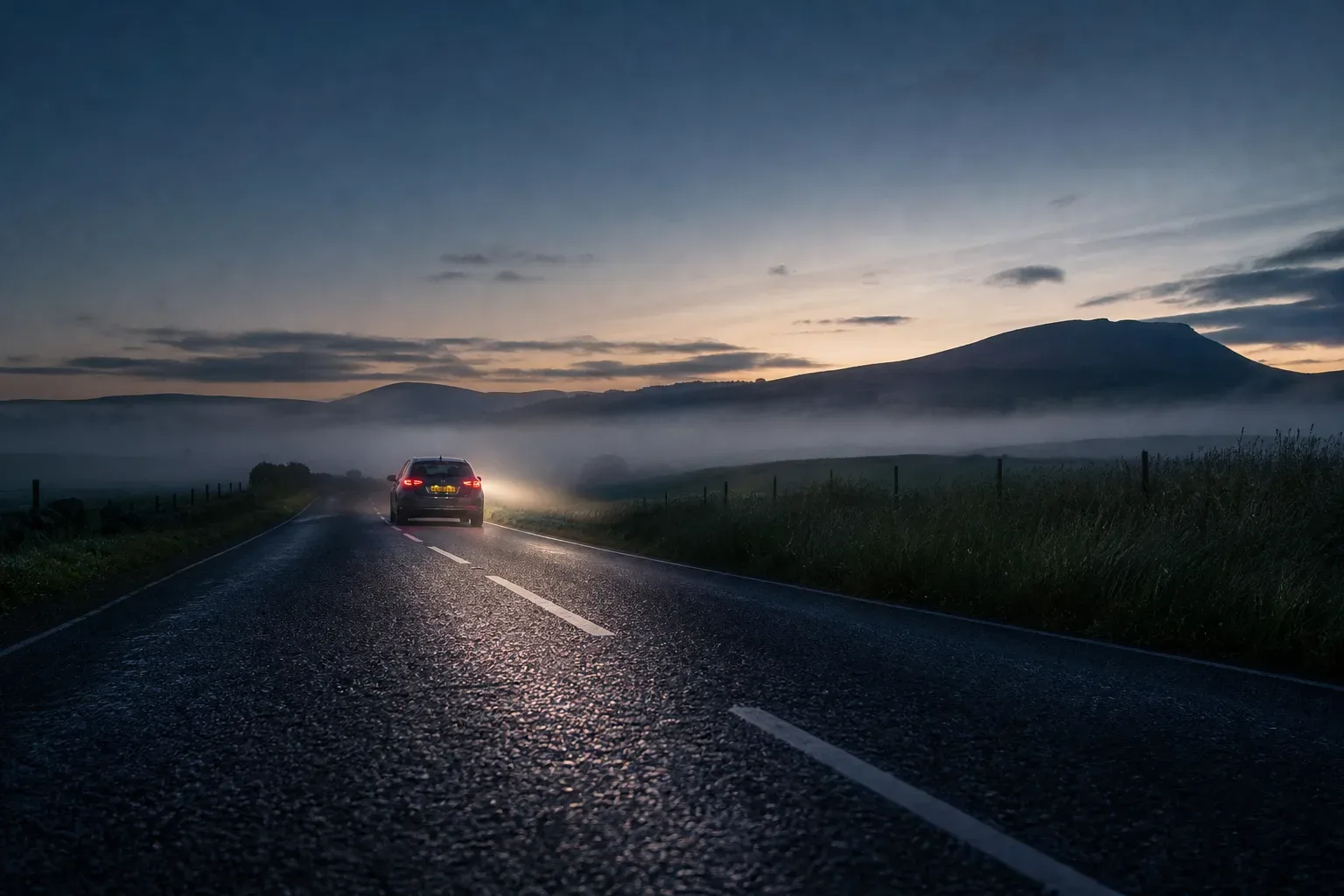
Driving dream meaning usually centers on control, direction, and momentum. If you were driving smoothly, the dream may reflect confidence. If the car sped up, lost brakes, crashed, or someone else drove, it often points to stress, uncertainty, or feeling carried by forces you haven’t fully chosen.
What does a driving dream usually mean?
A driving dream usually asks who is directing your life and whether the pace feels chosen or imposed.
The car is a common modern dream symbol because it belongs to ordinary life. In the United States alone, Federal Highway Administration data counted more than 228 million licensed drivers in 2022, so the image is close to the body for many people. You don’t need to believe the car has one fixed meaning. A car dream borrows the feeling of driving: attention, risk, speed, rules, destination, and the private space between where you are and where you’re going.
Psychologically, driving dreams often sit near agency. Calvin Hall’s dream-content work in the mid-20th century treated dreams as continuations of waking concerns, not as random theater. Later dream researchers such as G. William Domhoff argued that recurring dream themes often mirror persistent emotional patterns. So the first reading is simple: if you were steering, you may be examining your own choices. If the road chose for you, the dream may be naming pressure.
A useful first split looks like this:
| Dream detail | Common waking question |
|---|---|
| You drive calmly | Where do I feel competent right now? |
| The car won’t stop | What can’t I pause or refuse? |
| Someone else drives | Who has influence over my direction? |
| You can’t see the road | What information am I missing? |
| You crash | What feels like it may collide? |
Dreams reflect; they don’t foretell. A car crash in sleep is not a weather report for tomorrow morning. It is more often a body-level metaphor for tension, and the metaphor is worth treating with respect.
You can compare other symbols in the Dream dictionary (A–Z hub), but start with the car’s job in your dream. Was it carrying you, trapping you, protecting you, or disobeying you?
Does being the driver mean you’re in control?
Being the driver often suggests agency, but the quality of the driving matters more than the seat you’re in.
If you drove confidently, kept to the road, and knew where you were going, the dream may reflect a period of ordinary competence. That doesn’t mean everything is easy. It means some part of you recognizes, even at night, that you can respond. The National Safety Council has noted for years that driving requires constant scanning, decision-making, and motor control; dreams borrow that demand when waking life asks for similar attention.
If you were driving but panicked, the dream reads differently. You may technically be “in charge” of a job, family role, deadline, move, or relationship, yet feel undertrained for what the role requires. Many adults know this exact tension. The American Psychological Association’s 2023 Stress in America report found that money, health, and the future remained leading stressors for U.S. adults. A driving dream can turn that stress into hands gripping a wheel.
Notice the road conditions:
- A straight road can suggest clarity or repetition.
- A narrow road can suggest limited options.
- A mountain road can suggest risk, ambition, or fear of falling.
- Heavy traffic can suggest comparison, delay, or social pressure.
- Night driving can suggest moving without full information.
Control in a dream is rarely absolute. Even good drivers meet fog, detours, and other people’s mistakes. That is often the honest wisdom of the image: you may be responsible for your hands on the wheel, but not for every condition on the road.
A dream of control isn’t always congratulation. Sometimes it’s a question: are you steering, or just holding the wheel while old habits steer through you?
What if someone else is driving the car?
Someone else driving usually points to influence, trust, dependence, or a place where your choices feel delegated.
The identity of the driver matters. A parent driving can bring up early rules and inherited expectations. A partner may point to shared direction, conflict, or trust. A boss can suggest work pressure. A stranger driving may mean you don’t yet know what force is setting the pace. In Hall and Van de Castle’s classic dream coding system, characters and social interactions were central categories, because dreams are often relational even when the plot looks mechanical.
Ask whether you felt safe. If you relaxed in the passenger seat, the dream may show healthy trust. Not every passenger dream is a loss of power. Humans are social mammals; we rely on other people constantly. Pew Research Center reported in 2023 that many adults describe family relationships as a major source of meaning. Being carried by someone loving is not the same as being controlled by them.
But if you begged the driver to slow down, or they ignored you, the dream points toward a boundary. This is especially common in dreams that arrive during family conflict, workplace strain, or caregiving. The image is plain: your body knows the pace is wrong, but the person steering doesn’t listen.
Try this small inventory the morning after:
- Name the driver.
- Name your feeling in the passenger seat.
- Write one waking situation where that feeling appears.
- Ask what request you haven’t made clearly.
- Ask what decision you’ve handed away.
A passenger dream doesn’t accuse you of weakness. It simply shows where your direction may have become shared, borrowed, or quietly surrendered.
What does it mean when the brakes fail or the car speeds up?
Brake-failure dreams usually mean your waking life feels too fast, too committed, or hard to interrupt.
This is one of the clearest driving dream variations. The car moves, your foot presses down, and nothing responds. In waking life, brakes are the small mercy of stopping. In dreams, losing them can symbolize the loss of pause. Sleep researcher Rosalind Cartwright described dreams as part of emotional processing, especially after significant stress. A brake dream may be the mind’s blunt image for “I can’t slow this down.”
Look for acceleration in your week. Did you say yes too many times? Did one obligation become six? Did a conversation move faster than your honesty? The World Health Organization has estimated that anxiety disorders affected about 301 million people globally in 2019. Not every brake dream means anxiety, but speed and helplessness are familiar body states when anxiety is present.
There is also a habit reading. Sometimes the runaway car is not one big crisis. It is the small daily compulsion that keeps going: checking messages, spending, pleasing, scrolling, working late, rehearsing arguments. The dream gives the habit an engine.
If the brakes fail but you avoid a crash, pay attention. That detail suggests capacity. You were frightened, but you responded. You steered, downshifted, swerved, warned someone, or woke before impact. The dream may be less about doom than about the urgent need for a stopping practice.
The morning question is practical: what is one thing I can slow by 10 percent today? Ten percent is not heroic. It is often enough for the nervous system to notice.
Does a car crash dream predict danger?
A car crash dream doesn’t predict danger; it usually dramatizes conflict, fear of consequences, or a collision between needs.
People ask this one quietly because the dream can feel so physical. Your body may wake with a racing heart, tight jaw, or the echo of impact. That doesn’t make it a warning. REM sleep involves vivid imagery and strong emotion while most voluntary muscles are inhibited; sleep scientists have described this REM atonia for decades. The body can feel alarm without receiving a message from the future.
Nightmare research gives a steadier frame. A 2018 review in Sleep Medicine Reviews noted that nightmares are associated with stress, trauma exposure, and sleep disruption, though causes vary widely. Ernest Hartmann’s work on nightmares also emphasized emotion and central images. A crash is a central image: sudden consequence, no more pretending, things meeting at force.
Ask what collided in the dream. Was it your car and another car? You and a wall? A bridge? Water? Each changes the reading. Another car may suggest conflict with another person. A wall suggests limits. Water suggests emotion. A bridge suggests transition. You can look up related images in the Dream dictionary (A–Z hub), but keep the dream’s feeling first.
If you often have violent nightmares, or dreams leave you afraid to sleep, talk to a clinician or sleep specialist. That sentence isn’t meant to frighten you. It is ordinary care, like getting a persistent cough checked.
Most crash dreams ask for a course correction, not panic. They say, softly but firmly, that something can’t keep meeting something else at this speed.
What if you’re driving from the back seat, without headlights, or on autopilot?
Unusual driving positions usually point to divided attention, missing information, or habits acting before conscious choice.
Driving from the back seat is a strange dream image, and it tends to be memorable because it is almost possible and completely wrong. You can see the wheel, but your body is misplaced. This often appears when you are responsible for an outcome without enough authority to shape it. Organizational psychologists have long described role strain as stress that comes from conflicting demands; the dream turns that into a bad seating arrangement.
No headlights, fog, or an invisible road suggest limited information. The dream may not be saying you’re making a bad choice. It may be saying you can’t see enough yet. That distinction matters. A 2022 American Psychological Association survey found that uncertainty about the future was a significant source of stress for many adults. Night driving is uncertainty with a steering wheel.
Autopilot dreams are subtler. You may be in the car, but not really driving. The route repeats itself. You arrive without remembering the road. Cognitive scientists have studied automaticity for decades; repeated behaviors require less conscious attention over time. That is useful when brushing teeth. It is more troubling when a whole life starts to feel like a memorized commute.
Here is a plain comparison:
| Variation | Possible meaning | Morning check |
|---|---|---|
| Back-seat driving | Responsibility without authority | Where am I accountable but unheard? |
| No headlights | Missing information | What do I need to know before deciding? |
| Autopilot route | Habit or emotional numbness | What did I do this week without choosing it? |
| Wrong pedals | Confused response | Am I pushing harder when I need to stop? |
If the dream has a lucid quality, where you notice you’re dreaming while still inside it, you may find the Lucid dreaming pillar useful. Lucidity doesn’t make every dream controllable, but it can help you observe the symbol without being swallowed by it.
How do culture and spirituality read driving dreams?
Cultural and spiritual readings often treat driving dreams as symbols of life direction, but these are traditions rather than proof.
Because cars are recent in human history, older folklore doesn’t speak about them directly. It speaks about horses, carts, boats, roads, and crossroads. Modern dream books often translate those older travel symbols into cars. That can be useful, if we label it honestly. Folklore is a library of human comparison, not a laboratory.
In some Christian dream interpretations, driving may be read as stewardship, calling, or discipline. In some New Age-adjacent readings, a vehicle may represent the self moving through a life path. In Jung-adjacent language, the car can be treated as an ego vehicle: the way conscious identity moves through the world. Carl Jung wrote often about symbols as living images shaped by personal and collective material, though he didn’t give cars a single fixed definition.
The important caution is prediction. A red car doesn’t automatically mean anger. A black car doesn’t automatically mean death. A broken car doesn’t mean your life is broken. The color, driver, road, and emotion work together. Dreams are better read like poems than traffic signs.
Still, spiritual readings can hold one quiet truth: direction matters. If a dream leaves you asking where you’re going, don’t dismiss that. Write the question down. You don’t have to answer it before breakfast.
For a second pass, you can enter the remembered details into the AI dream interpreter tool. Use it as a mirror, not a judge. The best interpretation is the one that makes you more honest, not more afraid.
What should you do the morning after a driving dream?
The morning after a driving dream, write the concrete details first, then ask where control, pace, or direction showed up in waking life.
Do this before the day edits the dream. Dream recall fades quickly for many people; sleep researchers often ask participants to report dreams immediately because memory changes within minutes. Keep the notes ordinary. You don’t need a ceremonial notebook. A phone note at 7:04 a.m. is enough.
Use this five-line format:
- I was the driver / passenger / observer.
- The road was ____.
- The car did ____.
- I felt ____.
- In waking life, this reminds me of ____.
Then choose one action. Not a personality overhaul. One action. If the brakes failed, cancel or delay one nonessential thing. If someone else drove, make one clear request. If you were lost, gather one missing fact. If you crashed, identify one conflict you’ve been letting speed up.
Recurring driving dreams deserve special attention because repetition is the psyche’s highlighter. Domhoff’s continuity hypothesis suggests that dreams often reflect ongoing waking concerns; when the same image returns, the concern may be unresolved or simply important. If a dream repeats for weeks, track dates, stressors, and sleep conditions. Caffeine, alcohol, irregular sleep, and night shifts can all change dream intensity.
This is also where waking practice belongs, but lightly. The AYA Method is a daily audio manifestation practice: each day you listen to a short personalized recording, your Dream-Self Moment, narrated from the version of you who has already manifested the life you intend. Listening is the practice. Repetition is the work. The audio is the method. For a driving dream, it can serve as a daytime counterpoint: instead of waiting for the night to show your direction, you rehearse the voice of the self who can choose it.
The line to write down is this: where am I steering, and where am I only being carried?
Drive slowly through the answer.