dream symbolism
Teeth Falling Out Dream: What Your Mind May Release
A teeth falling out dream often points to stress, change, or fear of losing control. Learn the psychological, cultural, and morning-after meanings.
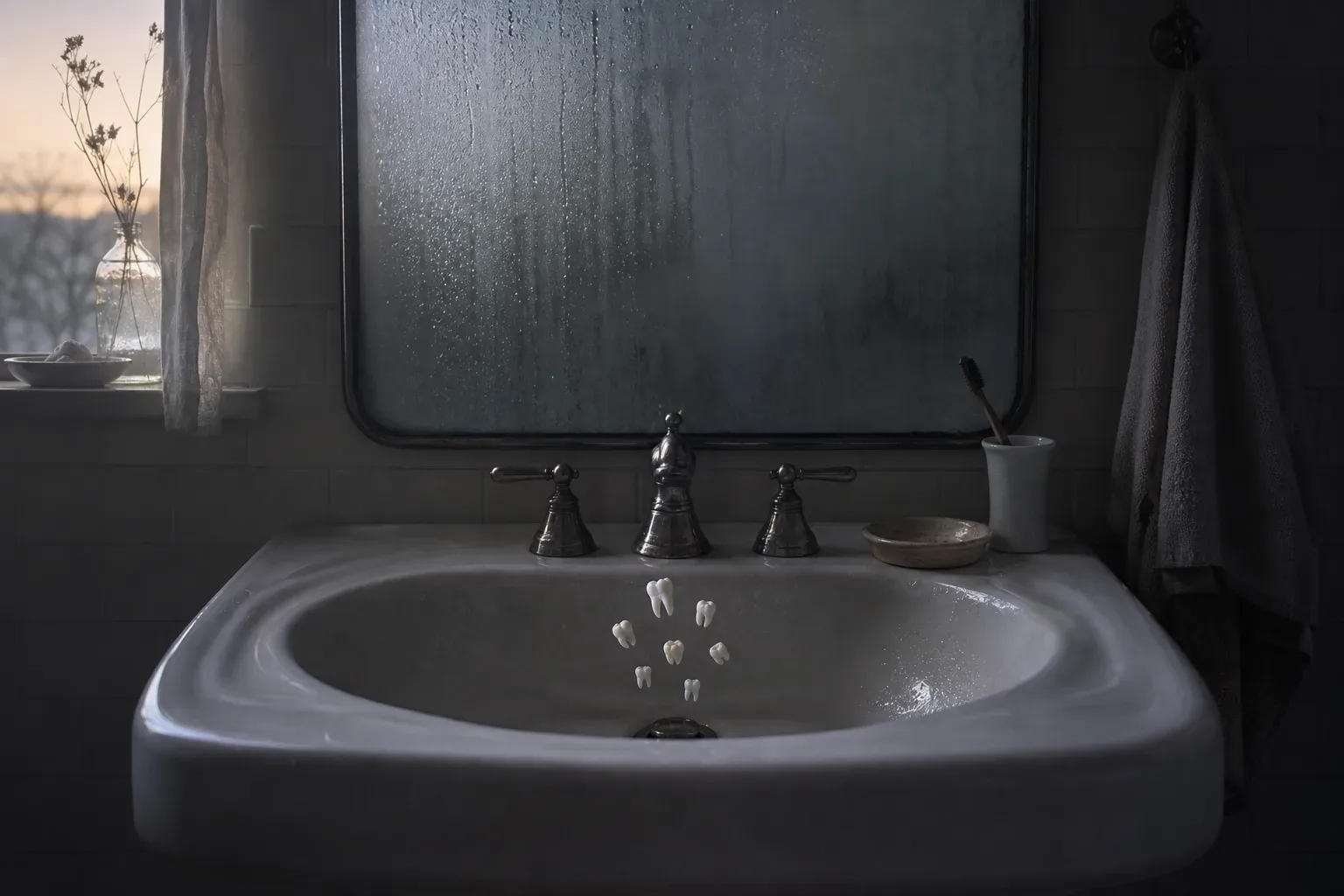
A teeth falling out dream usually means your mind is working through stress, loss of control, aging, appearance, or something you’re afraid to say. It isn’t a reliable prediction. The dream tends to ask one plain question: what in waking life feels loose, exposed, or no longer held in place?
What does a teeth falling out dream mean psychologically?
Psychologically, a teeth falling out dream most often points to anxiety about control, self-image, speech, or change.
This is one of the most reported dream themes across ordinary dream collections. In a widely cited 2018 paper in Frontiers in Psychology, researchers Rozen and Soffer-Dudek studied tooth dreams and found they were linked with dental irritation on waking, more than with general psychological distress alone. That is useful because it keeps the interpretation honest. Sometimes a tooth dream begins in the body. Sometimes it begins in the day.
The symbol still matters. Teeth are how we bite, speak, smile, grind, and hold a public face. When they loosen in a dream, the image can carry several meanings at once. You may be worried about saying the wrong thing. You may be aging into a role you didn’t ask for. You may be trying to keep an ordinary life looking intact while one private structure gives way.
A dream tooth is rarely just a tooth; it is a small white emblem of what you rely on without noticing.
Clinical dream traditions, including Jung-adjacent work, often read teeth as part of the persona: the social face, the smile, the polished surface. Freud wrote about tooth dreams too, but his sexual readings are not the only useful lens, and modern dream work tends to be more cautious. The honest question is not “What does this always mean?” It is “Where did I feel that same helplessness yesterday?”
If you want to compare this dream with other common symbols, the Dream dictionary (A–Z hub) is a good place to keep your associations grounded rather than dramatic. A symbol becomes clearer when you notice what it repeats beside.
Could the dream be caused by jaw tension or teeth grinding?
Yes, tooth dreams may sometimes be fed by jaw tension, dental irritation, or sleep bruxism.
The 2018 Frontiers in Psychology study is worth naming again because it complicates the usual anxiety-only reading. Participants who reported tooth dreams also reported more dental tension upon waking. That doesn’t prove grinding caused the dream, but it suggests a real pathway from body sensation into dream imagery. The sleeping brain often makes a story out of a sensation. A full bladder becomes a search for a bathroom. A cold room becomes snow. A tense jaw becomes a mouth full of broken teeth.
Sleep bruxism is not rare. Reviews in dental sleep medicine often estimate adult sleep bruxism around 8% to 13%, though numbers vary by method and age group. Many people don’t know they grind until a dentist notices wear, a partner hears it, or the person wakes with jaw soreness. If your teeth dream comes with facial pain, headaches, chipped enamel, or a clicking jaw, it’s reasonable to mention it to a dentist.
Here is a simple way to separate body clues from symbolic clues:
| Morning clue | More likely body-related | More likely stress-related |
|---|---|---|
| Jaw soreness | Yes | Maybe |
| Same dream after dental work | Yes | Maybe |
| Dream after conflict | Maybe | Yes |
| Shame about being seen | Maybe | Yes |
| Repeats during deadlines | Maybe | Yes |
No table can settle a dream. But it can keep you from floating too far from the ordinary facts. Dreams are symbolic, and they are embodied. The mouth belongs to both worlds.
Why do teeth dreams often appear during change or stress?
Teeth dreams often appear during change because teeth symbolize structures that are meant to stay fixed.
A tooth is not supposed to move. That is why the dream is so efficient. One loose tooth can say what a diary entry might need 600 words to say: something dependable no longer feels dependable. This can happen during a breakup, a job change, a move, a pregnancy, a graduation, a health scare, or the first month after becoming responsible for someone else.
Dream research has long shown that waking concerns enter dreams. The “continuity hypothesis,” discussed by researchers such as Michael Schredl and Calvin Hall, proposes that dreams often continue waking emotions, conflicts, and interests rather than inventing them from nowhere. In large dream-content studies, anxiety is one of the most common dream emotions; Hall and Van de Castle’s classic coding system helped make that visible in thousands of reports.
The teeth image is especially common because it combines three fears:
- Loss of control: the body is doing something you can’t stop.
- Exposure: other people may see the gap, blood, or brokenness.
- Irreversibility: once a tooth falls out, the dreamer often feels there is no repair.
The nightmare begins where control ends.
That sentence is not a diagnosis. It is a useful morning note. Ask where control recently ended in a small, specific way. Did you miss a deadline? Lose authority with a child? Spend money you didn’t mean to spend? Stay silent in a meeting? The dream may be less about disaster than about the body’s honest record of strain.
For readers who practice dream recall or lucidity, tooth dreams can also become dream signs. If your teeth fall out often, underline “teeth” in your journal and use it as a cue. Our lucid dreaming pillar explains how repeated dream signs become doors into lucidity, slowly and with dull consistency.

What do cultural and spiritual traditions say about teeth falling out?
Cultural traditions often treat teeth falling out as a sign of loss, family worry, money trouble, or transition, but these are folklore readings rather than evidence.
It is worth saying that gently. Folklore is not foolish. It is how families kept memory before they kept spreadsheets. In some Mediterranean, Middle Eastern, and Balkan traditions, a tooth falling out in a dream has been linked with concern for relatives or death in the family. In parts of East Asian folk interpretation, tooth loss may be tied to parents, household fortune, or shame. In some older European dream books, teeth could signal money, status, or the loss of strength.
No good scientific evidence shows that a tooth dream predicts death, illness, or a specific event. Pew Research Center has reported for years that large portions of the public hold at least some spiritual or supernatural beliefs; human beings naturally look for pattern when an image shakes them awake. But dreams reflect more reliably than they forecast.
Folklore gives the dream a family accent; psychology asks what the accent is saying now.
If your grandmother told you teeth dreams mean trouble, write that down too. The inherited meaning may be part of the dream’s emotional charge. A person raised with that belief may wake frightened not because the dream predicts anything, but because the symbol has been taught to carry fear. The cultural layer is still real inside the nervous system.
The best approach is layered:
- Record the literal dream.
- Note the body: jaw pain, dental work, illness, medication, sleep loss.
- Note the life pressure: speech, money, family, aging, visibility.
- Note inherited meanings: what your family or culture taught you.
- Keep only the interpretation that makes you more honest, not more afraid.
If you want a second pass without turning the dream into a prophecy, try the AI dream interpreter tool. Use it as a mirror, not a judge.
Do the details change the meaning of a teeth falling out dream?
Yes, the details matter because each variation points to a different kind of pressure.
A dream where one tooth wiggles is different from a dream where every tooth pours into your hands. One may suggest a single unstable situation. The other may suggest overwhelm, a sense that several structures are failing at once. Dream interpretation improves when it stops asking for a universal meaning and starts reading the exact scene.
Here are common variations and the morning question I’d ask:
| Dream variation | Possible reading | Morning question |
|---|---|---|
| One loose tooth | One unstable issue | What feels uncertain but not ruined? |
| Teeth crumble | Exhaustion, slow breakdown | What have I been grinding through? |
| Spitting teeth out | A truth leaving the mouth | What do I need to say plainly? |
| Swallowing teeth | Suppressed fear or words | What am I forcing myself to keep down? |
| Someone sees the gap | Shame, exposure | Who am I afraid will notice? |
| No pain, only relief | Release, transition | What am I ready to stop holding? |
In my own journals, the feeling is the strongest clue. I’ve kept the same format since 2006: date, one-line summary, dream signs underlined, lucidity noted in the margin. After 41 notebooks, I trust the emotional residue more than the symbol dictionary. A calm tooth dream and a panicked tooth dream are not the same dream.
Specificity prevents superstition. If the dream includes a bathroom mirror, the theme may involve self-scrutiny. If it happens at a wedding, school, interview, or dinner table, the social setting matters. If a parent or partner is present, ask whether the dream is about being seen by that person, not about teeth at all.
Numbers can matter too, but not as secret codes. Losing two teeth may simply feel different from losing all of them. The mind counts because the mind is measuring damage.
Is this dream connected to shame, appearance, or something unsaid?
Often, yes: teeth dreams commonly touch shame, appearance, and speech because the mouth is where the private self meets the public world.
Teeth are visible when we smile. They shape words before anyone hears them. They mark age, health, class, care, neglect, attraction, and embarrassment in ways most of us learn early. A 2022 report from the American Dental Association noted that cost remains a major barrier to dental care for many adults in the United States, which means teeth can carry social and financial pressure as well as bodily meaning.
If the dream focuses on people looking at you, it may be less about losing teeth than about being witnessed in a state you cannot manage. That is shame’s native weather: being seen before you are ready. If the dream focuses on trying to speak while teeth fall out, it may point toward a conversation that feels risky. The phrase “I couldn’t get the words out” is almost too literal here.
Ask these questions before choosing a meaning:
- Who was in the dream, and did I want to hide from them?
- Was I trying to speak, smile, chew, or explain?
- Did I feel disgust, panic, relief, or embarrassment?
- What did I avoid saying in the last 72 hours?
- What part of my life feels visible before it feels ready?
The mouth is the border between what you keep and what you release.
That is why this dream can feel so intimate. It takes an ordinary body part and makes it public. It stages the fear of being unable to maintain the face you use in daylight.

What should you do the morning after a teeth falling out dream?
The morning after, write the dream down, check for body clues, and name the waking-life pressure without turning the dream into a warning.
Do this before the phone if you can. Dream recall decays quickly; sleep researchers often note that reports are most detailed immediately after waking. Even 5 minutes of scrolling can replace the dream’s texture with other people’s sentences. You don’t need a beautiful journal. You need a repeatable one.
Use this four-line entry:
- What happened: “Three lower teeth crumbled into my hand in the bathroom.”
- What I felt: “Panic, then embarrassment when my sister came in.”
- What felt loose yesterday: “The rent increase, the meeting, the apology I avoided.”
- One sentence to write: “I’m afraid people can see I’m not holding it together.”
If this is a recurring dream, track it for 14 days. Note bedtime, wake time, alcohol, stress, jaw pain, and any major conversation. Patterns often appear faster than meanings. Dr. Andrew Huberman and many sleep educators emphasize regular sleep timing because the brain’s sleep architecture depends on consistency; dream recall also improves when waking is less chaotic.
This is where a waking practice can be useful, but it should be placed correctly. The AYA Method is a daily audio manifestation practice. Each day you listen to a short personalized recording, your Dream-Self Moment, narrated from the version of you who has already manifested the life you intend. Listening is the practice. Repetition is the work. The audio is the method. For a recurring tooth dream, that kind of repetition can give the mind a daytime sentence to return to instead of waiting for the night to speak first.
If the dreams are frequent, severely distressing, tied to trauma, or paired with insomnia, talk with a doctor or licensed mental health professional. If your jaw hurts or your teeth show wear, talk with a dentist. Ordinary help is still help.
Leave one line on the page: what am I ready to stop clenching?