lucid dreaming
SSILD Lucid Dreaming: A 3-Minute Senses Routine
SSILD lucid dreaming uses short sight, sound, and body scans after waking. Learn a calm 3-minute routine after audio, with timing, notes, and safety cues.

SSILD lucid dreaming is a simple after-waking routine: listen to a brief, calming audio if you use one, turn it off, then cycle attention through sight, sound, and body sensation for about 3 minutes. It works best after 4 to 6 hours of sleep, when REM dreaming is more available.
What is SSILD lucid dreaming, exactly?
SSILD lucid dreaming is a senses-based induction that asks you to notice seeing, hearing, and bodily feeling as you fall back asleep.
SSILD stands for Senses Initiated Lucid Dreaming. The method became known in lucid dreaming communities in the early 2010s, especially through practitioner reports rather than large clinical trials. It differs from MILD, the mnemonic method studied by Stephen LaBerge in the 1980s, because SSILD does not rely on repeating a sentence or rehearsing a dream scene. It gives the half-awake mind three ordinary tasks: look, listen, feel.
The timing matters because REM periods lengthen across the night. In a typical 8-hour sleep, REM may begin around 90 minutes after sleep onset and becomes longer in later cycles, according to standard sleep staging used by the American Academy of Sleep Medicine. That is why many lucid dreaming methods are paired with Wake Back to Bed, often after 4 to 6 hours.
The quiet logic is this: you wake the mind just enough to remember intention, then let sleep take the body again. Lucidity does not arrive because you strained. It tends to arrive because a thread of noticing remained intact.
A short SSILD routine is especially useful for people who find visualization too bright or affirmations too verbal at night. If you want the wider map, keep Lucid dreaming pillar open for later, not at 4 a.m. The night asks for less reading and more returning.
Why do the senses matter after audio?
The senses matter because they give attention a gentle structure after audio has done its calming work.
Audio can prepare the nervous system, but the SSILD practice begins when the audio stops. A 30- to 90-second track may soften the waking, mask household noise, or keep you from reaching for messages. Then you turn it off. If you keep listening closely, you may stay too alert, and the method becomes listening practice rather than sleep practice.
There is a useful sleep-science reason to keep this small. Dr. Andrew Huberman often notes that attention and arousal are linked through neuromodulators such as norepinephrine; in plain terms, too much effort can make the brain more wakeful. Sleep onset needs a narrowing of task demand. Three senses are enough. Ten steps are too many.
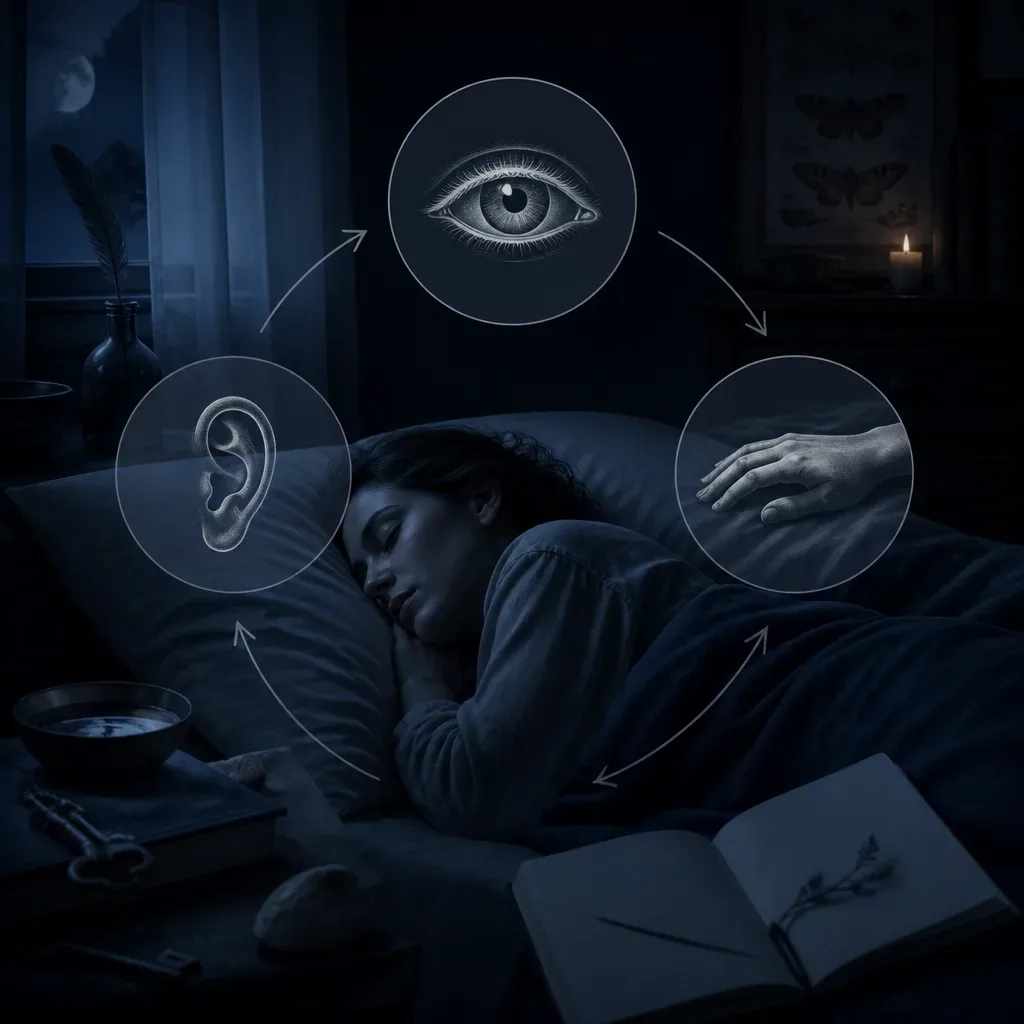
SSILD uses ordinary perception in a softened way:
- Sight: notice the darkness, colors, shapes, or lack of shapes behind closed eyes.
- Sound: notice nearby room sounds, far sounds, or the simple fact of quiet.
- Body: notice contact with the bed, warmth, pressure, tingling, or heaviness.
Do not hunt for special effects. No lights need to appear. No vibrations are required. The best sign is often boredom.
The audio is not the induction; it is the handrail you release before sleep.
In dream research, awakenings are already a known aid to recall. A 2014 paper by Ruby and colleagues in Neuropsychopharmacology found that high dream recallers had more intra-sleep awakenings than low recallers, giving memory more chances to encode dreams. SSILD borrows that doorway, then asks you to walk back through it quietly.
How do you do the 3-minute SSILD routine?
Do the 3-minute SSILD routine by waking briefly, playing short audio only if helpful, then completing three soft cycles of sight, sound, and body.
Here is the whole routine. It is deliberately plain.
- Wake after 4 to 6 hours of sleep. Use a soft alarm or a natural waking. Do not turn on bright lights.
- Stay awake for 30 to 90 seconds. If you use audio, keep it familiar and low. Turn it off before the cycles.
- Cycle one: 10 seconds sight, 10 seconds sound, 10 seconds body.
- Cycle two: repeat the same three senses, slightly slower.
- Cycle three: repeat again, then stop counting.
- Return to sleep. Roll to your normal sleep position. Let the routine be finished.
That makes roughly 3 minutes if you include the wake-up and settling. Longer SSILD instructions often recommend several short cycles followed by slower cycles. This compact version is for the person who will abandon a 15-minute protocol but can keep a small ritual 4 mornings a week.
| Phase | Time | What to do | What not to do |
|---|---|---|---|
| Wake | 30 to 90 seconds | Stay dim, calm, still | Check messages |
| Audio | 30 to 90 seconds | Listen lightly, then stop | Analyze the words |
| Sight | 10 seconds | Notice closed-eye darkness | Force imagery |
| Sound | 10 seconds | Notice room sound or quiet | Strain to hear |
| Body | 10 seconds | Notice pressure and warmth | Try to float |
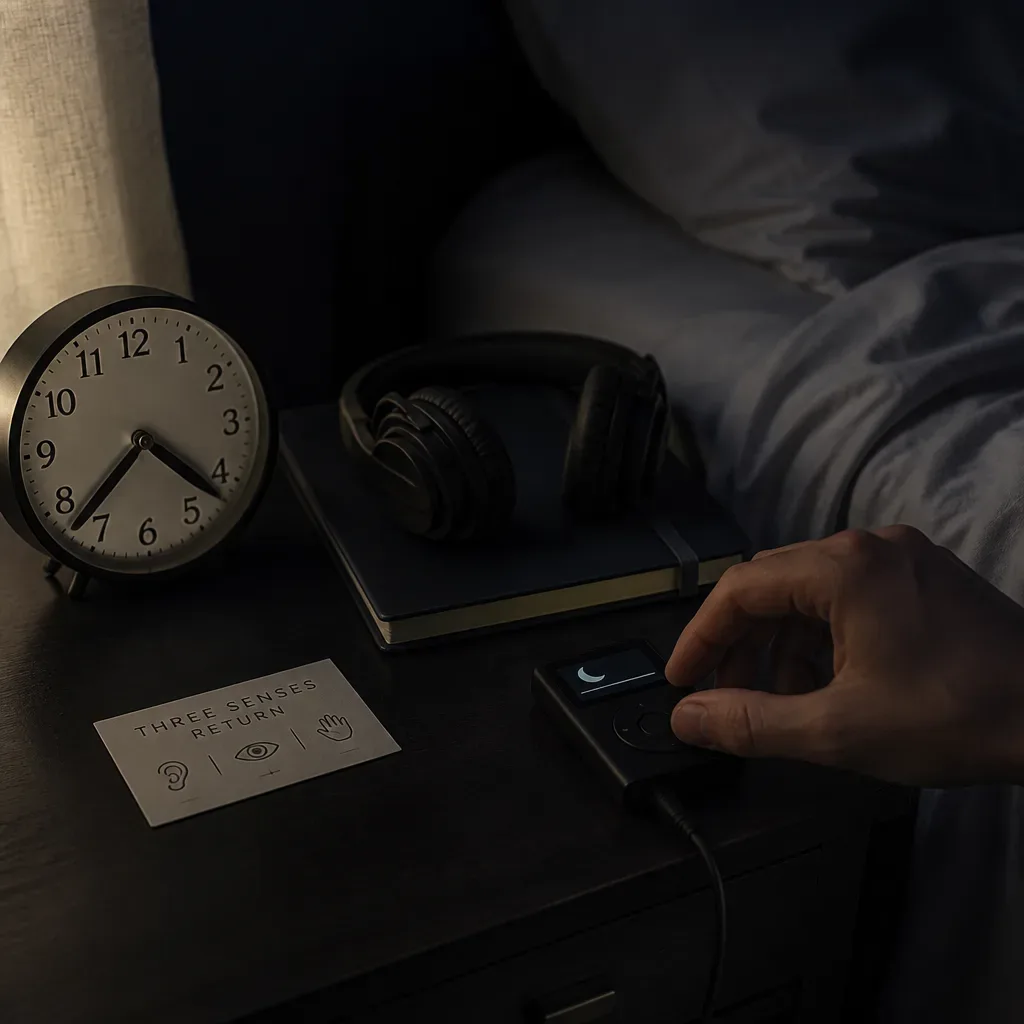
If you have a dream fragment already, write 3 words only, such as kitchen, blue dog, mother. The AI dream interpreter tool can wait until morning. At night, too much interpretation wakes the judge, and the judge is not invited back to bed.
What should you notice during each sense cycle?
Notice plain sensory facts, not mystical signs, because SSILD works by continuity of attention rather than drama.
For sight, keep your eyes closed and rest attention on the visual field. You may see blackness, faint grain, drifting color, or nothing you could name. In hypnagogia, brief images can appear at sleep onset. Researchers have studied these transitional perceptions for more than a century, and modern sleep labs classify them near the border of wake and N1 sleep. You do not need to enter them. You only notice.
For sound, include both external and internal sound. A radiator, distant traffic, a partner breathing, the pulse in your ear, or silence can all be the object. The point is not sharp hearing. It is enough to know, for 10 seconds, that hearing is happening.
For body, choose contact. Back on mattress. Hand on sheet. Jaw softening. A 2012 review in Sleep Medicine Reviews notes that lucid dreaming often occurs during REM sleep, when voluntary muscles are largely inhibited. Beginners sometimes become fascinated by heaviness or buzzing. Treat these as weather, not instructions.
A useful rule is to keep each observation under one sentence in your mind:
- dark behind eyes
- fan in the hall
- blanket on knees
- warm left hand
- quiet room
A lucid dream usually begins as a small continuity: the mind notices, then notices that it is noticing.
If fear appears, open your eyes, name the room, and stop for the night. SSILD should feel ordinary. If sleep paralysis happens often or comes with distress, talk to a doctor in one plain sentence and without shame.
How is SSILD different from MILD, WILD, and reality checks?
SSILD differs by using sensory cycling instead of memory rehearsal, direct wake-to-dream entry, or daytime questioning.
MILD, or Mnemonic Induction of Lucid Dreams, has the strongest research history. LaBerge reported success with intention and prospective memory training in the 1980s, and later studies, including work by Denholm Aspy and colleagues in 2017, found that combined techniques can raise lucid dream frequency for some participants. MILD asks you to remember, next time I’m dreaming, I’ll know I’m dreaming.
WILD, or Wake Initiated Lucid Dreaming, tries to carry awareness directly from waking into a dream. It can be beautiful for some people and too stimulating for others. SSILD is softer. You are not trying to stay conscious all the way through. You are setting a rhythm and then letting go.
Reality checks belong mostly to daytime training. You count fingers, read text twice, or ask whether you are dreaming. Their value is repetition. A habit practiced 5 to 10 times during the day may reappear at night, especially when paired with dream journaling. Our Dream dictionary (A–Z hub) is useful after recall, but it should not replace noticing your own repeated dream signs.
| Method | Main tool | Best for | Common mistake |
|---|---|---|---|
| SSILD | Sight, sound, body cycles | Sleepy beginners | Trying too hard |
| MILD | Intention and memory | People who like words | Repeating without feeling |
| WILD | Awareness through sleep onset | Patient practitioners | Chasing sensations |
| Reality checks | Daytime habit | Pattern builders | Doing them mechanically |
The honest reading is that lucid dreaming research is promising but uneven. Small samples are common. Lab-verified lucidity requires eye-signal methods, and those studies are harder to run than questionnaires. Still, one steady finding holds: recall supports lucidity. You remember more of the night you learn to notice.
What can go wrong, and how do you keep it gentle?
The main problems are over-effort, insomnia, fear of body sensations, and turning the method into a nightly test.
Over-effort is the most common. You wake after 5 hours, do the audio, begin the cycles, and then start checking: Is it working? Do I feel vibrations? Am I lucid yet? That checking is waking behavior. If you catch yourself measuring, return to one sense for 10 seconds, then quit. A method that keeps you awake has stopped serving the dream.
Insomnia deserves respect. The American Academy of Sleep Medicine estimates that chronic insomnia symptoms affect a meaningful share of adults, with many surveys landing around 10 percent for chronic insomnia disorder. If you already struggle to return to sleep, do SSILD only on nights when you wake naturally, and shorten the practice to one cycle.
Fear can also appear around sleep paralysis. Sleep paralysis is usually brief and not dangerous, though it can be frightening. Reviews often estimate that roughly 7 to 8 percent of the general population report at least one episode, with higher rates in students and psychiatric samples. If it happens, remind yourself that REM muscle inhibition has lingered into waking. Move a finger or toe, slow the breath, and orient to the room.
Keep the practice gentle with these rules:
- Stop after 3 minutes, even if nothing happens.
- Skip the method when you are sleep deprived.
- Do not combine it with bright screens.
- Record results in the morning, not during the night unless a dream is slipping away.
- Count a remembered dream as success.
The dream is not a performance review. It is weather from the sleeping mind.
If you want a waking counterpart to repeated dream attention, the AYA Method is a daily audio manifestation practice. Each day you listen to a short personalized recording, your Dream-Self Moment, narrated from the version of you who has already manifested the life you intend. Listening is the practice. Repetition is the work. The audio is the method. Use it by day; let SSILD remain a night practice.
What should you write down the morning after?
Write down the dream, the method timing, and one honest note about how your body and attention behaved.
Morning notes turn scattered nights into usable evidence. In a 2018 paper in Frontiers in Psychology, researchers noted that lucid dream frequency is associated with dream recall frequency, though cause and effect are not simple. For the ordinary dreamer, the practical point is clear: if you do not write dreams down, you cannot see patterns across 7, 14, or 30 mornings.
Use a small log. Keep it boring enough that you will actually do it.
- Time practiced: after 4 hours, 5 hours, or 6 hours.
- Audio used: yes or no, and length.
- Cycles completed: one, two, three, or more.
- Sleep return: easy, slow, or difficult.
- Dream result: none, fragment, vivid dream, false awakening, lucid dream.
- Dream sign: one repeated symbol, place, person, or feeling.
A false awakening is worth noting. SSILD practitioners often report them, and they can become a bridge to lucidity if you learn to ask, quietly, am I still dreaming? If you wake in your bedroom inside a dream, text may blur, light switches may behave strangely, or the room may carry one wrong detail.
For symbols that repeat, use interpretation after breakfast. Compare your notes with entries in the Dream dictionary (A–Z hub), or ask the AI dream interpreter tool for a first reading. Then return to your own report. The dictionary gives grammar. The dreamer supplies the accent.
A symbol is useful only when it brings you closer to the life that produced it.
Here is the line to write tomorrow morning: I woke after ___ hours, cycled sight-sound-body for ___ minutes, and the dream gave me ___.
Leave the notebook where your hand can find it.