dream symbolism
Spider Dream Meaning: Fear, Creativity, or Trapped?
Spider dream meaning usually points to fear, patience, creativity, or feeling caught in a situation. Learn the common readings and what to ask next.
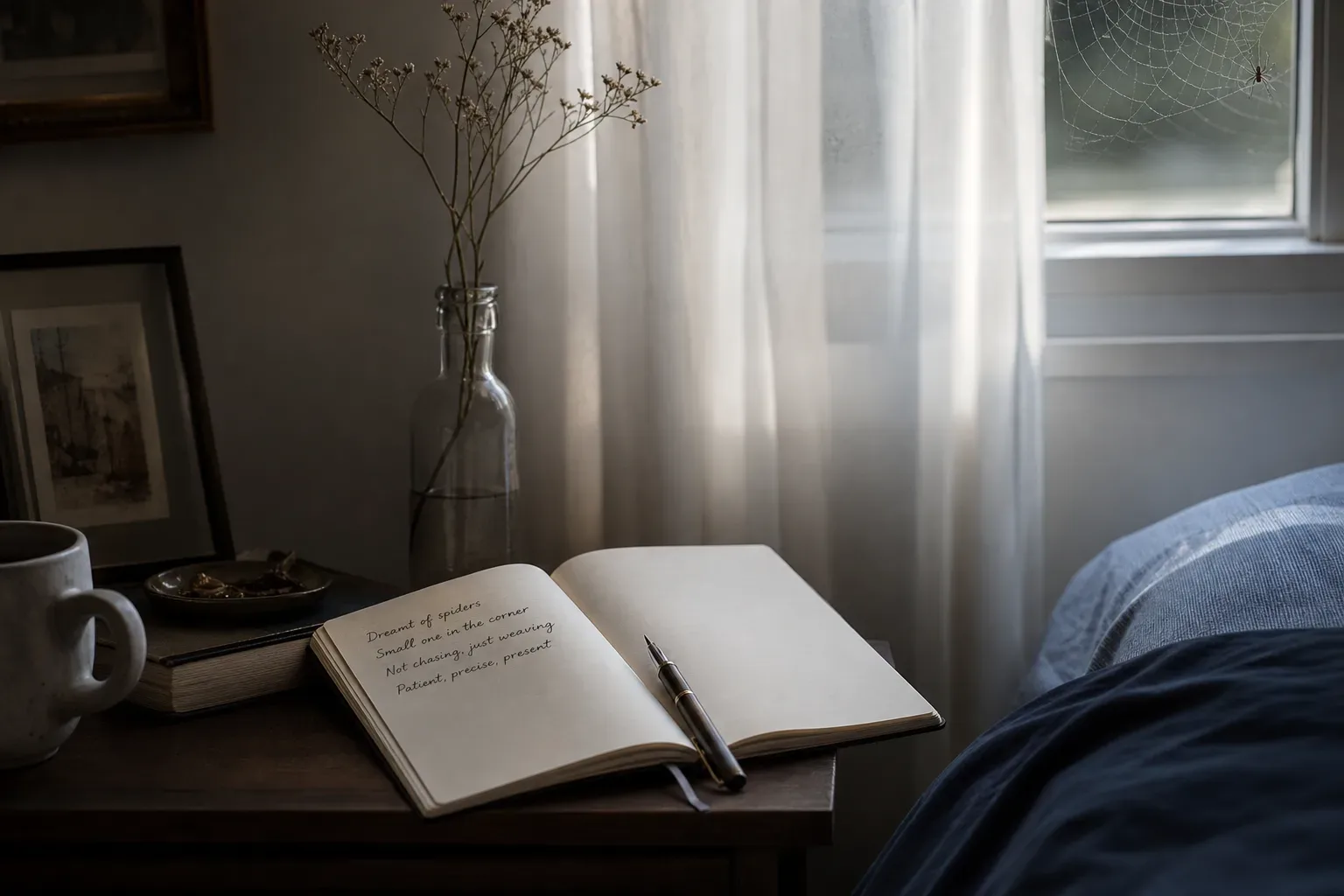
Spider dream meaning usually points to fear, patience, creativity, or feeling trapped in something you didn’t notice forming. The spider itself isn’t automatically bad. What matters is the action: watching, biting, crawling, weaving, or surrounding you in a web. Your emotion in the dream is the first clue.
What does a spider dream usually mean psychologically?
A spider dream usually means your mind is working with fear, control, patience, or a problem that feels hard to leave.
In dream research, animals often carry emotion before they carry story. Calvin Hall and Robert Van de Castle’s mid-20th-century coding system treated dream characters, settings, emotions, and actions as countable features, not mystical signs. Later researchers such as G. William Domhoff used large collections, including DreamBank’s 20,000-plus reports, to show that dreams tend to mirror waking concerns more than random fantasy. A spider dream often belongs to that ordinary continuity.
The spider is small, but the feeling can be large. That mismatch is important. A creature that fits in a corner can make the whole room feel unsafe. If the dream spider appears while you’re stressed, over-managed, watched, or stuck, it may be giving a body to a pressure you haven’t fully named. The symbol is doing what dreams often do: making a mood visible.
A spider can also stand for careful construction. Its web is not noise. It is structure. If the dream centers on weaving, repairing, or watching a web, the spider may be less about fear than craft. Writers, designers, parents, students, and people rebuilding a life after loss often dream in images of slow making. A web is what patience looks like when the mind turns it into a picture.
A useful first question is not, “Was the spider good or bad?” It is, “What was I doing in relation to it?” In a 2007 review in Sleep Medicine Reviews, Tore Nielsen and Ross Levin proposed that many nightmares combine emotional memory with threat simulation. That doesn’t mean the spider is a threat in waking life. It means the dream may be rehearsing how danger feels.
A dream symbol is not a verdict. It is a place where attention has gathered.
Is dreaming of spiders about fear or anxiety?
Yes, spider dreams are often about fear or anxiety, especially when the spider is crawling on you, multiplying, or impossible to remove.
Fear is the simplest reading because spiders are common fear objects. The National Institute of Mental Health estimates that about 12.5% of U.S. adults have a specific phobia at some point in life, and spiders are among the well-known animal phobias studied in clinical settings. If you already dislike spiders, the dream may borrow that fear because it’s efficient. The mind uses the image that works.
Still, the dream doesn’t have to be about spiders. A spider on your skin may stand for a worry that feels invasive. A spider in your bed may point to anxiety entering rest, intimacy, or the private self. A spider dropping from the ceiling may suggest a problem that seems to arrive from above: a deadline, a supervisor, a parent, a bill, a diagnosis you’re waiting on. The location sharpens the meaning.
Notice the size. A tiny spider can suggest a small worry you’re giving too much space. A giant spider can show how large the fear feels from inside the dream. Dreams are not measured in inches. They are measured in pressure. In Hall and Van de Castle’s classic American sample of 1,000 dreams, negative emotions appeared more often than positive ones, which fits the common finding that dreams frequently process threat, conflict, and unfinished concern.
Try sorting the dream by feeling:
- Disgust may point to something you want away from your body or home.
- Panic may point to overwhelm and a need for immediate distance.
- Frozen fear may suggest helplessness or avoidance.
- Curiosity may soften the reading toward creativity or patience.
- Protectiveness toward the spider may suggest a fragile project or part of yourself.
The morning test is plain: did the dream feel like danger, or did it feel like attention? Fear dreams often leave the body activated. If you wake with a racing heart, write down the first waking worry that comes to mind. It doesn’t have to be elegant. Accuracy matters more than style at 7 a.m.
Can spider dreams mean creativity, work, or patience?
Yes, a spider dream can mean creativity when the web, weaving, or careful placement feels more important than the scare.
The spider is one of the oldest natural images of making. It creates from its own body, repairs damage, waits, adjusts, and begins again. That doesn’t make every spider dream artistic, but it gives the image a strong creative grammar. In Jung-adjacent interpretation, the web can symbolize psychic pattern: the way one thought connects to another, the way a life is held together by visible and invisible threads.
This reading is strongest when the dream is calm. Maybe you watched a spider make a web in a window. Maybe you noticed dew on the web. Maybe the spider was not attacking you at all. The dream may be asking you to respect small, repeated work. In sleep studies, dream content often reflects daily residue, a term Freud used and later researchers still discuss in less grand language. If you spent the week drafting, planning, revising, coding, sewing, negotiating, or caring for a child, the web may be a picture of continuity.
Creativity is not always romantic in dreams. It can look sticky. A project can catch you as much as it calls you. The same web that shows design can also show obligation. That double meaning is why spider dream meaning depends on the dream’s mood. A beautiful web in morning light is not the same as a web over your mouth.
Here is a simple comparison:
| Dream detail | More likely fear reading | More likely creative reading |
|---|---|---|
| Spider crawling on your body | Boundary anxiety or intrusion | Rare, unless you felt calm |
| Spider weaving a web | Feeling trapped by a pattern | Building something patiently |
| Many spiders in a room | Overwhelm, many small worries | Many ideas, if the mood is lively |
| Web across a doorway | Blocked choice or avoidance | A threshold you’re preparing carefully |
| Holding a spider gently | Making peace with fear | Protecting a fragile idea |
A good creative dream leaves a trace of recognition, not only alarm. You wake and think, “I know what that web is.” It may be the chapter, the business plan, the family system, the recovery routine, the application, the apology. The web is the work that keeps asking for one more thread.
Sometimes the thing that frightens you in a dream is also the thing that knows how to build.
What does it mean to feel trapped in a spider web dream?
Feeling trapped in a spider web dream usually points to entanglement: a relationship, duty, secret, habit, or system that has become harder to move through.
Web dreams are often less about the spider and more about the structure. If you’re caught in a web, ask where waking life has become sticky. Sticky is different from locked. It suggests small threads, not one iron door. You may technically be free to leave, speak, rest, or change, but each movement seems to pull on something else. Family expectations, debt, workplace politics, and hidden resentment often feel like this.
Dreams are good at showing systems. A web has a center, edges, tension points, and invisible geometry. If the spider sits in the middle, the dream may give a face to whatever seems to control the system. That could be a person. It could also be your own fear of conflict. Clinical dream work often begins by separating the image from accusation: the spider may represent someone, but it may also represent the pattern around them.
A 2014 paper by Michael Schredl and colleagues in International Journal of Dream Research noted that dream emotions are meaningfully connected with waking emotional life, though exact interpretation remains individual. That’s the honest ground here. No dictionary can tell you which thread is yours. It can only name the structure and ask you to test it against your morning.
Use this 4-step check before deciding what the web means:
- Name the web. Write one sentence: “The web might be ____.”
- Name the center. Who or what seems to hold the tension?
- Name the cost. What happens in waking life when you try to move?
- Name one thread. What is the smallest practical strand you could loosen this week?
The last step matters because dreams can make a situation feel total. Waking action makes it specific. You don’t have to tear down the whole web by noon. You only have to notice one thread honestly.
For related symbols, the Dream dictionary (A–Z hub) can help you compare spiders with snakes, insects, houses, bedrooms, doors, and other images that often appear together. If the spider dream became lucid and you knew you were dreaming, the Lucid dreaming pillar explains how awareness can change the way fear behaves at night.
Do cultural and spiritual traditions read spider dreams differently?
Yes, many traditions read spiders as weavers, tricksters, protectors, or warnings, but these are cultural meanings rather than proof of prediction.
Folklore has given the spider a long life. In some West African and Caribbean traditions, Anansi is a spider figure linked with story, cleverness, and survival. In Greek myth, Arachne’s weaving becomes a story about skill, pride, punishment, and art. In many household traditions, killing a spider is said to bring bad luck, while seeing one can mean money or messages. These beliefs are not scientific evidence. They are inherited ways of speaking about patience, craft, fear, and fate.
A folklore reading can still matter if it belongs to you. The spider means one thing in a lab report and another thing in your grandmother’s kitchen. Both are worth knowing. If your family treated spiders as lucky, your dream may feel like a visitation from thrift, labor, or protection. If your childhood home treated spiders with panic, the same image may carry alarm before thought can catch up.
Religious and spiritual readings also vary. Some people read the web as destiny. Some read it as illusion. Some read the spider as feminine creative force because it makes, waits, and guards. I would keep the language careful: a dream may feel sacred without being a forecast. Dreams reflect; they don’t foretell. If a tradition says the spider predicts money, marriage, danger, or betrayal, receive that as folklore unless waking evidence supports it.
The stronger interpretive move is to ask what cultural layer the dream borrowed. Was the spider a feared pest, a patient maker, a clever survivor, or a house guardian? The answer may depend on a story you heard before you could spell the word spider.
Folklore doesn’t prove a dream. It preserves the feelings people kept having about the same image.
If you want a second pass after writing your own notes, the AI dream interpreter tool can help organize details without replacing your own memory. The report you write first is still the best evidence.
What do common spider dream variations mean?
Common spider dream variations change the meaning by changing the action: bite, web, swarm, house, body, or killing the spider.
A spider bite usually suggests a sharp emotional point. It may be criticism, envy, guilt, betrayal, or a boundary crossing that finally hurt. In waking life, small things can bite: a text, a look, a delayed answer, a sentence said in a meeting. If the bite leaves poison in the dream, ask what feeling keeps spreading after the original event.
Many spiders often mean many small worries. One spider can be a symbol. A hundred spiders can be a nervous system. If they scatter across the floor, the dream may point to problems you can’t gather into one clear task. If they hatch from an egg sac, the image may suggest a concern multiplying because it wasn’t addressed early. This is common nightmare logic: the mind turns “too much” into “too many.”
A spider in the house brings the meaning close to identity, privacy, and family. Houses in dreams often stand for the self or the life you live inside. A spider in the bedroom may involve intimacy or rest. A spider in the kitchen may involve nourishment, labor, or household roles. A spider in the bathroom may point toward cleansing, privacy, or shame. For house-related images, you can cross-check the Dream dictionary (A–Z hub) after you record the dream’s exact room.
Killing the spider can mean wanting control over fear. It can also mean cutting off a creative or instinctive part of yourself too quickly. The difference is usually in the feeling afterward. Relief suggests ending a threat. Sadness or guilt suggests you may have destroyed something delicate. In a small 2019 study of nightmare rescripting approaches, changing the dreamer’s response to a threat was associated with reduced distress, though methods and sample sizes vary. The practical point is modest: rehearsing a different response can change your relationship to the image.
If the spider speaks, listen to the sentence. Speaking animals in dreams often carry direct emotional material. Write the exact words down, even if they sound absurd. Especially if they sound absurd. The strange sentence is sometimes the most honest one.
What should you do the morning after a spider dream?
The morning after a spider dream, write the action, feeling, location, and one waking-life parallel before the day edits the dream into a neat story.
Dream recall fades quickly for many people. Sleep researchers often ask participants to report dreams immediately after waking because memory changes with time, light, conversation, and phone use. You don’t need a perfect record. You need the first honest version. Noor’s lab rule still holds: the first report is not always complete, but it is often clean.
Use this short morning note:
- Action: What did the spider do?
- Feeling: What did your body feel first?
- Place: Where did it happen?
- Thread: What waking situation has a similar texture?
- Line: Write one sentence beginning, “This may be about…”
If the dream repeats, track it for 2 weeks. Recurring dreams often change when the waking pattern changes, though not always immediately. If nightmares are frequent, cause daytime distress, or come with trauma symptoms, talk with a doctor or licensed therapist. That sentence is not meant to frighten you. It is ordinary care.
This is also where waking practice can meet dream material. A recurring dream shows you what your attention keeps returning to: the fears and wants underneath the image. The AYA Method is a daily audio manifestation practice. Each day you listen to a short personalized recording — your Dream-Self Moment — narrated from the version of you who has already manifested the life you intend. Listening is the practice. Repetition is the work. The audio is the method. For spider dreams, that can mean rehearsing steadiness while awake instead of waiting for the night to stage the fear again.
If you’re working with lucid dreams, compare your spider dream with the practices in the Lucid dreaming pillar. If you want a structured reading after your own notes, use the AI dream interpreter tool as a second voice, not the first one.
The dream gives you the image. The morning gives you the choice of what to do with it.
Write this down: “The spider may be the thread I’m finally ready to notice.”
Leave the notebook open for one more minute.