dream symbolism
Snake Dream Meaning: Fear, Change, or Old Self
Snake dream meaning often points to fear, change, healing, temptation, or the uneasy work of shedding an old self. Read the symbol clearly.

Snake dream meaning usually points to fear, change, healing, temptation, or the old self being shed. The snake is not automatically bad. It tends to mark something instinctive and difficult to ignore: a threat, a truth, a desire, a body signal, or a renewal already moving underneath ordinary life.
What does a snake dream usually mean?
A snake dream usually means you’re meeting an instinctive force that your waking mind has been managing, avoiding, or underestimating.
The snake is one of the oldest dream symbols because it belongs to several categories at once. It’s animal, threat, healer, skin-shedder, and secret mover. In dream reports collected by researchers such as Calvin Hall in the mid-20th century, animals were common dream figures, and threat-related dreams appeared often enough to support Antti Revonsuo’s 2000 “threat simulation” theory of dreaming. A snake fits that theory easily: it’s a living alarm.
But the snake isn’t only an alarm. In clinical dream work, a snake may carry what Jung called shadow material: the parts of the personality we prefer not to identify with. Anger can arrive as a snake. Sexual desire can arrive as a snake. So can ambition, envy, grief, intuition, and the body’s plain intelligence. The dream is not always accusing you. Sometimes it is returning something you exiled too quickly.
A symbol is not a sentence. It’s a door with several rooms behind it. A green snake in grass, a black snake in a hallway, and a gold snake coiled around your wrist may all use the same animal shape, but they don’t say the same thing.
If you’re reading this at 7 a.m., begin with the simplest record. Where was the snake? What was it doing? What did your body do when you saw it? According to sleep researcher Michael Schredl, dream recall varies widely, with some people remembering dreams several times a week and others rarely. Details fade quickly after waking, so write the snake down before breakfast.
For quick comparison, use the Dream dictionary (A–Z hub) as a map, not a verdict. Your own associations still matter most.
Is the snake about fear, danger, or anxiety?
Yes, a snake can represent fear or danger, especially when the dream makes your body tense before your mind understands why.
Humans notice snakes quickly. A 2017 review in Frontiers in Psychology discussed evidence that primates, including humans, have strong visual sensitivity to snakes, likely because snakes mattered to survival across evolution. This doesn’t mean every snake dream is biological residue, but it does explain why the image can feel immediate. The body may react before the story forms.
In threat dreams, the snake often appears in ordinary places: under the bed, in a shoe, near a child, inside a bag, beside a door. Ordinary locations matter. A snake in your kitchen can mean anxiety has entered nourishment, family routine, or private domestic life. A snake in your workplace can point toward competition, secrecy, or a situation where you don’t feel safe showing your full reaction.
Notice the difference between fear and warning. A warning says, “Look carefully.” Fear says, “Run before you know.” Dreams often mix the two. If the dream leaves you with the sense that a person or situation is unsafe, don’t treat the dream as evidence. Treat it as a reason to examine what you already know. In one Pew Research Center survey from 2009, 29% of Americans said they had felt in touch with someone who had died; people often give dreams spiritual weight, but emotional weight is not the same as factual proof.
Ask three plain questions:
- What did I know in the dream before the snake moved?
- Where in waking life do I feel watched, cornered, or unprepared?
- What am I calling “nothing” that my body is calling danger?
The snake may not be the enemy. It may be the part of you that refuses to keep smiling at the wrong thing.
Could the snake mean change or shedding an old self?
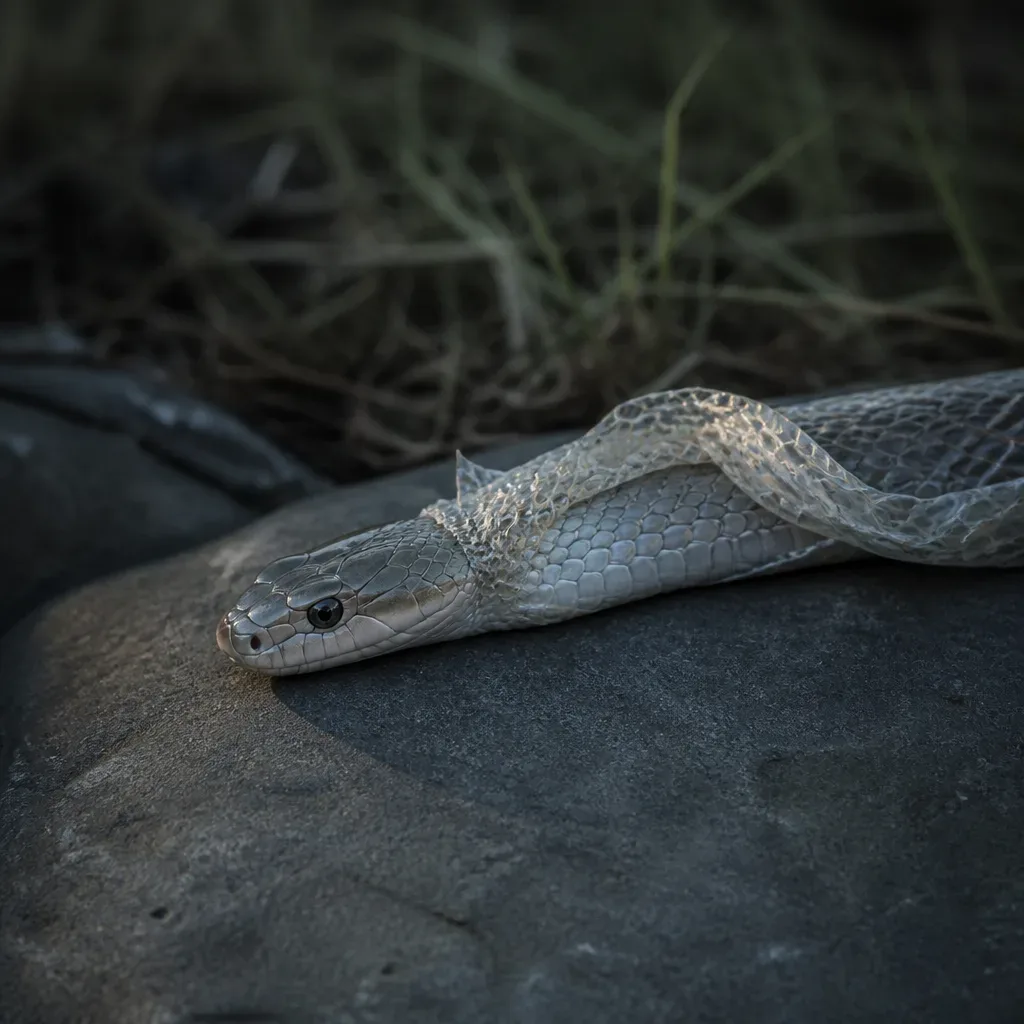
Yes, a snake often means change because it sheds its skin, and dreams borrow that visible fact for inner change.
Snakes shed through a process called ecdysis. Depending on age, species, growth, and health, many snakes shed several times a year; young snakes may shed more often because they grow faster. The dream image is exact: the old covering loosens before the new surface is ready to be seen. Change often feels like irritation before it feels like freedom.
A shedding snake dream may arrive when you’re leaving a role. You may be ending a relationship, aging out of an identity, changing work, becoming a parent, losing faith in an old story, or admitting a wish you once judged. In the consulting room, these dreams often came when the person said, “Nothing is happening,” while their behavior said otherwise. They had stopped laughing at old jokes. They had stopped volunteering for pain. They had begun to tell the truth in smaller sentences.
Jung wrote about symbols as bridges between conscious and unconscious material, especially in Man and His Symbols (1964). The snake’s bridge is primitive and elegant. It doesn’t argue for change. It simply shows the body doing what the psyche is trying to do.
Here’s a small guide:
| Snake detail | Possible reading | Morning question |
|---|---|---|
| Shedding skin | Leaving an old role | What no longer fits me? |
| Hiding snake | Change not yet admitted | What am I postponing? |
| Snake in water | Feeling-led change | What emotion keeps returning? |
| Snake in bed | Intimacy, vulnerability, desire | What is too close to ignore? |
| Dead snake | End of threat or vitality | What has gone quiet? |
If the snake is shedding, don’t rush to call it good. Shedding is tender. The new skin is sensitive first.
What do different snake colors and behaviors mean?
Snake colors and behaviors refine the meaning, but they don’t replace the feeling of the dream.
Color symbolism is culturally unstable. White can mean purity in one tradition and mourning in another. Red can mean vitality, anger, danger, luck, or blood. Because of this, it’s better to ask what the color means to you before you borrow a dictionary meaning. A black snake may be shadow, secrecy, depression, protection, or simply the color of the snake you saw last week in a documentary.
Behavior is often more reliable than color. A coiled snake is contained force. A striking snake is contact. A snake following you suggests avoidance has failed. A snake speaking in a dream may represent a thought you don’t want to think in your own voice. In lucid dreaming research, Stephen LaBerge’s work in the 1980s showed that dreamers can sometimes signal awareness from inside REM sleep through eye movements. Most snake dreams aren’t lucid, but the same principle matters: the dreamer’s relationship to the dream figure changes the dream.
Use this list as a starting place:
- A coiled snake may mean guarded instinct, waiting, or compressed anger.
- A snake bite may mean a truth has entered the body of your life.
- A snake chasing you may mean you’re avoiding a feeling that keeps pace.
- A snake in the house may mean the issue belongs to your private life.
- A snake in a garden may suggest temptation, growth, or a complicated innocence.
- A talking snake may carry a message from a disowned part of the self.
If you become aware inside the dream, you might also read our Lucid dreaming pillar. Lucidity doesn’t make a snake less meaningful. It simply lets you ask, “What are you here to show me?” before you wake.
The snake that terrifies you may be the one carrying the sentence you most need to hear.
What do cultural and spiritual traditions say about snake dreams?
Cultural traditions often treat snakes as signs of wisdom, danger, healing, fertility, temptation, or spiritual renewal, but these are traditions rather than proof.
In Greek imagery, the rod of Asclepius carries a snake and remains associated with medicine. In the Hebrew Bible, the serpent in Eden is linked with temptation and knowledge. In South Asian traditions, nāga figures can be guardians, water beings, or semi-divine serpent presences. In Mesoamerican history, feathered serpent figures such as Quetzalcoatl carried associations of wind, learning, and sacred order. These meanings aren’t interchangeable, but they show the snake’s range.
Folklore often reads snake dreams as warnings about enemies, money, pregnancy, or hidden knowledge. There is no good evidence that a snake dream predicts any of these events. Still, folklore matters because families carry symbols. The snake means one thing in the research and another thing in your grandmother’s kitchen. Both are worth knowing.
When a dream has a religious or spiritual charge, ask what tradition the dream is speaking in. A Catholic dreamer may feel the Eden serpent. A physician may feel the medical snake. A gardener may think of ordinary snakes eating pests. A person raised to fear snakes may read danger first. A person who keeps snakes may read calm, beauty, and restraint.
The mistake is to choose one meaning too quickly. If the dream snake felt sacred, don’t reduce it to anxiety. If it felt predatory, don’t polish it into wisdom. Honest interpretation lets the image keep its teeth.
For uncertain symbols, the AI dream interpreter tool can help you compare possibilities, especially if you give it concrete details: setting, color, action, emotion, and what happened the day before. A dream without context becomes a superstition. A dream with context becomes a conversation.
Why do recurring snake dreams keep happening?
Recurring snake dreams usually mean the psyche is circling the same unresolved fear, desire, conflict, or change.
Recurring dreams are common. Research by Antonio Zadra and colleagues has found that many adults report recurring dreams at some point, and recurrent themes often involve threat, pursuit, being unprepared, or losing control. The repetition is not a punishment. It’s a return. The mind brings the same figure back when the waking response remains incomplete.
A recurring snake can change over time. At first it may be hidden. Then it may appear in the open. Later it may bite, speak, shed, or die. Track the sequence. In dream work, movement across dreams often matters more than a single dramatic image. A snake that moves from the basement to the living room may suggest the issue is becoming more conscious. A snake that moves from outside the house to inside the bed has crossed into intimacy.
Here is a simple four-night record, even if the dreams happen weeks apart:
- Title the dream in five words or fewer. “Snake under the blue chair.”
- Name the strongest feeling. Fear, disgust, fascination, calm, shame.
- Record the snake’s action. Hiding, chasing, biting, watching, shedding.
- Write one waking parallel. “This feels like the conversation I’m avoiding.”
If recurring nightmares cause distress, interfere with sleep, or connect to trauma, talk with a mental health professional. That sentence is not meant to frighten you. It’s meant to keep the dream in proportion.
This is where waking practice can help. The AYA Method is a daily audio manifestation practice. Each day you listen to a short personalized recording — your Dream-Self Moment — narrated from the version of you who has already manifested the life you intend. Listening is the practice. Repetition is the work. The audio is the method. A recurring dream shows what attention keeps returning to at night; the waking counterpart is choosing what you rehearse by day.
What should you do the morning after a snake dream?
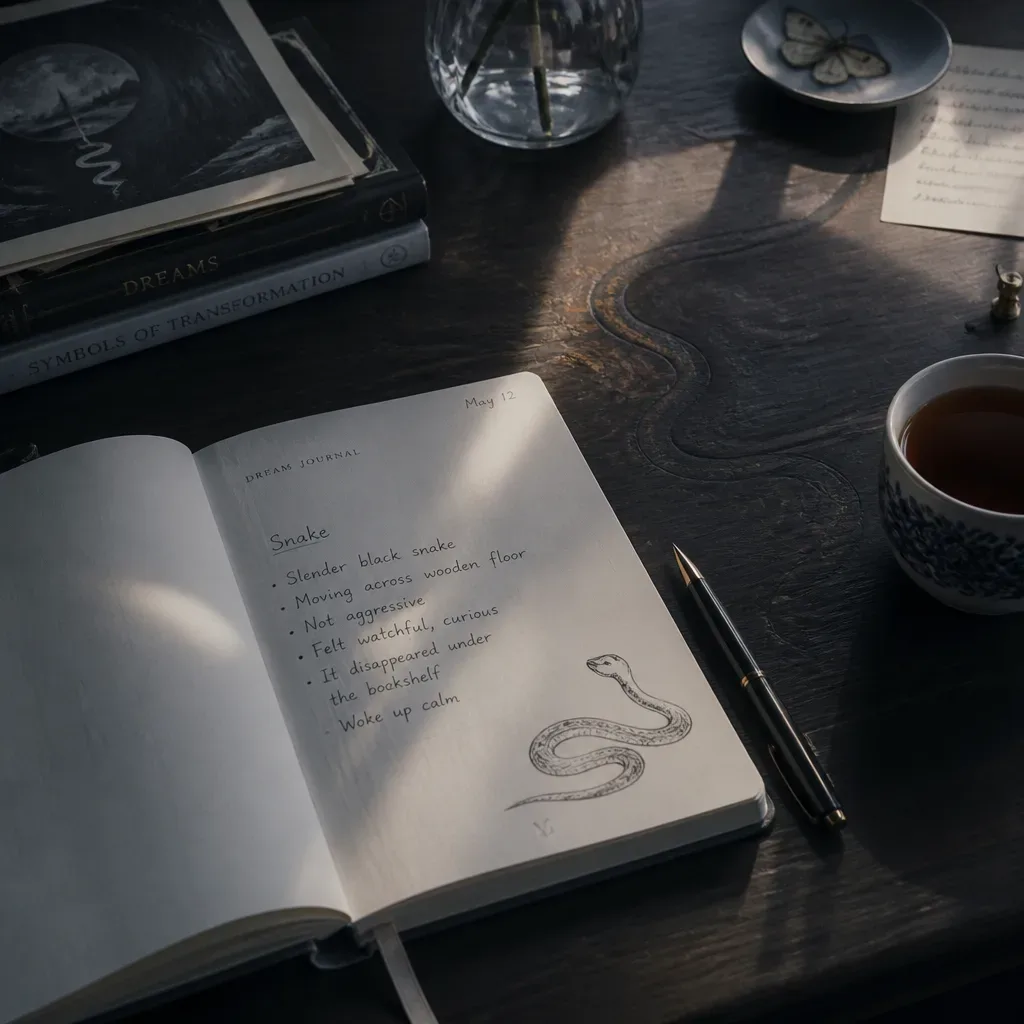
The morning after a snake dream, write the facts first, then ask what instinctive truth the snake may be carrying.
Do this before you interpret. Dream memory is fragile; studies by Schredl and others suggest recall is influenced by attention, awakening patterns, and interest in dreams. If you check your phone first, the snake may become a headline-shaped blur. Give the dream 3 minutes. That is enough for a useful record.
Write these lines:
- “The snake was…”
- “The snake did…”
- “I felt…”
- “The place was…”
- “This reminds me of…”
Then choose one meaning to test for the day. Not the grandest one. The most honest one. If the snake felt like fear, notice where your body tightens. If it felt like change, notice what no longer fits. If it felt like desire, don’t moralize immediately. If it felt like danger, check the facts calmly. Dreams reflect; they don’t foretell.
You can also compare the symbol with related entries in the Dream dictionary (A–Z hub), especially animals, houses, teeth, water, and being chased. Symbols rarely travel alone. A snake in a childhood house is not only a snake dream. It’s also a house dream, a memory dream, and perhaps a family dream.
If you want a short interpretation, use the AI dream interpreter tool after you’ve written your own associations. The order matters. Let the dream speak in your language before you ask any tool to help.
The line to write down is this: “The snake may be asking me to stop pretending I don’t know.”
Stay with the image one quiet minute longer.