lucid dreaming
Reality Check Lucid Dream Habit Without Obsessing
Learn a reality check lucid dream routine that builds daytime awareness, protects sleep, and keeps the practice ordinary, steady, and sane.

A reality check lucid dream habit works best when it’s small, repeated, and calm: pause 5 to 8 times a day, ask whether you’re dreaming, then test one ordinary rule of waking life. The aim isn’t obsession. It’s to teach your sleeping mind one quiet reflex: notice, question, verify.
What is a reality check lucid dream habit, exactly?
A reality check is a brief waking test meant to become available inside a dream.
Lucid dreaming means knowing you’re dreaming while the dream is still happening. The most cited laboratory proof comes from Stephen LaBerge’s 1981 work, where lucid dreamers used prearranged eye movements during REM sleep to signal awareness from inside the dream. Since then, the field has stayed small but serious. A 2016 meta-analysis by Saunders and colleagues estimated that about 55% of people report at least one lucid dream in their lifetime, while about 23% report them monthly or more often.
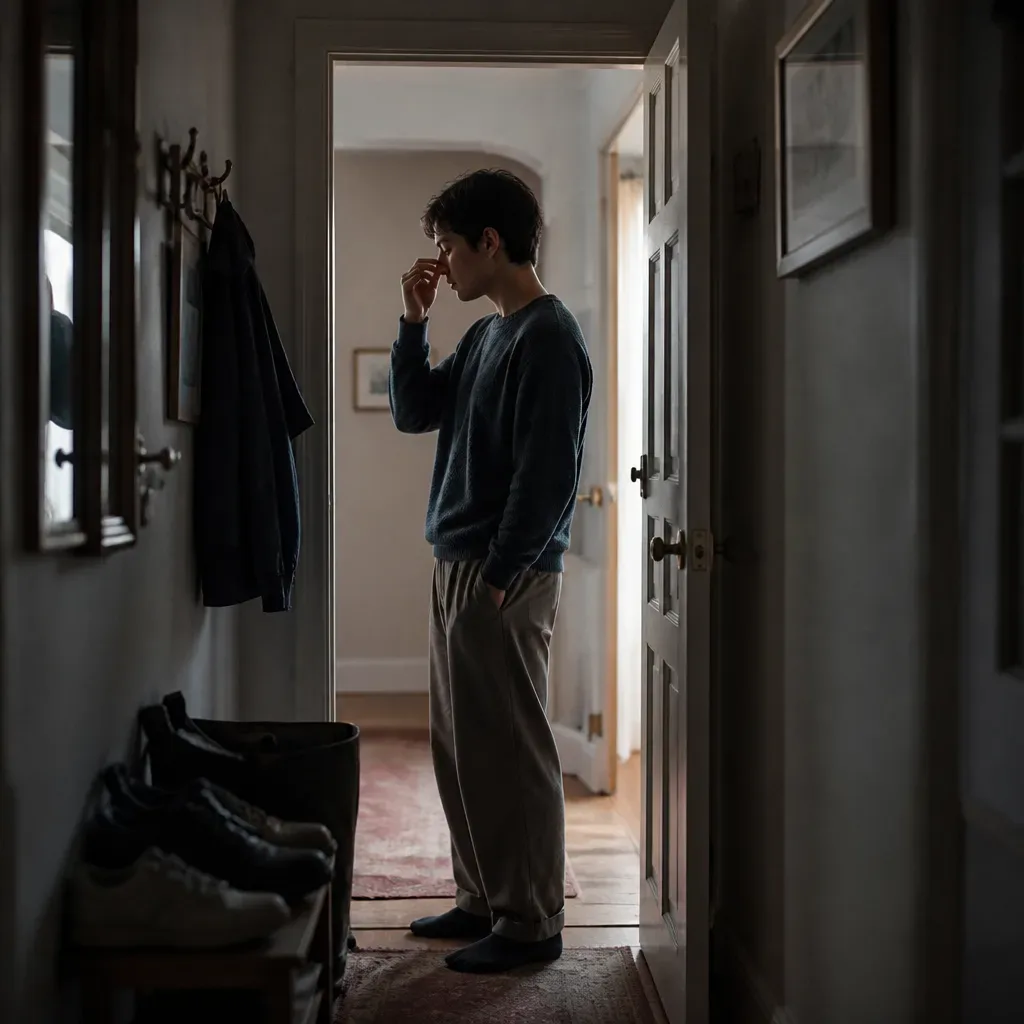
Reality checks sit in the daytime half of that practice. You ask, “Am I dreaming?” and then test something that tends to behave strangely in dreams. Common checks include pinching your nose and trying to breathe, reading text twice, counting fingers, or checking a digital clock. The check isn’t magic. It is a trained interruption.
A reality check is not a superstition. It’s a rehearsed question with a body attached.
The habit matters because dreams often lack reflective questioning. We accept the old house, the wrong school, the impossible staircase. By practicing a sober doubt during the day, you increase the chance that the same doubt appears at night. If you’re new to the wider topic, keep the full lucid dreaming pillar nearby; it gives the broader map without asking you to believe more than the research can hold.
The morning record matters too. Dream memory is fragile. In sleep labs, awakenings from REM sleep often produce higher dream recall than awakenings from non-REM sleep, but recall can fade within minutes. That is why a reality check habit should travel with a pen, a notes app, or a simple page in your dream journal.
Which reality checks should you use first?
Start with two checks: one physical test and one attention test.
The simplest physical test is the nose-pinch check. Pinch your nose closed and try to breathe through it. In waking life, you usually can’t. In a dream, people often report that breathing continues because the dreamed body doesn’t follow the same rule. Another common test is reading the same line twice. Written text often changes in dreams, though not always. Digital clocks may shift, hands may show too many fingers, and light switches may behave oddly.
Use this table as a starting point, not a law:
| Reality check | How to do it | Why it can work | Caution |
|---|---|---|---|
| Nose-pinch breathing | Pinch nose and try to inhale | Dream breathing may continue | Do it gently |
| Text re-read | Read a line, look away, read again | Dream text often changes | Some dreams keep text stable |
| Finger count | Count fingers on both hands | Dream bodies often distort | Don’t rush the count |
| Clock check | Look at time twice | Numbers may shift | Phones can make this too automatic |
| Memory check | Ask how you got here | Dreams often skip transitions | This is the most important part |
The memory check is the quiet center. Ask: “What was I doing 10 minutes ago? How did I arrive here?” Prospective memory research, much of it associated with Mark McDaniel and Gilles Einstein, shows that remembering to do something later depends strongly on cues. You aren’t only testing physics. You’re building a cue-response habit.
The best reality check is the one that wakes up your attention before it tests the world.
Pick two checks and keep them for 14 days. Beginners often rotate through five techniques because novelty feels productive. It usually isn’t. In Aspy’s 2017 PLOS ONE study of lucid dream induction techniques, combinations involving intention and waking after sleep showed measurable effects, but technique consistency mattered more than collecting tricks. Keep the practice plain enough to survive an ordinary Tuesday.
How do you build the habit without obsessing?
Limit the practice to 5 to 8 deliberate checks a day and attach each one to a normal cue.
Obsession begins when the check stops being a question and becomes a demand. You don’t need to test every doorway, every mirror, every strange feeling. Choose a small number of cues that already happen. Good cues are frequent but not constant. They give the day a gentle rhythm.
Try this 7-cue plan for two weeks:
- After waking and writing one dream note.
- The first time you look in a mirror.
- When you walk through your front door.
- Before lunch.
- The first time you notice a clock after 3 p.m.
- When you wash your hands in the evening.
- Before putting your phone away for sleep.
At each cue, pause for 5 seconds. Look at the room. Ask whether anything is inconsistent. Then do your two chosen checks. The whole sequence should take 15 to 25 seconds. If it takes longer, you’re probably adding strain.
Behavioral research on habit formation suggests that automaticity takes longer than the old “21 days” saying. A 2009 study by Phillippa Lally and colleagues in the European Journal of Social Psychology found an average of 66 days for a new behavior to become automatic, with wide variation. That number is useful because it softens urgency. You aren’t failing if nothing happens in week one.
Keep these boundaries:
- Don’t repeat a check because it “didn’t feel right.”
- Don’t use fear as the cue.
- Don’t sacrifice sleep to practice more.
- Don’t turn every odd moment into a test.
- Do write down when the habit starts feeling tight.
A lucid dream practice should widen attention, not shrink the day around a single question.
If you have a history of dissociation, panic, or obsessive-compulsive symptoms, keep reality checking especially bounded. This isn’t medical advice. It’s a plain caution. If the practice increases distress or makes waking life feel unreal, stop and speak with a qualified clinician.
What should you do each morning to make checks work better?
Write down one dream fragment before you judge whether it matters.
Reality checks become sharper when they aim at your actual dream signs. A dream sign is any repeated feature in your dreams: an old apartment, a school hallway, a dead phone, an animal, a missing shoe, a certain kind of embarrassment. The Dream dictionary (A–Z hub) can help you compare common symbolic readings, but your own repetition comes first. The snake means one thing in a clinical tradition and another thing in your grandmother’s kitchen. Both are worth knowing.
Keep the morning routine small. Within 5 minutes of waking, write 2 to 5 lines. Don’t reach first for interpretation. Record nouns and actions. “Train station. Couldn’t find ticket. Brother was there, younger than now. Blue coat. Felt late.” That is enough.
Sleep research gives a good reason for speed. Dream recall is sensitive to awakenings, attention, and timing. Studies by Tore Nielsen and others have shown that frequent recallers often have more awakenings and more attention to dream material, though this doesn’t mean broken sleep is desirable. You want to catch the memory, not damage the night.
Once a week, review your notes and circle repeats. If elevators appear 3 times in 10 dreams, add elevators to your daytime cue list. If phones fail in half your dreams, reality check whenever your phone glitches. You can also use the AI dream interpreter tool after you’ve written the raw report, especially when you want another angle on recurring images. Let the tool be secondary to the record.
A useful morning page has four fields:
| Field | Example | Why it helps |
|---|---|---|
| Scene | “Grandmother’s kitchen” | Finds recurring places |
| Action | “Searching for keys” | Finds repeated plots |
| Feeling | “Calm, then rushed” | Tracks emotional patterns |
| Odd detail | “Clock had no hands” | Supplies check cues |
The dream journal doesn’t prove what a dream means. It proves what keeps returning.
Can reality checks be paired with MILD or wake-back-to-bed?
Yes, but add night techniques only after the daytime habit feels steady.
MILD stands for Mnemonic Induction of Lucid Dreams. LaBerge described it as waking from a dream, remembering it, and intending to recognize dreaming the next time. A common phrase is simple: “Next time I’m dreaming, I’ll remember I’m dreaming.” The method relies on prospective memory, the same faculty your daytime checks are training.
Wake-back-to-bed, often shortened to WBTB, means waking after several hours of sleep, staying awake briefly, then returning to bed with lucid intent. REM periods tend to lengthen across the night; in a typical 7 to 8 hour sleep period, later REM episodes can be longer than early ones. That timing may explain why late-night induction attempts sometimes work better.
Aspy’s 2017 study found that participants using a combination of reality testing, WBTB, and MILD reported higher lucid dreaming rates than baseline, with MILD appearing especially useful when people fell asleep again quickly. The study was meaningful, but like much lucid dream research, it depended partly on self-report. Treat it as guidance, not a guarantee.
If you add MILD, keep it brief:
- Wake naturally or after a planned late-night alarm, no more than 1 or 2 nights a week.
- Recall the dream you just had.
- Identify one dream sign.
- Say your intention once or twice.
- Picture noticing the sign and becoming lucid.
- Go back to sleep.
Don’t use WBTB if it worsens insomnia, daytime sleepiness, or anxiety. The American Academy of Sleep Medicine advises adults to get at least 7 hours of sleep per night on a regular basis. Lucid dreaming is not worth trading away the ordinary repair work of sleep.
This is also where waking intention practices sometimes interest readers. The AYA Method is a daily audio manifestation practice. Each day you listen to a short personalized recording, your Dream-Self Moment, narrated from the version of you who has already manifested the life you intend. Listening is the practice. Repetition is the work. The audio is the method. For lucid dreaming, the overlap is attention: what you repeat in waking life is more likely to be remembered when the mind loosens at night.
How do you know the habit is working?
The first sign is usually better dream recall, not immediate lucidity.
A good practice changes the texture of the morning before it changes the dream. You may remember more scenes. You may notice repeated settings. You may catch yourself asking better questions during the day. These count. Frequent lucid dreams are less common than social media makes them look; the Saunders meta-analysis found monthly lucid dreaming in roughly 23% of people, not most people every week.
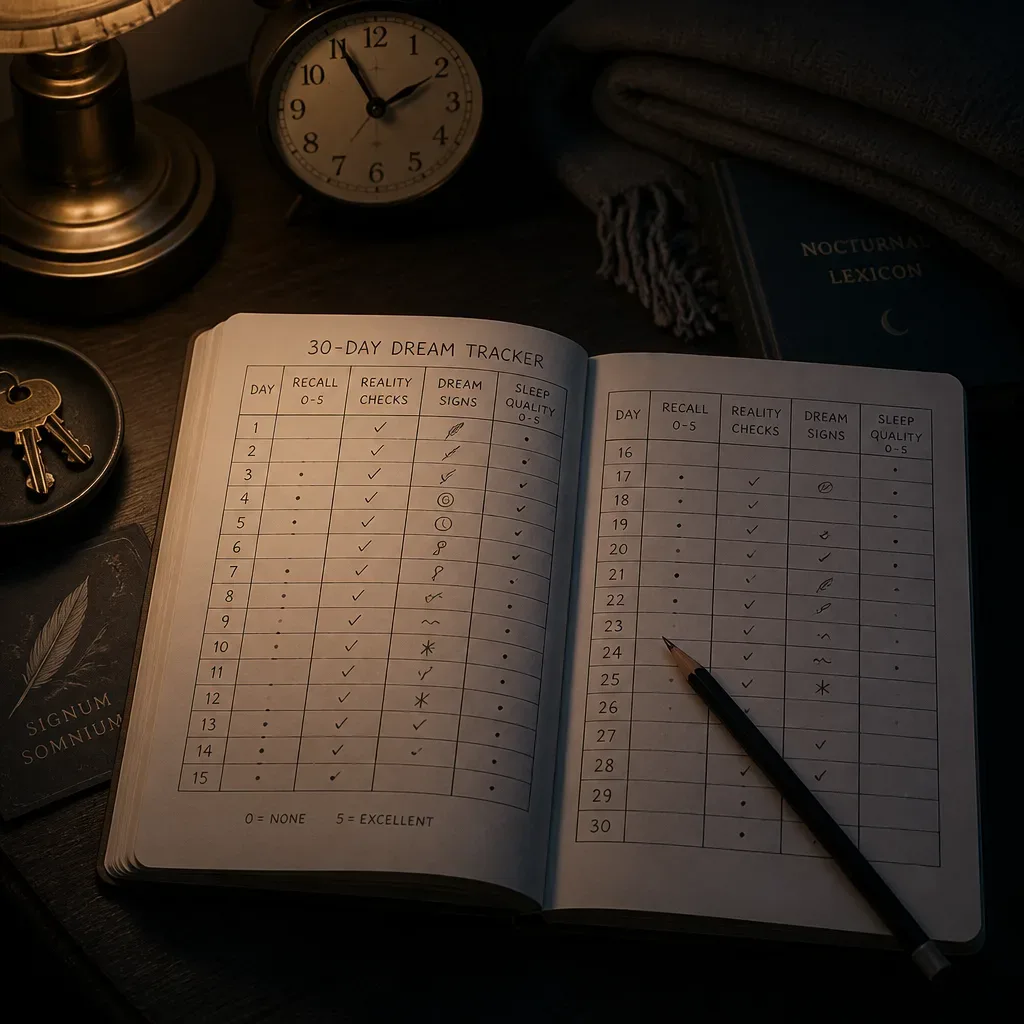
Track progress for 30 days using modest measures:
| Measure | Good sign | Warning sign |
|---|---|---|
| Dream recall | More fragments remembered | Staying awake too long to record |
| Daytime checks | 5 to 8 calm checks | Repeating checks anxiously |
| Dream signs | Repeats becoming clear | Forcing meanings too quickly |
| Sleep quality | Stable sleep length | Lost sleep from alarms |
| Lucidity | Brief recognition, even seconds | Frustration after every non-lucid dream |
A first lucid moment may last only a few seconds. You notice the impossible clock, feel a lift of recognition, and wake. That’s still a result. In lab studies, lucid dream signals often happen during REM, but home practice is messier. The nervous system gets excited. The dream collapses. Next time, aim for one calm action: look at your hands, touch a wall, or say, “This is a dream.”
If you’re using symbols to understand repeated dreams, cross-check them gently. The Dream dictionary (A–Z hub) is useful for common motifs, while the lucid dreaming guide keeps the induction side in view. Interpretation and lucidity are cousins, not twins. One asks what the dream may be carrying. The other asks whether you can notice the dream while it carries it.
Progress is not only the night you become lucid. Progress is the morning you remember honestly.
What can go wrong, and when should you stop?
You should stop or scale back when the practice makes waking life feel less stable, sleep shorter, or anxiety louder.
Most people can do reality checks safely as a light attention habit. The risk comes from intensity. If you check 40 times a day, set multiple alarms nightly, and treat non-lucid dreams as failure, the practice has lost its shape. Lucid dreaming asks for curiosity, not pressure.
Nightmares deserve special care. The threat-simulation theory, associated with Antti Revonsuo, argues that dreams may rehearse threatening events, but it remains a serious hypothesis rather than settled fact. Clinical nightmare work, including imagery rehearsal therapy, has better evidence for reducing nightmare distress in some groups. If nightmares are frequent, trauma-linked, or impairing your day, talk with a clinician instead of trying to lucid-dream your way through them alone.
Sleep paralysis also needs calm language. It can include sensed presences, pressure on the chest, or vivid images while waking or falling asleep. Researchers such as Brian Sharpless have estimated that around 8% of the general population reports sleep paralysis at least once, with higher rates in students and some psychiatric groups. It is often frightening and usually not dangerous, but recurrent or distressing episodes are worth discussing with a doctor.
Use this stoplight rule:
- Green: You check calmly, sleep normally, and record dreams without strain.
- Yellow: You’re impatient, adding alarms, or thinking about lucidity too much.
- Red: You feel unreal while awake, lose sleep, panic at night, or can’t stop checking.
If you’re in yellow, take a week off from induction and keep only the morning dream note. If you’re in red, stop the practice and get support. The point is not to win against the night. The point is to become a little more honest inside it.
Tonight, choose one cue, one check, and one line to write down in the morning.