lucid dreaming
Lucid Dreaming for Beginners: 7-Night Audio Cue Plan
Lucid dreaming for beginners can start with this calm 7-night audio cue plan: recall, reality checks, REM timing, and safe morning notes.
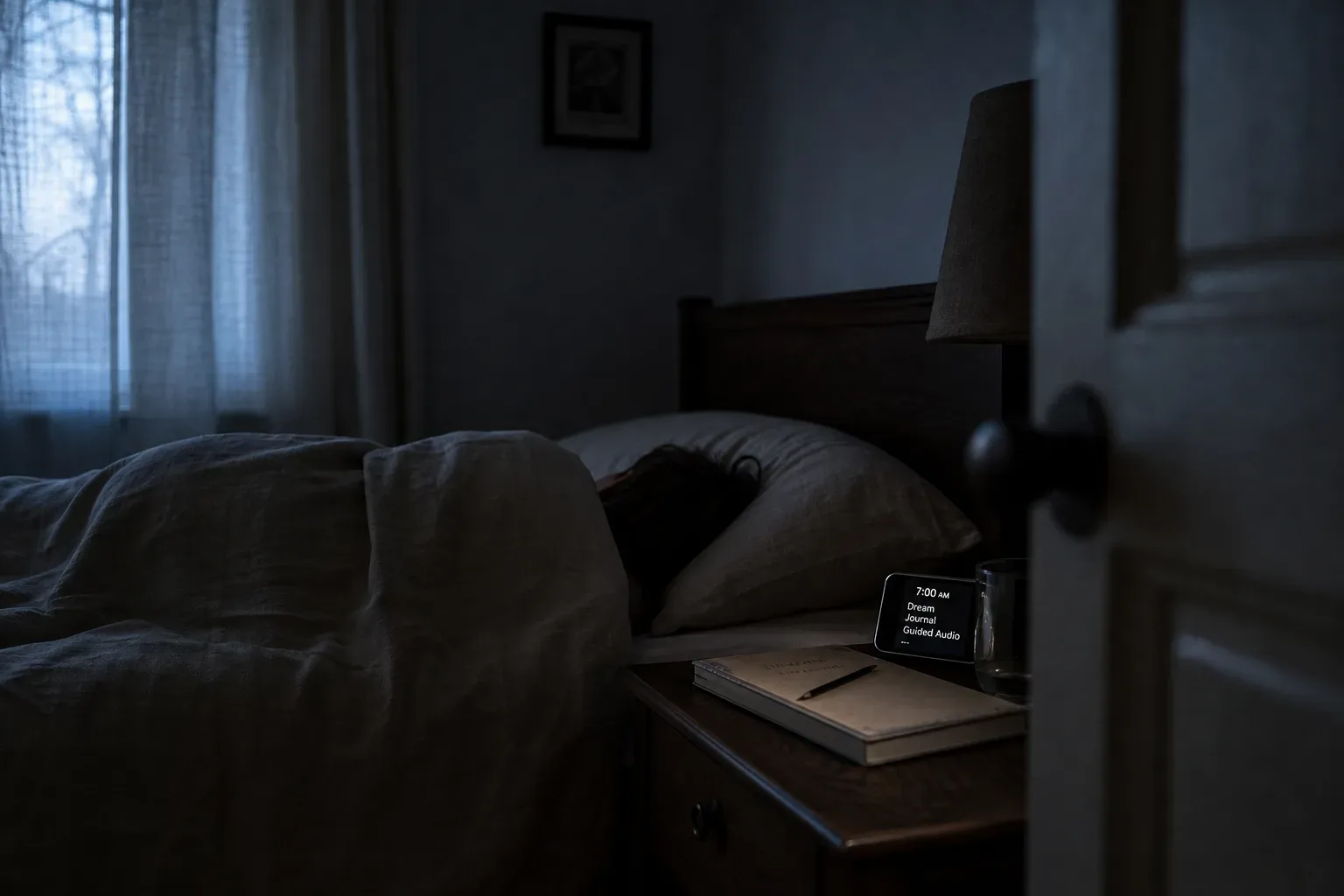
Lucid dreaming for beginners works best as a small practice, not a midnight stunt. For 7 nights, you’ll build dream recall, choose one recurring dream sign, pair it with a soft audio cue, and write down what happens each morning. The aim is recognition inside the dream, not perfect control.
What is lucid dreaming, and what should beginners expect first?
Lucid dreaming means knowing you’re dreaming while the dream is still happening.
That knowledge can be faint. You may think, this is odd, then lose it. You may know you’re dreaming but still follow the dream’s plot. Full steering is not the beginner’s first task. Recognition is. Stephen LaBerge’s early laboratory work in the 1980s showed that lucid dreamers could signal awareness with pre-agreed eye movements during REM sleep, giving researchers an observable marker rather than a romantic guess.
Most beginners should expect fragments before lucidity: a clearer memory, a strange moment noticed, a dream sign repeated 2 or 3 times across a week. A 2016 meta-analysis by Saunders and colleagues estimated that about 55% of people report at least one lucid dream in their lives, while roughly 23% report lucid dreams monthly or more. That means lucidity is common, but not nightly for most sleepers.
A beginner plan needs to protect ordinary sleep. The American Academy of Sleep Medicine recommends 7 or more hours for most adults, and lucid training that cuts sleep down will usually make recall worse. The night mind is easier to meet when the body isn’t being argued with.
Use this simple distinction:
| Term | What it means | Beginner goal |
|---|---|---|
| Dream recall | Remembering dream material after waking | 1 to 3 fragments each morning |
| Dream sign | A repeated oddity or theme | 1 sign to watch for |
| Reality check | A waking test of whether you’re dreaming | 5 calm checks per day |
| Audio cue | A quiet sound paired with intention | 1 soft cue in later sleep |
| Lucidity | Knowing you’re dreaming in the dream | A few seconds of recognition |
A lucid dream begins the moment the dream stops being invisible to itself.
If you want the wider background before starting, our lucid dreaming pillar explains the research, the old techniques, and the limits without making the dream do more than it can.
Why use audio cues instead of only reality checks?
Audio cues help because sound can sometimes enter REM dreaming without fully waking you.
This is the same ordinary fact that lets an alarm clock become a church bell in a dream, or a phone vibration become thunder. Researchers call related methods targeted memory reactivation when a sound learned before sleep is replayed during sleep. Oudiette and Paller reviewed this field in 2013, noting that sensory cues can bias sleeping memory, though lucidity is a narrower and harder target than memory alone.
For lucid dreaming, the best-known experimental phrase is targeted lucidity reactivation. In a 2020 study by Carr and colleagues, participants paired cues with lucidity training before sleep, then received sensory cues during REM. The findings were promising but small, which is the honest way to hold them. Audio cues may help some people notice the dream. They are not a button.
Reality checks still matter. If you hear a bell at night but have never trained the question during the day, the dream has little reason to understand it. The sound is a door knock; the daytime habit is learning to answer. In one large online study by Aspy and colleagues in 2017, the MILD technique was associated with higher lucid dream induction success than some other methods, especially when paired with brief awakenings.
Keep the audio plain:
- A single bell or chime, 1 to 3 seconds long
- A spoken phrase under 5 seconds, such as, This is a dream
- Low volume from a phone or speaker, not a startling alarm
- No urgent music, no harsh tones, no repeated loops for an hour
The cue should be kind enough that sleep doesn’t defend itself.
How do you prepare during the day for a 7-night plan?
Prepare by choosing one dream sign and rehearsing one calm question while awake.
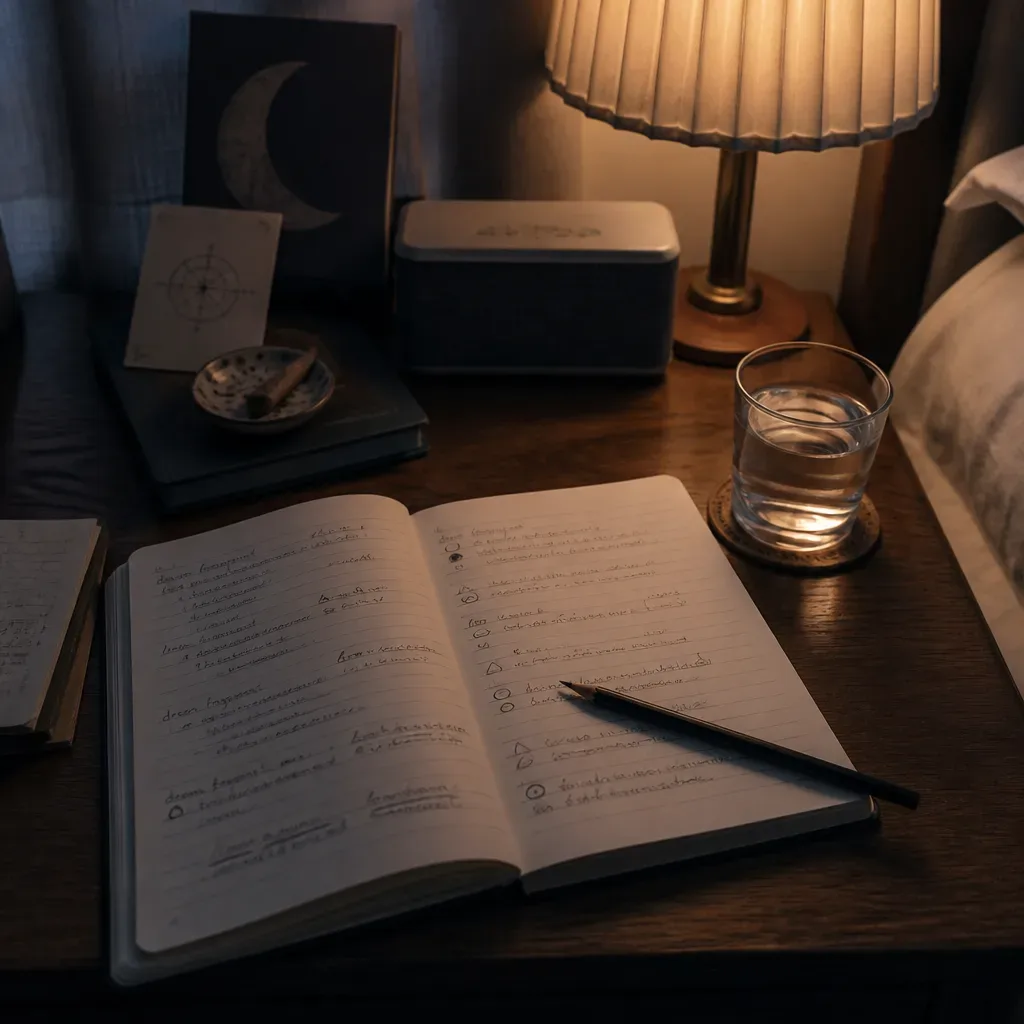
Start with a page, not an app if the screen pulls you away from the morning. Write yesterday’s dream if you remember it. If not, write the last dream you do remember. Then mark anything repeated: houses, water, school, dead relatives, lost phones, animals, teeth, elevators, trains, impossible architecture. The Dream dictionary (A–Z hub) can help you name symbols, but your own repetition matters more than any entry.
Research supports the continuity hypothesis of dreaming, associated with Calvin Hall and later dream researchers, which says dreams often reflect waking concerns rather than random theater. In large dream-content studies, recurring themes tend to cluster around threat, social conflict, work, family, and unfinished tasks. If your dream sign is a childhood kitchen, don’t rush to make it mystical. Ask what kind of room it is in your life: a room of care, noise, duty, hunger, or old weather.
Then practice the same check 5 times during the day. Do not perform it like a superstition. Stop, look at your hands, read a line of text twice, or ask whether the room obeys ordinary physics. In dreams, text often shifts and spaces misbehave. In waking life, the point is not to prove you’re awake. The point is to make the question familiar.
Try this daytime sequence for all 7 days:
- Notice your chosen sign or think of it on purpose.
- Pause for 10 seconds.
- Ask, Am I dreaming?
- Check one stable detail: hands, text, clock, light switch.
- Picture hearing your night cue and becoming aware.
- Return to the day without drama.
A good reality check is less like suspicion and more like attention.
If a symbol feels emotionally charged, you can run it through the AI dream interpreter tool after you’ve written your own first sentence. Let the tool be second. Your morning knows things before analysis does.
What exactly should you do each night?
Follow the 7 nights in order, changing only the volume if the cue wakes you too sharply.
Night 1 is baseline. No cue. Put a notebook within arm’s reach and write whatever arrives in the morning: one image, one sentence, even one mood. Dream recall improves with attention alone. In clinical and sleep-lab settings, awakenings from REM sleep produce dream reports more often than awakenings from non-REM sleep, with classic studies often finding reports after roughly 70% to 80% of REM awakenings.
Night 2 is pattern. Read your baseline note and choose one dream sign. If you remembered nothing, choose a sign from an older recurring dream. Night 3 is pairing. Practice your 5 daytime checks, then before sleep say the sign and the cue once. Keep it plain: When I hear the bell, I ask if I’m dreaming.
Night 4 is the first audio cue. Set one soft tone for about 5 hours after bedtime. REM periods lengthen in the second half of the night, so a later cue has a better chance of meeting dream-rich sleep. A typical sleep cycle runs about 90 minutes, though real bodies vary. If the cue wakes you fully, lower it the next night.
Night 5 adds the phrase. Use either the tone followed by This is a dream, or the phrase alone. Don’t use your own anxious voice if that makes the night tense. Choose a calm recording. Night 6 uses a brief wake-back-to-bed: wake after about 5 hours, stay up 5 to 10 minutes, read your dream sign, then return to sleep with the cue set for 20 to 40 minutes later. Aspy’s 2017 study found MILD worked better when people returned to sleep quickly after setting intention.
Night 7 is review. Keep the gentlest cue, not the most dramatic one. Ask what changed: recall, vividness, oddness, emotional tone, or actual lucidity. A week that gives you better recall has not failed. It has taught the door where to appear.
How should you set up the audio cue without disturbing sleep?
Set the cue late, low, brief, and tied to one sentence you’ve practiced while awake.
The practical setup is simple. Use a phone across the room, a soft alarm app, or a small speaker. Set the volume at the lowest level you can notice while lying still. Test it before bed. If another person shares the room, use a vibration or a barely audible tone only if it won’t disturb them. Lucid practice should not make someone else’s sleep pay the bill.
Timing matters more than novelty. For an 11 p.m. bedtime, a first cue around 4 a.m. roughly matches the later part of the night, when REM periods are longer. For a midnight bedtime, try 5 a.m. These are approximations, not rules. Wearable sleep trackers can estimate stages, but consumer devices vary in accuracy; validation studies often find they are better at sleep-wake detection than precise REM staging.
Use this cue plan as a starting map:
| Bedtime | First cue | Optional second cue | Morning note |
|---|---|---|---|
| 10:00 p.m. | 3:00 a.m. | 4:30 a.m. | Did the cue enter a dream? |
| 11:00 p.m. | 4:00 a.m. | 5:30 a.m. | Did it wake me gently? |
| 12:00 a.m. | 5:00 a.m. | 6:15 a.m. | Did recall improve? |
| 1:00 a.m. | 6:00 a.m. | Skip if needed | Was sleep shortened? |
Do not stack 10 alarms. More cues can mean less sleep, and less sleep can mean poorer attention the next day. Dr. Andrew Huberman often emphasizes consistent sleep timing and morning light for circadian stability; whatever one thinks of any single protocol, that basic sleep hygiene is well supported across decades of sleep research.
The dream is more likely to listen when you stop shouting at it.
How does this connect with intention practices like the AYA Method?
It connects through repetition: the sleeping mind notices what the waking mind returns to.
A recurring dream is one kind of repetition. A daily audio practice is another. The AYA Method is a daily audio manifestation practice. Each day you listen to a short personalized recording, your Dream-Self Moment, narrated from the version of you who has already manifested the life you intend. Listening is the practice. Repetition is the work. The audio is the method.
For lucid dreaming, your recording is not trying to force a dream. It is teaching one clean recognition: when I hear this, I notice. That’s close to what memory researchers have seen in cueing studies, where sounds linked to learning before sleep can influence later recall. The claim should stay modest. Your cue may become part of the dream. It may wake you. It may do nothing for 6 nights and then appear as a doorbell on the seventh.
This is why beginners should avoid turning lucid dreaming into conquest. Neville Goddard wrote often about imaginal rehearsal, and Joe Dispenza writes about mental practice and identity, but dreams resist command language. They answer better to relationship. The sleeping mind is not a machine that dispenses symbols when fed the right phrase. It is more like a shy animal that returns when the yard is quiet.

If you already keep affirmations or a visual board, let them remain complements. For this plan, the audio cue is the main thread. One phrase. One tone. One morning note. Too many objects of attention make the dream muddy.
What should you write down the morning after?
Write the smallest true record before you interpret anything.
Reach for the notebook before the phone. Movement and light can scatter recall quickly; many dream researchers ask participants to report immediately for this reason. Write in fragments if that’s all you have. A useful note may be only: blue hallway, father young, bell became school chime, knew for 2 seconds. That is enough. The dream does not need literary treatment to be respected.
Use four lines each morning:
- Time I woke:
- Dream fragments:
- Did I hear the cue, in sleep or waking?
- What was strange enough that I might notice next time?
Then add one sentence of meaning, but keep it honest. Not, the dream means I will succeed. Try, the dream placed me back in a room where I still feel tested. If grief appears, be especially gentle. Visitation dreams and dreams of the dead are common after loss; studies by Joshua Black and others have documented grief dreams as meaningful for many mourners, though they are not proof of contact in any scientific sense. They can still matter.
If nightmares increase, if you begin avoiding sleep, or if sleep paralysis becomes frequent and distressing, talk with a doctor or qualified sleep clinician. One plain sentence is enough because fear doesn’t need decoration.
For deeper symbol work, compare your notes with the Dream dictionary (A–Z hub), then return to your own line. For technique, revisit the lucid dreaming guide after the week ends, not in the middle of every night. And if you want a second reading of a stubborn image, the AI dream interpreter can help you form better questions.
The morning after is where the night becomes a practice.
Write the cue down, then let the morning be ordinary.