dream symbolism
Pregnancy Dream Meaning: New Life or Anxiety?
Pregnancy dream meaning often points to growth, fear, responsibility, or identity change. Learn common readings, variations, and what to write down.

A pregnancy dream usually points to something developing: a new self, a new responsibility, a creative idea, or an anxiety about change. If you are pregnant, trying, grieving, or avoiding pregnancy, the dream may be more literal. Either way, the pregnancy dream meaning depends on who is pregnant, how it feels, and what is beginning in waking life.
What does a pregnancy dream usually mean?
A pregnancy dream usually means your mind is picturing growth, change, or responsibility in the most bodily symbol it knows.
Pregnancy is one of the oldest images for a hidden process. Something exists, but it is not fully visible. It asks for protection. It changes the body that carries it. That is why the symbol often appears when a person is starting a job, making art, entering therapy, considering a move, or becoming someone they cannot yet describe. A dream pregnancy is often the mind choosing the clearest body-image for something that is not ready to be born.
The psychological reading fits what dream researchers call the continuity hypothesis: dreams tend to continue waking concerns rather than send supernatural messages. G. William Domhoff has written for decades that dream content often reflects personal preoccupations, relationships, and emotional patterns. In large dream collections, ordinary concerns show up more often than rare symbols; Domhoff’s Hall and Van de Castle coding system, first published in 1966, treated dreams as analyzable reports rather than riddles.
This does not make the symbol small. It makes it more useful. Ask what has a beginning, a due date, or a risk attached to it. Ask what you are carrying quietly. The baby in the dream may be real, symbolic, or both; your morning life decides which reading has weight.
A quick map helps:
| Dream detail | Common psychological reading | Morning question |
|---|---|---|
| You are pregnant | New identity or responsibility | What am I carrying now? |
| Someone else is pregnant | Change noticed in them or projected onto them | What do they represent to me? |
| Unwanted pregnancy | Pressure, obligation, fear of consequences | What feels imposed? |
| Joyful pregnancy | Readiness, care, anticipation | What am I glad is growing? |
| Hidden pregnancy | Private change or secrecy | What am I not ready to show? |
For a wider symbol map, keep the Dream dictionary (A-Z hub) nearby, but do not let any dictionary outrank your own emotion in the dream.
Does dreaming of pregnancy mean I am pregnant?
No, a pregnancy dream is not evidence that you are pregnant, though it can reflect waking attention to the possibility.
Dreams are not medical tests. They can include bodily sensations, fears, wishful thinking, and half-heard details from the day. If pregnancy is possible, take a home test at the right time or speak with a clinician. The U.S. Food and Drug Administration notes that many home pregnancy tests claim high accuracy when used after a missed period, but timing and instructions matter. The dream itself cannot do that work.
Still, literal context matters. A person trying to conceive may dream of pregnancy because the subject is emotionally present every day. A person using contraception may dream of pregnancy because the fear is emotionally present. A pregnant person may dream of pregnancy because the body is changing during sleep. In a well-known 1993 paper, researcher Tore Nielsen and colleagues reported that dream content in pregnancy can include themes of babies, childbirth, and maternal concerns, especially as waking attention increases.
There is also the ordinary fact of recall. REM sleep becomes easier to remember when you wake from it, and most adults have several REM periods each night, often totaling around 90 to 120 minutes. If you wake early, anxious, or physically uncomfortable, you may catch a dream you would otherwise lose. The dream feels special partly because you remember it cleanly.
So use two tracks. Track one is practical: if a test or appointment is needed, do that. Track two is symbolic: what possibility has your mind been rehearsing? Dreams reflect; they do not foretell. Folklore may speak otherwise, and folklore deserves a chair at the table, but it should not hold the lab results.
What if the pregnancy dream feels happy, strange, or frightening?
The feeling tells you whether the dream frames change as welcome, confusing, threatening, or unfinished.
A happy pregnancy dream often arrives when a person is ready to care for something new. It may be a relationship that feels tender, a skill that is finally taking shape, or a future that seems less abstract. The dream may not say the work will be easy. It says some part of you recognizes the life in it. A quiet dream can be more honest than a dramatic one.
A strange pregnancy dream, especially one with impossible details, usually asks for symbolic rather than literal reading. You may be pregnant with an animal, an object, twins, or a child who speaks. Dreams use compression. Freud called this condensation in 1900, though modern dream science does not need all of Freud’s theory to notice the pattern. One image can hold several meanings at once: care, fear, body, family, secrecy, time.
A frightening pregnancy dream tends to show conflict. Maybe the pregnancy is unwanted. Maybe nobody believes you. Maybe the birth starts too soon. In nightmare research, Nielsen and Levin’s 2007 affective network model connects distressing dreams with emotional concerns that have not been fully processed. That does not mean the dream is a diagnosis. It means the dream may be using fear to mark importance.
Notice these emotional cues:
- Relief often points to readiness or permission.
- Shame often points to visibility and judgment.
- Panic often points to responsibility arriving too fast.
- Wonder often points to a new identity forming quietly.
- Disgust often points to a change you have not accepted.
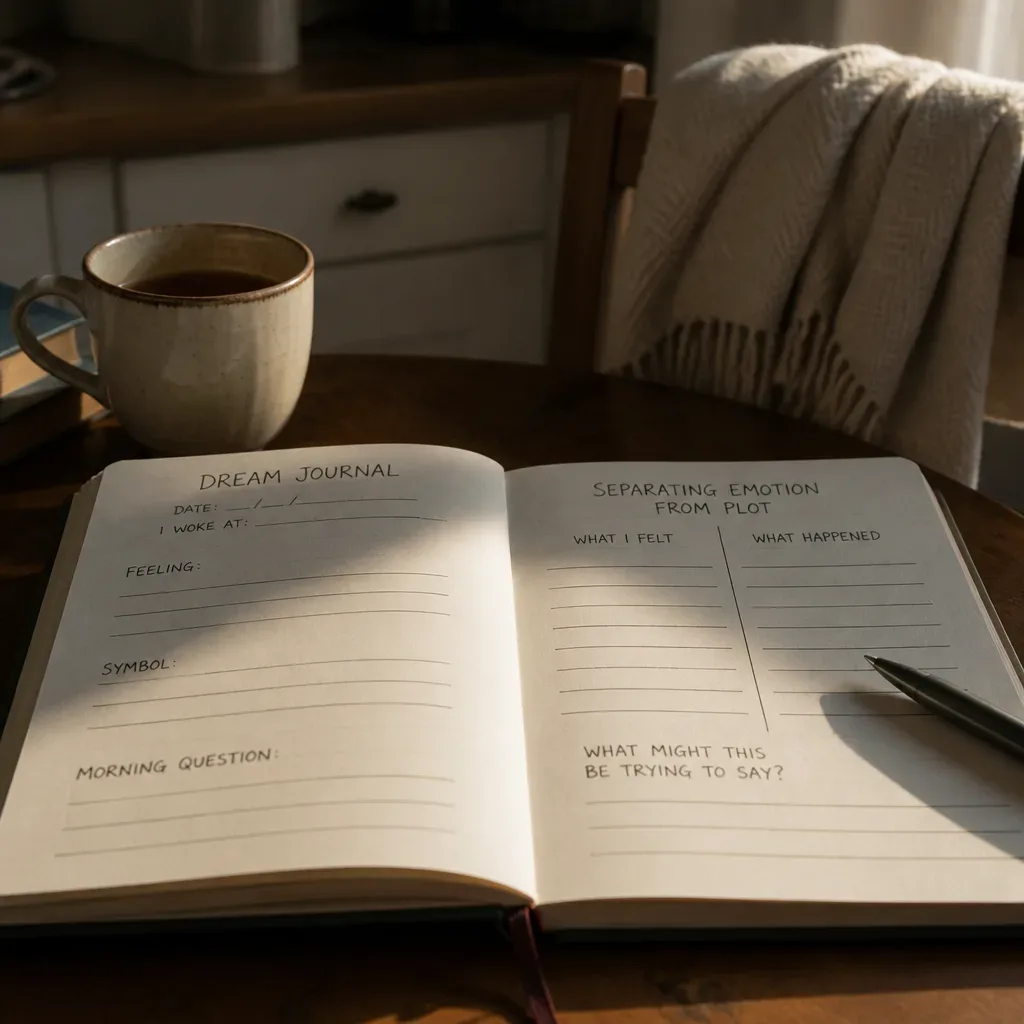
If the dream was disturbing, write the feeling first, before the plot. The plot is the costume. The feeling is the address.
What does it mean when someone else is pregnant in the dream?
When someone else is pregnant in your dream, your mind may be placing growth, vulnerability, or responsibility outside you so you can look at it.
The person matters, but not always literally. A sister may represent family expectation. A friend may represent freedom. A coworker may represent ambition or comparison. A stranger may represent a part of you that has no familiar face yet. Jung used the word complex for emotionally charged clusters of meaning; you do not need to become Jungian to notice that certain people carry more than themselves in dreams.
Start with association, not biography. If your ex is pregnant, the dream may not be about your ex. It may be about what the relationship left unfinished. If your mother is pregnant, the dream may point to old family patterns renewing themselves, or to your own changing relation to care. If your partner is pregnant, it may concern shared responsibility, future planning, or unequal emotional labor. Pew Research Center reported in 2023 that adults continue to describe family, finances, and work as major sources of stress; dreams often borrow the faces closest to those pressures.
The gender of the pregnant figure can also loosen the symbol. A man pregnant in a dream may show creativity outside expected roles, or the absurd pressure of carrying what no one thinks he carries. A child pregnant in a dream can feel alarming; often it points to innocence burdened too early, a young part of the self asked to hold adult concerns.
Use this numbered check before settling on an interpretation:
- Name the pregnant person in one word: generous, demanding, free, fragile, hidden.
- Name your strongest emotion toward them in the dream.
- Ask what in your life shares that word and emotion.
- Write one sentence connecting the two without forcing it.
If the dream remains unclear, you can compare symbols with the AI dream interpreter tool, then return to your own notes. The tool can suggest patterns. Your body remembers the tone.
How do culture, spirituality, and folklore read pregnancy dreams?
Cultural readings often treat pregnancy dreams as signs of blessing, burden, creativity, or change, but these are traditions rather than proof.
Many traditions read pregnancy as increase: new work, family growth, money, harvest, or spiritual responsibility. In some Christian folk readings, pregnancy can mean a calling or promise being carried. In some Islamic dream manuals, often attributed through long interpretive traditions rather than modern authorship, pregnancy can be read differently depending on the dreamer’s gender, status, and circumstances. In parts of European folklore, dreaming of pregnancy has been linked to news arriving soon. These readings have long lives, but no good evidence shows they predict events.
That does not make them useless. Folklore preserves how communities think about risk and hope. Pregnancy has never been only biological; it has always been social. It changes inheritance, labor, belonging, reputation, and care. Anthropologists have noted across many cultures that rites around pregnancy and birth mark transition, not only reproduction. Arnold van Gennep’s 1909 work on rites of passage remains a standard reference for how societies frame threshold moments.
Spiritual readers may say the dream shows a soul project, inner child, or new phase. If that language helps you be kinder and more responsible, use it. If it makes you frightened or fatalistic, set it down. A good interpretation gives you more honesty, not more dread.
It is also worth separating symbol from superstition. A dream can feel sacred without being predictive. You can honor your grandmother’s reading and still take a pregnancy test only because biology requires one. You can light a candle, say a prayer, or write in a notebook, then make breakfast and answer your email.
For related symbols such as babies, birth, water, blood, or houses, the Dream dictionary (A-Z hub) can help you see neighboring meanings. Symbols live in families. Pregnancy dreams often sit close to dreams of rooms, doors, hospitals, animals, and lost children.
Why do pregnancy dreams repeat?
Recurring pregnancy dreams usually mean the same emotional problem or developing identity keeps asking for attention.
A recurring dream is less like a prophecy and more like a sticky note from the nervous system. It repeats because the concern is still active. In clinical sleep literature, recurring dreams are often associated with stress, unresolved emotion, or repeated waking patterns. A 2012 review by Antonio Zadra and colleagues noted that recurrent nightmares and bad dreams are common enough to be clinically relevant when they impair sleep, though ordinary recurring dreams can occur without disorder.
Look for what changes between versions. Are you more pregnant each time? Is the baby never born? Do you hide it, lose it, forget it, or protect it? The repeated structure matters. A pregnancy that never reaches birth may point to a project that never enters the world. A hidden pregnancy may point to privacy, shame, or careful timing. Twins may point to two futures developing at once.
Lucid dreamers pay special attention to recurring themes because they become dream signs. If pregnancy appears again and again, you can use it as a cue to ask, am I dreaming? The practice is simple but not easy. My own notebooks since 2006 use the same format: date, one-line summary, underlined dream signs, lucidity in the margin. If you want to train that skill, start with the Lucid dreaming pillar. Two boring weeks of recall usually help more than one clever technique.
This is also where waking practice can meet dream practice. A recurring dream shows you what your attention keeps returning to, especially the fears and wants underneath it. The AYA Method is a daily audio manifestation practice. Each day you listen to a short personalized recording, your Dream-Self Moment, narrated from the version of you who has already manifested the life you intend. Listening is the practice. Repetition is the work. The audio is the method.

What should you do the morning after a pregnancy dream?
The morning after a pregnancy dream, write down the dream plainly and connect it to one waking change without rushing to a verdict.
Do it before the phone. Dream recall decays quickly; sleep researchers often ask participants to record dreams immediately on waking because memory changes within minutes. Even 3 minutes of delay can blur the order, and by breakfast many people have only the emotional residue. A notebook works better than a perfect system you never use.
Use a compact format. I teach beginners this because it survives tired mornings:
- Date and wake time.
- One-line summary.
- Who was pregnant.
- Feeling on waking, from 1 to 10 in intensity.
- Three waking-life links.
- One sentence: Something in me is developing as…
For example: Something in me is developing as a willingness to be seen at work. Or: Something in me is developing as fear about a decision I have delayed. The sentence may feel too simple. Good. Simple sentences are harder to hide behind.
Then ask the honest questions. What am I carrying? What feels too early? What needs care before it is shown? Who in the dream made me feel supported or judged? If the dream touched grief, infertility, miscarriage, abortion, birth trauma, or medical fear, be gentle with the symbol. Roughly 10 to 20 percent of known pregnancies end in miscarriage, according to estimates often cited by Mayo Clinic and ACOG, so many readers carry real histories into this dream image.
If pregnancy dreams become frequent nightmares, disturb sleep for several weeks, or connect with panic, depression, or trauma symptoms, talk with a doctor or licensed therapist. That sentence is not meant to frighten you. It is meant to keep dream work in its proper place.
For a final cross-check, compare nearby symbols in the Dream dictionary (A-Z hub), or use the AI dream interpreter tool when the details are tangled. Then return to your own page. The dream came through your life, not through a general rule.
Write the line down before the day teaches you to forget it.