dream symbolism
Hair Falling Out Dream: Control, Aging, or Identity?
A hair falling out dream usually points to control, aging, stress, or identity change. Here’s how psychology and folklore read it.
A hair falling out dream usually means you’re worried about control, aging, identity, health, or being seen differently. It doesn’t predict baldness. The dream takes something public and intimate, your hair, and makes its loss visible. Look first at what you were losing in waking life: authority, youth, privacy, beauty, certainty, or an old self.
What does a hair falling out dream usually mean?
A hair falling out dream usually means that a visible part of your identity feels unstable.
Hair is practical, but symbolically it’s rarely neutral. It’s what others see before they hear your history. It can mark age, gender, religion, mourning, rebellion, illness, class, and attraction. In a 2019 survey by the International Society of Hair Restoration Surgery, 62.5% of men reported some degree of hair loss concern, which tells us something simple: hair carries emotional weight before it ever reaches the pillow.
Psychologically, the dream tends to gather around control. You may be managing a change you didn’t choose: a job restructuring, a difficult diagnosis, a family role that has shifted, or a relationship in which you don’t recognize your old place. The sleeping mind is economical. Instead of writing a report, it gives you a handful of hair.
The dream is especially common when appearance has become a pressure point. Research on body image, including work summarized in the journal Body Image since its 2004 launch, repeatedly finds that visible traits are tied to self-esteem and social anxiety. Hair is visible, changeable, and judged. That makes it a useful symbol when you feel watched.
The dream is not saying you are vain. It’s saying the body is where many private fears become public.
If you woke frightened, note the loss. If you woke oddly relieved, note that too. Sometimes hair falling out is not only about losing beauty or youth. It can mark the shedding of a role that has grown too tight. The same image can say, “I’m afraid I’m disappearing,” or “I’m done performing this version of myself.” For other common body-symbol dreams, the Dream dictionary (A–Z hub) can help you compare patterns without forcing one meaning onto every night.
Is the dream about losing control?
Yes, it often is about losing control, especially if the hair came out suddenly, in clumps, or while other people watched.
Hair is one of the few body parts we routinely shape. We cut it, dye it, cover it, braid it, shave it, straighten it, oil it, pin it, and display it. A study published in Psychology of Women Quarterly in 2012 found that appearance surveillance, or frequently monitoring how one looks, is associated with body shame and anxiety. A dream where hair won’t stay attached can dramatize that same loss of management.
Ask how the dream handled agency. Did you pull the hair out yourself, or did it fall without warning? Did someone else cut it? Did you try to sweep it away before anyone noticed? These details matter because they show whether the dream is centered on pressure from within, pressure from others, or a change that feels indifferent to your wishes.
A simple reading map helps:
| Dream detail | Common psychological reading | Morning question |
|---|---|---|
| Hair falls out in clumps | Sudden loss of control | What feels like it’s happening too fast? |
| You pull it out yourself | Compulsion, guilt, or self-criticism | Where am I being harsh with myself? |
| Someone cuts it off | Boundary violation or outside authority | Who has been deciding for me? |
| You hide the hair | Shame or fear of exposure | What don’t I want seen? |
| You feel calm | Release, surrender, new identity | What am I ready to stop carrying? |
Clinical dream research is careful about certainty. Calvin Hall and Robert Van de Castle’s 1966 system for dream-content analysis showed that dreams often reflect waking concerns, but not as one-to-one translations. A hair falling out dream doesn’t mean “control” every time. It means control becomes a strong reading when the dream’s emotion is panic, helplessness, embarrassment, or urgency.
A dream symbol is not a code to crack. It’s a place where your feeling chose a picture.
Is it really about aging, beauty, or health anxiety?
It can be about aging, beauty, or health anxiety when the dream’s strongest feeling is exposure, decline, or fear of being changed by the body.
Hair has a clock inside it. It grays, thins, recedes, thickens during pregnancy for some people, sheds after illness for others, and changes texture with hormones. The American Academy of Dermatology notes that losing 50 to 100 hairs a day is normal. That ordinary fact doesn’t stop the mind from treating visible shedding as a message, especially during periods of stress or bodily change.
Aging dreams often arrive at thresholds: birthdays ending in 0, a parent’s illness, a child leaving home, a divorce, menopause, a new role at work, or seeing a younger colleague take the room with ease. The dream may not be about age in years. It may be about your relationship to time. The mirror in the dream often matters. A mirror says, “Look at how you’re seeing yourself.” A crowd says, “Look at how you fear being seen.”
Health anxiety can also use hair because hair is a visible health marker. After fever, childbirth, major stress, or nutritional changes, some people notice temporary shedding called telogen effluvium. Dermatology texts commonly describe it as appearing about 2 to 3 months after a trigger. If the body has been on your mind, the dream may borrow that worry and exaggerate it.
This is not medical advice. If you’re losing hair while awake, noticing bald patches, scalp pain, sudden shedding, or other symptoms, speak with a doctor or dermatologist.
The kinder reading is this: the dream may be grieving a former image of yourself. Not because that image was false, but because it was familiar. A self can be loved and still outgrown.
What do cultural and spiritual traditions say about hair loss in dreams?
Cultural traditions read hair falling out as a sign of status, vitality, shame, grief, money, or spiritual vulnerability, depending on the community and period.
In biblical tradition, Samson’s hair carries strength and covenant. Judges 16 is not a dream text, but it shaped later European and Middle Eastern associations between hair and power. To lose hair in that symbolic world can mean a loss of protection, social force, or sacred obligation. That doesn’t make the dream a prediction. It shows how old stories teach the sleeping mind what hair can mean.
In many European folk dream books from the 18th and 19th centuries, losing hair was linked to worry, poverty, or grief. These books were not scientific; many were commercial almanacs, often recycled across borders with altered headings. Still, they preserve ordinary anxieties. Hair loss meant reduction. Less beauty, less money, less strength, less standing in the village eye.
In parts of South Asia, hair can be tied to ritual purity, devotion, and sacrifice. Tonsure at temples, including the well-known practice at Tirumala in India where millions of pilgrims offer hair each year, gives hair loss a different charge: surrender, vow, humility, or gratitude. If you grew up near that symbolism, a dream of hair falling may not feel only frightening. It may feel like being stripped down to what is honest.
African, Indigenous, and diasporic traditions are too varied to flatten. In some communities, hair is ancestry, social identity, craft, and memory. In others, hair left in the wrong hands can carry fears of harm through folk magic. A careful reader asks: whose kitchen, whose church, whose grandmother, whose barber shop taught you what hair means?
- In folklore, hair often stores vitality.
- In religious practice, hair can mark vow, mourning, or humility.
- In social life, hair often signals belonging or refusal.
- In family memory, hair may carry a parent’s rule or blessing.
The snake means one thing in Cairo and another in São Paulo. Hair is the same. Culture doesn’t replace psychology. It gives psychology an accent.
Do the details of the dream change the meaning?
Yes, the details change the meaning because hair loss in a bathroom is not the same dream as hair loss on a stage.
Dreams are built from setting, action, characters, and feeling. The AI dream interpreter tool can help organize those pieces, but the first pass should be yours. In the morning, write the dream in 6 lines or fewer before interpretation. Dream recall drops quickly after waking; sleep researchers have noted for decades that even vivid dreams can fade within minutes if they aren’t rehearsed.
Use this numbered check before deciding what the dream means:
- Name the place. Bathroom, bedroom, workplace, salon, hospital, temple, street.
- Name the witness. Alone, partner, parent, stranger, crowd, child, rival.
- Name the method. Falling, cutting, pulling, burning, shaving, washing out.
- Name the feeling. Panic, shame, relief, numbness, anger, curiosity.
- Name the waking parallel. One situation where you feel similarly exposed.
A salon dream often concerns chosen identity. A hospital dream may concern health anxiety or vulnerability. A work dream may point to competence and reputation. If a parent appears, the dream may involve inherited standards: how your family taught you to be respectable, beautiful, masculine, feminine, modest, wild, or safe.
Lucid dreamers sometimes meet this image differently. If you become aware you’re dreaming while your hair falls out, you can ask the dream a question: “What am I afraid to lose?” Studies by Ursula Voss and colleagues in 2009 linked lucid dreaming with hybrid features of waking awareness and REM sleep, though lucid dreaming remains uncommon for many people. Our Lucid dreaming pillar gives a careful overview if this happens to you often.
Pay attention to color. White hair may point toward age or wisdom. Black hair may carry family, sensuality, or cultural identity. Dyed hair can suggest a chosen persona. A wig falling off may be more about performance than loss. The dream doesn’t only ask, “What fell?” It asks, “What did that hair help you be?”
Why does this dream happen during stress or change?
This dream often happens during stress because the sleeping mind turns pressure into body images you can’t ignore.
Stress dreams are usually not subtle. They use missed trains, broken teeth, exam rooms, locked doors, and bodies changing without consent. The American Psychological Association’s 2023 Stress in America report found that many adults described stress as affecting health, decision-making, and daily functioning. When waking life feels crowded, the dream may choose the scalp because it’s intimate and visible at once.
REM sleep is active, emotional, and associative. Matthew Walker and other sleep researchers have described REM as a state in which emotional memories can be processed with a different neurochemical profile than waking life. The exact function of dreaming is still debated, but many studies support the idea that dreams often incorporate recent concerns, especially those with emotional charge.
Hair falling out can also appear after an identity change that hasn’t been fully spoken. You left a religion. You became a parent. You stopped being the reliable one. You retired. You started dating after years alone. You changed your name, your pronouns, your clothes, your work, your city. The dream may not be punishing you for change. It may be showing that the old image hasn’t quietly gone.
Identity rarely changes all at once. First it loosens at the edges.
This is where a waking practice can be useful, if it stays honest. The AYA Method is a daily audio manifestation practice. Each day you listen to a short personalized recording, your Dream-Self Moment, narrated from the version of you who has already manifested the life you intend. Listening is the practice. Repetition is the work. The audio is the method. For a recurring hair falling out dream, that kind of daily audio can serve as the waking counterpart: instead of waiting for the night to show you your fear, you give your attention a steadier sentence.
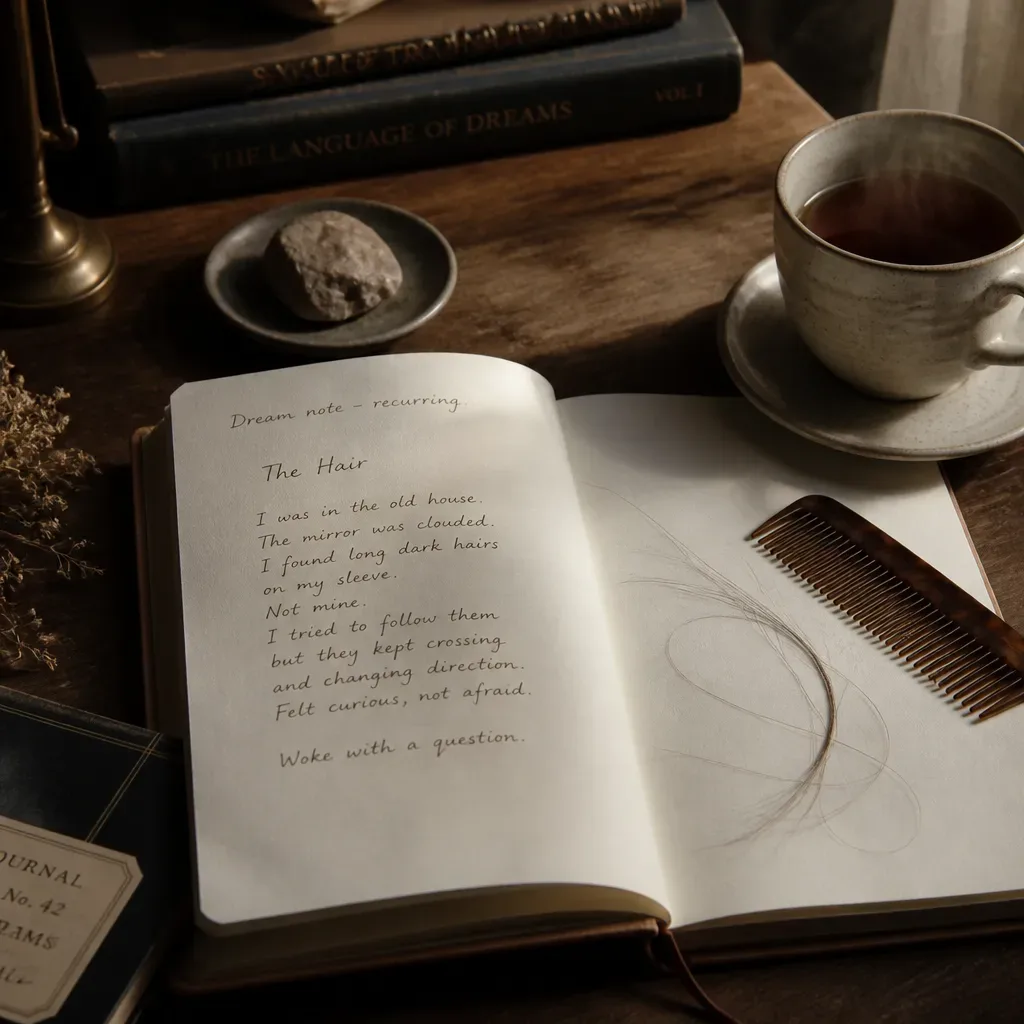
When is a hair falling out dream connected to grief or shame?
It’s connected to grief or shame when the dream feels like being diminished, exposed, punished, or separated from a former self.
Grief often uses the body because loss is bodily. People feel grief in appetite, sleep, posture, skin, and breath. A 2019 paper in Frontiers in Psychology reviewing bereavement dreams noted that dreams of the dead are common and often emotionally significant, though frequency varies across studies. Hair falling out after a death, breakup, estrangement, or migration may represent the body admitting, “I’m not who I was before this.”
Shame dreams have a different texture. They involve being seen at the wrong moment. Hair comes out in public. A bald patch appears under bright light. Someone laughs. You try to cover your head and can’t. The symbol here is not hair alone. It’s exposure. Shame says, “If they see this, they’ll know.” The dream asks what “this” is.
In some traditions, cutting hair marks mourning. Victorian England made mourning jewelry from hair, preserving the dead in bracelets, brooches, and lockets. In parts of the Mediterranean and Balkans, laments and hair tearing appear in older mourning customs. These practices are culturally specific, but they share one idea: hair can carry attachment. To lose it in a dream may mean a bond is being altered.
But don’t over-darken the image. Some shame dreams soften when written down. Try this sentence: “I felt ashamed when ___ saw my hair fall out.” Then ask whether that person has waking authority over your self-image. It may be a living person. It may be a dead parent’s standard. It may be an old school hallway still living in the nervous system.
A nightmare becomes more ordinary when it has a sentence attached to it.
What should you do the morning after this dream?
The morning after, write the dream plainly, identify the feeling, and connect it to one waking situation where your identity feels less secure.
Do this before checking messages. Keep it simple. Dream work doesn’t improve by becoming theatrical. A 2018 study in Nature Communications found that sleep helps consolidate emotional memories, but interpretation still belongs to the waking person. You’re not hunting for fate. You’re noticing a pattern.
Use this 5-minute note:
- “My hair was falling out in ___.”
- “The person who saw it was ___.”
- “The feeling was ___.”
- “In waking life, I feel that way about ___.”
- “One thing I can do today is ___.”
If the dream was frightening, reduce the day’s demand for certainty. Drink water. Look at your actual hair without accusation. If there’s real shedding, book a medical appointment rather than searching forums at 2 a.m. If there’s no waking hair issue, treat the dream as symbolic. The mind is allowed to use the body as metaphor.
You can also compare nearby symbols. Teeth falling out dreams, mirror dreams, naked-in-public dreams, and haircut dreams often share themes of exposure and control. The Dream dictionary (A–Z hub) is useful when one image seems to belong to a larger pattern. If the dream becomes lucid or repeats with small changes, read the Lucid dreaming pillar and note whether awareness changes the ending.
The best question is not “What does hair mean?” It’s more exact: “What did my hair mean to me in that room, with that person watching?”
Write the strand down before the morning carries it away.