lucid dreaming
Lucid Dream Journal Prompts for Audio Cues
Use a lucid dream journal to turn recurring dream signs into short audio cues you can rehearse before sleep and recognize at night.

A lucid dream journal turns useful when it stops collecting everything equally and starts tracking dream signs. Write the repeated image, name the feeling around it, then turn it into a short audio cue you hear before sleep. The cue teaches your sleeping mind what to notice without bullying the night.
What counts as a dream sign in a lucid dream journal?
A dream sign is any repeated detail that could make you ask, “Am I dreaming?”
In a lucid dream journal, the best signs are not necessarily the strangest ones. A dragon is memorable, but if it appears once in ten years, it isn’t your best teacher. A malfunctioning phone, a childhood hallway, an exam you never studied for, or a dead relative making breakfast may be more useful because they return. The sign is ordinary to the dream and suspicious to the waking mind.
Lucid dreaming research often treats recognition as a trainable skill. In a 2016 review in Consciousness and Cognition, Saunders and colleagues estimated that about 55 percent of adults have had at least one lucid dream, while roughly 23 percent report lucid dreams once a month or more. That number matters because lucidity isn’t a rare gift. It tends to arrive when memory, attention, and oddity meet at the right moment.
Your journal helps that meeting happen. If you want a broader map of common symbols, the Dream dictionary (A–Z hub) can give you old meanings and clinical traditions, but your own repetition has priority. The snake in a book matters less than the snake that appears whenever you avoid a phone call from your sister.
A dream sign is not a secret code. It is a place where the dream repeats itself until you notice.
Start with five categories. They are simple enough to use at 7 a.m., when the tea is steeping and the dream is already fading:
- People: dead relatives, old teachers, former partners, strangers who feel familiar.
- Places: childhood homes, schools, hotels, trains, impossible rooms.
- Objects: phones, teeth, keys, mirrors, clocks, shoes.
- Events: flying, being chased, missing transport, taking exams.
- Feelings: shame, hurry, wonder, grief, being watched.
A sign becomes workable when you can name it in six words or fewer. “The house has extra rooms” is better than “weird architecture.” “My phone won’t dial” is better than “technology problems.” The night speaks in images. The morning has to make them portable.
How do you collect dream signs before choosing audio cues?
You collect dream signs by writing first, sorting second, and interpreting last.
For the first seven mornings, don’t try to be clever. Write the dream as if you’re reporting weather: who was there, where you were, what changed, and what feeling remained. Sleep researchers have long noted that dream recall varies widely; in laboratory settings, awakenings from REM sleep produce reports more often than awakenings from non-REM sleep, with classic studies by Dement and Kleitman in 1957 helping establish the REM-dream connection. Your home journal won’t be a lab, but it can be consistent.
Use timestamps. A note written at 6:42 a.m. is different from a reconstruction written after lunch. In small studies on dream recall, frequent recording tends to increase remembered dreams over time, though the evidence is not magical and not uniform. The plain mechanism is likely attention. What you ask the mind to save, it becomes somewhat more likely to save.
Here is a reliable morning order:
- Stay still for 20 seconds. Movement can scatter the final images.
- Write three nouns. Person, place, object.
- Write one emotion. Choose the feeling before the meaning.
- Mark anything impossible. Dead people alive, rooms changing, time bending.
- Underline repeats. Compare with the last 14 days.
If you need help holding a fragment while you type, the AI dream interpreter tool can help you organize the material, but don’t hand it your authority. A tool can suggest patterns. Only you know that the blue car belonged to your father, or that the hotel lobby smelled like the clinic where you waited for bad news.
A good lucid dream journal keeps interpretation on a short leash. First record. Then recognize. Then ask. If you reverse the order, you may end up with a beautiful theory and no useful cue.
Which journal prompts turn dream signs into audio cues?
The best prompts make the sign specific, emotional, and easy to hear in one sentence.
Audio cues fail when they sound like slogans. “I will be lucid tonight” may feel tidy, but it gives the dream no image to work with. “When the hallway gets longer, I notice I’m dreaming” gives the mind a scene and an action. Stephen LaBerge’s MILD technique, first developed in the 1980s, depends partly on prospective memory: remembering to do something later. Later work, including a 2017 study by Denholm Aspy and colleagues in Dreaming, found that participants using MILD soon after waking during the night had higher lucid dream rates, especially when they fell asleep again within about five minutes.
Use these prompts after you have at least three written dreams or one strong recurring dream. If you’re new to lucidity, read the Lucid dreaming pillar first, then return with a pen. Technique without dream material often becomes strain.
| Journal prompt | What it finds | Audio cue shape |
|---|---|---|
| What object kept failing? | Frustration sign | “When the phone fails, I check the dream.” |
| What place changed shape? | Spatial sign | “When the house grows rooms, I know I’m dreaming.” |
| Who appeared out of time? | Person sign | “When I see my old teacher, I pause and notice.” |
| What feeling arrived too strongly? | Emotional sign | “When the hurry feels too large, I ask if this is a dream.” |
| What law of waking life broke? | Physics sign | “When I float, I remember my sleeping body.” |
Now write your own cue in three passes:
- Name the sign: “The elevator has no buttons.”
- Name the recognition: “That means I may be dreaming.”
- Name the action: “I look at my hands and stay calm.”
The finished line becomes: “When the elevator has no buttons, I know I may be dreaming, and I look at my hands.” Keep it under 18 words if you can. Short cues survive sleep better than ornate ones.
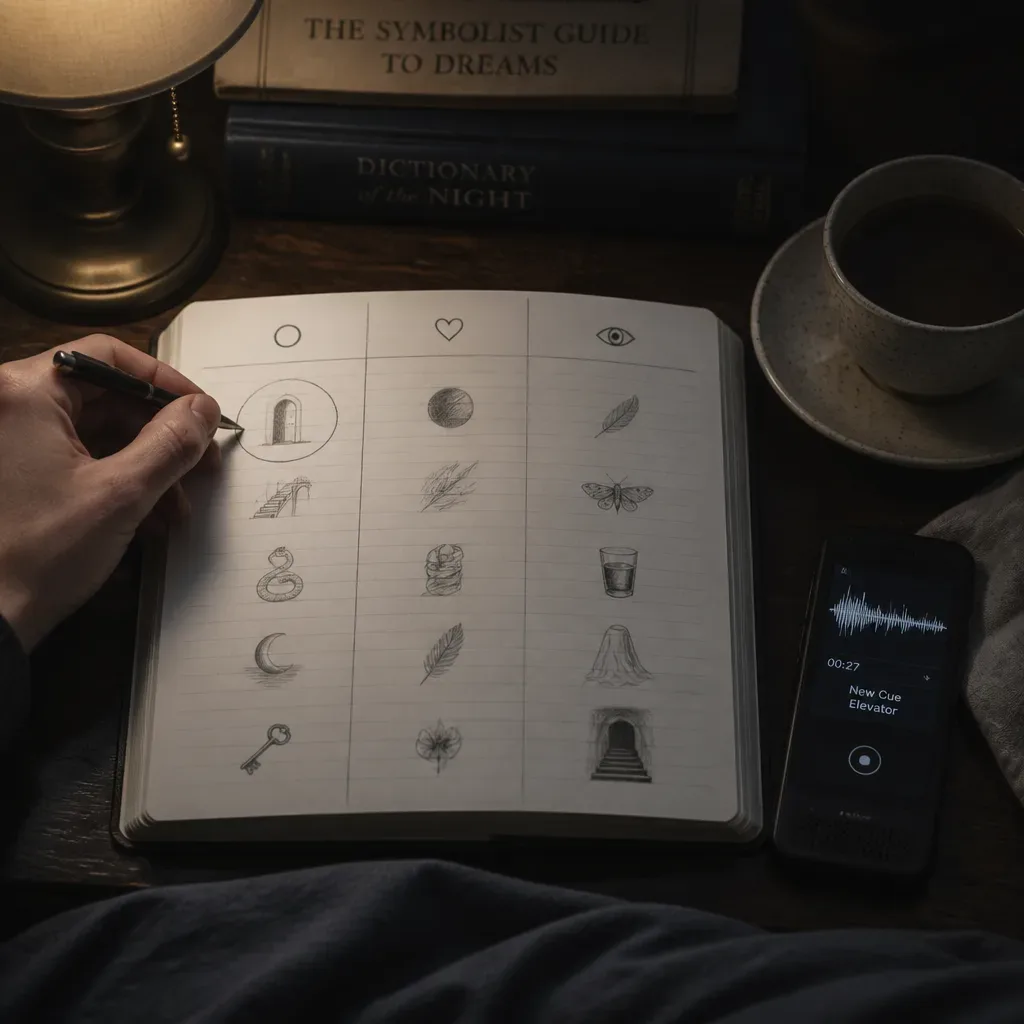
The cue should be small enough to remember and strange enough to wake the mind inside the dream.
Don’t choose a sign because it sounds impressive. Choose the sign that returns. A person who dreams of teeth falling out every month may find more practical use in a teeth cue than in a flying cue, even if flying sounds more classically lucid. If the teeth image is troubling, the entry on the Dream dictionary (A–Z hub) can offer context, but the cue should remain plain: “When my teeth loosen, I ask whether I’m dreaming.”
How should an audio cue sound before sleep?
An audio cue should sound slow, ordinary, and believable to your nervous system.
Recordings for lucid dreaming do not need theatrical music or a dramatic voice. In fact, too much atmosphere can keep you awake. A useful audio cue is usually 30 to 120 seconds long, with one to three sentences repeated gently. Dr. Andrew Huberman has often summarized sleep onset as a state helped by lowered arousal; while his podcast is not a dream lab, the point is practical. If your cue makes you alert in the wrong way, it is no longer serving sleep.
Use first person if it feels natural. Use second person if you respond better to being addressed. Test both for three nights each. Your body will tell you which one causes less effort.
Examples:
- “When the house has extra rooms, I notice the dream and breathe slowly.”
- “If my phone won’t work, I ask, ‘Am I dreaming?’”
- “When I see my grandmother alive, I remember to look at my hands.”
- “If the road becomes water, I stay calm and know I’m dreaming.”
The phrase “stay calm” matters. Many beginners wake up as soon as they become lucid. In lucid dreaming reports collected over decades, excitement is one of the most common reasons the dream collapses. A cue that includes steadiness gives you something to do after recognition. It is not enough to open the door. You must learn how to stand in the room.
Audio also has a waking counterpart. The AYA Method is a daily audio manifestation practice: each day you listen to a short personalized recording, your Dream-Self Moment, narrated from the version of you who has already manifested the life you intend. Listening is the practice. Repetition is the work. The audio is the method. For lucid dreaming, the same respect for repetition applies, but the aim is narrower: recognize the dream sign when it appears.
How do you rehearse the cue without trying too hard?
You rehearse the cue by pairing it with a clear image, then letting the effort end before sleep begins.
Trying too hard is one of the quiet enemies of lucid dreaming. It turns the bed into a workstation. Use a short rehearsal window instead: two minutes while sitting up, then no more deliberate practice once your head is on the pillow. The brain already rehearses future actions during waking imagination; prospective memory research, far beyond dreams, shows that cues work best when they are specific and tied to context.
A simple nightly sequence looks like this:
- Read the chosen dream sign from your lucid dream journal.
- Close your eyes and picture the sign for 10 seconds.
- Play or speak the audio cue once.
- Picture yourself noticing the sign inside the dream.
- Put the journal away.
- Sleep without checking whether it “worked.”
If you use wake-back-to-bed, be gentle. Many lucid dreamers wake after 4.5 to 6 hours of sleep because later REM periods tend to be longer. The method appears in LaBerge’s work and in later MILD studies, including Aspy’s 2017 paper. Still, it can disturb sleep. If you have insomnia, bipolar disorder, untreated sleep apnea, or severe daytime sleepiness, speak with a clinician before experimenting with night waking.
The cue should feel like placing a bookmark, not forcing a door. Write that sentence in the margin if you need to. Dream practice rewards regularity more than intensity.
You can also pair the cue with one reality check during the day. For example, every time your phone freezes, ask, “Am I dreaming?” and look at your hands. Do this for 14 days. The waking habit gives the dream a rehearsed action. The point isn’t suspicion. The point is memory.
What should you write after a lucid or almost-lucid dream?
After a lucid or almost-lucid dream, write what triggered awareness and what happened in the next 10 seconds.
Most dreamers only record the success: “I became lucid.” That is pleasant, but thin. The useful material is the hinge. Did the audio cue appear as a remembered phrase, a feeling, a voice, or a sudden knowing? Did you see the dream sign and ignore it? Did you become lucid only after waking slightly? These distinctions help you adjust the cue.
Use this after-dream form:
| Question | Why it matters |
|---|---|
| What was the first sign I noticed? | Shows which cue is active. |
| Did I hear, think, or feel the cue? | Tells you the best audio style. |
| What did I do in the first 10 seconds? | Reveals whether calm was rehearsed. |
| What woke me, if anything? | Helps reduce excitement or fear. |
| What should stay the same tonight? | Prevents needless tinkering. |

Near-lucidity is not failure. In consulting-room work, I often saw that the psyche rehearses a change before it permits the whole act. A dreamer says, “I almost realized my mother couldn’t be there.” That “almost” is gold. It means the sign is becoming visible.
If the dream becomes frightening, treat it carefully. Nightmare-focused therapies such as imagery rehearsal therapy have shown benefit in clinical settings, and the American Academy of Sleep Medicine has discussed it as a treatment option for nightmare disorder. This article isn’t medical advice. If nightmares are frequent, traumatic, or harming your sleep, talk to a doctor or licensed therapist.
For ordinary frightening dreams, the same journal can help. Visit the AI dream interpreter tool if you want structured reflection, but write your own final line: “The sign appeared, and next time I will pause.” That is enough work for one morning.
When should you change your lucid dream journal prompts?
Change prompts only when the dream sign stops repeating or the cue has clearly gone stale.
Give a cue at least seven nights before judging it, unless it disturbs sleep. Dream recall and lucidity both fluctuate. Stress, alcohol, medication, sleep timing, and illness can change recall from one week to the next. The National Sleep Foundation commonly describes adult sleep need as about 7 to 9 hours; lucid practice sits on top of sleep, not in place of it.
Use a small review every Sunday morning. Count the signs, not the victories. How many times did the house appear? How many times did the phone fail? How many times did you notice either one? A cue that appears in dreams but doesn’t spark recognition may need a clearer action. A cue that never appears may be based on a sign that has passed.
Here is a plain decision guide:
- Keep the cue if the sign appeared once and you noticed it even faintly.
- Simplify the cue if you remembered the sign but forgot the action.
- Replace the cue if the sign has not appeared in 14 days.
- Pause the practice if it makes sleep tense or broken.
- Return to journaling only if your recall has gone quiet.
A dream practice should make you more honest, not more frantic. The Lucid dreaming pillar can help you choose a broader technique, and a recurring symbol can be checked against the Dream dictionary (A–Z hub), but the morning page remains the center. It is where the private pattern shows itself.
The line to write tomorrow is simple: “When I see ___, I will notice ___.” Fill it with the sign that actually came, not the one you wish you had.
Write the sign down before the day learns how to explain it away.