dream science
Hypnic Jerk Dream: Why You Jolt Awake While Falling
A hypnic jerk dream is the falling-startle that wakes you at sleep onset. Learn why it happens, what it means, and when to worry.
A hypnic jerk dream is the sudden falling, slipping, or tripping sensation that wakes you with a body jolt just as you’re falling asleep. It’s usually a normal sleep-start, not a warning. The dream is often your brain giving an image to a brief muscle contraction at sleep onset.
What is a hypnic jerk dream?
A hypnic jerk dream is a sleep-onset startle that your dreaming mind often translates into falling, missing a step, or being dropped.
Sleep researchers usually call the body movement a hypnic jerk, hypnagogic jerk, or sleep start. The American Academy of Sleep Medicine’s classification of sleep disorders places these brief contractions among common sleep-related movement events, and clinical sleep texts often describe them as benign when they are occasional. Estimates vary because many people forget them by morning, but reviews commonly report that roughly 60% to 70% of adults notice sleep starts at least once in their lives.
The word “dream” matters here because the story may be only a second long. You’re not necessarily in a long REM dream. You may be in the hypnagogic borderland, the transition from waking to sleeping, when images are quick and odd. A curb appears. A staircase vanishes. The bed becomes an elevator shaft. Then the body kicks.
A hypnic jerk dream is not a prophecy of falling; it is the mind making a picture out of a sensation. That distinction is small, but it calms the morning. The body moved first, or the image and movement rose together, and the brain did what brains do: it made meaning fast.
If you’re trying to compare this with other night images, the Dream dictionary (A–Z hub) can help separate a sleep-onset event from a symbolic dream that unfolds later in the night. The grammar is different. A long dream has scenes, characters, and turns. A hypnic jerk dream has impact.
Why does it feel like I’m falling right before sleep?
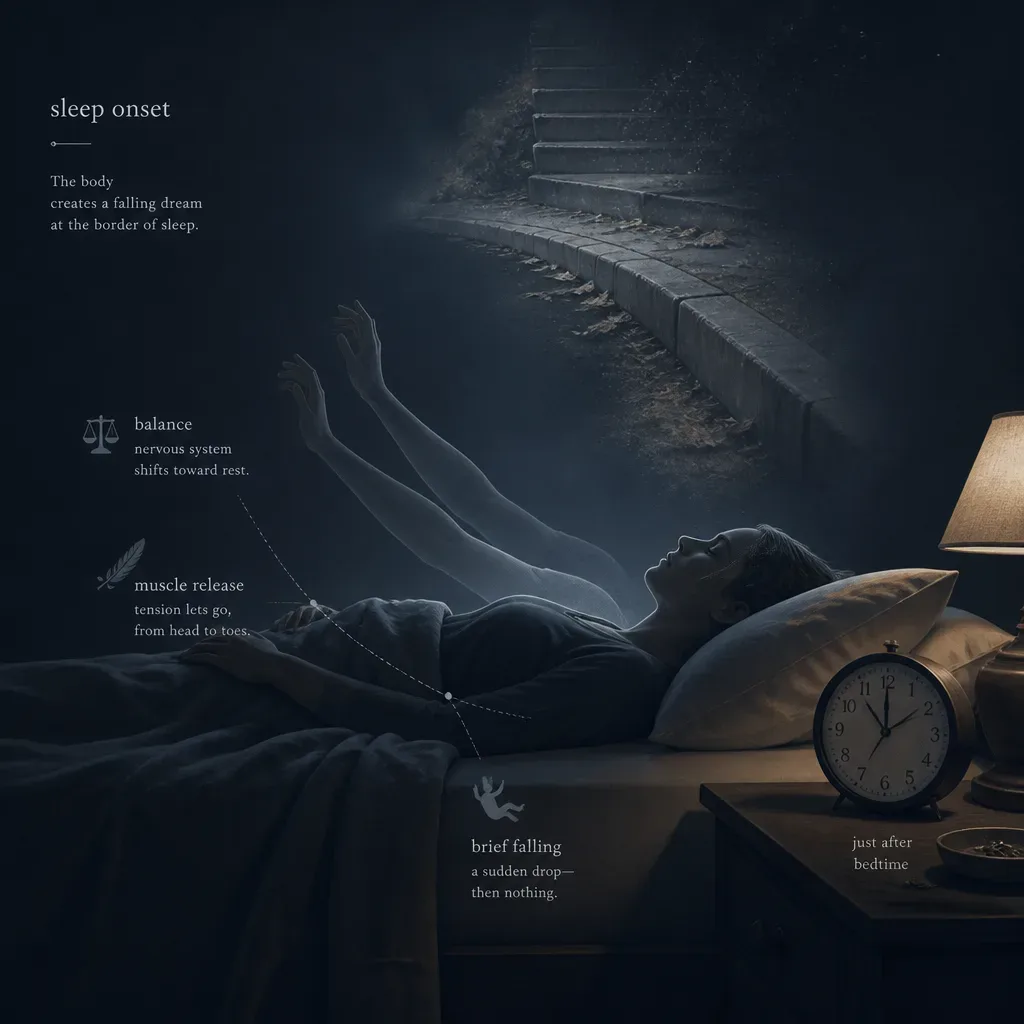
It feels like falling because your balance, muscle tone, and body-position systems are changing quickly while your brain is not fully asleep yet.
As sleep begins, skeletal muscles relax, heart rate tends to slow, and attention loosens its grip on the room. The vestibular system, the inner-ear network that helps you sense motion and balance, can contribute to drifting, floating, tilting, or dropping sensations. In laboratory sleep scoring, stage N1 is the lightest non-REM sleep, often lasting only 1 to 7 minutes before deeper sleep arrives in healthy adults.
During that thin interval, the brain is still checking the body. If muscle relaxation is interpreted as loss of support, the mind may supply a falling image. A 2016 review in Sleep Medicine Clinics notes that hypnagogic phenomena can include vivid visual, auditory, and bodily sensations, especially at the border of sleep. These are not failures of sanity. They are features of a nervous system changing states.
There is also a simple evolutionary story sometimes offered: the brain startles the body awake because it mistakes relaxation for a dangerous fall. It’s a tidy idea, but evidence for that exact explanation is thin. We can say more honestly that the falling image fits the body data available in that second.
The dream doesn’t need to be long to be memorable. One second can be enough when it ends with your leg kicking the blanket and your heart knocking once against the ribs.
What makes hypnic jerk dreams more likely?
Hypnic jerk dreams tend to be more likely when the nervous system is tired, stimulated, stressed, or asked to fall asleep on an irregular schedule.
The usual suspects are ordinary: sleep deprivation, caffeine, nicotine, late intense exercise, emotional stress, and inconsistent bedtimes. Caffeine is especially worth naming because its average half-life is often cited as about 5 hours, though it can range from roughly 2 to 10 hours depending on the person, according to clinical pharmacology reviews. A 4 p.m. coffee may still be a guest at 10 p.m.
Sleep loss matters too. The CDC has reported that about 1 in 3 U.S. adults sleep less than the recommended 7 hours on many nights. When the body is overtired, sleep onset can feel less like a soft descent and more like dropping through a trapdoor. That sharper transition may make the jerk easier to notice.
Common triggers include:
- Caffeine after midday, especially if you’re sensitive to it
- Alcohol close to bedtime, which can fragment sleep later in the night
- Hard workouts within 1 to 2 hours of bed
- Anxiety, deadlines, arguments, or unresolved decisions
- Irregular sleep timing across the week
- Sleeping in a tense posture or dozing upright
The practical test is not moral. It’s observational. Change one variable for 7 nights and watch what happens. If you remove late caffeine and the jolts soften, the dream has told you something plain about your body, not your destiny.
A useful rule: if the dream begins at the exact edge of sleep and ends with one kick, think physiology first. Symbol can still be present, but the body is holding the pen.
Does a hypnic jerk dream have a psychological meaning?
A hypnic jerk dream can carry psychological meaning, but its first explanation is usually sleep physiology rather than hidden prophecy.
Falling dreams have a long interpretive history. In modern clinical language, they often get linked to loss of control, insecurity, sudden transition, or fear of not being supported. Calvin Hall’s mid-20th-century dream content research, based on thousands of dream reports, found that negative emotions and misfortunes are common dream material. Later work by G. William Domhoff continued that line, showing that dreams often reflect waking concerns more than exotic symbols.
So if you jolt awake from falling during a week of layoffs, exams, grief, or a relationship decision, it’s reasonable to ask what in your waking life feels unsupported. Not because the dream has a single coded answer, but because the body chose a familiar metaphor. Falling is one of the oldest human grammars for losing control.
Here is the honest split:
| Layer | What it may suggest | How much weight to give it |
|---|---|---|
| Body | Sleep-onset muscle contraction | Start here, especially if it happens as you doze |
| Emotion | Stress, overwork, loss of control | Consider if the timing fits your week |
| Memory | A real fall, accident, or fear of heights | Notice if the image repeats with detail |
| Folklore | Warning, visitation, spiritual drop | Treat as tradition, not evidence |
Folklore in many places treats falling dreams as warnings, but there is no good evidence that they predict literal events. The old stories are still worth hearing because they tell us what communities feared: collapse, shame, bad luck, the ground disappearing. Folklore is a map of human worry, not a weather report.
If the scene becomes longer or more symbolic, you can bring it to the AI dream interpreter tool and compare the reading with your own notes. Let the tool be a mirror, not a judge.
How is this different from lucid dreaming, nightmares, or sleep paralysis?
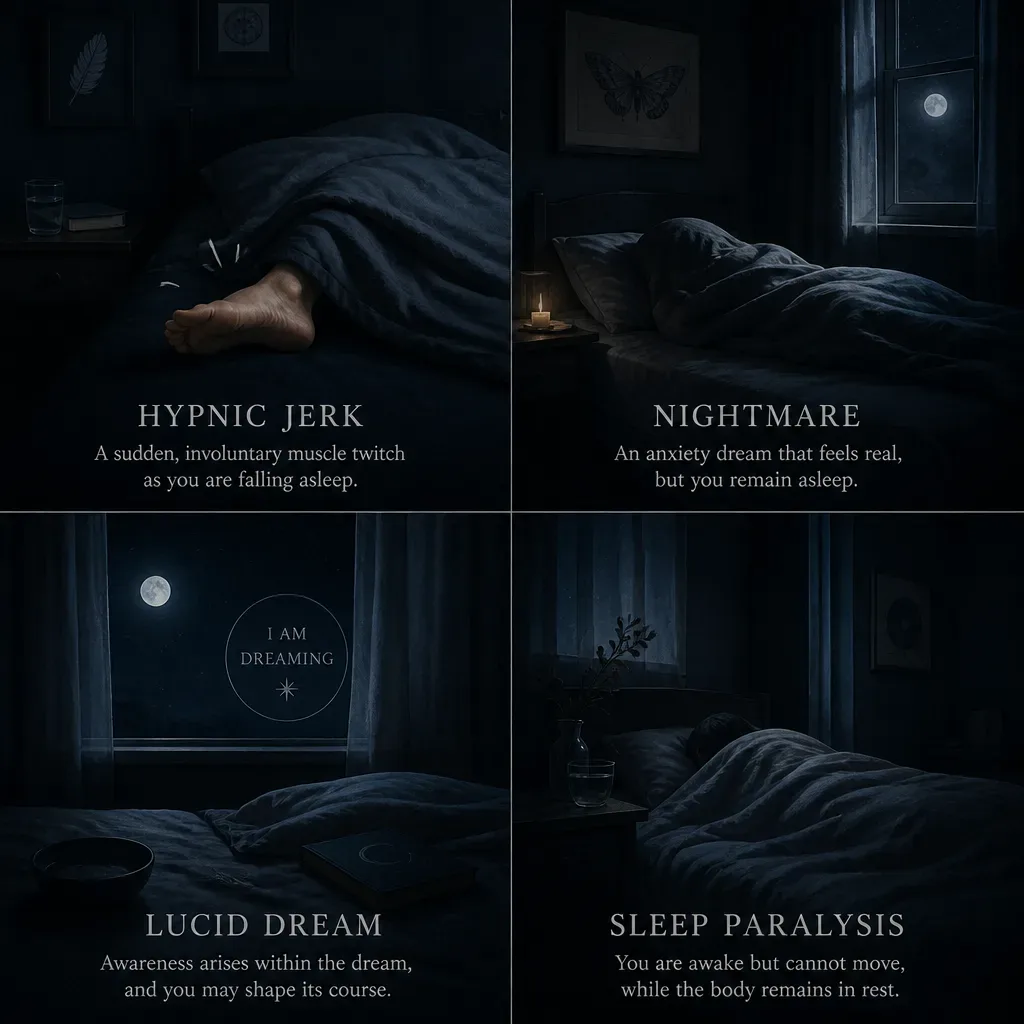
A hypnic jerk dream is usually brief and happens at sleep onset, while lucid dreams, nightmares, and sleep paralysis have different timing, awareness, and body features.
The timing is the first clue. Hypnic jerks usually arrive as you’re falling asleep. Nightmares more often occur during REM sleep, which becomes longer in the second half of the night. Lucid dreams also tend to arise from REM, with the defining feature that you know you’re dreaming while the dream continues. Sleep paralysis often happens while falling asleep or waking, but it includes temporary inability to move, not a single kick.
The numbers help. Adults cycle through sleep stages about every 90 minutes, and REM periods lengthen toward morning. That is why many vivid narrative dreams are remembered at 5 a.m. or 6 a.m., while a hypnic jerk may happen at 11:17 p.m., before the night has properly begun.
A quick comparison:
| Event | Usual timing | Body sign | Dream quality |
|---|---|---|---|
| Hypnic jerk dream | Sleep onset | Sudden twitch or jolt | Falling, slipping, impact |
| Nightmare | Later REM more often | Wakes distressed | Longer threat story |
| Lucid dream | REM sleep | Body mostly still | Awareness inside dream |
| Sleep paralysis | Sleep-wake boundary | Can’t move briefly | Pressure, presence, fear |
If you’re curious about awareness inside dreams, our Lucid dreaming pillar explains why lucidity is a different phenomenon from a startle. If your issue is waking unable to move, read about sleep paralysis dreams and talk to a doctor if episodes are frequent, frightening, or paired with severe daytime sleepiness.
One jolt is usually just one jolt. The mind may dress it in a cliff, a staircase, or a missed curb, but the event itself is often small.
When should I worry about jolting awake while falling?
You should worry only when the jolts are frequent, injuring you, disrupting sleep, or accompanied by other concerning symptoms.
Occasional hypnic jerk dreams are common and usually harmless. Sleep medicine sources tend to reassure patients when the movements are brief, happen at sleep onset, and don’t cause ongoing insomnia. The line changes when the body events become repetitive, violent, or confusing. If you’re losing sleep because you fear the next jolt, the problem has become real even if the original event was benign.
Speak with a clinician if you notice any of these:
- Jolts many times per night for several nights in a row
- Injury to you or a bed partner
- Loss of awareness, tongue biting, or unusual confusion afterward
- Loud snoring, gasping, or pauses in breathing
- Severe daytime sleepiness despite enough time in bed
- New movements after starting or changing medication
This is not because the falling dream is sinister. It’s because several sleep and neurological conditions can include nighttime movements, and a professional can sort them out. Periodic limb movement disorder, REM sleep behavior disorder, some seizure disorders, medication effects, and untreated sleep apnea all require different questions than a simple sleep start.
The calm approach is best. Write down the time, what you felt, what your body did, caffeine and alcohol that day, stress level, and whether you could return to sleep. Two weeks of notes can be more useful than one dramatic memory. In clinical settings, patterns matter more than single nights.
Dreams reflect attention; symptoms require observation. Keep both truths in the room.
What should I do the morning after a hypnic jerk dream?
The morning after, write the exact image down, check your sleep conditions, and make one small adjustment for the next night.
Start with the dream report before interpretation touches it. “I stepped off a curb that wasn’t there.” “The bed dropped.” “I missed the last stair.” Details matter because they show whether this is a repeated body-startle image or a fuller dream theme. Dream researchers from Hall onward relied on written reports because memory changes quickly after waking; even 5 minutes can sand the edges off a dream.
Use this 3-minute note:
- Scene: What was the falling image?
- Body: Which part jerked: leg, arm, whole body, chest?
- Timing: Had you just fallen asleep, or was it near morning?
- Day residue: Caffeine, exercise, argument, deadline, alcohol, short sleep?
- Question: Where did I feel unsupported yesterday?
If the dream repeats, you might also notice what your attention keeps returning to. That is where waking practice can meet night material. The AYA Method is a daily audio manifestation practice: each day you listen to a short personalized recording, your Dream-Self Moment, narrated from the version of you who has already manifested the life you intend. Listening is the practice. Repetition is the work. The audio is the method. The daily affirmation and Manifestation Board can complement it, but the audio is the center.
For dream symbols beyond falling, use the Dream dictionary (A–Z hub) after you’ve written your own version first. A dictionary can give you the grammar. You supply the accent.
Write this line in the morning: “The ground disappeared when ____.”
Then let the day answer quietly.