lucid dreaming
How to Dream Journal When You Never Remember Dreams
Learn how to dream journal when your dreams vanish by morning, using simple recall cues, bedside notes, and a quiet five-minute routine.

You learn how to dream journal by recording fragments before they disappear: mood, body feeling, color, name, place, or one strange object. Don’t wait for a full plot. Put the journal beside the bed, wake gently, stay still for 60 seconds, and write whatever remains.
Why don’t I remember my dreams in the morning?
Most forgotten dreams are lost because waking attention moves too quickly, not because nothing happened at night.
Dreaming is common across normal sleep, especially during REM periods, which lengthen toward morning. The National Institute of Neurological Disorders and Stroke notes that adults usually cycle through sleep stages every 90 to 120 minutes. If your alarm pulls you out of bed, into light, sound, and tasks, the dream may have only a few seconds to survive. A dream is not stored like a receipt. It’s more like steam on glass.
Researchers have long found that dream recall rises when people wake during or near REM sleep. In laboratory studies, awakenings from REM sleep produce dream reports far more often than awakenings from quiet non-REM sleep, though non-REM dreams also occur. A 2014 study by Ruby and colleagues in Neuropsychopharmacology linked frequent dream recall with greater brain response to sounds during sleep and brief awakenings at night. The practical lesson is simple: remembering often depends on a small waking window.
Your habits matter. Alcohol close to bedtime can suppress REM in the first half of the night and fragment the second half, according to sleep medicine reviews from the National Sleep Foundation and clinical sleep researchers. Certain medications, stress, short sleep, and irregular schedules can change recall too. If dream loss begins suddenly with severe insomnia, distressing nightmares, or medication changes, speak with a doctor in one plain appointment.
A forgotten dream is not an empty night. It is a message that dissolved before you turned toward it.
This is why a journal begins before the writing. You’re training the first minute after waking. That minute is small, but it’s the door most dreamers miss.
What should I put beside the bed before I start?
Put one simple recording tool within arm’s reach, and remove every morning obstacle you can predict.
Choose paper if you can. A notebook and pen don’t glow, ping, or show you the weather. The American Academy of Sleep Medicine has repeatedly cautioned that bright screens at night can interfere with sleep timing, and even in the morning a phone can scatter attention before recall settles. If you do use a phone, keep it on airplane mode and open directly to a voice memo or notes app.
Your bedside setup should be boring on purpose. Dream memory likes low friction. You want to record before you decide whether the dream was interesting.
Use this small kit:
- A notebook that opens flat
- A pen that writes in dim light
- A tiny book light or warm lamp
- A glass of water, if waking thirsty pulls you away
- A one-line prompt on the cover: What was here before waking?
There is old folklore around dream tools too. In parts of Scandinavia and Eastern Europe, people once avoided telling dreams before breakfast if the dream felt unlucky; in other households, the telling itself was thought to loosen harm. There’s no good evidence that breakfast changes fate. But the custom notices something true: the first telling fixes the dream. Your first written line does similar work, without the fear.
A simple table can help you choose your tool honestly:
| Tool | Best for | Watch for |
|---|---|---|
| Paper notebook | Calm recall and sketching symbols | Hard to read if you write half-asleep |
| Voice memo | Fast capture without opening eyes | Rambling unless you name key details |
| Notes app | Searchable patterns over weeks | Notifications and screen brightness |
| Index cards | One dream per card | Easy to lose |
If you already use the AI dream interpreter tool, wait until after you’ve written your own raw notes. Interpretation belongs after memory. Morning first, meaning second.
How do I write when I remember only a blank?
Write the blank as data, then circle its edges with mood, body sensation, and the first waking thought.
A blank entry is still an entry. Write the date, waking time, sleep length, and one sentence: No dream recalled. Then add three small facts. How did you wake: startled, heavy, calm, irritated? Where was the feeling in the body: jaw, chest, stomach, hands? What was the first thought: I’m late, I need to call her, I don’t want to go? In cognitive psychology, memory is often cue-dependent; a small cue can retrieve a larger pattern. Dream recall works that way in ordinary bedrooms too.
Try this 5-line template for seven mornings:
- Date and waking time.
- Sleep facts: bedtime, alcohol, late food, stress, alarm or natural waking.
- First feeling: one word is enough.
- First image, color, name, or place, even if it seems invented.
- One association from waking life.
The Centers for Disease Control and Prevention says adults generally need at least 7 hours of sleep per night. If you’re sleeping 5 or 6 hours, you may be cutting off the later REM-rich portion of the night. A dream journal can’t replace sleep. It can only catch what sleep has time to make.

There is a useful distinction here: a dream report is not a literary object. It doesn’t need plot, grammar, or beauty. Write door. Blue coat. Embarrassed. Mother’s kitchen but not Mother’s kitchen. These fragments are the bones. Later, they may connect.
The first rule of dream journaling is mercy: record the scrap without punishing it for not being a story.
If nothing comes after 60 seconds, stop. Don’t dig until you’re annoyed. The journal should teach the morning that remembering is safe, not that waking comes with an exam.
What morning routine improves dream recall fastest?
The fastest routine is stillness, backward remembering, and immediate recording before speech, screens, or standing.
When you wake, don’t move yet. Keep your eyes closed or half-open. Notice the emotional weather of the dream first. Then ask: where was I just now? Who was there? What problem was I trying to solve? Work backward from the last trace. Many dreamers remember the final scene first because it sits closest to waking. Follow it gently to the earlier scene.
Use a 3-minute routine:
- First 30 seconds: stay still and name the feeling.
- Next 60 seconds: scan for image, person, place, sentence, color, animal, or object.
- Next 90 seconds: write fragments in the order they arrive, not in story order.
Specific timing helps because the waking brain is impatient. A 2021 Sleep Foundation summary notes that REM sleep may account for roughly 20 to 25 percent of adult sleep, with longer REM periods later in the night. That means a natural waking after a full night often gives better recall than a harsh alarm after short sleep.
If you use an alarm, make it quieter. Put it close enough that you don’t have to cross the room. The old productivity advice to force yourself upright is bad dream advice. For recall, the body should remain ordinary and unalarmed for a minute.
After writing, add a title. Not a clever one. Use the plainest phrase: Train station with dead phone. Sister and the white dog. Flood in the office. Titles make weekly review easier, and pattern recognition is the real value of the practice. If an image repeats, look it up later in the Dream dictionary (A–Z hub), then compare the entry with your own life.
Folklore can sit beside psychology without replacing it. A snake in a dream may carry healing in one tradition, danger in another, and a memory of your uncle’s garden in yours. The Lucid dreaming pillar is useful here because recall is also the first skill for lucidity. You can’t become aware inside a dream you never learn to remember.
How do I find patterns without forcing meanings?
Look for repetition across seven to fourteen entries before deciding what a symbol tends to mean for you.
A single dream can be vivid and still be temporary noise. A repeated setting, conflict, animal, or feeling deserves more attention. Jungian tradition treated recurring dream images as meaningful expressions of the psyche, but modern dream researchers such as G. William Domhoff have also emphasized continuity: dreams often reflect waking concerns, relationships, and emotional preoccupations. The honest bridge is this: repetition usually points toward attention.
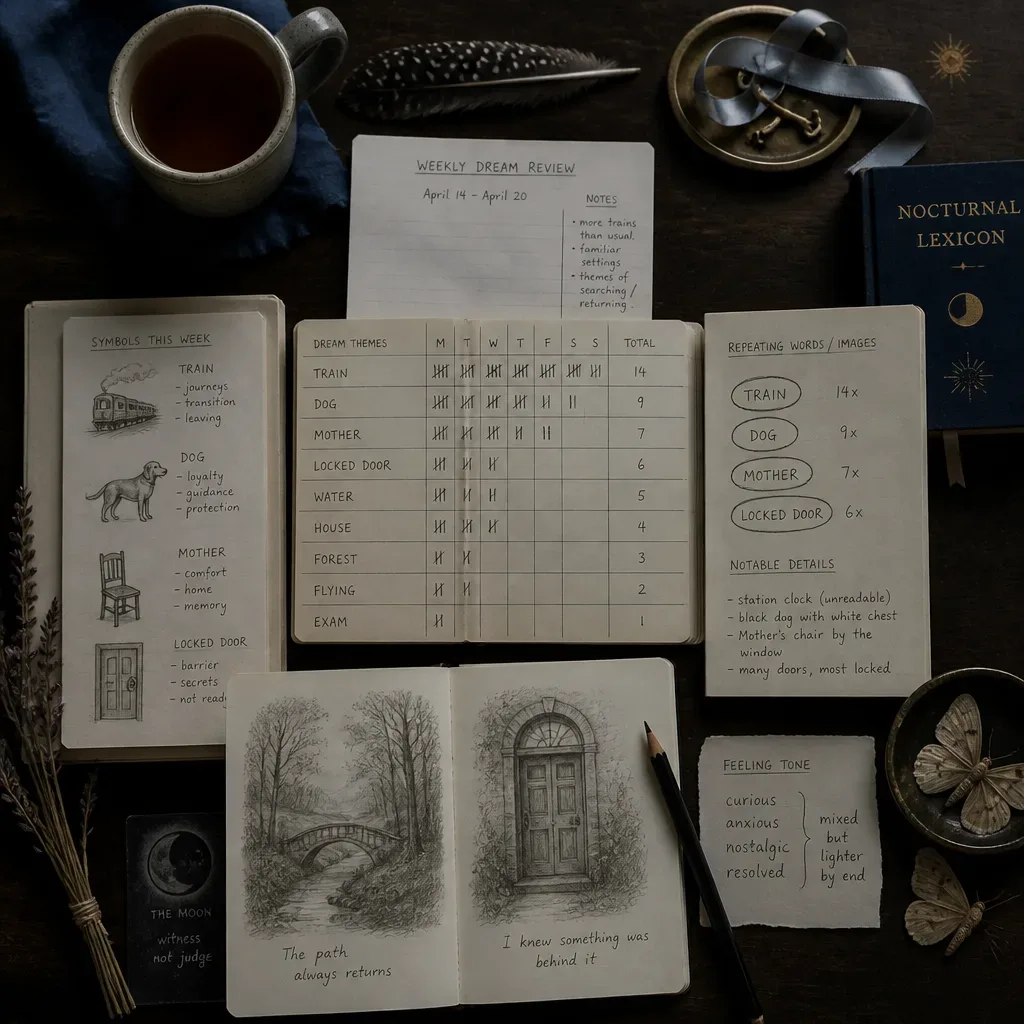
Review once a week, not every morning. Morning is for capture. Review is for pattern. Mark repeated items with simple symbols: P for person, L for location, F for feeling, A for animal, C for conflict. After 10 entries, count them. If work appears in 6 of 10 dreams, that number matters more than a single dramatic image.
Try these review questions:
- Which feeling appears most often?
- Which place keeps returning?
- Who is missing from the dreams?
- What task am I failing, avoiding, or repeating?
- What object seems strangely emphasized?
- What changed after a difficult conversation or decision?
This is where dream dictionaries are helpful if you use them carefully. A symbol entry gives you common readings, cultural history, and possible associations. It should not overrule your grandmother’s kitchen, your childhood fear, or the dog you actually loved. You can start with the Dream dictionary (A–Z hub), then write one private sentence under the public meaning: In my life, this image usually belongs to ____.
A symbol is not a verdict. It is a place where memory, culture, and feeling meet.
If you’re working with intentional waking practice, bring it in only after the dream has spoken. The AYA Method is a daily audio manifestation practice. Each day you listen to a short personalized recording — your Dream-Self Moment — narrated from the version of you who has already manifested the life you intend. Listening is the practice. Repetition is the work. The audio is the method. A recurring dream shows what attention returns to at night; the audio is a waking counterpart, said in your own voice before the day hardens.
How can I use a dream journal for lucid dreaming later?
Use the journal to build recall first, then mark recurring dream signs that can become lucidity cues.
Lucid dreaming usually begins with noticing. Stephen LaBerge’s research at Stanford in the 1980s helped establish that trained lucid dreamers could signal from REM sleep with prearranged eye movements. But before techniques such as MILD or reality testing work well, you need dream memory. A journal gives you the raw material: the odd places, impossible devices, repeated relatives, broken elevators, sudden exams, and animals that appear only at night.
After two weeks, create a dream-sign list. Choose 3 to 5 recurring cues, not 20. Too many signs become another form of noise. If you often dream of trains, locked doors, childhood rooms, or missing shoes, write them on a small card. During the day, when you see a related cue, ask calmly: Am I dreaming? Then check something stable, such as reading a line of text twice or noticing whether your hands look ordinary.
A practical sequence looks like this:
| Week | Focus | What to write |
|---|---|---|
| 1 | Recall | Fragments, feelings, sleep facts |
| 2 | Pattern | Repeated places, people, conflicts |
| 3 | Dream signs | 3 to 5 cues for daytime checks |
| 4 | Lucid practice | Short intention before sleep |
Keep expectations modest. Surveys vary, but a widely cited 2016 meta-analysis by Saunders and colleagues estimated that about 55 percent of people have had at least one lucid dream, while around 23 percent report lucid dreams monthly or more. That means lucidity is common enough to practice, but not something to force.
If your dreams are frightening, don’t make lucidity the first goal. Stabilize sleep, reduce distress, and record gently. For frequent nightmares tied to trauma, talk with a clinician; image rehearsal therapy has evidence in nightmare treatment, including studies published in the Journal of the American Medical Association and sleep medicine journals. A dream journal should make the night more speakable, not more frightening.
What should I write tonight before sleeping?
Write one plain intention and prepare the page so morning has less work to do.
Before bed, open tomorrow’s page. Put the date at the top. Write: I’ll record whatever I remember, even if it’s only a feeling. That sentence matters because it removes the demand for a complete dream. A 2018 review in Frontiers in Psychology discussed how intention and prospective memory are central to several lucid dreaming methods; for simple recall, the same principle applies in a quieter form. You’re asking the mind to remember to remember.
Keep the page structured. The less you need to decide at 6:40 a.m., the more likely you are to write. Use headings that wait for you:
- Dream fragments:
- Feeling:
- People or creatures:
- Place:
- Waking-life link:
- Possible symbol to check later:
If you wake during the night, write only keywords unless the dream feels urgent. Full sentences can wake you too much. A 2020 review in Sleep Medicine Reviews notes that sleep continuity affects next-day functioning; your journal should not become a reason to lose an hour at 3 a.m. Write fox, wet stairs, apology, then return to sleep.
In the morning, do not judge the material. Strange is normal. Ordinary is normal. Sexual, childish, repetitive, boring, grand, petty: all normal. The dream journal is not a museum. It is a field notebook.
Write the dream down before you decide what kind of person it makes you.
When you have enough material, compare your symbols with careful sources, your own associations, and tools such as the AI dream interpreter tool. If a dream becomes lucid or nearly lucid, read the Lucid dreaming pillar and keep recall as the base practice. The base is humble. It works because it repeats.
Tonight, leave the page open and ask for one remembered thing.