dream symbolism
Fire Dream Meaning: Anger, Cleansing, Creative Spark
Fire dream meaning usually points to intense emotion, pressure, renewal, or desire. Learn the psychological, cultural, and personal readings.
Fire dream meaning usually centers on intensity: anger, fear, desire, renewal, or creative pressure. A small flame may show focus or warmth; a spreading fire often shows something that feels out of control. The dream isn’t a prediction. It’s a signal that some part of your life feels hot enough to notice.
What does fire usually mean in a dream?
Fire usually means emotional charge: something in you is active, reactive, consuming, or ready to change form.
That reading is old, but it also fits what sleep research says about dreaming. REM sleep, where many vivid dreams occur, makes up about 20% to 25% of adult sleep, according to standard sleep-stage summaries from the American Academy of Sleep Medicine. During REM, emotional memory systems are active, while parts of the prefrontal cortex involved in ordinary daytime evaluation are less steady. That doesn’t make dreams mystical. It makes them dramatic.
Fire is dramatic because it has two honest faces. It warms and it destroys. It cooks food and burns houses. It clears a field and leaves ash. In a dream, that double nature matters more than a fixed dictionary answer. A candle at a table isn’t the same symbol as a forest fire at the edge of town.
A useful first split looks like this:
| Dream fire image | Common psychological reading | Morning question |
|---|---|---|
| Candle or lamp | Attention, hope, vigil, memory | What am I keeping alive? |
| Fireplace | Warmth, home, contained feeling | Where do I feel safe enough to soften? |
| Wildfire | Overwhelm, fear, social pressure | What has spread beyond my control? |
| Burning house | Identity, family, private life under strain | What part of my life feels unsafe? |
| Being burned | Vulnerability, shame, pain, exposure | Where do I feel too close to something? |
Dreams prefer images to explanations. The sleeping mind may not say, “I’m angry about work.” It may show a red kitchen, smoke under a door, and your hands trying to carry water in a cracked bowl. The symbol is not a verdict. It’s a witness.
A dream symbol is not a code to break. It’s a scene to remember accurately.
If you want a broader comparison of common symbols, the Dream dictionary (A–Z hub) is useful, but start with the heat of your own morning. General meanings help only after the dream has been described honestly.
Is a fire dream about anger?
A fire dream can be about anger, especially when the flame spreads, erupts, or threatens other people.
Anger has a bodily signature. Heart rate rises, muscles prepare, attention narrows. Psychophysiology studies have measured changes in cardiovascular activation during anger tasks for decades; one 2019 review in Frontiers in Psychology described anger as a high-arousal negative emotion with strong approach tendencies. In plain terms, anger moves toward. Fire does too.
Look at your position in the dream. If you start the fire, you may be touching an anger you don’t let yourself claim by day. If someone else starts it, the dream may place danger outside you: a person, rule, family pattern, workplace demand, or memory. If you watch fire spread while doing nothing, the core feeling may be helplessness rather than rage.
There is also displaced anger. The dream may show a burning object that stands in for a situation you can’t name directly. A desk catches fire after a week of missed deadlines. A phone melts after a hard conversation. A childhood bedroom fills with smoke before a family visit. These details are not random decoration.
But be careful. Fire is not anger every time. If the dream felt beautiful, solemn, or clarifying, anger may be the wrong word. If the flame was controlled, the stronger reading may be focus. If the fire removed clutter without harming anyone, the dream may be about ending something cleanly.
A simple morning test helps:
- Write, “The fire was controlled / uncontrolled.”
- Write, “I was afraid / relieved / fascinated / guilty.”
- Write, “The person closest to the fire was ___.”
- Write, “The hottest issue in my life is ___.”
The fourth line is often where the dream becomes ordinary enough to use.
Can fire dreams mean cleansing or renewal?
Fire dreams can mean cleansing when the fire removes, purifies, or completes something without leaving you terrified.
Many cultures have used fire in rites of clearing: candles in churches, lamps in Hindu and Buddhist settings, bonfires at seasonal festivals, incense in homes, memorial flames for the dead. This is cultural symbolism, not laboratory proof. But symbols gather force through repetition, and fire has carried ideas of purification for thousands of years. The Olympic flame tradition, for example, was formally introduced in the modern Games in 1928, borrowing from much older associations between flame and continuity.
In dreams, cleansing fire often behaves differently from nightmare fire. It may burn old papers, dead branches, a field after harvest, or a dark room that becomes visible. You may wake sad but lighter. That matters. Affect is data. Dream researcher Calvin Hall’s content-analysis work, later expanded by G. William Domhoff, treated dream reports as structured records of characters, actions, emotions, and settings. The method isn’t glamorous. It’s counting what actually appears.
Fire can be destruction in the image and relief in the feeling.
A renewal reading is strongest when the dream has three features: the fire is bounded, the loss is specific, and something remains. A burned letter, a clean hearth, a field with black soil, a room cleared of smoke. If everything and everyone is gone, the dream may be closer to fear. If something is made possible afterward, the dream is speaking in the grammar of change.
There’s a psychological parallel here. Sleep supports memory consolidation; a widely cited 2013 review by Rasch and Born in Physiological Reviews describes sleep as active in stabilizing and reorganizing memory. Dreams are not simply memory storage, but they often borrow from memory while emotion is being worked over. A fire dream after a breakup, resignation, move, or confession may be your mind giving visible shape to a severance already underway.
The question is not, “Was the fire good or bad?” The better question is, “What did the fire make impossible to keep carrying?”
What if the fire feels creative, sexual, or alive?
A fire dream can point to creative or erotic force when the flame feels compelling rather than only dangerous.
This is the reading people often miss because fear gets first claim on fire. Yet not all heat is threat. Desire is heat. Attention is heat. So is the hour when an idea won’t leave you alone. In dream reports, strong emotion is common: a 2010 study by Michael Schredl and colleagues found that dream emotions are frequently negative, but positive emotions and fascination also appear, especially in non-nightmare dreams.
Creative fire dreams often show contained intensity. A forge, kiln, stove, candlelit room, stage lights, or a match held carefully in the hand. The image suggests something being made, not merely ruined. A blacksmith’s fire changes metal. A kiln hardens clay. A stove turns raw ingredients into food. These are not subtle images.
Sexual fire dreams may involve warmth, red light, skin, breath, forbidden rooms, or a sense of being drawn close to danger. Don’t flatten that into a single meaning. The dream may be about wanting someone. It may be about shame around wanting. It may be about the fear that desire will cost you your current life.
Jungian tradition often reads fire as libido in the broad sense: life force, appetite, psychic movement. That tradition is clinically influential, though not easily tested in the way a sleep-lab hypothesis is tested. Treat it as a useful lens, not a fact handed down from above.
The distinction is practical:
- Creative fire tends to shape, cook, forge, illuminate, or call you toward work.
- Erotic fire tends to draw the body closer, with pleasure mixed with risk.
- Angry fire tends to rush outward and threaten people or places.
- Anxious fire tends to trap, chase, suffocate, or spread too fast.
The meaning of fire is not in the flame alone. It’s in your distance from it.
If you woke with the odd sense that the dream wanted you to make something, give it one small task. Draft 100 words. Sketch the room. Repair the object. Send no dramatic message at 7 a.m. Fire is not always instruction. Sometimes it’s only heat asking for a vessel.
What do different fire dream variations mean?
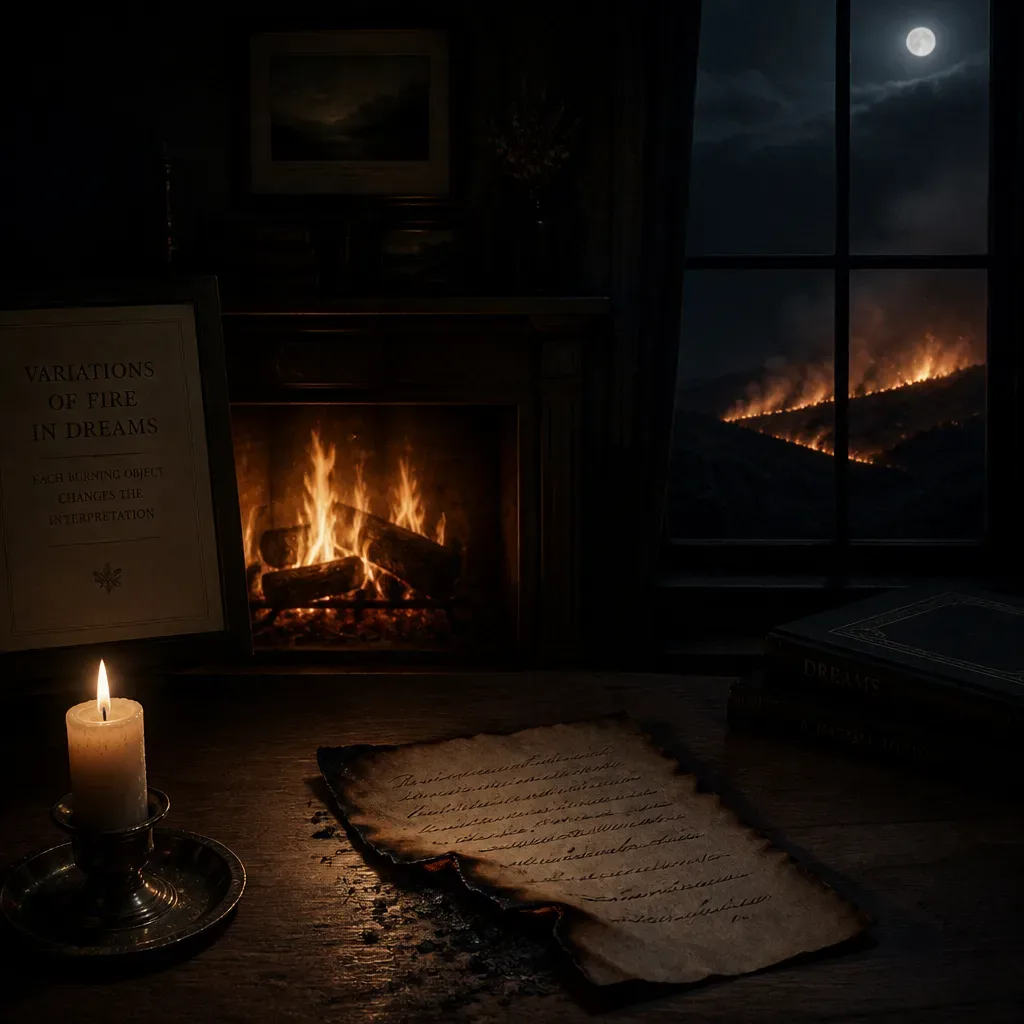
Different fire dreams mean different things because the object burning carries much of the message.
A house fire is among the most emotionally loaded versions. Houses often stand for the self, family, privacy, or the structure of ordinary life. If your childhood home burns, the dream may touch early patterns. If your current home burns, it may speak to present safety or pressure. If only one room burns, attend to that room: kitchen, bedroom, bathroom, attic, basement. Dream content researchers often code settings because settings are not neutral; Domhoff’s dream database includes thousands of reports sorted by characters, social interactions, misfortunes, and emotions.
A wildfire usually has a wider social feeling. It may reflect news exposure, climate anxiety, community conflict, or a sense that one person’s anger has spread through a group. This reading is especially plausible if you live in a fire-prone region. The National Interagency Fire Center reported more than 56,000 wildfires in the United States in 2023, burning millions of acres. Real-world exposure feeds dream imagery.
Being trapped in a burning building often belongs closer to nightmare research. Finnish cognitive scientist Antti Revonsuo proposed the threat-simulation theory in 2000: nightmares may rehearse danger-related scenarios. It’s a serious hypothesis, not settled law. Still, the fit is obvious when the dream is escape, smoke, locked doors, and a body that won’t move fast enough.
If you know you’re dreaming while the fire happens, you may be in a lucid dream. Lucidity is not rare but not nightly for most people; a 2016 meta-analysis by Saunders and colleagues found that about 55% of people reported at least one lucid dream in their lifetime, while around 23% reported lucid dreams monthly or more. For more on that state, see the Lucid dreaming pillar.
Common variations:
| Variation | Tends to suggest | Notice this |
|---|---|---|
| Your clothes catch fire | Shame, exposure, social fear | Who sees you? |
| A car burns | Direction, autonomy, blocked movement | Were you driving? |
| A forest burns | Large-scale overwhelm or natural cycles | Did animals escape? |
| You put out a fire | Containment, repair, responsibility | Was help available? |
| You enjoy the fire | Desire, relief, release, danger | Did anyone get hurt? |
Specifics keep interpretation honest. A dream of a church candle and a dream of a school burning down should not be forced into the same sentence.
Are fire dreams spiritual signs or just brain activity?
Fire dreams can be read spiritually as long as you don’t confuse tradition with proof.
Folklore gives fire many roles: blessing, warning, purification, divine presence, household protection, ancestral memory. In some traditions, a bright flame is welcome; in others, uncontrolled fire is a cautionary symbol. These readings are part of human culture. They deserve respect. They don’t deserve to be sold as prediction.
The research reading is plainer. Dreams draw on memory, emotion, bodily sensation, and recent concerns. The continuity hypothesis of dreaming, associated with researchers such as Michael Schredl and G. William Domhoff, holds that dream content often reflects waking-life concerns. It isn’t a perfect rule, but it has more support than the idea that dreams reliably foretell events.
Spiritual and psychological readings can sit beside each other if you label them. You might say, “In my family, fire means blessing,” and also say, “This week, I’m angry and exhausted.” Both can be true as meaning. Neither has to become a forecast.
There is one exception to all symbolic reading: real safety. If you wake smelling smoke, hearing an alarm, or remembering that you left a candle burning, check your home. If fire nightmares are frequent after trauma, or if they disturb your sleep for weeks, talk with a licensed clinician or sleep specialist. The American Academy of Sleep Medicine notes that recurrent nightmares can affect daytime mood and sleep quality; treatment options exist, including imagery rehearsal therapy.
You can also bring the dream to a tool, with caution. The AI dream interpreter tool can help you compare symbols and patterns, but your body’s first memory of the dream still matters most: smoke in the throat, heat on the face, relief after the ashes.
Good interpretation lowers the temperature. It doesn’t make the dream more frightening.
What should you do the morning after a fire dream?
The best morning practice is to record the dream plainly, name the heat, and choose one small waking response.
Do it before the day edits the dream. Dream recall drops quickly after waking; sleep researchers have long noted that reports are most detailed when collected immediately, often in lab awakenings after REM periods of roughly 90-minute sleep cycles. You don’t need a lab. You need 3 minutes and a sentence you won’t improve.
Write this:
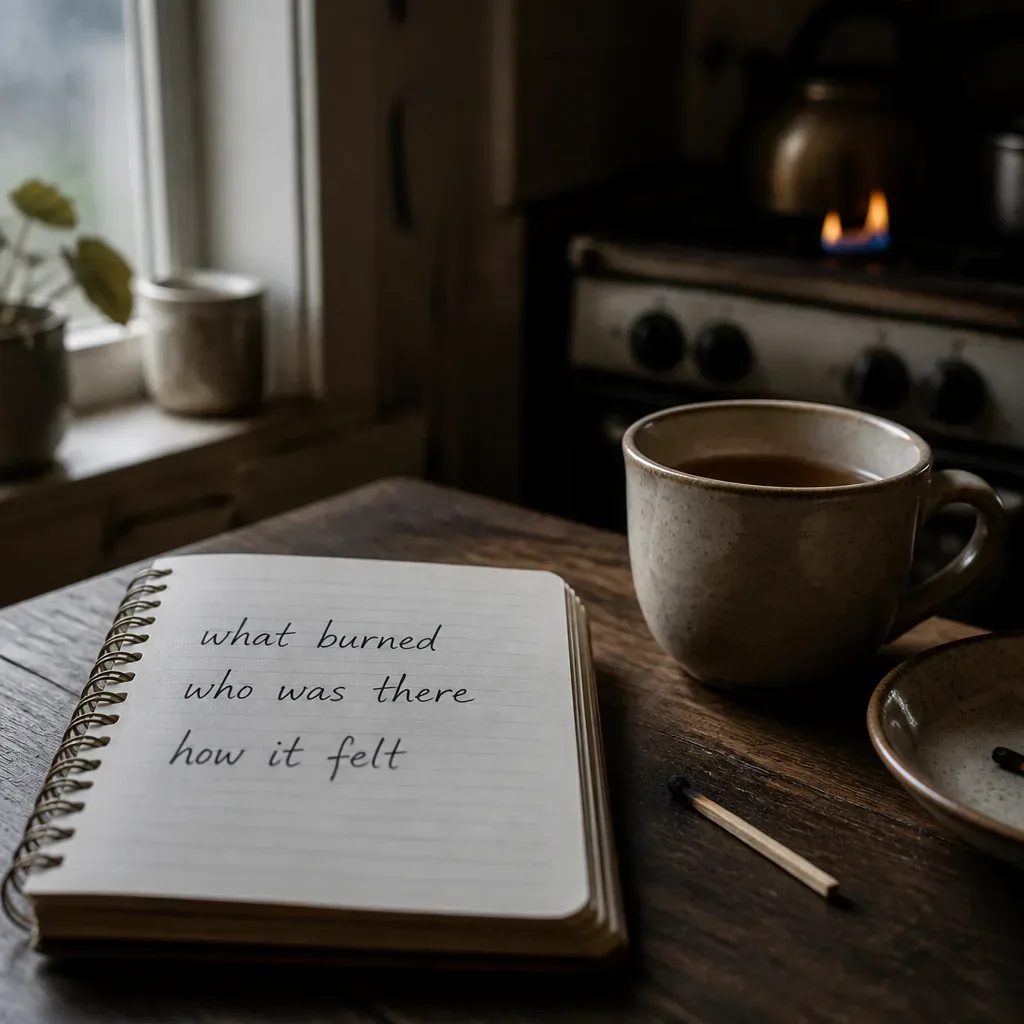
- What burned: the house, field, letter, body, car, forest, candle.
- How the fire behaved: steady, spreading, hidden, explosive, dying out.
- What you felt: fear, relief, guilt, fascination, grief, desire.
- Who was present: family, stranger, ex, child, animal, no one.
- One waking link: “This may connect to ___.”
Then choose one response small enough to do today. Apologize if anger leaked out. Rest if the dream shows exhaustion. Remove one obligation if everything felt flammable. Begin the draft if the fire felt creative. Replace the smoke alarm batteries if the dream reminded you of actual safety. A symbol should make you more attentive to ordinary life, not less.
If the dream is recurring, compare entries across 2 weeks. Recurring dreams often repeat until the emotional pattern changes, though the evidence base is mixed and much of it relies on self-report. Still, patterns are useful. Does the fire start in the same room? Does the same person vanish? Are you always trying to save the same object?
This is also where the AYA Method can fit, if the dream keeps pointing to the same fear or want. The AYA Method is a daily audio manifestation practice. Each day you listen to a short personalized recording — your Dream-Self Moment — narrated from the version of you who has already manifested the life you intend. Listening is the practice. Repetition is the work. The audio is the method. For fire dreams, the waking counterpart is not more analysis; it’s repeatedly hearing the identity you’re trying to live into when the night keeps showing you what burns.
If you’re building a personal lexicon, keep fire near other high-intensity symbols: snakes, floods, teeth, storms, blood, locked rooms. The Dream dictionary (A–Z hub) can help you notice neighbors, while the Lucid dreaming pillar can help if you become aware inside the dream and want to stay calm. Use interpretation as a lamp, not a match.
Write down one line: “The heat in my life right now is ___.”
Leave the rest to the morning.