dream science
Fever Dreams: Why Being Sick Makes Dreams Vivid
Fever dreams feel strange, bright, and intense because illness changes sleep, body signals, and memory. Here’s what they usually mean.
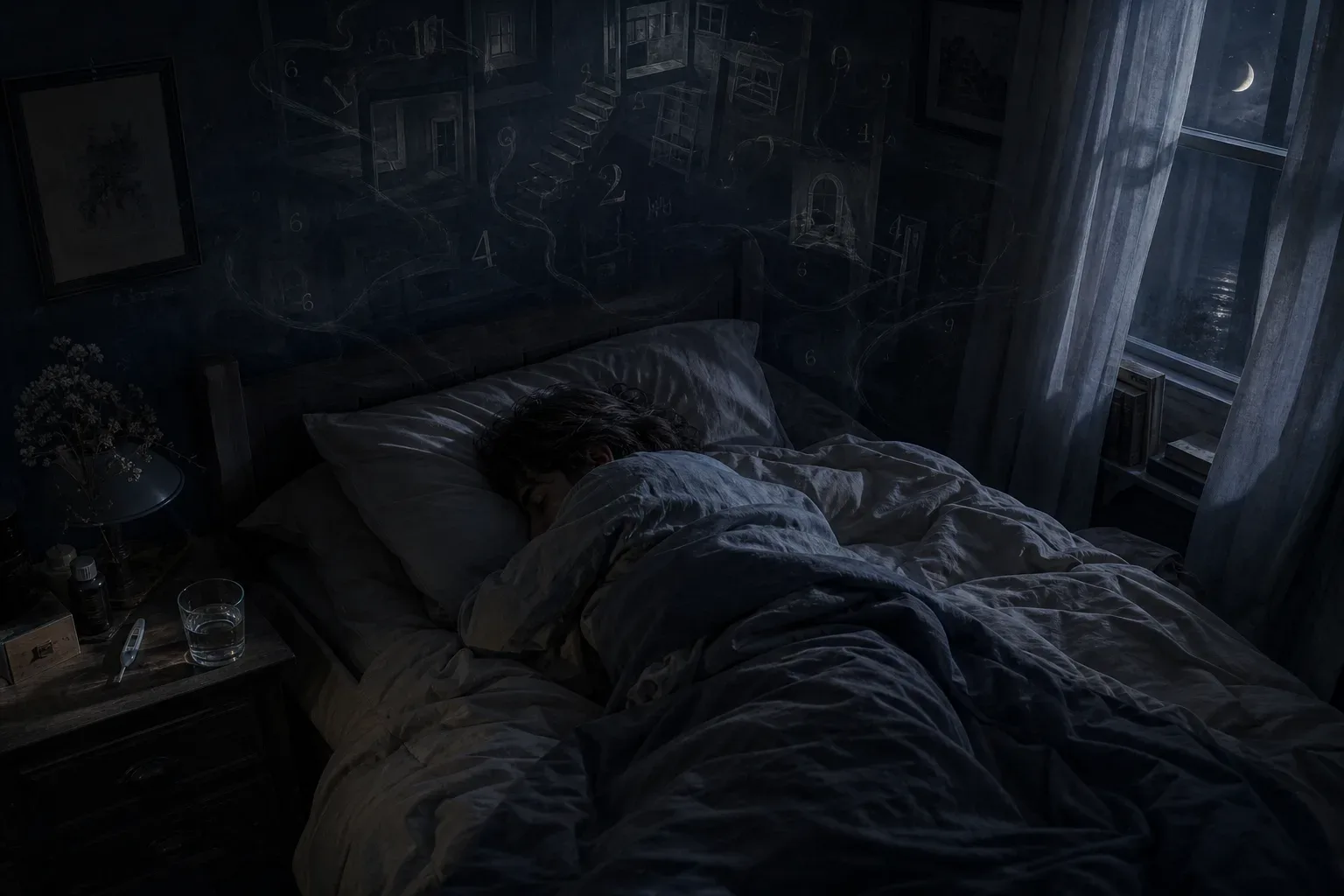
Fever dreams are vivid, strange dreams that happen when illness raises your temperature and disrupts sleep. They’re usually normal. Fever changes REM sleep, fragments the night, and feeds the dreaming mind with heat, chills, pain, and confusion. The dream is often less a message than a body signal wearing pictures.
What are fever dreams, and are they normal?
Fever dreams are illness-related dreams that tend to feel intense, distorted, repetitive, or unusually memorable.
Most people use the phrase after waking from a sick sleep that felt too bright or too crowded. The room was ordinary. The dream was not. You may remember impossible geometry, a task you couldn’t finish, a sense of being too large or too small, or a scene that kept restarting. Clinically, fever is often defined as a body temperature of 100.4°F, or 38°C, or higher; that simple number can change the whole texture of a night.
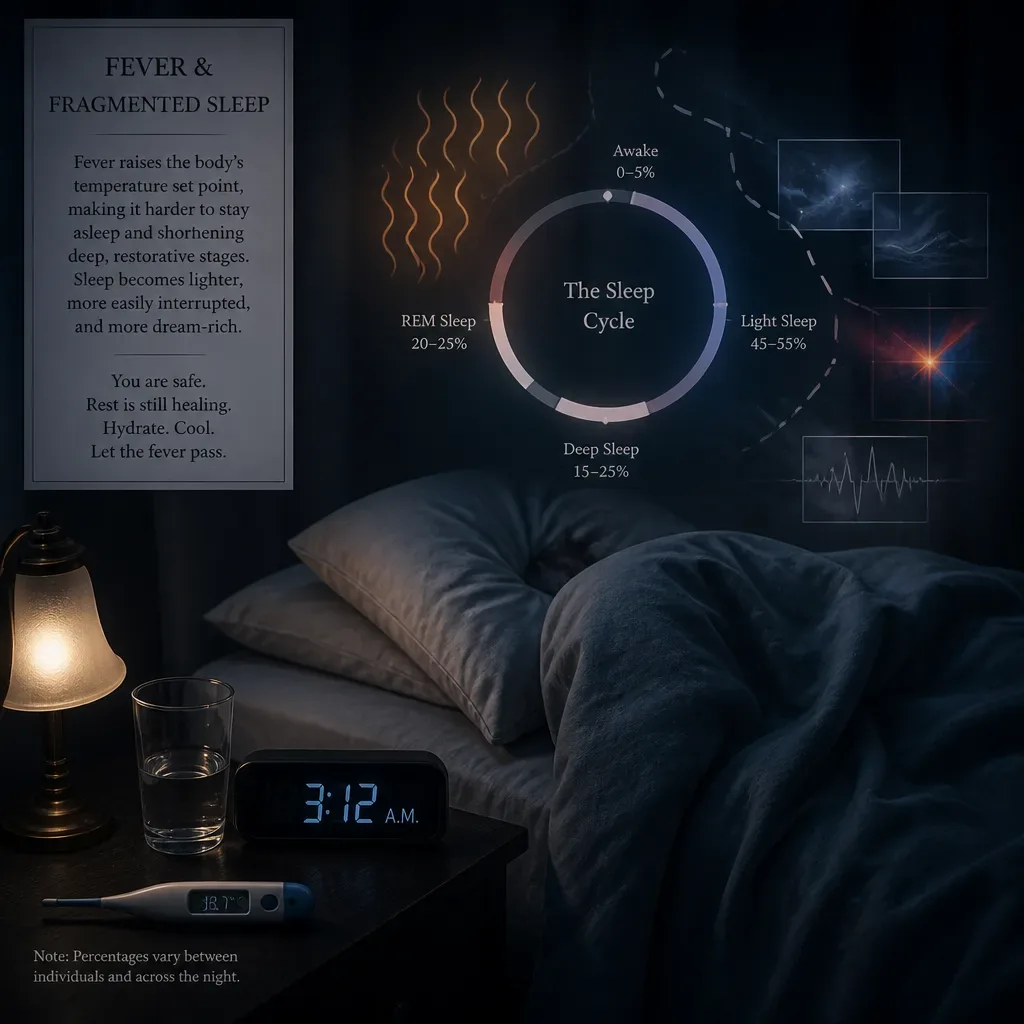
They’re normal because sleep is sensitive to internal conditions. The American Academy of Sleep Medicine describes sleep as a cycling process, with non-REM and REM stages repeating roughly every 90 minutes in adults. Fever, coughing, congestion, medication, pain, and sweating can interrupt those cycles. A dream remembered at 3:12 a.m. may feel stranger because you woke inside it, not because it carried a larger command.
Dream research has long found that awakenings increase recall. In laboratory sleep studies, people awakened from REM sleep often report dreams at high rates; classic work by Dement and Kleitman in 1957 found dream reports after about 80% of REM awakenings. Fever gives the night more edges. More edges mean more chances to remember.
A fever dream can still matter. Dreams borrow from the body, but they arrange those signals into personal images. The heat may become fire. Congestion may become suffocation. Weakness may become a hallway that lengthens as you walk. The body supplies the weather; the psyche supplies the room.
If you want a broader symbol check after you’re well, use the Dream dictionary (A–Z hub) lightly, not literally. Fever first. Meaning second.
A sick dream is often the body speaking in the only language sleep has: image, pressure, and repetition.
Why does a fever make dreams feel so vivid?
Fever makes dreams feel vivid because it raises bodily arousal while breaking sleep into smaller, more memorable pieces.
Your sleeping brain doesn’t turn the body off. It monitors temperature, breathing, pain, thirst, and threat. During fever, inflammatory molecules called cytokines rise as part of the immune response. Research published in Brain, Behavior, and Immunity has linked cytokines such as interleukin-1 and tumor necrosis factor with changes in sleep depth and continuity. That doesn’t mean a cytokine writes the dream. It means the immune system changes the room where dreaming happens.
REM sleep is already physiologically unusual. Heart rate and breathing become more variable, muscles are largely inhibited, and the brain shows high activity compared with deep non-REM sleep. Adults usually spend about 20% to 25% of sleep in REM, according to standard sleep medicine texts. Fever may reduce, delay, or fragment REM, depending on the illness and the person. Fragmented REM can feel like a film cut into hot, alarming scenes.
Body temperature also matters. Normal core temperature tends to dip at night, helping sleep deepen. Fever pushes against that pattern. Dr. Andrew Huberman has often described temperature as one of the major levers of sleep timing and quality; peer-reviewed circadian research says the same in plainer terms. When the body is too warm, sleep can become shallower and more broken.
That brokenness explains the memory. A dream you sleep through may dissolve by breakfast. A dream you wake from, sweating and thirsty, gets stamped into memory with the force of discomfort. The mind remembers what the body made urgent.
Are fever dreams different from nightmares or lucid dreams?
Fever dreams overlap with nightmares and lucid dreams, but they’re defined by illness rather than fear or self-awareness.
A nightmare is usually a frightening dream that wakes you. The International Classification of Sleep Disorders treats nightmare disorder as recurring disturbing dreams that cause distress or impairment, not a single bad night with flu. Fever dreams may frighten you, but they often have a different flavor: confusion, distortion, heat, endless tasks, or the sense that the dream is too close to the skin.
Lucid dreaming is different again. In lucid dreams, you know you’re dreaming while the dream continues. Surveys suggest that about 55% of people report at least one lucid dream in their lifetime, and around 23% report them monthly or more, according to a 2016 meta-analysis by Saunders and colleagues. Fever dreams can include moments of “This can’t be real,” but illness usually makes control harder, not easier. If you’re interested in the research and practice side, see our lucid dreaming pillar.
Here’s a simple comparison:
| Dream type | Main feature | Common trigger | Morning reading |
|---|---|---|---|
| Fever dream | Vivid, distorted, bodily strange | Fever, infection, broken sleep | Ask what body sensation became image |
| Nightmare | Fear strong enough to wake you | Stress, trauma, medication, poor sleep | Ask what threat felt familiar |
| Lucid dream | Awareness that you’re dreaming | Training, spontaneous REM awareness | Ask what you did with awareness |
| Stress dream | Repetitive pressure or failure | Deadlines, conflict, uncertainty | Ask where life feels unfinished |
The distinctions help because they keep you from over-reading. If you had a fever of 102°F and dreamed the ceiling was breathing, start with physiology. If the same breathing ceiling returns when you’re well and anxious, then the symbol deserves more attention.
A dream can be meaningful without being mystical. It can also be biological without being meaningless.
What themes do people usually report in fever dreams?
People often report fever dreams involving distortion, impossible tasks, heat, threat, repetition, and changes in body size or space.
In one small 2020 study in Frontiers in Psychology, Michael Schredl and Daniel Erlacher examined fever dreams and found that participants described more bizarre and negatively toned dreams than ordinary dreams. The sample was modest, so it shouldn’t be treated as a final map. Still, the findings match what many people report: fever dreams are often less narrative and more sensation.
Common motifs include:
- Rooms that expand, shrink, tilt, or repeat
- Objects that are too large, too small, too close, or too numerous
- Endless counting, sorting, packing, or solving
- Heat, fire, deserts, ovens, bright light, or melting surfaces
- Being trapped in bed, unable to finish a task
- Crowds, noise, pressure, or someone standing too near
- A sick relative, a childhood bedroom, or a caretaker figure
The old clinical phrase “Alice in Wonderland syndrome” describes distortions in body size or perception and has been associated with migraine, infection, and other neurological conditions. It’s rare, and not every strange fever dream belongs there. But the comparison is useful: illness can alter perception, and dreaming can dramatize that alteration with startling precision.
Psychologically, fever dreams often show a temporary loss of agency. You can’t complete the task. You can’t cool the room. You can’t make the numbers stop. That doesn’t mean you’re failing at life. It may mean your body is busy with repair, while the dreaming mind turns helplessness into architecture.
The dream exaggerates what the sick body already knows: control is smaller when the body is working hard.
If the dream included a striking animal, object, or place, you can later compare it with entries in the Dream dictionary (A–Z hub). Wait until the fever has passed. Interpretation is cleaner when you’re hydrated.
When should a fever dream worry you?
A fever dream should worry you only when the waking symptoms around it suggest medical risk or the distress continues after recovery.
The dream itself is rarely the problem. A bizarre dream during a fever is expected. What matters is what happens when you’re awake. Many public health sources advise medical attention for very high fever, fever lasting more than 3 days, dehydration, breathing trouble, severe headache, stiff neck, rash, chest pain, or confusion while awake. For infants, older adults, immunocompromised people, and anyone with serious chronic illness, thresholds can be lower.
Confusion matters especially. Dream confusion ends when you wake and orient yourself. Delirium is different: the person remains confused, disoriented, agitated, or unusually sleepy while awake. Medical literature treats delirium as an acute change in attention and awareness, and it deserves prompt care. If someone can’t answer simple questions, doesn’t know where they are, or seems unsafe, don’t treat it as dream symbolism.
Medication can also shape the night. Some cold medicines, antihistamines, steroids, nicotine patches, antidepressants, and sleep aids have been associated with vivid dreams or nightmares in some patients. Alcohol disrupts REM sleep too; after alcohol wears off, REM rebound can make dreams more intense. A 2013 review in Alcoholism: Clinical and Experimental Research described alcohol’s reliable disruption of sleep continuity.
Here’s the plain rule: if the body seems unsafe, tend to the body first. If the body is recovering but the dream keeps returning, tend to the image.

What can you do the morning after a fever dream?
The morning after a fever dream, write down the strongest image and pair it with the body sensation you remember.
Do this after water, temperature check, and any needed care. The aim isn’t to produce a grand interpretation. It’s to keep the useful thread before the dream fades. Dream recall drops quickly after waking; sleep researchers often collect reports immediately for that reason. Even 3 minutes can change what you remember.
Try this small sequence:
- Name the body state. Write: “I was hot, chilled, congested, aching, thirsty, or weak.”
- Name the strongest image. One image only: the burning room, the endless staircase, the tiny hands, the crowded bed.
- Connect them without drama. Ask: “How might this image picture that sensation?”
- Name the feeling. Was it panic, irritation, helplessness, shame, loneliness, or urgency?
- Write one ordinary sentence. “When I’m sick, I feel afraid of needing help.” Or: “My body wanted rest, and my mind made it a task.”
This is where tools can help, if they stay humble. The AI dream interpreter tool can offer possible readings, but your fever, medications, and waking mood belong in the prompt. A good interpretation should reduce confusion, not decorate it.
Depth psychology asks for the uncomfortable familiar thing. Not the most dramatic thing. If you dreamed of sorting stones forever, the question may be simple: Where am I still trying to be useful when I need to lie down?
The morning practice is not to solve the dream. It’s to meet it while it’s still warm.
Can recurring fever dreams tell you something about waking life?
Recurring fever dreams may point to a repeated emotional pattern, especially if the same image appears when you’re not sick.
One fever dream is usually a weather report from the body. Three similar dreams across different illnesses deserve a closer look. Recurring dreams are common; studies often find that a majority of adults report at least one recurring dream theme across life, with rates varying by age and method. Common recurring themes include being chased, unprepared, trapped, late, or unable to complete a task. Fever can amplify those old grooves.
Look for the pattern beneath the fever. A person who always dreams of impossible work while sick may have trouble resting without guilt. Someone who dreams of being abandoned in a hospital corridor may carry an older memory of not being cared for well. Someone who dreams of giant objects pressing down may be picturing bodily pressure and emotional pressure at once.
This is also where waking practice can answer night practice. The AYA Method is a daily audio manifestation practice. Each day you listen to a short personalized recording, your Dream-Self Moment, narrated from the version of you who has already manifested the life you intend. Listening is the practice. Repetition is the work. The audio is the method. For a recurring sick dream, that kind of repetition can become a calm waking counterpoint: not a cure for fever, but a way to speak steadily to the fear underneath the image.
You can also cross-check recurring symbols in the Dream dictionary (A–Z hub), then return to the body. The best reading usually has two feet on the floor: one in physiology, one in personal history.
The line to write down is this: “When my body was ill, my dream gave this feeling a shape.”
Keep the image gently, then take your temperature again.