dream symbolism
Elevator Dream Meaning: Rising, Stuck, Between Selves
Elevator dream meaning explained through psychology, folklore, and common variations: rising, falling, stuck lifts, broken doors, and strange floors.
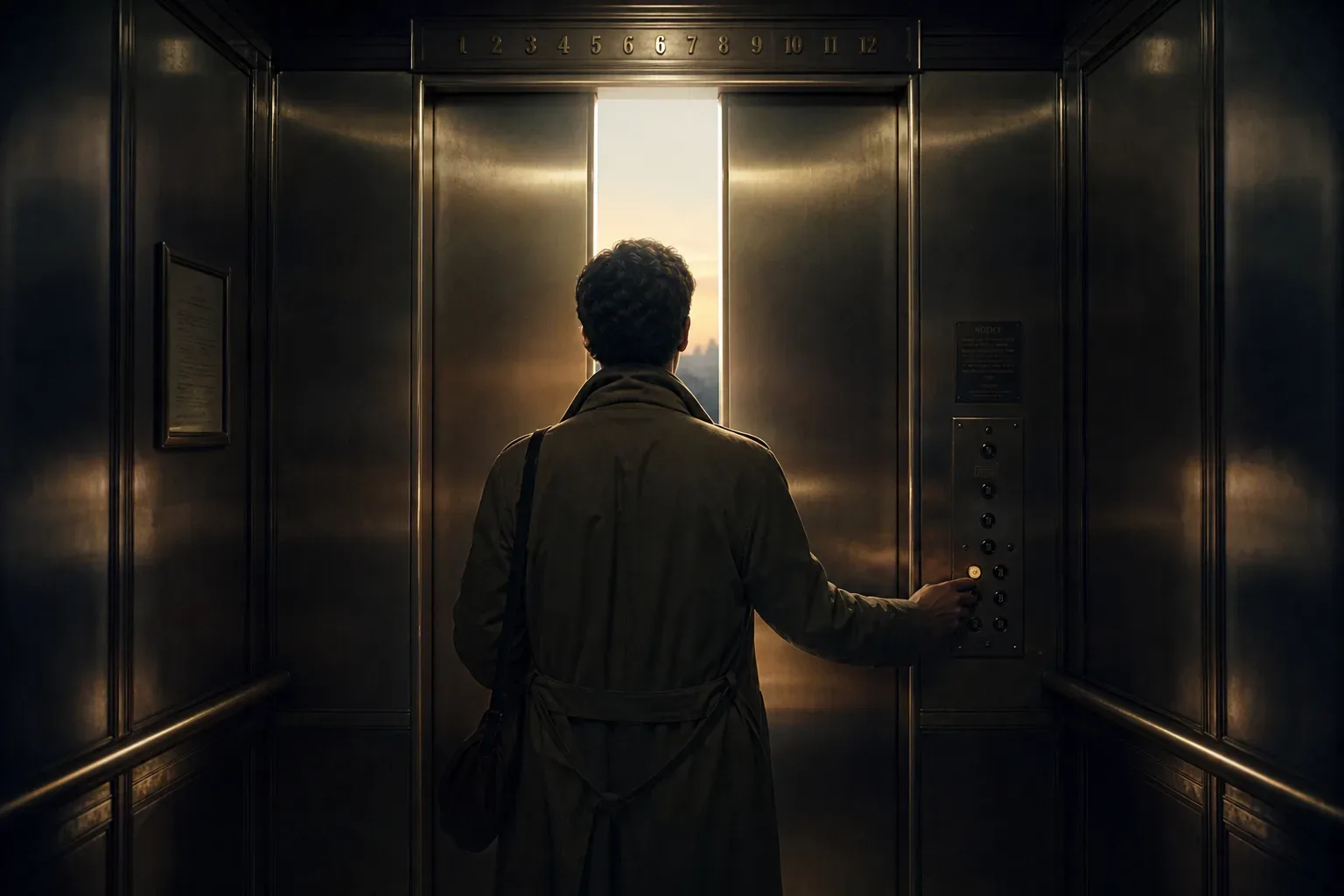
The elevator dream meaning usually points to transition, control, and social movement. Rising can reflect ambition or pressure. Going down often suggests fear, fatigue, or a return to older feelings. Being stuck tends to mean blocked progress. The important detail is not the machine. It’s where it was taking you.
What does an elevator dream usually mean?
An elevator dream usually means you’re between states: not where you were, not yet where you’re going.
An elevator is a small room that moves without your walking. That matters. Stairs ask for effort; an elevator asks for trust. You enter, press a button, and let a hidden system carry you. In dreams, that system often stands in for work structures, family expectations, age, class, illness, recovery, or the ordinary machinery of a life you don’t fully control.
Freud wrote about dreams as disguised wish and conflict in 1900, while Jung later described dream images as symbolic material shaped by both personal history and shared patterns. Neither man had to dream of a glass lift in a corporate tower, but both would have recognized the central drama: the ego in a moving container, carried by forces partly out of sight.
Dream researcher Calvin S. Hall coded more than 50,000 dream reports in the 20th century and found that dreams often reflect ordinary concerns rather than rare prophecies. The lift belongs to that ordinary category. You may dream of it after an interview, a breakup, a promotion, a hospital visit, a move, or a week in which your position in a group felt uncertain.
An elevator is a room that asks you to surrender control for a few floors.
For a quick first reading, notice these 4 details before you search any symbol book:
- Was the elevator going up, down, sideways, or nowhere?
- Were you alone, crowded, watched, or trapped?
- Did you choose the floor, or did the lift choose for you?
- What feeling did you wake with: relief, shame, fear, curiosity, or calm?
If the dream felt emotionally sharp, compare it with nearby entries in the Dream dictionary (A–Z hub). Symbols rarely travel alone. An elevator plus a school, dead relative, hotel, or basement changes the reading.
What does it mean when the elevator is rising?
A rising elevator usually reflects ascent, expectation, ambition, pressure, or the uneasy feeling of being carried upward faster than you can settle.
In waking life, higher floors often mean status. Offices place executives above entry-level workers. Hotels charge more for views. Penthouse apartments sell height as privacy and success. So when you dream of rising, the dream may be borrowing a real social grammar: up means more visible, more exposed, more judged, or more desired.
But rising isn’t always happy. Many people dream of an elevator shooting upward too fast, passing the chosen floor, or entering the sky. That version often has more anxiety than triumph. In a 2023 American Psychological Association report, 77% of U.S. adults said stress affected their health in the previous month. A body under pressure can turn achievement into a vertical panic.
The old symbolic split of up and down is widespread, though not universal. In many European folk readings collected in 19th-century dream books, upward motion promised success, news, or spiritual favor. Those books were often commercial compilations, not sacred texts. Still, their popularity tells us something: people have long wanted height to mean hope.
Here is a plain way to separate the possible readings:
| Rising elevator detail | Possible waking question |
|---|---|
| Smooth rise | Am I allowing growth without needing to prove it? |
| Too fast | Am I moving faster than my nervous system can follow? |
| Passing my floor | Did I miss a chance, or do I fear missing one? |
| Rising with strangers | Whose expectations am I carrying upward? |
| Rising into open air | Where has success become frightening? |
A dream of rising asks a quiet question: can you receive movement without turning it into a test?
What does it mean when the elevator is falling or descending?
A descending or falling elevator usually points to fear of losing control, lowered mood, regression, or a return to something hidden underneath daily life.
There is a useful distinction here. Descending slowly is not the same as falling. A slow descent can mean you’re going into memory, grief, the body, or practical matters. Basements in dreams often hold storage, family history, old shame, and unexamined needs. A falling elevator is sharper. It’s the body saying, “I don’t trust what is holding me.”
Sleep science gives one ordinary explanation for the physical terror. Hypnic jerks, the sudden falling sensations near sleep onset, are common; Cleveland Clinic describes them as normal muscle contractions that can affect up to 70% of people at some point. Not every falling elevator dream is a hypnic jerk, but the body already knows how to make falling feel real.
Psychologically, falling may appear during sudden change: a job ending, a relationship losing its shape, money trouble, illness, or a family role collapsing. In Hall and Van de Castle’s dream research, negative emotions appeared more often than positive ones in many dream samples. That doesn’t make the dream dangerous. It makes it honest about fear.
Folklore often treats descent with caution. In some Mediterranean and Eastern European traditions, going downward in a dream could be read as illness, bad news, or a warning to slow down. That’s folklore, not evidence. I’d keep the caution and discard the prediction. The old reading is useful when translated into waking language: descend carefully; don’t ignore the body.
If you woke afraid, write one sentence without drama: “Something in me feels unsupported by ____.” Then fill the blank with the first ordinary answer. Work. Marriage. Money. Sleep. Your own knees.
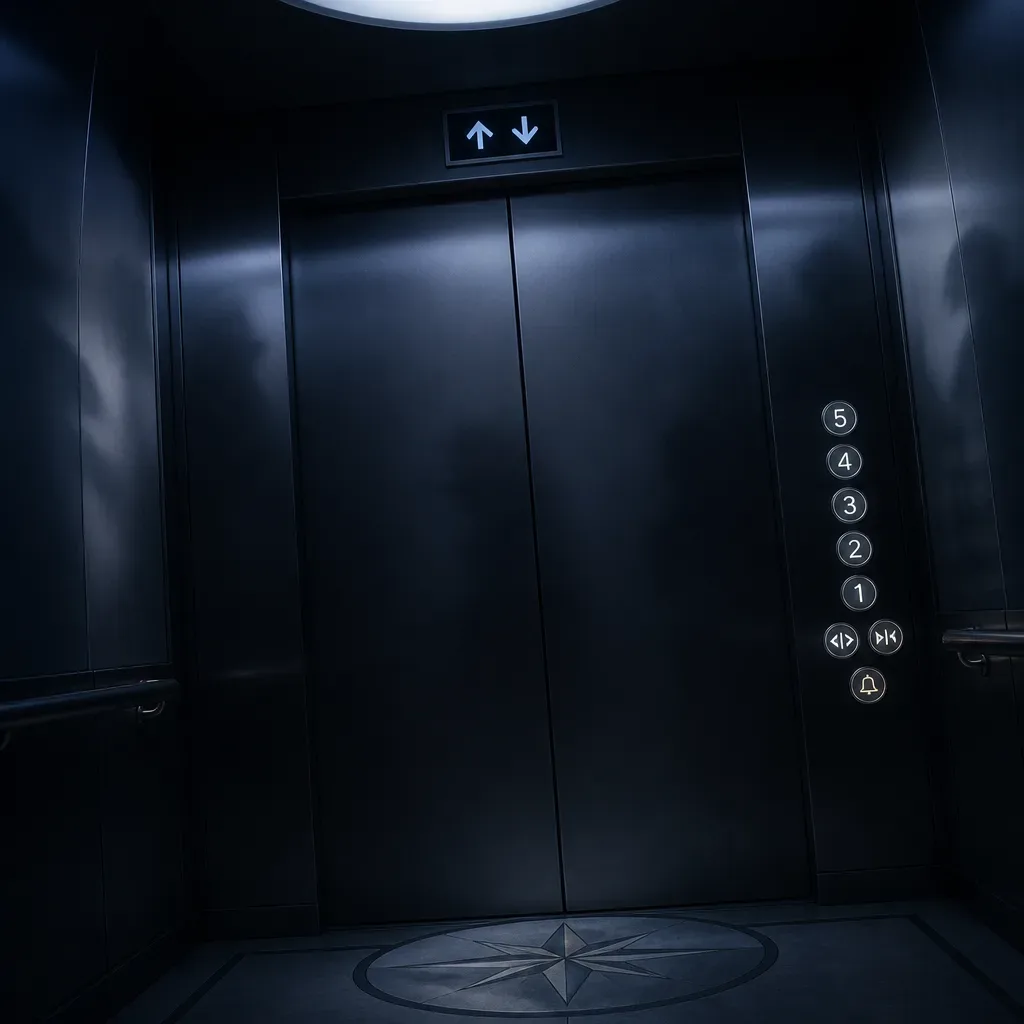
What does a stuck elevator dream mean?
A stuck elevator dream usually means blocked movement: you can see that change is needed, but you can’t yet reach the next floor.
Being stuck is one of the most common modern variations because it matches a modern feeling. You’re in a system. You obeyed the instructions. You pressed the button. Still, nothing moves. The image fits applications waiting for review, messages left unanswered, medical results pending, family decisions delayed, and careers held in someone else’s calendar.
A 2022 Gallup report found that only 23% of employees globally were engaged at work, while many described stress or disconnection. It’s not hard to see why elevators enter work dreams. They are corporate arteries. When they stop, the building stops feeling neutral. It becomes a container.
The emotional tone matters. If you were calm while stuck, the dream may be asking for patience rather than escape. If you were pounding the doors, it may point to panic around delay. If nobody heard you, pay attention to whether you feel unheard in waking life. The lift may be literalizing a sentence you haven’t said: “I’m here, but I can’t get out.”
There’s also a social layer. A crowded stuck elevator can show the suffocation of other people’s needs. A stuck lift with one particular person may point to a relationship that has stopped changing. A stuck elevator alone can be more existential, especially after grief, unemployment, or a long caregiving season.
A stuck dream is not a verdict. It’s a map of where movement has become difficult.
If you get recurring stuck elevator dreams, use the AI dream interpreter tool as a second notebook, not as an authority. Feed it the exact details: floor, people, feeling, ending. Then keep your own judgment. A dream tool can suggest patterns; only your morning life can confirm them.
Why do elevator doors, buttons, and floors matter?
Doors, buttons, and floor numbers matter because they show agency: what you could choose, what opened, and where the dream placed you.
Buttons are especially telling. Pressing a button means intention. Pressing the wrong one can suggest fear of choosing poorly. No buttons at all may mean the system is choosing for you. In dream reports, small mechanical details often carry the emotional logic. The machine is rarely random. It behaves like the problem feels.
Floor numbers add another layer, though they shouldn’t be forced. A 13th floor may bring in cultural superstition. In the United States, a 2007 Gallup poll found that 13% of respondents would be bothered by staying on a hotel’s 13th floor. Many hotels still skip the number in their labeling, which makes a dream of floor 13 less private than it seems. Culture is already in the elevator with you.
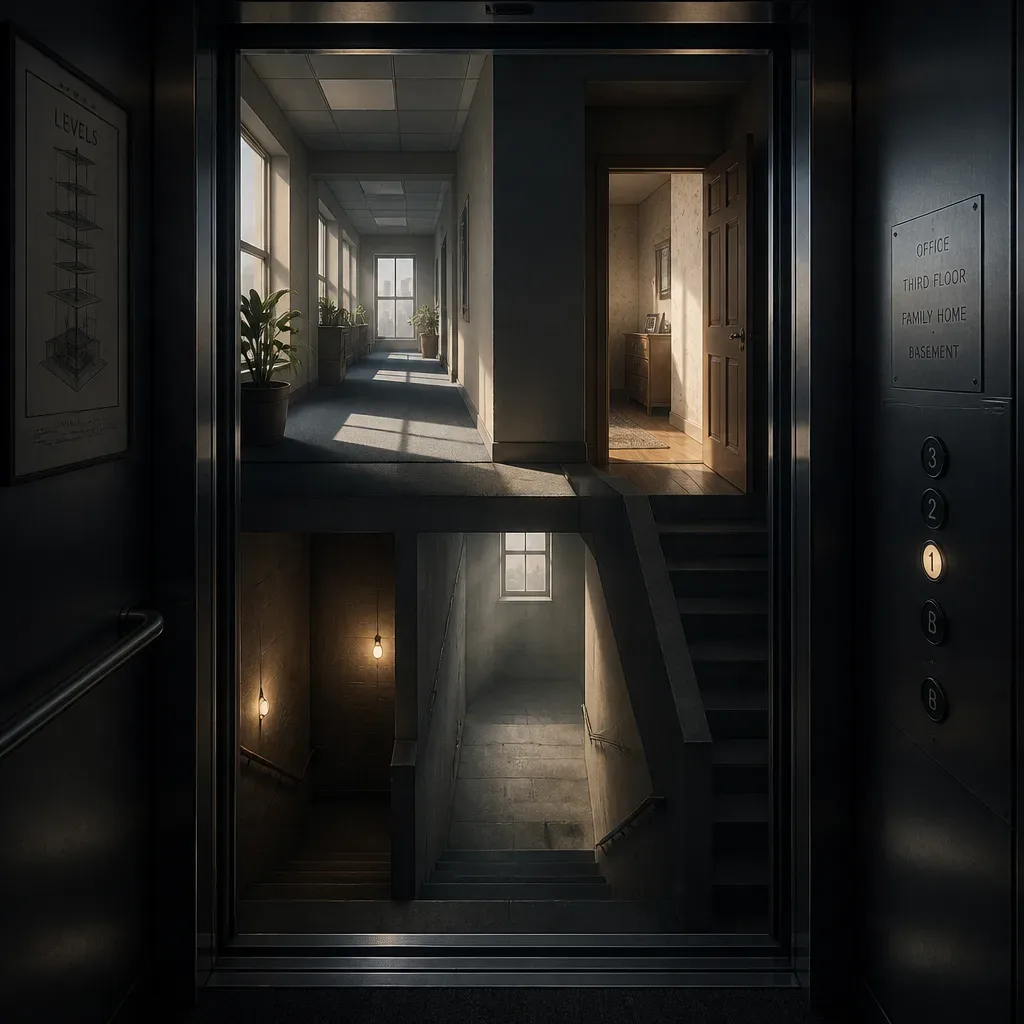
Doors are threshold symbols. Open doors suggest permission, access, or exposure. Doors that won’t open suggest delay or exclusion. Doors opening onto impossible places, like a childhood kitchen, a hospital corridor, or the sea, often show that the elevator is connecting parts of the self that don’t usually share a hallway.
Use this simple morning check:
- Button: What did I try to choose?
- Door: What was I allowed, or not allowed, to enter?
- Floor: What level of life did the dream name: childhood, work, intimacy, money, body, spirit?
- Malfunction: Where does waking life feel unreliable?
- Witnesses: Who saw me in transition?
If your elevator opened onto a dreamlike room, pair this entry with the Lucid dreaming pillar. Lucid dreaming research by Stephen LaBerge in the 1980s showed that some dreamers can signal awareness from REM sleep through planned eye movements. Even without lucidity, doorways often mark moments when awareness is close to the surface.
What do cultural and spiritual traditions say about elevator dreams?
Cultural traditions usually read vertical movement as status, fate, danger, or spiritual nearness, but elevators are modern, so older meanings attach to ladders, stairs, towers, and wells.
No medieval village had an elevator dream in the current sense. It had ladder dreams, hill dreams, tower dreams, well dreams, and underworld dreams. When elevators entered cities in the 19th century, the older vertical symbols moved into the machine. Folklore is practical like that. It uses what the house provides.
In European dream books, climbing often meant honor or gain, while descending warned of loss. In Islamic dream interpretation traditions associated with Ibn Sirin, height can relate to rank, piety, or danger depending on context; falling from a height may suggest loss of position or moral fear. These are inherited readings, not clinical findings. They tell us how communities made meaning from vertical space.
In parts of Latin American folk interpretation, an elevator going up may be read as improvement in work or money, while a broken lift can signal envy, delay, or bureaucratic trouble. Again, evidence is thin, but the pattern is socially revealing. Modern life gave people new machines, and people gave the machines old anxieties.
Jung’s idea of descent into the unconscious is often applied here, sometimes too quickly. Still, it can help if the elevator goes below ground. The lower floor may not be “bad.” It may be storage. It may be memory. It may be the part of you that didn’t get invited to the top floor.
Folklore doesn’t prove what a dream means. It preserves what people feared losing.
If you grew up between cultures, don’t choose only one reading. A Polish grandmother’s warning, a Brazilian aunt’s money sign, and a therapist’s language of anxiety can all be present in the same dream. The Dream dictionary (A–Z hub) is most useful when it helps you hold more than one meaning without turning any of them into law.
What should you do the morning after an elevator dream?
The morning after an elevator dream, write down the direction, feeling, floor, people, and one waking situation that currently feels between stages.
Do it before the day edits the dream into something neater. Dream recall drops quickly after waking; sleep researchers have long noted that reports are most detailed when recorded immediately. Even 3 minutes can preserve the image: the metal door, the wrong button, the smell of carpet, the silence after the fall.
Use a 5-line note rather than an essay:
- “The elevator was going ____.”
- “I felt ____.”
- “The floor number or destination was ____.”
- “The person with me was ____.”
- “This reminds me of ____ in waking life.”
This is also where a recurring dream becomes useful. If the lift appears 3 times in a month, it’s probably circling a stable concern. Recurring dreams are reported by many adults; studies vary, but a 2012 review in Consciousness and Cognition notes that recurrent dreams are common and often tied to unresolved stress or emotional themes.
If the dream leaves you curious rather than afraid, you can work with it gently. If it leaves you panicked often, or if nightmares are disrupting sleep for weeks, talk with a doctor or licensed mental health professional in one plain appointment. That isn’t an overreaction. Sleep is part of health.
This is also the natural place to mention the AYA Method, if waking intention is what the dream keeps pointing toward. The AYA Method is a daily audio manifestation practice. Each day you listen to a short personalized recording, your Dream-Self Moment, narrated from the version of you who has already manifested the life you intend. Listening is the practice. Repetition is the work. The audio is the method.
A recurring dream shows you what attention returns to at night. A daily audio practice gives that attention a sentence in the morning.
Write this line down: “I am between ____ and ____, and today I can take one ordinary step toward ____.”
The doors open when the body believes the floor is real.