lucid dreaming
Dream Signs Lucid Dreaming: How to Spot Your Cues
Learn dream signs lucid dreaming practice by finding your repeated personal cues, tracking them in the morning, and using them before sleep.

Dream signs lucid dreaming practice means learning the odd details that tell you, while you’re asleep, that you’re dreaming. The most useful signs are personal: repeated places, impossible technology, dead relatives, unstable text, or a mood that keeps returning. Notice them in the morning, then rehearse them before sleep.
What are dream signs for lucid dreaming?
Dream signs are the recurring clues in your dreams that can become triggers for lucidity.
Stephen LaBerge, the Stanford psychophysiologist who helped bring lucid dreaming into the sleep laboratory in the 1980s, used the term dreamsigns for features that indicate the dream state. In his system, a person studies remembered dreams, finds repeated anomalies, and trains themselves to ask one simple question when those anomalies appear: Am I dreaming? The method is plain, but not casual. It asks the waking mind to become familiar with the sleeping mind’s habits.
A dream sign is not always bizarre. Sometimes it’s ordinary and wrong by 5 degrees. Your kitchen is in your childhood house. Your phone has 17 unread messages from someone who died. You’re late for an exam you passed in 2009. The clue is not the object itself. The clue is the slight break in reality.
Dream signs fall into 4 useful families. LaBerge described categories such as inner awareness, action, form, and context. You don’t need the vocabulary to begin, but it helps. A flying body is an action sign. A face with changing features is a form sign. A dead grandmother making tea in your current apartment is a context sign. Terror without cause may be an inner sign.
Lucidity begins when a dream detail stops being scenery and becomes evidence.
If you’re new to the wider practice, read the Lucid dreaming pillar alongside this guide. It explains how lucid dreams are identified in sleep research, including eye-signal studies from REM sleep. For symbol references, the Dream dictionary (A–Z hub) can help you compare personal signs with common dream images without pretending that one meaning fits everyone.
How do you find your personal dream signs?
You find personal dream signs by collecting dreams for at least 7 mornings and marking what repeats.
The first rule is speed. Dream memory decays quickly after waking. In sleep research and clinical work, recall is often strongest in the first few minutes, before light, language, and tasks crowd the mind. A 2010 review by Michael Schredl in International Review of Neurobiology notes that dream recall varies widely, but attention to dreams is one of the strongest behavioral correlates. What you notice tends to return with more detail.
Use a small structure instead of a long essay. Write 5 lines if that’s all you have. Date. Location. Main figure. Strong emotion. Strange thing. If you remember nothing, write that too: no dream recalled, woke with pressure in chest, blue light from window. This keeps the morning appointment with the dream, even on thin days.
After 7 to 14 entries, read them as if they were written by someone you care about. Circle repeated places, repeated people, repeated mistakes, repeated weather, and repeated bodily sensations. Most people expect the sign to be dramatic. Often it is not. In consulting rooms, I saw old schools, elevators, teeth, missing shoes, and wrong bathrooms appear more often than dragons.
Try this simple table:
| Dream detail | Type of sign | Question to ask next time |
|---|---|---|
| Childhood house with new rooms | Context sign | Am I back somewhere that no longer exists? |
| Phone won’t work | Form or action sign | Does this device behave normally? |
| Dead relative is alive | Context sign | Is this meeting possible in waking life? |
| Heavy legs while running | Inner or action sign | Is my body obeying ordinary physics? |
| Text changes when reread | Form sign | Can I read this twice with the same words? |
A personal sign is a footprint, not a verdict. It shows where the dream keeps walking.
Which dream signs are common enough to start with?
The best starter signs are unstable text, broken technology, impossible places, strange bodies, and strong repeated emotions.
Some signs appear across many dreamers because dreaming changes memory, perception, and body sense. REM sleep usually includes vivid imagery, reduced voluntary muscle movement, and altered access to reflective thought. That mix helps explain why clocks blur, phones fail, and rooms rearrange themselves. Dr. Andrew Huberman has often summarized REM as a state with high visual and emotional activity and low noradrenaline compared with waking stress. The exact neurochemistry is complex, but the practical point is simple: dreams are good at making a world and poor at keeping it stable.
Start with this numbered list for 2 weeks:
- Text and numbers. Look for signs, books, screens, clocks, receipts, and passwords. In dreams, they often change when reread.
- Technology. Phones, cameras, locks, cars, and light switches may fail or behave strangely.
- Places that cannot coexist. Your current bedroom opens into your childhood school. A city has the wrong river.
- People out of time. A dead person is alive, a child is grown, or an old friend has your manager’s voice.
- Body anomalies. Extra fingers, floating, heavy limbs, missing teeth, or the inability to scream.
- Emotional weather. Panic, shame, grief, or desire arrives before the plot gives a reason.
Don’t treat these as universal meanings. Teeth dreams often reflect stress or transition in popular dream writing, but a dentist, singer, and new parent may carry the symbol differently. If you want help comparing your image with traditional entries, use the AI dream interpreter tool after you’ve written your own notes first. The order matters. Your record comes before any outside reading.
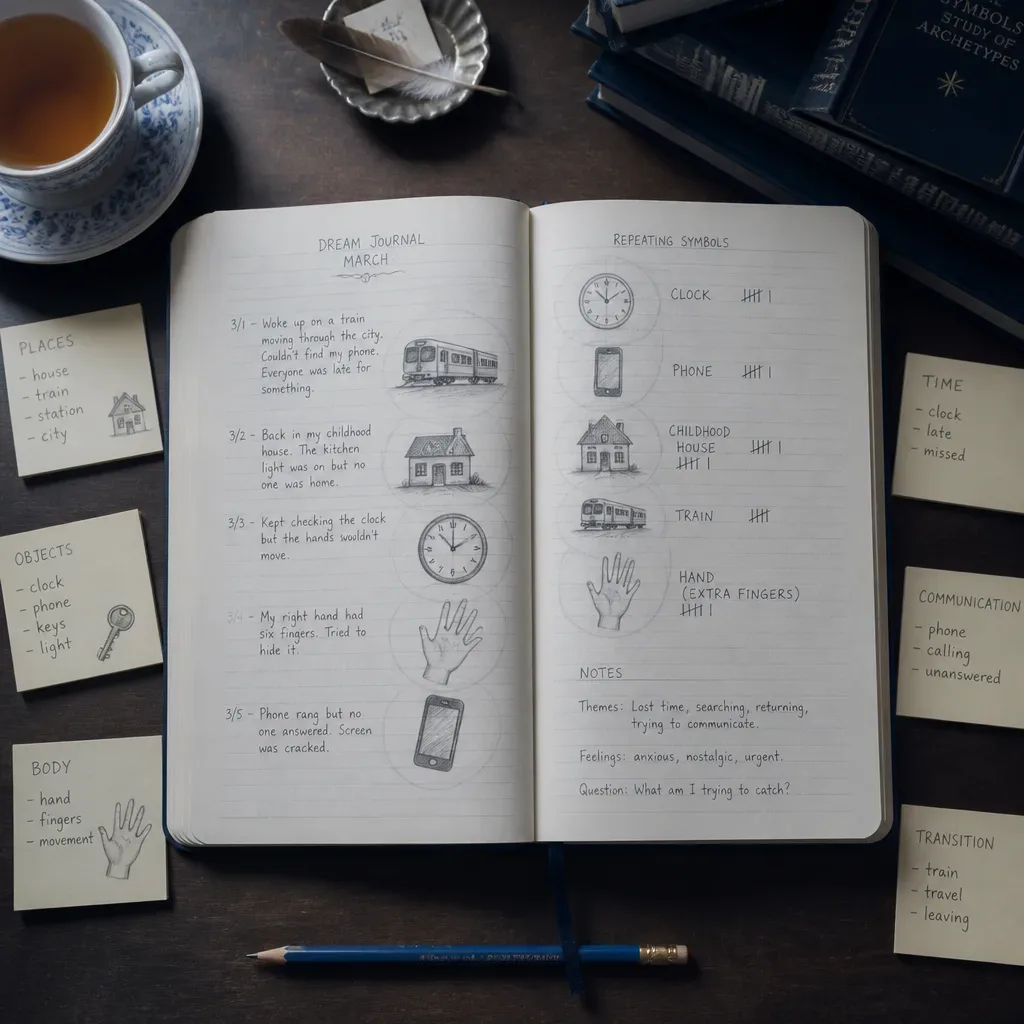
How do you turn a dream sign into a lucid cue?
You turn a dream sign into a lucid cue by pairing it with a repeated reality question while awake.
A sign alone is not enough. You may dream of your old school 30 times and still never question it, because the dream presents it as normal. The work is to attach a small habit to the sign during the day. When you see a school, a locked door, a strange mirror, or a phone glitch while awake, pause and ask: Am I dreaming? Then test the world.
Reality testing has mixed evidence when used by itself, but it remains common in lucid dreaming training. In a 2017 study in Dreaming, researchers found that combining techniques such as reality testing, wake-back-to-bed, and MILD was more effective than using only one casual cue. Another widely cited 2020 meta-analysis in Consciousness and Cognition reported that induction methods show promise, though study quality varies. The honest reading is this: repetition helps, but no technique works for everyone every night.
Use a reality check that has a clear result:
- Read a short line of text, look away, and read it again.
- Count the fingers on one hand slowly.
- Check a digital clock twice.
- Press one finger into the opposite palm.
- Ask how you arrived in this exact place.
The last check is my favorite because it brings memory into the room. In dreams, you may be standing in a hotel, holding a fish, while wearing your father’s coat. The question, how did I get here, often exposes the missing bridge.
Practice should be brief and sincere. Ten shallow checks a day train boredom. Three honest checks train recognition. When the cue appears, stop for 10 seconds. Look. Test. Ask. A dream sign becomes useful when you’ve taught your attention to bow to it.
What should you do before sleep with your dream signs?
Before sleep, rehearse one recent dream sign and imagine recognizing it inside the dream.
This is close to MILD, the mnemonic induction of lucid dreams developed by LaBerge. In the classic version, you wake from a dream, remember it, and set the intention to notice that you’re dreaming the next time. Many modern versions add wake-back-to-bed, often after 4.5 to 6 hours of sleep, because later REM periods tend to be longer. Sleep-cycle timing is not magic. It is biology with a clock.
Here is a 5-minute version for ordinary nights:
- Read your last dream entry.
- Choose one sign, not several.
- Say quietly: Next time I see this, I’ll ask if I’m dreaming.
- Picture the old scene for 30 seconds.
- Picture yourself noticing the sign.
- Let the scene fade and go to sleep.
Keep the practice small enough that you’ll actually do it. If it becomes a performance, it will fail by Tuesday. A 2018 paper by Aspy and colleagues found that MILD success was higher when participants could return to sleep quickly after setting intention. Strain is not the friend of dreaming.
You can also use your dream sign list as a nightly review. Read 3 cues: grandmother in kitchen, phone melting, train station under water. Then stop. The sleeping mind does not need a lecture. It needs a clean thread.
This is where waking intention and dream practice quietly meet. The AYA Method is a daily audio manifestation practice. Each day you listen to a short personalized recording, your Dream-Self Moment, narrated from the version of you who has already manifested the life you intend. Listening is the practice. Repetition is the work. The audio is the method. For lucid dreaming, the parallel is simple: what you repeat with care becomes easier to recognize.
How do you read signs without forcing them to mean one thing?
Read dream signs as patterns first and symbols second.
A lucid dreaming cue has a practical job: it helps you know you’re dreaming. A dream symbol has a different job: it asks what the image means in your life. These overlap, but they’re not identical. If water appears in 9 dreams, it may become a cue for lucidity. It may also point toward grief, birth, overwhelm, cleansing, or simply the fact that you live near a river. The dream deserves both readings, kept separate.
Depth psychology is useful here because it respects repetition. Jung wrote that dreams compensate conscious attitudes, though not in a simple one-for-one code. Modern sleep science is more cautious, but it agrees that dreams often include waking concerns. The continuity hypothesis, discussed by researchers such as Calvin Hall, G. William Domhoff, and Michael Schredl, suggests that dream content frequently reflects waking-life themes. The symbol and the week often know each other.
When you review a sign, ask 3 questions:
- How often has this appeared in the last month?
- What emotion comes with it most often?
- What waking situation has the same emotional shape?
If the sign is your childhood home, don’t rush to nostalgia. Ask which room appears. Ask who is missing. Ask what age you feel in the dream. A house with endless rooms may be curiosity. It may also be avoidance. An interpretation that flatters you is probably incomplete.
The dream does not hand you a slogan. It hands you a scene and waits to see if you’ll look again.

What’s the morning-after practice for dream signs?
The morning-after practice is to record, classify, and choose one cue for the next night.
Do it before messages, news, or bright conversation if you can. A 2021 survey study on dream recall habits found that people who keep dream journals report more frequent recall than those who don’t, though self-selection matters. The useful point is modest: a written practice gives dreams a place to land. Without a place, they evaporate into breakfast.
Use this 4-line format:
- What happened? Write the plot in 2 to 4 sentences.
- What was strange? List the impossible or unlikely details.
- What repeated? Mark any known sign from past dreams.
- What will I notice next time? Choose one cue for tonight.
Here is an example. Dream: I’m in my old secondary school, but it has hospital corridors. My phone only types the word blue. I’m late, and my shoes are wet. Signs: old school, broken phone, wet shoes, lateness panic. Cue for tonight: if my phone won’t type correctly, I’ll ask whether I’m dreaming.
If you want to compare the image after writing, visit the Dream dictionary (A–Z hub) or read the broader Lucid dreaming pillar. If the dream is emotionally tangled, the AI dream interpreter tool can help you organize possibilities, but keep your own language at the center.
Talk to a doctor or qualified mental health professional if nightmares are frequent, sleep is badly disrupted, or dream practice increases distress. Lucid dreaming should make you more honest with the night, not less rested by morning.
Tonight, choose one sign and write one quiet sentence: Next time I see this, I’ll remember.