dream symbolism
Dream of Deceased Loved One: Grief, Memory, or Message?
A dream of deceased loved one can be grief, memory, or comfort. Learn the honest psychological, cultural, and morning-after readings without fear.
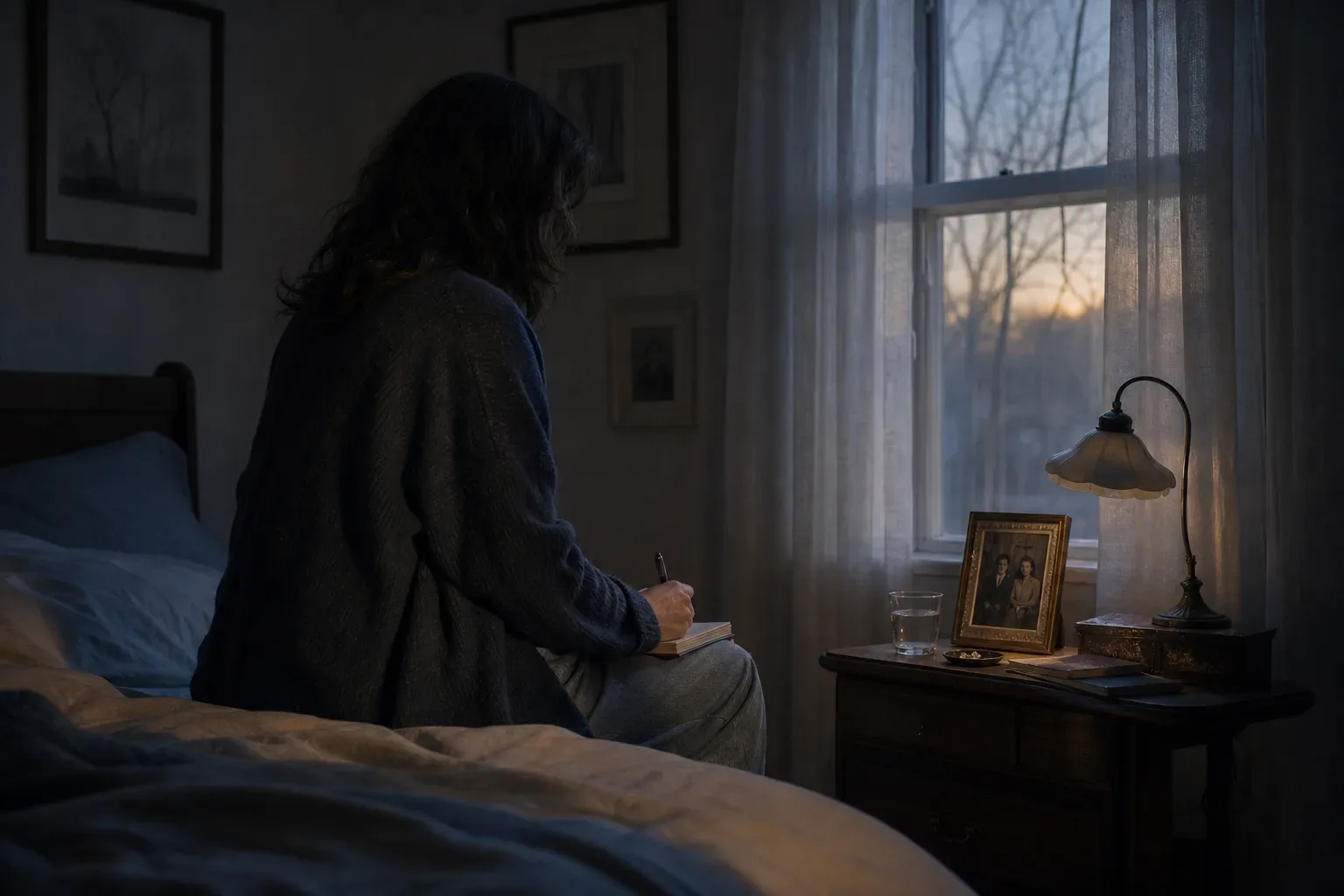
A dream of deceased loved one usually means your grief, memory, and attachment are still working in the night. It may feel like a message, and it can be treated with reverence, but dreams don’t prove prediction or contact. The honest question is what the dream changed in you by morning.
What does a dream of a deceased loved one usually mean psychologically?
Psychologically, it usually means the bond is still alive inside you, even though the person is dead.
Bereavement research has moved away from the old idea that healthy grief requires detachment. In the 1996 book Continuing Bonds, Dennis Klass, Phyllis Silverman, and Steven Nickman argued that many mourners adapt by keeping an inner relationship with the dead, not by cutting it off. Dreams are one ordinary place where that relationship speaks. Not because the mind is weak. Because attachment is durable.
A deceased mother in a kitchen, a grandfather at a train station, a partner standing at the foot of the bed: these scenes often gather what the waking mind keeps in separate drawers. Love. Anger. Guilt. Relief. The body may sleep, but memory keeps arranging the furniture. REM sleep makes up about 20 to 25 percent of adult sleep, according to the National Institute of Neurological Disorders and Stroke, and the brain is active in emotion and memory during that time.
In clinical work, the first question isn’t, “Was this real?” It’s, “What happened between you?” If the loved one comforted you, the dream may be helping you carry a steadier version of the bond. If they criticized you, the dream may be showing an internalized voice you still answer to. If they ignored you, the dream may be staging absence itself.
The dead in dreams often arrive as memory wearing a face we still trust.
This doesn’t make the dream “only psychological.” Only is a small word for something this intimate. A psychological reading doesn’t flatten the dream. It gives you a way to work with it by breakfast.
Is it grief, memory, or your mind trying to heal?
It can be all three at once, because grief uses memory as its language.
Studies of bereavement dreams suggest they are common. In a 2016 paper in the journal Dreaming, Joshua Black and colleagues reported that many bereaved participants had dreamed of the deceased, and a large portion described those dreams as meaningful or comforting. The exact rate varies by sample, relationship, and time since death, but the pattern is steady enough to notice: mourners dream of the dead often enough that no one should feel strange for it.
Grief dreams tend to cluster around unfinished tasks. The dream may let you say goodbye. It may let the person say, “I’m okay.” It may replay the hospital room because the nervous system still hasn’t found a place to put it. After traumatic loss, intrusive images and disturbed sleep are also common; the American Psychiatric Association notes that prolonged grief disorder can be considered when severe grief persists beyond 12 months in adults and impairs daily life.
Memory is not a recording. Each time you remember someone, the memory is touched by the present. Neuroscience calls this reconsolidation; Karim Nader’s early 2000s work helped establish that recalled memories can become changeable before being stored again. A dream of your father at your current age, for example, may not be about 1998. It may be about needing a fatherly gaze now.
Here are three morning distinctions that help:
- Grief dream: the central feeling is loss, longing, guilt, or release.
- Memory dream: the central feeling is recognition, habit, family atmosphere, or ordinary detail.
- Message-feeling dream: the central feeling is instruction, blessing, warning, or permission.
A dream can sit in more than one row. Human bonds rarely keep clean borders.

Could the dream be a message from the person who died?
It may feel like a message, but an honest interpretation should separate personal meaning from proof.
Many people wake from these dreams with unusual clarity. The room feels charged. The words are short. The person looks well. In Black’s bereavement-dream research, participants often described dreams of the dead as comforting and sometimes life-changing, though the studies measure reports, not metaphysical facts. That distinction matters. Dreams reflect; they don’t reliably foretell.
Cultural traditions have long made room for visitation dreams. In parts of Catholic folk practice, dreams of the dead may be connected with prayer, remembrance, or the need to tend a grave. In many West African, Indigenous, East Asian, and Latin American traditions, ancestors may appear in dreams as guides or kin who remain socially present. There is no single folklore reading. The snake means one thing in the research and another thing in your grandmother’s kitchen. Both are worth knowing.
A balanced way to read the dream is to ask what kind of message it seemed to carry, without arguing with the morning.
| Dream pattern | Possible psychological reading | Cultural or spiritual reading, where held |
|---|---|---|
| They say they are okay | The mind offers comfort and reduces distress | A reassurance from the dead |
| They ask for food, prayer, or attention | Unfinished care, guilt, or family duty | A request for remembrance or ritual |
| They warn you | Anxiety shaped in a trusted voice | An ancestral caution in some traditions |
| They embrace you silently | Continuing bond, self-soothing, longing | Blessing, protection, or farewell |
You don’t have to prove a dream before you let it soften you.
If calling it a message helps you live more kindly, remember more honestly, or repair a family pattern, that is already important. If it makes you frightened, obedient, or cut off from ordinary judgment, step back. No good dream interpretation asks you to abandon your common sense.
For symbol background, you can compare the image with the Dream dictionary (A–Z hub), but keep your own relationship at the center. A dictionary can name the road. It can’t know your dead.
Why did the dream feel so vivid, comforting, or frightening?
It felt vivid because dreams often join strong emotion, sensory memory, and unfinished attachment in one scene.
REM sleep is associated with intense imagery and emotional processing. Sleep researchers including Matthew Walker and Rosalind Cartwright have written about dreaming as part of mood regulation, though the field still debates the exact function. Most adults cycle through REM roughly every 90 minutes, with longer REM periods toward morning. That may be why the dream you remember at 6:40 a.m. feels like it has been waiting at the edge of the bed.
Comforting dreams often have a simple structure. The person is healthy. They smile. They say one sentence. They stand in an ordinary place, a porch, a bus stop, a kitchen. Ordinary detail matters. The psyche rarely needs thunder to speak. In bereavement dream reports, positive dreams frequently include reunion, reassurance, or seeing the deceased as no longer ill.
Frightening dreams require the same care, but not panic. A dead loved one appearing angry may reflect your anger, their old authority, or a guilt you’ve not wanted to name. A decomposed body may belong less to the person and more to your confrontation with death as a fact. After sudden or violent loss, nightmares can repeat elements of shock; if they persist or disrupt functioning, a licensed clinician can help.
A useful morning sequence is:
- Name the strongest feeling. Use one word before you explain anything.
- Name the setting. House, hospital, road, church, childhood room.
- Name the action. Did they speak, leave, touch, refuse, wait?
- Name the change. How did you feel after waking compared with before sleep?
The emotion is often the key; the plot is how the dream hides it in plain sight.
If you want a second lens, the AI dream interpreter tool can help you organize the symbols. Use it as a notebook with pattern recognition, not as an oracle. Your body’s response still gets a vote.
Do different deceased-loved-one dreams mean different things?
Yes, variations matter because the role of the loved one changes the emotional task of the dream.
A deceased parent often carries authority, safety, criticism, or inheritance. A deceased child may carry unbearable tenderness, interrupted future, or the mind’s attempt to stay near what cannot be replaced. A deceased partner may bring attachment, daily habit, sexuality, loyalty, or permission to live. The relationship is the symbol before any object in the dream is a symbol.
Dream reports collected in grief studies often show recurring themes: reunion, the deceased being alive again, farewell, advice, and the dreamer realizing in the dream that the person has died. That last variation can be especially piercing. Lucidity, the awareness that you’re dreaming, has been studied since the late 20th century; Stephen LaBerge’s work in the 1980s helped show that lucid dreamers could signal from REM sleep through eye movements. If you become aware during a grief dream, you may be able to ask one question, though trying to control the dream can also make it fade. For basics, see our lucid dreaming pillar.
Common variations include:
- They are alive again and everyone acts normal. This often shows the mind returning to the world before the rupture.
- They die again in the dream. This can mark grief repeating the fact until it becomes more bearable.
- They give you an object. The object may stand for an inheritance, burden, task, or permission.
- They are younger or healthier. This may restore them beyond illness, especially after long caregiving.
- They won’t look at you. This can point to shame, avoidance, or a part of the relationship you still can’t meet.
- They appear with other dead relatives. Family history may be speaking as a system, not as one person.
Specific symbols around the loved one can be checked against the Dream dictionary (A–Z hub), especially houses, phones, water, teeth, cars, and doors. Still, don’t let the symbol outrank the relationship. If your grandmother hated the sea, water in her dream carries family weather, not just archetypal depth.
For wider symbol work, the dream symbolism cluster can help you compare repeating images across nights.

What should you do the morning after the dream?
Write it down, treat it gently, and ask what living action the dream points toward.
The morning after is not the time to force certainty. Within minutes of waking, dream recall begins to thin; sleep researchers have noted that recall is strongest when waking occurs near REM sleep, and many people lose detail quickly when they move, check a phone, or speak. Keep a notebook close. Write fragments if that is all you have. A sentence is better than a vanished cathedral.
Use this simple record:
- The scene: Where were you?
- The loved one: How old, healthy, distant, or familiar did they seem?
- The sentence: What was said, if anything?
- The feeling: What stayed in your body after waking?
- The task: What one honest action belongs to today?
The action should be small. Call your sister. Put flowers by a photograph. Stop carrying an apology that was never yours. Make the appointment. Rest. If the dream asks for ritual, choose one ordinary enough to keep: light a candle, visit the grave, cook their soup, say their name aloud. Ritual doesn’t need spectacle. It needs attention.
This is also where waking practice can meet night material. A recurring grief dream shows what your attention keeps returning to, the fear or wish underneath the image. The AYA Method is a daily audio manifestation practice. Each day you listen to a short personalized recording, your Dream-Self Moment, narrated from the version of you who has already manifested the life you intend. Listening is the practice. Repetition is the work. The audio is the method. It belongs here only if the dream has shown you who you’re still becoming after loss.
The dead may visit at night, but the living answer in the morning.
If the dream leaves you distressed for days, worsens insomnia, or comes with panic, depression, or thoughts of self-harm, talk to a doctor or licensed therapist. That’s not a failure of meaning. It’s care for the nervous system carrying the meaning.
Write this line before the day gets loud: “When I saw you, I felt ___, and now I know I need ___.”