dream symbolism
Dream About Water Meaning: Emotions, Change, or Self
Dream about water meaning usually points to emotion, change, memory, or stress. Learn what oceans, floods, clear water, and drowning may suggest.

A dream about water meaning usually begins with emotion: what you can hold, what spills over, what changes shape. Calm water tends to suggest steadiness or reflection. Floods, storms, and drowning often point to overwhelm. The exact meaning depends on the water, your body in it, and the morning you woke into.
What does a dream about water usually mean?
A dream about water usually means your mind is giving emotional life a visible shape.
Water is one of the most common dream symbols because it does several jobs at once. It can carry, cover, cleanse, drown, reflect, separate, or return. In waking life, the body itself is mostly water. In sleep, the image becomes both ordinary and symbolic. That is why a glass of water, a bathroom flood, a childhood lake, and a black ocean should not be filed under one simple meaning.
Modern dream research is cautious here. The Hall and Van de Castle system, built from thousands of dream reports in the mid-20th century, found that dreams often contain familiar settings, social conflict, emotion, and movement rather than neat messages. G. William Domhoff later argued that dreams are continuous with waking concerns. In plain terms: the brain often dreams with the materials it has been handling all week.
A useful first reading is not mystical. Ask what the water was doing. Was it still, rising, dirty, clear, warm, frozen, tidal, or impossible? A lake might hold grief quietly. A flood might show too much demand. A swimming pool might suggest contained feeling, family memory, or the rules of a public place. The symbol matters, but the action matters more.
Water dreams are less like fortune-telling and more like weather reports from attention.
If you want a broader symbol map after reading, the Dream dictionary (A–Z hub) is useful for comparing water with nearby images: fish, rain, boats, bathrooms, rivers, and drowning. Symbols rarely arrive alone. A boat on dark water is not the same dream as standing under clean rain.
Does calm water mean peace, or is that too simple?
Calm water often points to emotional steadiness, but the dream’s feeling decides whether it is peace, numbness, waiting, or distance.
A calm sea at sunrise may be one of the mind’s cleanest images of relief. A still pond in a locked courtyard may feel less peaceful. The same surface can mean rest or emotional suspension. Notice whether you wanted to enter the water, avoid it, drink it, photograph it, or simply stand beside it. In dream interpretation, your position is evidence.
Sleep science gives us a careful frame. Adults typically need at least 7 hours of sleep, according to the American Academy of Sleep Medicine and Sleep Research Society consensus statement from 2015. Across a full night, REM periods lengthen toward morning, and vivid dreams are often remembered when waking from REM. That means the water dream you recall at 7 a.m. may come from the brain’s late-night emotional sorting, not from a distant message system.
Calm water can also mark a pause after conflict. In many dream reports, a person reaches a lake, pool, or shore after running, arguing, searching, or escaping. The water then becomes a boundary. It says: here is the place where motion stops. Sometimes that is healing. Sometimes it is avoidance. The difference is in the body. Did your shoulders loosen, or did you feel trapped by the quiet?
Use this simple comparison table the morning after:
| Water image | Common psychological reading | Morning question |
|---|---|---|
| Clear lake | Emotional clarity, memory, stillness | What can I finally see plainly? |
| Calm ocean | Acceptance, scale, distance | What feels large but not urgent? |
| Swimming pool | Contained emotion, family or social rules | Who set the edges here? |
| Frozen water | Delay, inhibition, grief held still | What feeling has not moved yet? |
| Warm bath | Comfort, privacy, repair | Where do I need ordinary care? |
Jung wrote often about water as an image of the unconscious, especially in essays collected in the 20th century. That language can be helpful if we keep it modest. The unconscious is not a secret theater with perfect scripts. It is also memory, bodily sensation, old association, and yesterday’s unfinished sentence.
What do floods, waves, or drowning mean in water dreams?
Floods, waves, and drowning dreams usually point to overwhelm, loss of control, or fear that feeling will exceed your capacity.
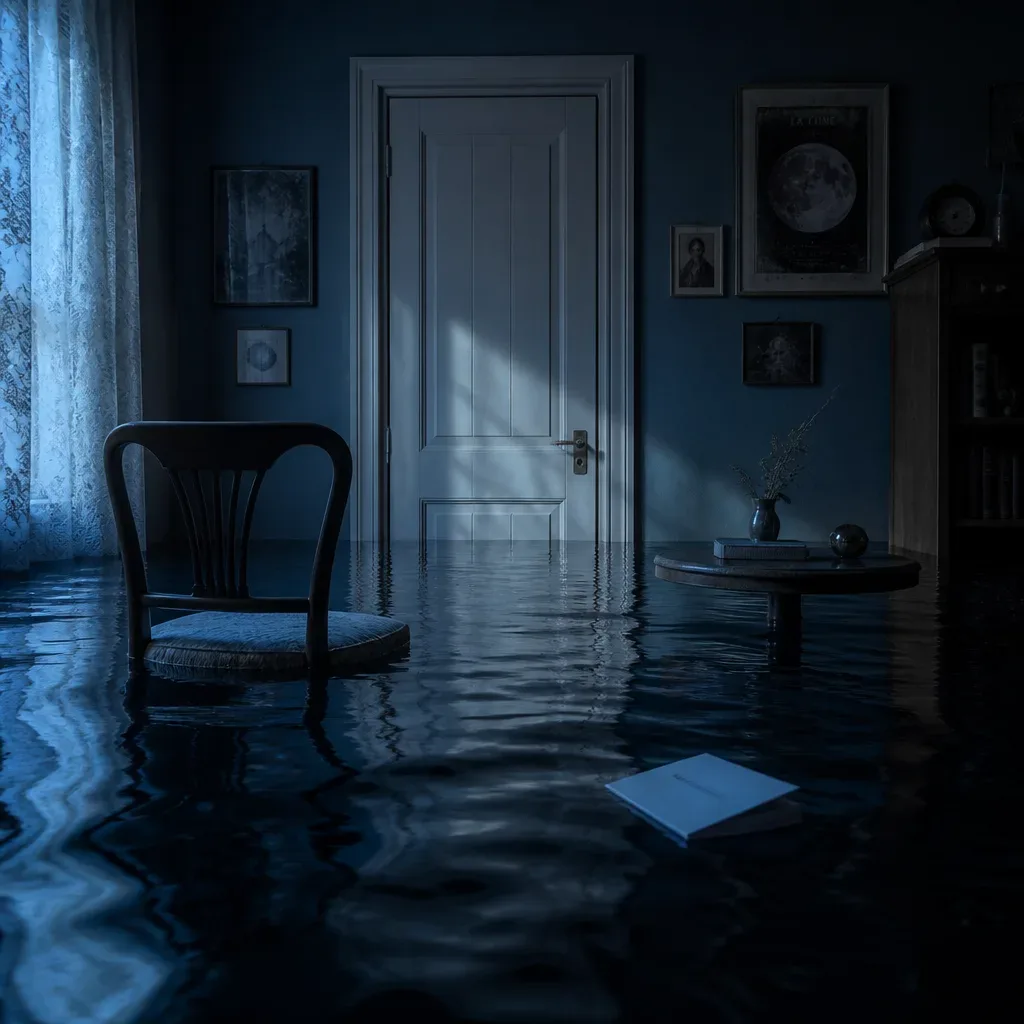
A flood dream is often about boundaries failing. Water comes through the ceiling, rises in the street, enters the childhood home, or fills a room where you were trying to sleep. The image is blunt because the feeling is blunt. Something crosses a line. Emails, caregiving, grief, money pressure, conflict, illness, desire: the dream may not name the source, but it stages the overflow.
Nightmares are common enough that they should not be treated as rare warnings. A 2010 review in Sleep Medicine Reviews noted that recurrent nightmares affect a meaningful minority of adults, with higher rates under stress and after trauma. Antti Revonsuo’s threat-simulation theory, published in Behavioral and Brain Sciences in 2000, proposes that dreams may rehearse danger. It is a serious hypothesis, not settled fact. Still, it explains why waves chase rather than politely symbolize.
Drowning has a sharper tone. It can mean you feel unable to breathe inside a situation. But details matter:
- You are drowning and no one sees you. This often points to private pressure or hidden need.
- Someone rescues you. The dream may be testing trust, help, or dependence.
- You watch someone else drown. The dream may concern guilt, fear for them, or a part of yourself you cannot reach.
- You breathe underwater. This can suggest adaptation. What once frightened you may now be survivable.
- The water rises slowly. Slow dread often belongs to chronic stress rather than one sudden event.
A nightmare is not a prophecy. It is a body alarm with pictures.
If drowning dreams repeat, disturb sleep, or come with panic, one plain step is worth taking: speak with a doctor or mental health professional. That is not because the dream is dangerous. It is because repeated bad sleep can make ordinary days harder.
Does the type of water change the dream meaning?
Yes, the type of water changes the meaning because each setting carries a different emotional grammar.
Ocean dreams often concern scale. You may be facing something too large to manage with the usual tools. If you are floating, the ocean can feel like surrender. If you are pulled out by a current, it can suggest fear of being carried beyond your plans. A river is different. Rivers move in one direction, so they often read as time, transition, aging, travel, or a decision already in motion.
Rain usually comes from above. It can cleanse, expose, soak, or interrupt. A gentle rain has a different nervous system than a storm through a broken roof. Freud, in The Interpretation of Dreams in 1900, used water images in several symbolic ways, but modern readers should be careful with his certainty. The better method is association first, theory second.
Here are common water types and honest readings:
- Ocean: scale, the unknown, fear, awe, distance from shore.
- River: movement, time, transition, being carried forward.
- Lake: memory, stillness, depth, reflection, old feeling.
- Rain: release, sadness, cleansing, interruption, exposure.
- Floodwater: overwhelm, failed boundaries, sudden demand.
- Dirty water: confusion, shame, illness worry, mixed motives.
- Clear water: honesty, visibility, readiness to face something.
- Bathroom water: privacy, bodily vulnerability, cleansing, embarrassment.
Dream dictionaries are most useful when they give you options, not verdicts. If a water dream included animals, rooms, teeth, snakes, or flying, compare the images rather than forcing one master symbol. The AI dream interpreter tool can help organize details while they are still fresh, but your own associations remain the primary evidence.
The best interpretation is the one that makes you more honest, not more frightened.
Culture also matters. A river may mean baptism to one dreamer, migration to another, and childhood fishing with a grandfather to a third. In folklore, water is often a threshold between life and death, purity and danger, the village and the wild. That tradition is old. It is not proof. But old images last because they keep finding new mornings.
What do cultural and spiritual traditions say about water dreams?
Cultural and spiritual traditions often read water as cleansing, birth, danger, passage, or contact with the unseen, but these are inherited meanings rather than proven predictions.
In many Christian traditions, water evokes baptism, washing, repentance, and new life. In Jewish ritual life, the mikveh carries ideas of purification and transition. In Islamic dream manuals, water can be associated with life, knowledge, trial, or blessing, depending on clarity and context. In Hindu traditions, rivers such as the Ganges carry sacred associations of cleansing and liberation. These readings are meaningful because people live inside cultures, not because dreams issue certified forecasts.
Anthropologists have long noted that water often marks borders: shorelines, wells, springs, rivers, baths, and crossings. The specific belief changes, but the structure repeats. Water separates one state from another. In a dream, that may be psychological as much as spiritual: before and after the apology, before and after the diagnosis, before and after leaving home.
There is no good evidence that a water dream predicts pregnancy, death, money, or a future event. There is a long tradition of people reading it that way. Both sentences can sit together. Respect for folklore does not require surrendering your judgment.
If the dream felt sacred, write that down without rushing to explain it. Sacred is a quality of attention. It does not need a loud interpretation. A small study can suggest a pattern, but a single dream asks first for careful remembering.
This is also where lucid dreaming sometimes enters. If you become aware within a water dream, you may choose to swim, ask the water a question, or change the scene. Research by Stephen LaBerge in the 1980s showed that some lucid dreamers could signal awareness through prearranged eye movements during REM sleep. For a careful guide, see our Lucid dreaming pillar. Lucidity does not make every symbol clear. It simply gives you a little more room inside the dream.
How should I interpret my own water dream the morning after?
Interpret your water dream by recording the exact image, the feeling in your body, and the waking situation that may have supplied the pressure or relief.
Do it quickly. Dream recall fades fast for many people, and even 5 minutes of checking messages can sand off the useful edges. Sleep researchers such as Michael Schredl have found that dream recall varies widely by person and is influenced by interest, awakenings, and memory habits. You do not need a perfect report. You need the few details that still carry heat.
Use a 6-line method:
- Write the water first. Ocean, flood, pool, rain, sink, river, ice.
- Write the action. Rising, falling, carrying, drowning, cleansing, leaking.
- Write your position. In it, beside it, under it, above it, afraid of it.
- Write the strongest feeling. Fear, calm, grief, relief, shame, curiosity.
- Write one waking link. What has felt fluid, unstable, or too much this week?
- Write one plain sentence. The water in this dream may be showing me ____.
The sentence matters because it keeps interpretation from becoming theater. Try: The water in this dream may be showing me how much I am holding for my family. Or: The water may be showing me that I am calmer about the move than I admitted. Do not over-polish it. The first honest sentence is usually better than the clever third one.
For recurring water dreams, track frequency. Three similar dreams in a month say something different from one dream after a stormy movie. A 2021 paper in Frontiers in Psychology discussed how pandemic stress changed dream content for many people, with more negative emotion reported in several samples. Context is not decoration. It is part of the dream.

A recurring dream shows you what your attention keeps returning to: the fears and wants underneath it. The waking counterpart can be deliberate. The AYA Method is a daily audio manifestation practice. Each day you listen to a short personalized recording, your Dream-Self Moment, narrated from the version of you who has already manifested the life you intend. Listening is the practice. Repetition is the work. The audio is the method. Daily affirmations and a Manifestation Board can complement it, but they are not the center.
If you want to compare this water dream with other night images, keep the Dream dictionary (A–Z hub) nearby. Look especially at rooms, animals, weather, and vehicles. Water rarely arrives without a shore.
Write the line before the day teaches you to forget it.