dream science
Do Dreams Mean Anything? Science Before Symbolism
Do dreams mean anything? See what sleep science can honestly say about memory, emotion, nightmares, symbols, and what to write down.

Do dreams mean anything? Usually, yes: dreams tend to reflect memory, emotion, bodily state, and current concerns. Science doesn’t support one fixed symbolic code or reliable prophecy. It does support a quieter claim: dreaming is meaningful brain activity, and the meaning becomes clearer when you connect the dream to waking life.
What does science mean when it asks, do dreams mean anything?
Science means that dreams may carry information about memory, emotion, and attention, not that every dream has a secret translation.
The first honest distinction is between meaning and message. A message implies an author with a sentence to deliver. Meaning can arise from patterns: what your brain repeats, exaggerates, avoids, or rehearses. In laboratory sleep studies, people woken from REM sleep report dreams about 80% of the time, according to classic work summarized by sleep researcher J. Allan Hobson. REM isn’t the only dream state, but it gives researchers a measurable door into the problem.
The modern science of dreaming grew partly as a correction to older certainty. Freud’s 1900 book The Interpretation of Dreams treated many dreams as disguised wishes. Jung later gave symbols a wider cultural and archetypal life. Both still influence clinical language, but neither gives us the kind of controlled evidence a sleep lab asks for. A dream can be psychologically serious without being a solved equation.
Researchers such as G. William Domhoff have argued, using thousands of dream reports, that dreams often show continuity with waking concerns. This is called the continuity hypothesis. If you’re under pressure at work, grieving, newly in love, studying for exams, or afraid of illness, those concerns are more likely to appear at night. The sleeping mind doesn’t file the day away neatly. It makes scenes.
A dream is not a verdict. It is a record of what the mind kept touching in the dark.
That is why a scientific reading should come before a symbolic one. Ask first: What was my brain processing? Only then ask: What does the snake, house, river, door, or dead relative mean to me? If you want a broad index after that first pass, the Dream dictionary (A–Z hub) can help you compare patterns without pretending every symbol means one thing.
Are dreams random noise or meaningful brain activity?
Dreams are not pure random noise, though they can be strange because the sleeping brain is working under different rules.
In 1977, Hobson and McCarley proposed the activation-synthesis model, arguing that dreams arise when the brain tries to make sense of internally generated neural activity. The phrase is often shortened, unfairly, to “dreams are random.” The model was more subtle than that. It said the brain synthesizes a story from activation. A story made from scattered signals can still reveal what the brain reaches for first.
REM sleep changes the balance of brain systems. Studies using PET and fMRI have found relatively high activity in limbic and visual association areas during REM, with reduced activity in parts of the dorsolateral prefrontal cortex, which helps with logical monitoring. That rough pattern helps explain why dreams can feel emotionally convincing while making little ordinary sense. The dream accepts the impossible because the night watchman is half off duty.
Memory research gives the question more weight. Matthew Walker and Robert Stickgold have both written about sleep’s role in memory consolidation, and many studies show that sleep helps stabilize learned material. In one well-known 2000 paper in Science, Stickgold and colleagues reported that people trained on a visual discrimination task improved after sleep. That doesn’t mean dreams are rehearsal tapes, but it does place dreaming near the machinery of learning.
A useful comparison looks like this:
| Scientific idea | What it says | What it does not prove |
|---|---|---|
| Activation-synthesis | Dreams build stories from brain activity | Dreams are meaningless |
| Continuity hypothesis | Dreams reflect waking concerns | Every detail has a fixed meaning |
| Memory consolidation | Sleep supports learning and integration | Dreams always show the exact memory being stored |
| Threat simulation | Dreams may rehearse danger | Every nightmare is useful |
The best answer is modest. Dreams are constructed, biased, emotional simulations. They may be messy, but messy isn’t the same as meaningless.
What can recurring dreams and nightmares tell you?
Recurring dreams and nightmares often point to repeated stress, unresolved emotion, or a learned fear pattern rather than a supernatural warning.
Most adults have had at least one recurring dream, and nightmare frequency rises with stress, trauma exposure, anxiety, and some medications. The American Academy of Sleep Medicine has estimated that nightmare disorder affects about 4% of adults, while occasional nightmares are far more common. A nightmare once in a while is ordinary. A nightmare that ruins sleep for weeks deserves care.
The content is often blunt. People are chased. Teeth loosen. Cars won’t brake. Doors won’t lock. Exams appear years after graduation. These dreams don’t need exotic interpretation at first. They often dramatize being unprepared, exposed, pursued, stuck, or unable to control speed. Tore Nielsen and Ross Levin’s neurocognitive model, published in 2007, links disturbing dreams to emotion regulation and fear-memory networks. It is a model, not a final answer, but it fits much of what people report.
Threat simulation theory, associated with Antti Revonsuo, goes further. It proposes that dreaming evolved partly to rehearse dangers. The theory is taken seriously, especially for nightmares, but it isn’t settled fact. Some dreams rehearse threat. Some rehearse embarrassment. Some put your childhood kitchen inside your current office and ask you to act normal.
For recurring dreams, ask three plain questions:
- What emotion repeats? Fear, shame, grief, desire, urgency, or helplessness.
- What role do I play? Hiding, searching, rescuing, failing, fleeing, watching.
- Where does this pattern appear while I’m awake? Work, family, health, money, intimacy, identity.
If the same dream returns for months, write the repeating part in one sentence. “I can’t find the room.” “The animal is in the house.” “I’m late and no one helps.” That sentence is often more useful than a symbol list. The dream may be naming a posture you know too well.
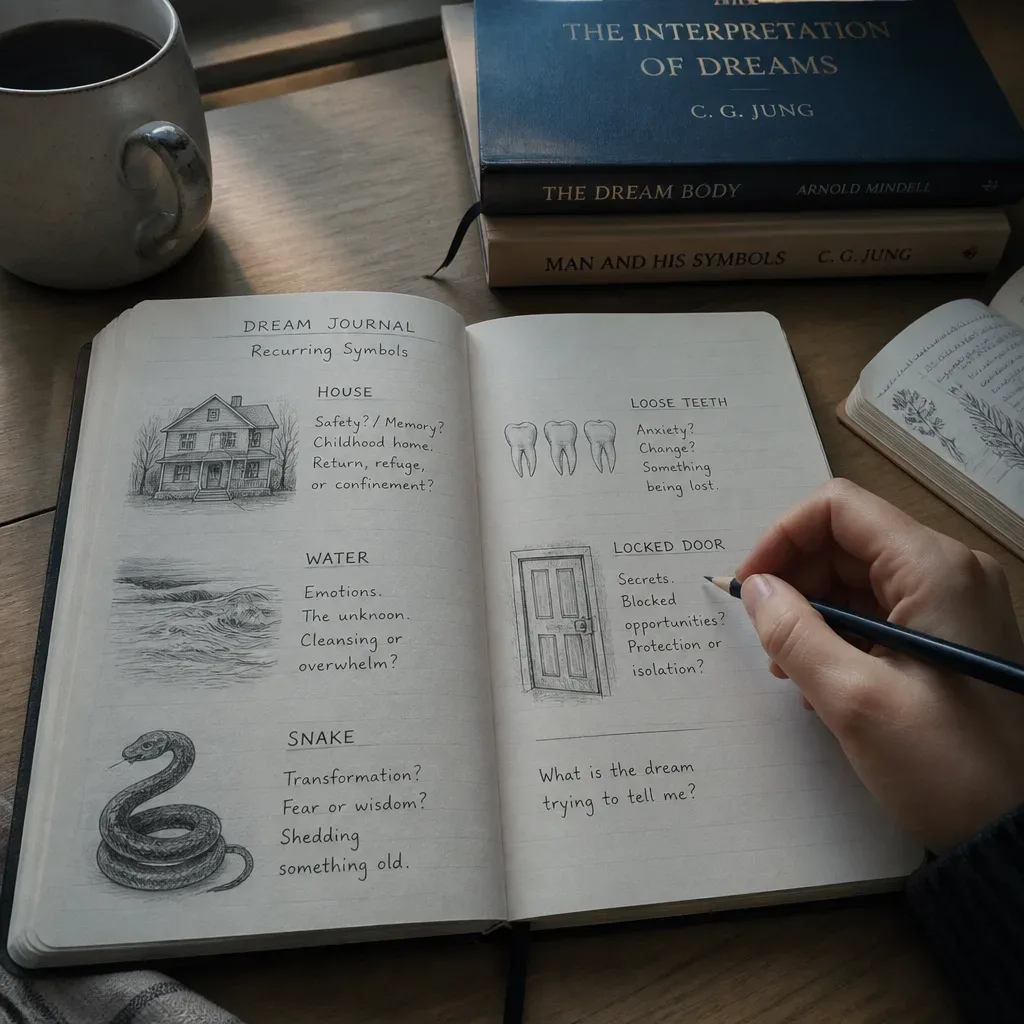
How should I read common dream symbols without overclaiming?
Read symbols as clues shaped by biology, culture, and personal memory, not as fixed entries in a secret codebook.
Some dream images are common because human life is common. Teeth, blood, water, houses, animals, sex, death, travel, school, and falling all come from shared bodies and shared social pressures. Calvin Hall’s large mid-20th-century dream collections, later analyzed by Domhoff and others, showed that familiar characters, social interactions, misfortunes, and ordinary settings appear often. The average dream is less like a mythic film than people expect. It is usually domestic, social, and emotionally tilted.
Still, symbols can matter. A house often maps onto self, family, privacy, or memory because we live inside houses and inside bodies. Water often carries feeling because it changes shape, depth, and danger. Teeth often point toward speech, appearance, age, aggression, or vulnerability because teeth do all that work in waking life. These are not laws. They are good starting places.
A symbol becomes useful when it meets context. If you dream of a snake after seeing one on a hiking trail, the recent memory matters. If your grandmother kept a brass snake in her kitchen, that matters too. If you grew up in a tradition where snakes were linked with healing, temptation, wisdom, or danger, the cultural layer should be respected. The snake means one thing in the research and another thing in your grandmother’s kitchen. Both are worth knowing.
Use this order before reaching for a symbolic meaning:
- Recent residue: Did I see, hear, read, or talk about this image in the last 48 hours?
- Emotion: What did I feel in the dream: fear, tenderness, disgust, longing, calm?
- Personal history: Where has this image appeared in my life before?
- Cultural inheritance: What did my family, religion, or folklore teach about it?
- Current concern: What problem in waking life has the same shape?
If you want help comparing your notes with common patterns, the AI dream interpreter tool can offer a second pass. Treat it as a mirror with footnotes, not an authority over your own life.
Do cultural and spiritual readings still have a place?
Yes, cultural and spiritual readings have a place when they are named honestly as tradition, not sold as scientific proof.
Humans were reading dreams long before EEG electrodes existed. Ancient Mesopotamian dream manuals date back more than 3,000 years. Greek healing temples invited dream incubation. Many Indigenous, African, Asian, and European traditions have treated dreams as visits, warnings, ancestral contact, or moral instruction. These traditions are not laboratory claims. They are cultural memory, and cultural memory can shape what a dream means to the dreamer.
The mistake is not having a spiritual reading. The mistake is pretending that one reading cancels all others. If someone dreams of a dead parent and wakes comforted, a lab cannot measure the full human meaning of that comfort. It can say grief dreams are common. Studies of bereavement dreams, including work by Joshua Black and colleagues, suggest that many grieving people report dreams of the deceased, often with mixed or comforting emotions. That finding doesn’t prove visitation. It does prove the dream matters.
Folklore should be handled with affection and boundaries. A crow in one tradition may be a messenger. In another, a bad sign. In another, simply a bird you noticed outside the clinic. Dreams reflect; they don’t foretell. When folklore says a dream predicts a birth, death, betrayal, or illness, report that as folklore. Don’t hand fear to someone at 7 a.m.
There is also a practical reason to keep spiritual readings in view. Symbols live in communities. If your mother taught you that muddy water means family trouble, your dreaming mind may use muddy water that way because the association is already stored. Meaning isn’t less real because it was learned.
If you want a fuller symbolic comparison after the science pass, the Dream dictionary (A–Z hub) is best used slowly: one symbol, one memory, one honest question.
What should I do with a dream the morning after?
The best morning practice is to record the dream quickly, name the strongest emotion, and connect it to one waking concern without forcing certainty.
Dream recall fades fast. In sleep studies, awakenings during REM produce much higher recall than later morning reconstruction, and ordinary memory interference begins as soon as you check messages, speak, or stand up. Give the dream 3 to 5 minutes before the day edits it. You don’t need beautiful prose. Fragments count.
Write four lines:
- What happened? Keep it concrete: “I was in a train station and couldn’t find my bag.”
- What did I feel? One word is enough: panic, guilt, relief, hunger, tenderness.
- What stood out? Object, person, color, sentence, room, animal, body sensation.
- What waking thing rhymes with it? A deadline, a conversation, a loss, a wish, a decision.
This is where a dream begins to become useful. Not because you solved it. Because you stopped it from vanishing. A remembered dream is a small data point from the night mind; one dream is a clue, and a month of dreams is a pattern.
For people interested in lucid awareness, the morning note can also train recognition. Lucid dreaming research has shown that techniques such as reality testing and mnemonic induction can increase lucid dream frequency for some people; a 2012 review by Ursula Voss and colleagues summarized both promise and limits. The Lucid dreaming pillar explains that practice without turning lucidity into a contest.

A related waking practice can help when the same dream keeps circling the same fear or want. The AYA Method is a daily audio manifestation practice. Each day you listen to a short personalized recording, your Dream-Self Moment, narrated from the version of you who has already manifested the life you intend. Listening is the practice. Repetition is the work. The audio is the method. It belongs here only lightly: dreams show what attention returns to at night; the audio gives attention a chosen sentence in the day.
When is a dream just a dream, and when should I talk to someone?
A dream is usually just a dream unless it repeatedly harms sleep, brings severe distress, or connects with trauma, sleep paralysis, or unsafe daytime symptoms.
Most strange dreams are ordinary. REM periods lengthen across the night, with the longest REM episodes often occurring in the final third of sleep, which is why morning dreams can feel detailed and close. A bizarre dream after fever, alcohol, sleep loss, jet lag, or a new medication may say more about the body than the soul. The body enters the dream wearing costumes.
There are cases where help is wise. If nightmares happen weekly or more and lead you to avoid sleep, if dream content is tied to trauma, or if you wake acting out dreams physically, speak with a clinician. REM sleep behavior disorder, in which people may move during dreams because normal muscle paralysis is reduced, is uncommon but medically important, especially in older adults. This isn’t a reason to panic. It is a reason not to explain everything symbolically.
Sleep paralysis also deserves calm language. It can involve waking while unable to move, sometimes with a sensed presence or pressure on the chest. Population estimates vary, but a 2011 review in Sleep Medicine Reviews found that about 7.6% of the general population reported at least one episode. It is frightening and usually brief. If it is frequent, distressing, or accompanied by daytime sleep attacks, talk to a doctor.
Here are plain signs to take the dream beyond your notebook:
- Nightmares are frequent and make you fear sleep.
- The dream repeats after trauma or loss and doesn’t soften over time.
- You injure yourself or someone else while asleep.
- You have strong daytime sleepiness, sudden weakness, or hallucinations at sleep edges.
- A medication change clearly coincides with disturbing dreams.
Science leaves room for meaning, but it also protects you from over-reading. Some dreams ask for interpretation. Some ask for rest, safer sleep, or professional care.
Tomorrow morning, write the dream down before the room fully returns.