lucid dreaming
DILD vs WILD Lucid Dreaming: Which Fits Your Sleep?
DILD vs WILD lucid dreaming compared by sleep style, recall, timing, risks, and practice so you can choose the method your nights will tolerate.

DILD vs WILD comes down to where lucidity begins: DILD starts inside a dream when you recognize it, while WILD carries awareness from waking into REM sleep. Most beginners should start with DILD. WILD suits patient sleepers who can wake briefly at night without losing the rest of the morning.
What is the real difference between DILD and WILD?
The real difference is timing: DILD notices the dream from within, while WILD tries to enter the dream without losing awareness.
DILD means dream-initiated lucid dream. You’re already dreaming, then something odd gives the game away: your dead grandfather is cooking in your old school cafeteria, your phone has no letters, or the hallway has too many doors. The lucidity arrives as recognition. In the common language of dream practice, DILD is the art of noticing, not forcing.
WILD means wake-initiated lucid dream. You lie down while keeping a thread of attention intact as the body falls asleep. If it works, dream imagery forms around you and you enter the lucid dream directly. This usually goes better after several hours of sleep, because REM periods lengthen in the second half of the night. The National Institute of Neurological Disorders and Stroke describes typical sleep cycles as roughly 90 minutes, with REM becoming more prominent later.
Lucid dreaming itself is not rare. A widely cited review by Saunders and colleagues in 2016 estimated that about 55% of people have had at least one lucid dream, while roughly 23% report lucid dreams once a month or more. That matters because DILD vs WILD is not a question for a strange minority. It’s an ordinary question about how your sleeping mind prefers to become conscious.
Here is the plain comparison:
| Method | Where lucidity begins | Best for | Main difficulty |
|---|---|---|---|
| DILD | Inside an existing dream | Beginners, strong dream recall, symbolic thinkers | Remembering to question the dream |
| WILD | At the edge between waking and sleep | Patient sleepers, nap users, stable night-wakers | Staying aware without staying awake |
A lucid dream is not a trophy. It’s a moment when the dreaming mind lets you see the room while you’re still inside it.
For a broader foundation, read the Lucid dreaming pillar, then come back to this comparison with your own sleep patterns in mind.
Which method fits your sleep schedule best?
DILD fits most ordinary schedules better because it doesn’t require interrupting sleep as carefully as WILD does.
If you wake to an alarm, share a bed, care for a child, work shifts, or struggle to fall back asleep, DILD is kinder. It asks you to keep a dream journal in the morning, look for dream signs, and perform brief reality checks during the day. None of that demands a perfect night. DILD tolerates human life. WILD, by contrast, often asks for a well-timed waking after four to six hours of sleep, followed by a return to bed with calm attention.
Researchers often pair lucid dream induction with wake-back-to-bed, or WBTB, because REM is more available late in the sleep period. Stephen LaBerge’s work at Stanford helped formalize several lucid dreaming methods, including MILD, which often supports DILD. Later reviews, including Stumbrys and colleagues’ 2012 meta-analysis, found that evidence varies by technique, with mnemonic methods and sleep interruption showing promise but not certainty.
Use this rough sleep-fit guide:
- Choose DILD if you sleep lightly or wake tired. It protects continuity.
- Choose DILD if you remember at least one dream a week. Recall gives it material.
- Try WILD if you can wake after 5 hours and return to sleep easily. That timing matters.
- Avoid frequent WILD attempts if insomnia is active. Lucidity isn’t worth a frayed morning.
- Use naps for WILD if nights are too guarded. Many people find late-morning naps more forgiving.
Sleep is the instrument. Don’t tune it by breaking the strings.
If your dream memory is thin, spend 7 days with a notebook before choosing a method. Write even fragments: color, room, person, feeling. The Dream dictionary (A–Z hub) can help you name symbols after you’ve recorded them, but the first task is simpler. Catch the dream before breakfast takes it.
What does DILD ask you to practice?
DILD asks you to train recognition during waking life so it can return inside the dream.
The practice begins with dream recall. Keep a notebook or phone note beside the bed and write 3 to 5 details before you check messages. In many dream studies, recall is a basic requirement because you can’t evaluate lucidity in dreams you don’t remember. Even one line counts: “I was in my aunt’s kitchen, but it had airport windows.” That odd seam is a future dream sign.
Then you build reality testing. A reality check is not a superstition. It’s a brief test paired with genuine doubt: “Am I dreaming?” Look at text twice. Count fingers. Try to push one finger through the opposite palm. More important than the test is the sincerity. If you ask mechanically 20 times a day, the dream may copy the motion without copying the awareness.
DILD also works well with MILD, the mnemonic induction of lucid dreams. LaBerge described MILD as waking from a dream, remembering it, and intending to recognize dreaming next time. In one 2017 study by Aspy and colleagues, a combination of reality testing, WBTB, and MILD produced higher lucid dream rates than baseline for some participants, especially when they fell asleep within a reasonable window after the practice.
A simple DILD pattern looks like this:
- Morning: write one dream or one fragment.
- Afternoon: mark one recurring sign, such as schools, elevators, dead relatives, or water.
- Evening: reread the sign without strain.
- Night waking: remember the last dream and say, quietly, “Next time I see this, I’ll know I’m dreaming.”
DILD respects the way dreams already speak. The snake means one thing in research and another thing in your grandmother’s kitchen; both are worth writing down.
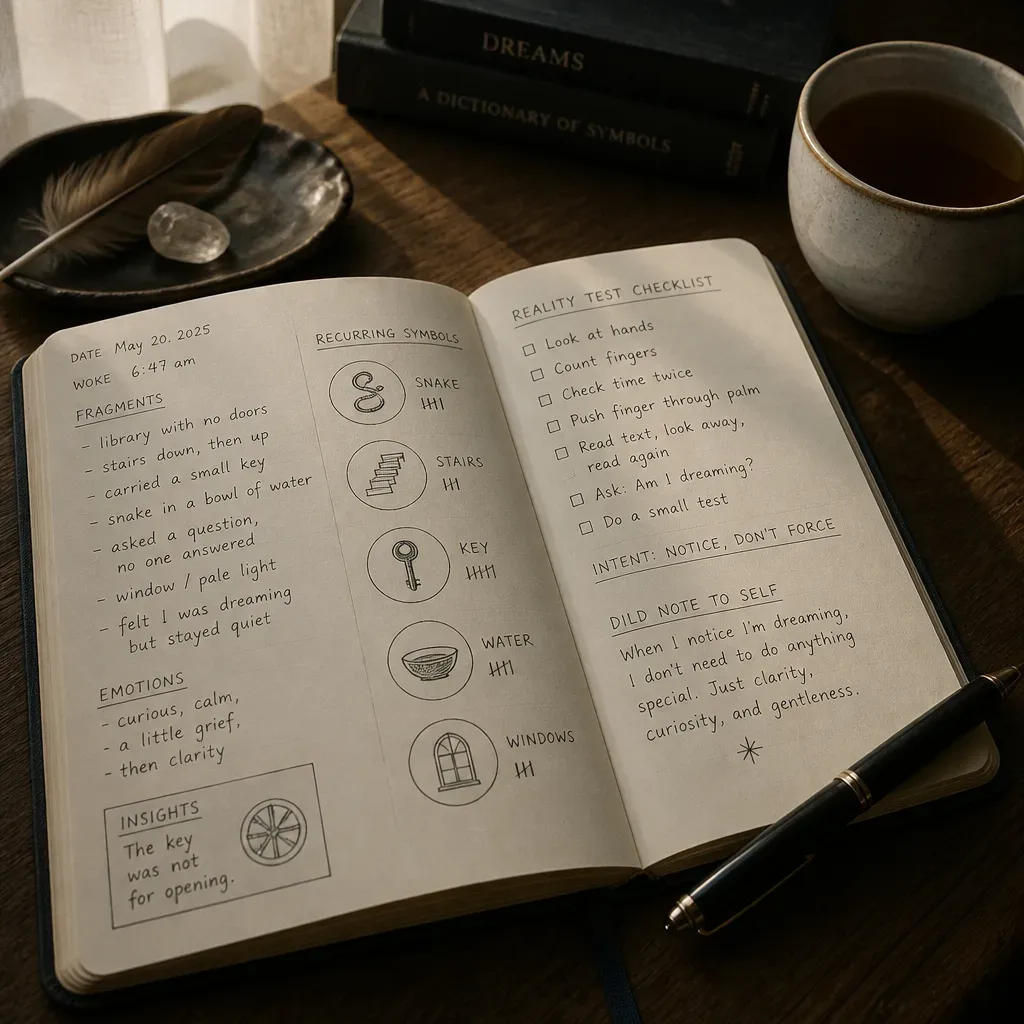
If a recurring image keeps appearing, you can compare it with entries in the Dream dictionary (A–Z hub), then ask what it means in your actual week. A symbol becomes useful when it stops being decorative and starts being specific.
What does WILD ask you to tolerate?
WILD asks you to tolerate the border of sleep without clenching around it.
That border can be strange. People report floating, buzzing, flashes of imagery, shifting body size, or the sense that sounds are happening inside the head. Some of this belongs to hypnagogia, the transitional state between waking and sleep. The method is simple to describe and difficult to do: remain gently aware while the body goes to sleep. Too much effort wakes you. Too little effort becomes ordinary sleep.
WILD is often attempted after 4 to 6 hours of sleep, sometimes with WBTB. You wake briefly, stay up for 5 to 30 minutes depending on how easily you fall asleep, then return to bed. The numbers aren’t holy. They’re practical. A 20-minute waking may help one person; for another, it may open the tax drawer of the mind and ruin the night.
Sleep paralysis deserves a calm word here. A 2011 review by Sharpless and Barber estimated lifetime sleep paralysis prevalence around 7.6% in the general population, with higher rates in students and psychiatric samples. WILD doesn’t require sleep paralysis, but it can bring awareness near REM atonia, the normal muscle quieting that keeps dreams from being acted out. If it happens, breathe slowly and remind yourself that it passes.
WILD tends to suit people who:
- fall asleep easily after brief awakenings;
- enjoy body-based meditation without becoming tense;
- can nap in the morning or early afternoon;
- are curious about hypnagogic imagery;
- don’t panic when sleep sensations feel unusual.
The threshold is not a door you kick open. It’s a shoreline you notice after the water has already reached your ankles.
If you want to record what happens without over-interpreting every sensation, the AI dream interpreter tool can help organize a report after the fact. Use it as a mirror, not a judge. Your own morning detail still matters most.
Which method is safer for sleep quality and anxiety?
DILD is usually safer for sleep quality because it builds awareness around sleep instead of placing pressure on the act of falling asleep.
This doesn’t make WILD unsafe. It means WILD is easier to misuse. If you’re lying still for 60 minutes trying not to swallow, counting vibrations, and checking whether a dream has arrived, the method has become insomnia in ceremonial clothing. The American Academy of Sleep Medicine generally treats consistent sleep timing and reduced nighttime arousal as good sleep hygiene. A lucid dreaming method that repeatedly violates those principles should be adjusted.
DILD can become compulsive too, especially if reality checks turn into anxious checking. The difference is that DILD practice can be moved into daylight and softened. You can ask “Am I dreaming?” 5 careful times a day instead of 50 brittle times. You can keep the notebook but stop grading yourself. You can remember that a non-lucid dream is not a failed lucid dream. It is still a dream, and it still brought you something.
A useful rule is the 3-morning rule. If a technique leaves you noticeably tired, irritable, or preoccupied for 3 mornings in a week, reduce it. Try DILD only for 14 days. Drop WBTB. Keep recall. If nightmares intensify, if sleep paralysis becomes frequent and frightening, or if daytime sleepiness is severe, talk with a doctor or sleep clinician. That sentence is ordinary, and it belongs here.
The best lucid dreaming method is the one that leaves you more honest in the morning, not more exhausted.
There is also a psychological difference. DILD grows out of relationship with dream material: recurring houses, old friends, teeth, animals, water. WILD can become more technical, which suits some people and distances others from meaning. If your purpose is self-understanding, don’t skip interpretation just because you gained control. Control is not the same thing as understanding.

How should you choose between DILD vs WILD tonight?
Choose DILD tonight if you’re unsure, and reserve WILD for nights when your sleep can afford an experiment.
Here is a practical decision table for the evening version of you, not the heroic version who makes plans at noon:
| Your condition tonight | Better choice | Why |
|---|---|---|
| You’re already tired | DILD | It won’t ask you to wake yourself further |
| You remember dreams often | DILD | Dream signs give you leverage |
| You wake naturally after 5 hours | WILD or DILD + WBTB | REM timing may support either |
| You have insomnia this week | DILD only | Sleep continuity comes first |
| You can nap tomorrow morning | WILD nap attempt | Naps can reduce pressure on nighttime sleep |
| You had sleep paralysis recently | DILD | Less attention on the REM border |
If you choose DILD, write one sentence before bed: “When I see something impossible, I’ll know I’m dreaming.” Then sleep. If you wake from a dream, remember it for 20 seconds before moving. That small pause is often worth more than elaborate ritual.
If you choose WILD, set one modest container. Wake after about 5 hours, stay up for 10 minutes, return to bed, and follow one anchor: breath, counting, or faint imagery. If you’re awake after 25 to 30 minutes, stop practicing and sleep normally. A method that can’t be abandoned kindly will teach the wrong lesson.
Lucid dreaming sits close to intention, which is why some readers connect it with waking practices. If recurring dreams show what your attention returns to at night, the AYA Method is the waking counterpart: a daily audio manifestation practice built around listening to a short personalized Dream-Self Moment, narrated from the version of you who has already manifested the life you intend. Listening is the practice. Repetition is the work. The audio is the method.
For the dream side, keep your inquiry plain. You can read more on the Lucid dreaming pillar, use the AI dream interpreter tool after a strong night, and return to your notebook before any outside source. A lucid dream may let you steer, but the morning still asks you to listen.
Tonight, write one line: “My sleep chooses the method before my ambition does.”