dream symbolism
Baby Dream Meaning: New Self, Need, or Duty?
Baby dream meaning usually points to a new part of life: a need, project, identity, responsibility, or tender self asking for care.
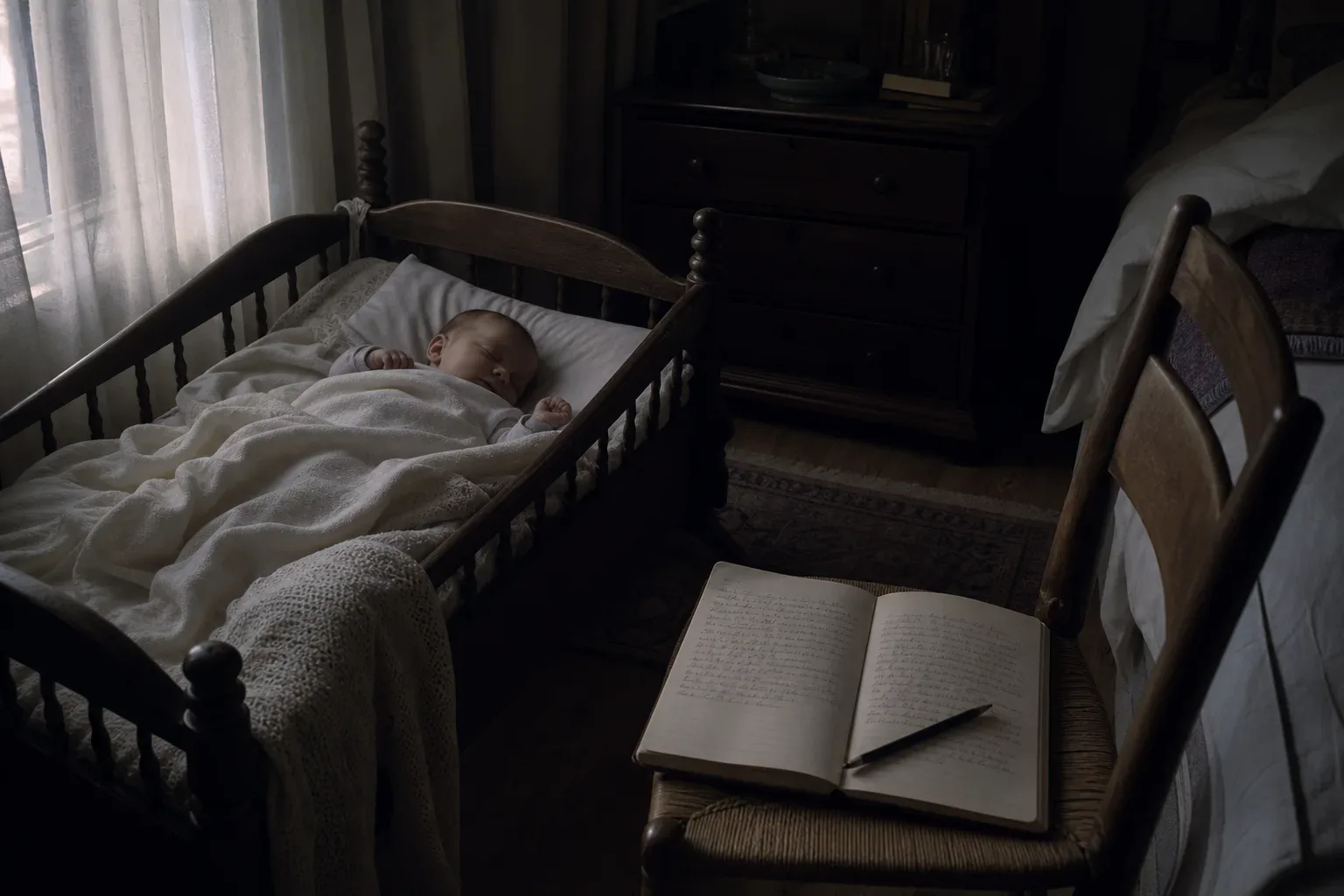
Baby dream meaning usually points to something new, vulnerable, and not yet self-sufficient: a project, identity, relationship, responsibility, or younger part of you asking for care. It doesn’t automatically mean pregnancy or prediction. The question is simpler and more honest: what has begun, and what does it need from you?
What does a baby in a dream usually mean?
A baby in a dream most often means a new beginning that needs care before it can survive on its own.
In ordinary dream work, babies tend to gather several meanings at once. They can stand for innocence, dependence, unfinished development, a wish to nurture, or the fear of being responsible for something fragile. Calvin Hall’s mid-20th-century dream content studies, which coded more than 50,000 dream reports over decades, showed that dreams often reuse familiar social roles and emotional problems rather than inventing symbols from nowhere. A baby is rarely just an object. It is a relationship.
That relationship matters. If you were feeding the baby, the dream may be about sustaining something. If you were searching for the baby, it may concern something neglected. If someone handed you the baby without warning, the dream may be about responsibility arriving before confidence. A dream symbol is not a label. It is a scene with pressure in it.
A useful first split is between the baby as new life and the baby as need. A person starting a job, sober month, marriage, degree, or creative practice may dream of a newborn because the psyche has noticed a beginning before language has caught up. The CDC reported 3.59 million births in the United States in 2023, but baby dreams are common far beyond actual parenthood because birth is one of the mind’s oldest images for emergence.
If you’re using a reference like our Dream dictionary (A–Z hub), treat it as a map, not a verdict. The baby’s age, health, voice, clothing, and location all change the reading. A sleeping baby on a clean bed is not the same dream as a baby left in a parking lot.
A baby dream asks less, “What will happen?” and more, “What has already begun?”
Does dreaming of a baby mean pregnancy?
Dreaming of a baby can reflect pregnancy hopes or fears, but it doesn’t prove pregnancy.
This is the question people ask most urgently at 7 a.m. The honest answer is plain: if pregnancy is possible, take a test. A dream isn’t a diagnostic tool. The American College of Obstetricians and Gynecologists notes that home pregnancy tests are designed to detect hCG, usually after a missed period; dreams are not part of that evidence chain. The body may create vivid dreams during hormonal change, stress, or interrupted sleep, but the image alone doesn’t confirm anything.
Pregnancy can still be part of the meaning. Someone trying to conceive may dream of babies because the wish is close to waking thought. Someone afraid of pregnancy may dream of babies because the fear has no quiet place to go. During pregnancy, dreams often become more emotionally intense. A 2016 study in BMC Pregnancy and Childbirth reported that pregnant participants described more frequent disturbing dreams and nightmares than nonpregnant controls, especially later in pregnancy.
Symbolically, baby dreams also appear when no physical pregnancy is involved. A new business can feel like a baby. A private grief can feel like a baby. A recently discovered talent can feel like a baby. The dream may be saying: this part of life is real now, but it is not mature yet.
Here is a practical way to separate literal concern from symbolic meaning:
| Dream context | Literal question | Symbolic question |
|---|---|---|
| You may be pregnant | Do I need a test or appointment? | What fear or hope is strongest right now? |
| You don’t want a baby | What boundary needs care? | What responsibility feels imposed? |
| You want a baby | What support do I need today? | What longing is asking to be held? |
| Pregnancy isn’t relevant | What changed recently? | What new self is developing? |
No dream should replace common sense. But no dream should be dismissed just because it isn’t literal.
Why was the baby crying, lost, or forgotten?
A crying, lost, or forgotten baby usually points to a need that has been delayed, minimized, or left without care.
Crying is communication before speech. In dreams, that can make it a strong image for a need you haven’t been able to name. The need may be physical, like sleep, food, touch, or rest. It may be emotional, like reassurance or grief. It may be practical, like a bill, a deadline, or a conversation you’ve put off for 2 weeks. The baby cries because the dream refuses to make the need abstract.
A lost baby often shows anxiety about failing something vulnerable. Parents may have these dreams when exhausted, and nonparents may have them during periods of obligation. Sleep researchers have long noted that stress changes dream content; the American Psychological Association’s 2023 stress survey found that 27% of U.S. adults reported being so stressed they couldn’t function on some days. Dreams tend to borrow the nearest image of helplessness.
A forgotten baby has a slightly different feel. It often comes with guilt in the dream: you suddenly remember there is a baby in another room, car, house, or bag. This can reflect a neglected project, an ignored emotion, or an older wound. Jungian analysts might call this a disowned part of the psyche. Cognitive researchers would phrase it more carefully: the dream dramatizes an unresolved concern.
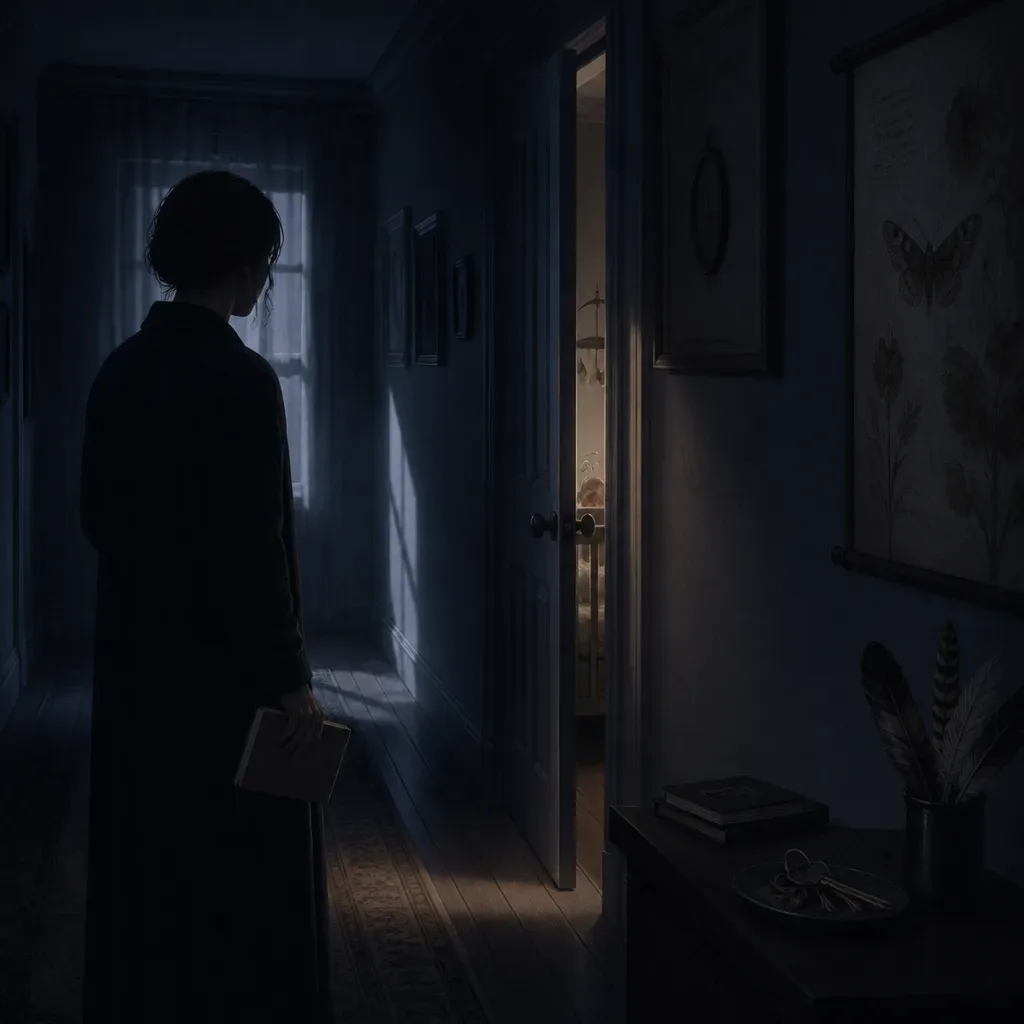
Try this the morning after a crying or lost baby dream:
- Write the baby’s condition in 1 sentence.
- Name your feeling before interpreting anything.
- List 3 waking-life things that currently need care.
- Circle the one you keep postponing.
- Do one small task for it before noon, if possible.
The crying baby in a dream is not a punishment. It is a sound your waking life has not been able to make clearly.
If the dream includes panic, harm, or violent images, be gentle with yourself. Disturbing dreams are common. If nightmares are frequent, impair your sleep, or connect with trauma, talk to a licensed clinician or doctor in one plain step.
What does holding, feeding, or rescuing a baby mean?
Holding, feeding, or rescuing a baby usually means you are in direct contact with a vulnerable responsibility.
Holding a baby is different from seeing one across the room. The dream has placed the responsibility in your arms. Notice your competence level. Were you calm? Afraid you’d drop the baby? Proud? Annoyed? The feeling tells you whether the new thing in life feels welcome, burdensome, or unfamiliar. In dream journaling, I ask students to record emotion first because memory fades quickly; one study by L. Strauch and B. Meier in 1996 found that dream recall decreases sharply within minutes of waking if not rehearsed.
Feeding a baby often points to nourishment. That may be literal caregiving, but it may also concern creative work, study, recovery, friendship, or self-respect. Anything young needs repetition. A seedling doesn’t care that you watered it beautifully once. It asks again tomorrow.
Rescuing a baby can indicate a protective instinct toward something endangered. Perhaps you are defending a boundary, recovering a talent you abandoned at 15, or trying to save a relationship from neglect. The rescue setting matters. Water often brings emotion into the scene. Fire may show urgency or anger. A hospital may bring healing, illness, or institutional authority.
Common baby-care actions in dreams tend to read like this:
- Bathing a baby: cleansing, repair, or making a new start feel acceptable.
- Changing a diaper: dealing with the unglamorous part of care.
- Rocking a baby: soothing anxiety, yours or someone else’s.
- Giving the baby away: relief, guilt, delegation, or fear of losing a role.
- Finding a baby: discovering a new need or a hidden tenderness.
This is where a dream can become practical. If the baby represents a project, the question isn’t whether the project is grand. The question is whether you are willing to feed it in ordinary ways for 30 days.
What if the baby is strange, talking, sick, dead, or not human?
An unusual baby usually intensifies the symbol: the new thing feels uncanny, threatened, unusually wise, or hard to accept.
Dream babies are not always soft and ordinary. They may speak in full sentences, have adult eyes, appear as animals, glow, vanish, or seem sick. None of this means the dream is predicting harm. Dreams exaggerate so we remember. REM sleep, where vivid dreaming is most common, occupies roughly 20% to 25% of adult sleep, according to standard sleep medicine texts, and the brain’s visual-emotional systems are highly active during it.
A talking baby may represent a young part of you with an unexpectedly clear message. Write the sentence exactly if you remember it. Don’t polish it. Dream speech is fragile. If the baby sounds older than it looks, the dream may be showing an old issue in a new form.
A sick baby can point to concern that a beginning isn’t being cared for well. Maybe a new habit is already strained. Maybe a relationship began with tenderness but little structure. The dream asks for attention, not despair. A dead baby dream is more upsetting and should be handled carefully. Often it marks fear that something new has failed, or grief over an unrealized possibility. If you have had pregnancy loss, infant loss, or trauma, the dream may be part of grief memory rather than a symbol to solve.
A nonhuman baby, such as a kitten, bird, snake, or unknown creature, asks you to read both symbols. A baby bird may suggest a voice or freedom not ready to fly. A baby snake may suggest instinct, fear, healing, or secrecy in an early stage. You can compare related symbols in the Dream dictionary (A–Z hub), then return to your own feeling. The dictionary helps. Your dream has the final accent.
For complicated dreams, the AI dream interpreter tool can help you organize details without pretending there is only one answer. Use it with your notes beside you. The best interpretation is usually the one that makes you more honest, not more dramatic.
How do different traditions read baby dreams?
Psychological traditions read baby dreams as new development or dependency, while folklore often reads them as luck, burden, or warning.
In Jung-adjacent dream work, the baby often belongs to the motif of the divine child: a small figure representing future development, renewal, or the self in early form. Jung wrote about child imagery in The Archetypes and the Collective Unconscious, first published in English in 1959, but modern readers should use that material carefully. Archetypes are not fixed subtitles. They are patterns that become personal only inside a life.
Freudian readings sometimes move toward wish, sexuality, or family conflict. Contemporary sleep researchers are more cautious. They usually treat dream content as connected to memory, emotion, and waking concerns. The continuity hypothesis, associated with researchers such as Calvin Hall and later G. William Domhoff, suggests that dreams often continue waking-life interests rather than arriving from a separate symbolic code.
Folklore varies widely. In some European traditions, dreaming of a healthy baby was linked with fortune or family increase. In other traditions, a crying baby could be taken as a warning of trouble. These are long traditions, not strong evidence. They matter because families pass meanings down. The baby means one thing in a clinical paper and another thing in your grandmother’s kitchen. Both are worth hearing, but only one should be allowed to run your morning.
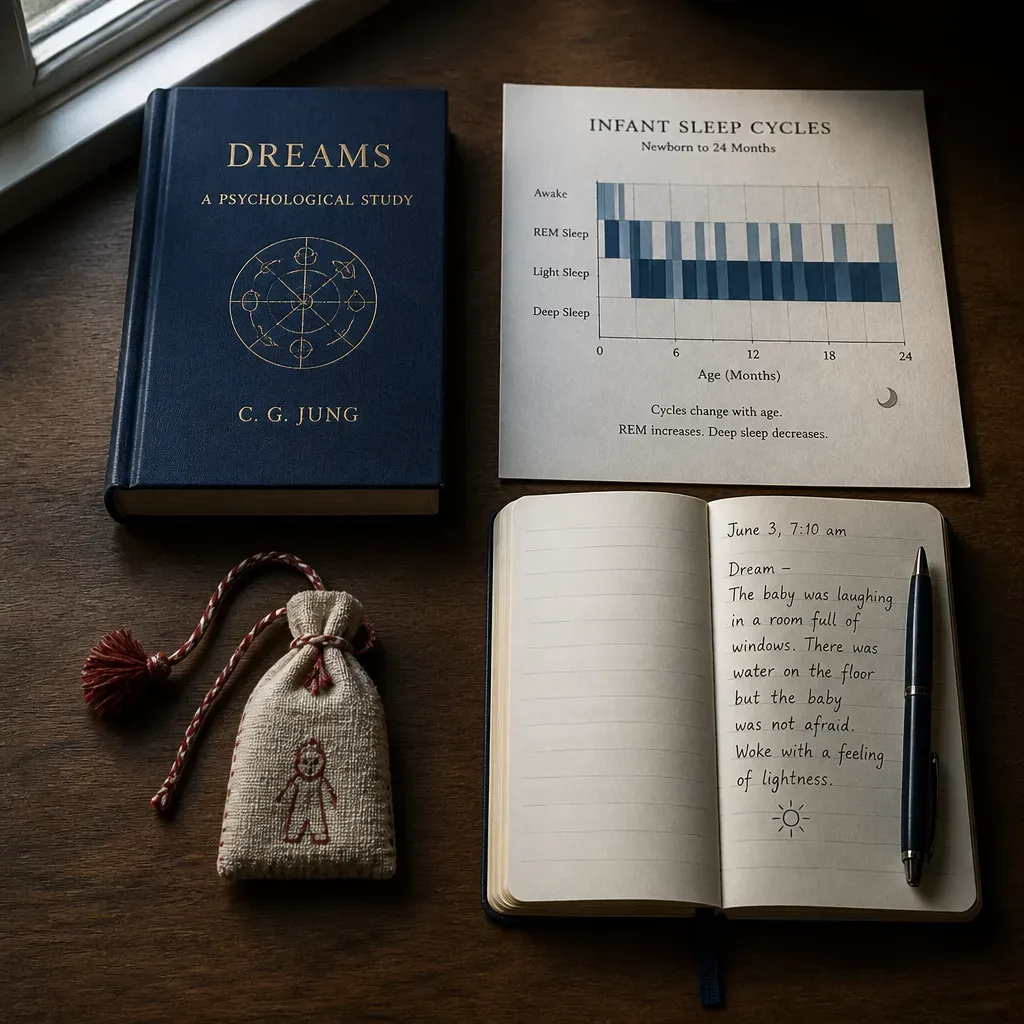
Here is the honest comparison:
| Reading lens | What it tends to ask | Evidence level |
|---|---|---|
| Psychological | What new need or identity is forming? | Moderate clinical tradition, mixed research |
| Sleep science | What waking concern is being processed? | Stronger for emotion and memory links |
| Folklore | What did my culture say this image means? | Long tradition, thin evidence |
| Personal journal | What pattern repeats across my dreams? | Strong for self-knowledge over time |
If you practice lucid dreaming, baby dreams can also become dream signs: repeated images that help you notice you’re dreaming. Our Lucid dreaming pillar explains reality checks and recall training, but I’ll say the unpretty part here: most lucid practice improves after 14 quiet days of writing down ordinary dreams.
What should you do the morning after a baby dream?
The best next step is to write the dream down, name the need, and choose one small act of care.
Don’t rush to a final meaning. Dream recall is weakest when treated like breaking news. Keep the scene intact first. I use the same format I’ve used since 2006: date, one-line summary, dream signs underlined, lucidity noted in the margin. It takes under 3 minutes when done badly, which is better than waiting for a perfect entry and losing the dream entirely.
Use this short morning practice:
- Title the dream: “Forgotten baby in blue room,” not “weird dream.”
- Write the baby’s state: sleeping, crying, sick, laughing, missing, talking.
- Write your role: parent, stranger, rescuer, observer, older sibling.
- Name the strongest feeling: tenderness, dread, guilt, surprise, irritation.
- Ask one question: what in my life is new and not yet self-sufficient?
- Choose one act of care: send the email, rest, apologize, schedule, feed the project.
A baby dream improves when you stop asking it to be mystical on command. It becomes useful when you let it be specific. If you have recurring baby dreams, compare at least 3 entries before deciding what they mean. Patterns are quieter than panic and usually more accurate.
Some readers find that recurring dreams point to the same waking desire again and again. That is where the AYA Method can fit, lightly. The AYA Method is a daily audio manifestation practice. Each day you listen to a short personalized recording, your Dream-Self Moment, narrated from the version of you who has already manifested the life you intend. Listening is the practice. Repetition is the work. The audio is the method.
A recurring dream shows where attention keeps returning; a daily practice decides what attention will rehearse while you’re awake.
If you want a broader symbol check after journaling, use the Dream dictionary (A–Z hub) or organize the details with the AI dream interpreter tool. But keep one line for yourself, written before any tool or book speaks.
Write this down: “The baby may be the part of my life that needs care before judgment.”