Teeth falling out dream meaning
Teeth falling out usually means anxiety about control, appearance, speech, or change, and can also reflect real dental irritation.
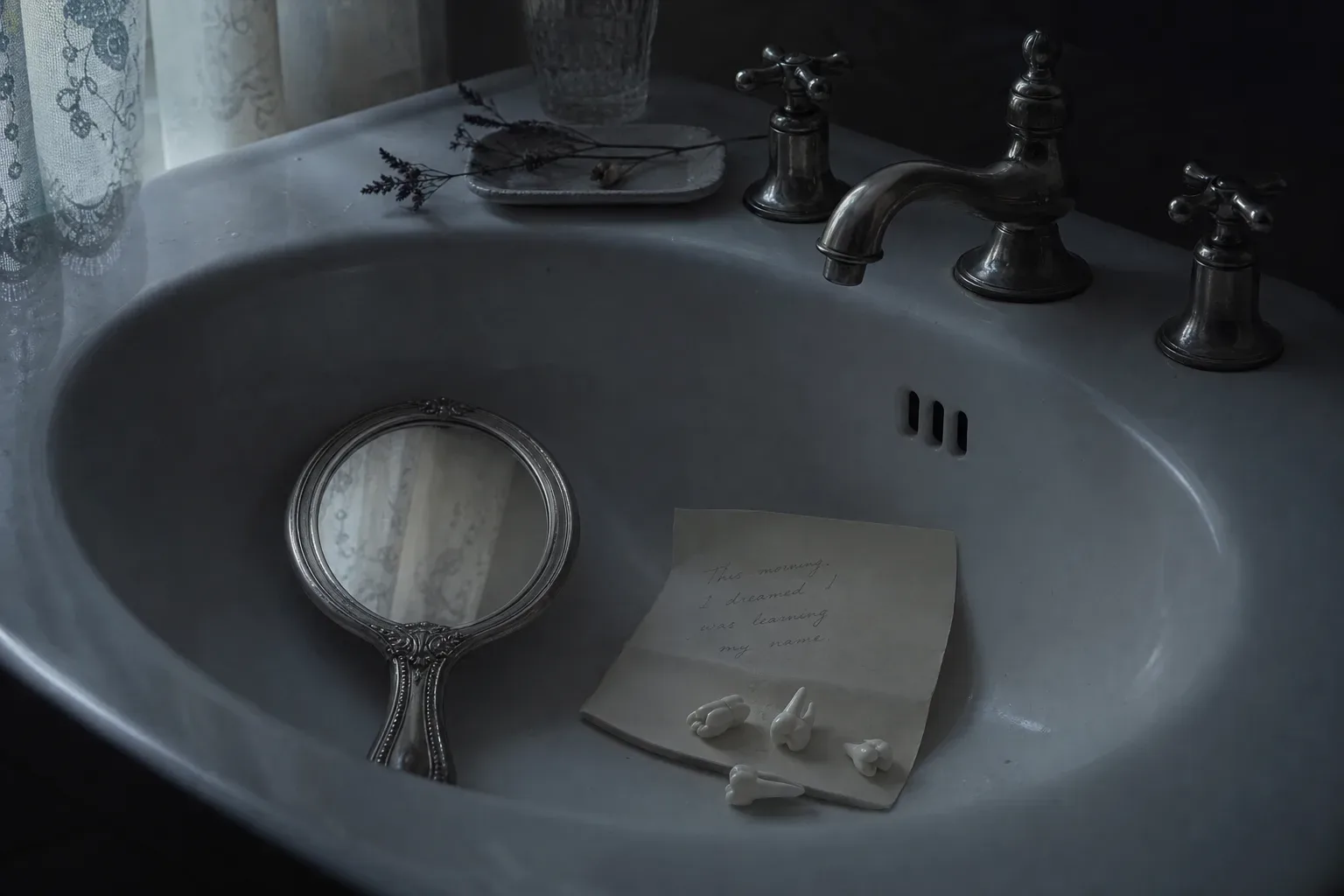
Teeth falling out in a dream usually points to worries about control, appearance, speaking, or change. It can also be oddly literal: one study found these dreams were linked with dental irritation on waking. You’re probably not being warned. Notice what was loose in the dream, and what feels unstable this morning.
what the psychology says
Teeth falling out is one of the common modern dream reports. People describe it with striking detail: the tooth loosens under the tongue, crumbles like chalk, drops into the palm, or fills the mouth in pieces. The feeling is often worse than the image. Embarrassment, helplessness, and a strange silence tend to be at the center.
In clinical tradition, teeth dreams are usually read through three ordinary themes.
First: control. Teeth are hard, visible, useful parts of the body. When they fall out, the dream gives form to the fear that something reliable is no longer reliable. A job role, a relationship, your body, a decision, your money, your schedule. Something you counted on may feel less secure than it used to.
Second: speech. Teeth shape words. A mouth full of loose teeth can appear when you’re afraid of saying the wrong thing, being misunderstood, holding back anger, or trying to keep a secret. If you woke with the sense that you couldn’t talk, the dream may be about expression as much as appearance.
Third: self-image. Teeth are part of how we present ourselves. Losing them in front of other people often sits near the same emotional shelf as dreams of being naked in public: exposure, shame, and the fear of being seen at a bad moment. The dream may be less about vanity than about social safety.
Research gives a useful correction to the purely symbolic reading. In a 2018 paper in Frontiers in Psychology, Nirit Rozen and Nirit Soffer-Dudek studied dreams about teeth and found that they were associated with dental irritation upon awakening, such as tooth tension or discomfort. They did not find the same clear link with general psychological distress. That doesn’t mean every teeth dream is caused by grinding your teeth. It means the body may be contributing. Dreams often borrow from sensation: pressure in the jaw, a dry mouth, a retainer, sinus tension, or sleeping with the mouth open.
This fits the continuity hypothesis of dreaming, associated with researchers such as Calvin Hall, William Domhoff, Michael Schredl, and others: dreams tend to continue waking concerns, moods, and bodily signals rather than arrive from nowhere. If you’re under stress about how you look, what you said, or whether you can hold something together, a teeth dream has good material to work with.
Threat-simulation theory, proposed by Antti Revonsuo, offers another angle. Many dreams rehearse threat: being chased, losing something, being injured, failing a test. Teeth falling out is not usually a predator dream, but it can still simulate vulnerability. The body is compromised. Speech is compromised. Social confidence is compromised. The dream asks, quietly and physically, what if I can’t manage?
Freud wrote about teeth dreams in The Interpretation of Dreams and tied some of them to sexual anxiety and bodily taboo. That reading belongs to psychoanalytic history, not settled science. Jung would likely have asked for the dreamer’s own associations: Were the teeth old or young, beautiful or rotten, baby teeth or adult teeth? For Jung, a symbol wasn’t a fixed code. It was a living image shaped by the person, the culture, and the moment.
So the honest psychological reading is this: teeth falling out dreams often gather anxiety, bodily sensation, self-presentation, speech, aging, and change into one memorable image. Sometimes the dream is about your mouth. Sometimes it’s about your life. Often it’s both.
If you wake with jaw pain, tooth pain, frequent grinding, or repeated sleep disruption, it’s sensible to talk to a dentist or doctor.
what tradition and folklore say
Folklore has treated teeth dreams with unusual seriousness. That doesn’t make the old meanings factual. It does show how long people have felt that teeth are tied to family, vitality, status, and time.
In ancient Greek dream interpretation, Artemidorus of Daldis wrote in the Oneirocritica that teeth could represent members of the household. Different teeth were assigned to different relatives or ranks. A tooth falling out might be read as a family change, illness, loss, or departure. This is folklore and historical dream theory, not evidence. Still, it makes emotional sense: teeth live together in rows, like a household, and losing one changes the whole mouth.
In Islamic dream tradition, especially in texts attributed to Ibn Sirin and later interpreters, teeth also often stand for relatives, age, debts, or lineage. A falling tooth could be read in several ways depending on whether it fell into the hand, the lap, the ground, or disappeared. Some readings are hopeful, such as long life or repayment. Others are sorrowful. Again, this is tradition, not prediction.
In parts of Chinese folk interpretation, teeth falling out has been linked with worries about elders, family misfortune, or with the idea that the dreamer has spoken falsely. The exact meaning varies by region and family. Some grandparents will tell you to be careful with your words. Others will tell you to call home. As folklore, that advice is gentler than the fear behind it: remember your people, and speak honestly.
In European folk belief, a lost tooth in a dream was sometimes treated as a sign of death or bad news. It’s important to say plainly: there’s no good evidence that a teeth dream foretells death. If your dream has that feeling, it may be because teeth are one of the body’s small memento mori. They remind us of age, childhood, decay, and care. They sit close to dreams of death, which are usually about endings, fear, transition, or love, not literal prediction.
As with every entry in this dream-dictionary, the old meanings are worth knowing, but they don’t outrank your own morning sense of the dream.
what does it mean if your teeth crumble in the dream?
Crumbling teeth usually point toward depletion rather than sudden loss. A tooth that falls out whole can feel like a single event. A tooth that turns to grit suggests erosion: stress accumulating, confidence wearing down, a problem handled for too long with clenched patience.
Ask what has been slowly breaking down. A routine. A boundary. A friendship. Your rest. Your sense of competence. Crumbling also appears when people feel they’re trying to stay composed while something inside them is less solid than it looks.
The mouth matters here. If you kept spitting pieces out, the dream may be about trying to get rid of words, obligations, or evidence of strain. If you swallowed the pieces, notice whether you’ve been taking in something hard to digest emotionally.
There may also be a physical layer. Tooth grinding, jaw tension, dental work, or sleeping with pressure on the face can give the dream its texture. The symbol and the sensation can share the same room.
what if your teeth fall out with blood or pain?
Blood usually makes the dream feel more urgent. It can bring the image closer to injury, shame, or fear of damage that can’t be hidden. Pain in the dream may point to a waking pain, but it can also symbolize a change that feels costly.
If the dream had blood, ask whether the loss felt private or public. Bleeding alone in a bathroom is different from bleeding while other people watch. The first may suggest private worry. The second may suggest exposure or fear of judgment.
Painful teeth falling out can also connect to anger. We clench our jaws when we hold back words. We grind when tension has nowhere clean to go. A painful mouth in a dream can be the body’s image for unsaid speech.
Still, don’t make it grander than it needs to be. If you woke with actual tooth, gum, or jaw pain, take the body seriously. Dreams are not medical tests, but they sometimes point your attention to something ordinary that needs care.
what if your teeth fall into your hand?
Teeth falling into your hand is a different dream from teeth vanishing. The hand adds responsibility. You’re not just losing something; you’re holding the evidence. You may be trying to understand what happened, decide what can be saved, or present the loss to someone else.
In folklore, a tooth falling into the hand has sometimes been read more favorably than a tooth falling to the ground. In some traditions it can mean recovery, payment, or keeping what might have been lost. As folklore, that’s not a promise. But symbolically, it’s a useful distinction. What you catch, you can examine.
Psychologically, this version often appears when you’re aware of a change and trying to manage it. You may be between denial and action. The dream says: here it is. Not as an idea, but as a small hard object in your palm.
Notice the emotion. Were you horrified, calm, ashamed, curious? A calm dream about holding a fallen tooth may mark acceptance of a transition. A panicked one may show that the transition feels too fast.
what if someone else’s teeth are falling out?
When another person’s teeth fall out in your dream, start with your feelings toward them. Were you worried for them, disgusted by them, angry, helpless, protective? The dream may be less about their actual condition and more about your perception of their vulnerability.
If it’s a parent, partner, child, or close friend, the dream may touch fear of their aging, illness, instability, or changing role in your life. This is where old folklore about teeth and family can feel emotionally true without being predictive. Teeth stand in for the household because we’re frightened by the thought of losing our people.
If it’s a stranger, public figure, or enemy, the dream may be about authority losing its bite. Someone who seemed confident may now look fragile. Someone whose words mattered may no longer persuade you. A person’s teeth falling out can symbolize a change in how much power you give their voice.
If you were relieved when their teeth fell out, be honest about that. Dreams often let unacceptable feelings appear in symbolic form. Relief doesn’t make you cruel. It may mean you’re tired of being hurt, criticized, or talked over.
the morning after
Ask yourself one question: where in my life do I feel less able to hold things together, speak clearly, or be seen as I want to be seen?
Write this line down: My teeth were falling out, and the feeling was ____.
That blank matters. Shame, panic, relief, disgust, curiosity, grief, and calm each point to a different reading. Then add one ordinary detail from yesterday: a conversation, a mirror, a bill, a jaw ache, a family worry, a moment when you held your tongue.
If this is a recurring dream, it may be showing you what your attention keeps returning to at night. The waking counterpart is the Dream-Self Moment in the AYA Method, a short personalized recording of your future self, spoken in your own voice, so you don’t have to wait for the night to tell you what you’re practicing becoming.
And if the dream was simply strange and unpleasant, let it be that too. Drink water. Unclench your jaw. Notice your mouth. Then go into the morning gently.