Death and Dying Dream Meaning
Death and dying dreams usually mean change, fear, grief, or an ending your mind is trying to name, not a prediction of literal death.
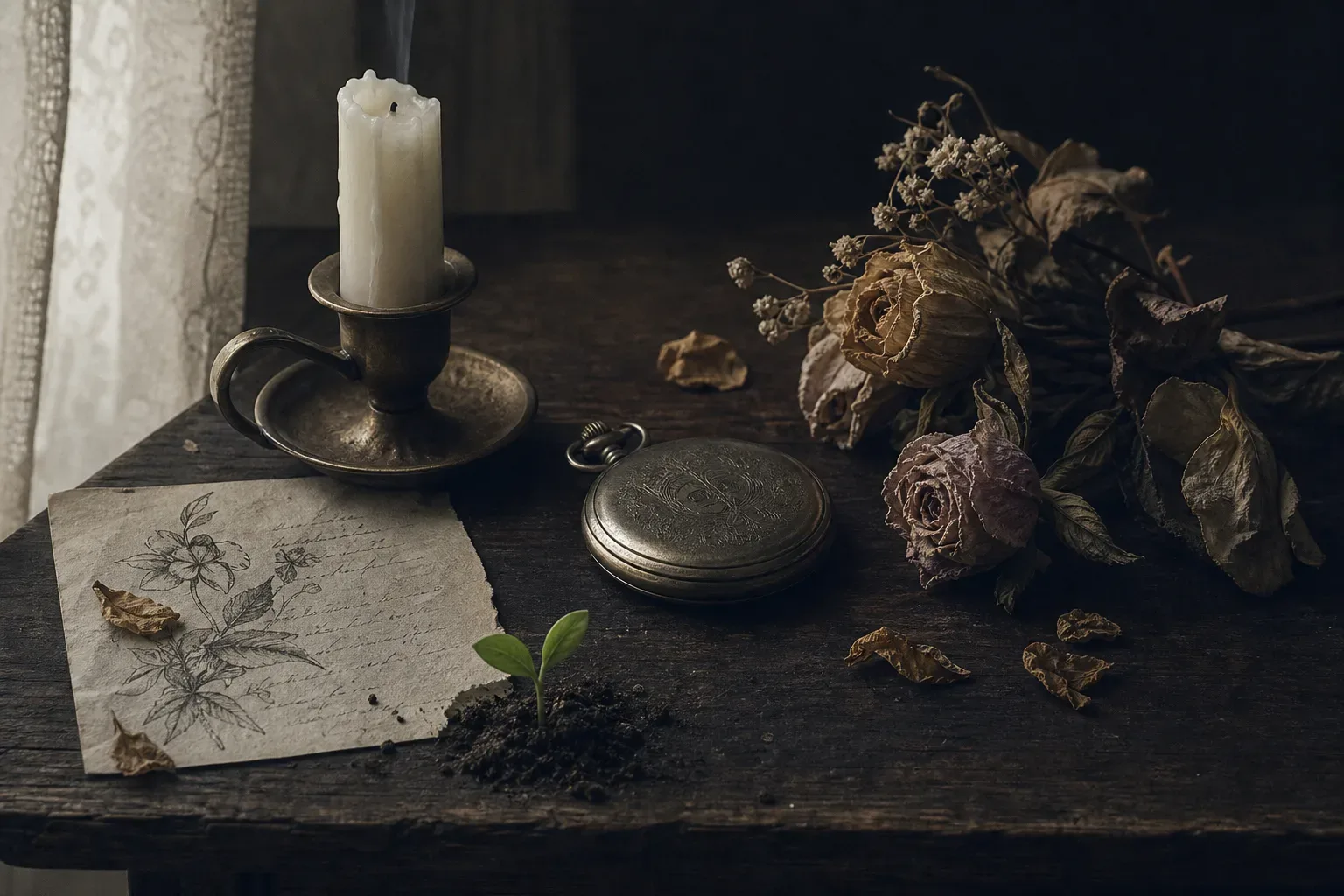
Dreaming of death or dying usually points to an ending, a fear of loss, or a change you haven’t fully named yet. It doesn’t predict death. More often, the dream is your mind giving a hard shape to transition: a role ending, a relationship changing, grief returning, or the old self making room for the new.
what the psychology says
In clinical tradition, death in dreams is rarely read as literal. It tends to be symbolic, but not in a simple codebook way. The person who dies, the manner of dying, and your feeling in the dream all matter.
Carl Jung treated death dreams as images of psychic change. In Jungian writing, death often belongs to the same family as winter, burial, descent, and night: something is ending so that another form of life can begin. That can sound too neat if you’ve woken frightened. Still, the basic idea is useful. A dream death may mark the end of an identity, a defense, a desire, or a period of life.
Modern dream research is more cautious. The continuity hypothesis, associated with researchers such as Calvin Hall and later G. William Domhoff, suggests that dreams often continue waking concerns. They don’t copy daily life exactly. They dramatize it. If you’re worried about your health, your parents aging, your child leaving home, a marriage changing, a job ending, or a private part of yourself disappearing, death may be the image sleep chooses.
Threat-simulation theory, proposed by Antti Revonsuo, argues that dreaming may simulate danger so the mind can rehearse perception and response. Under this view, death dreams can be a night practice in facing threat, separation, helplessness, or survival. The evidence for broad theories of dreaming is mixed, and no serious researcher can tell you that one symbol always means one thing. But the pattern is honest: frightening dreams often gather around what the nervous system is already monitoring.
Nightmares also cluster around stress. Ernest Hartmann’s work on nightmares described how intense emotion can organize a dream image. Death is one of the oldest, clearest images for fear. It says, quietly or loudly, “this matters.” It may not be about dying at all. It may be about losing control, losing a version of yourself, or being unable to protect someone.
If the dream involved someone who has already died, it may be closer to a grief dream than a death-symbol dream. Many people dream of the dead during mourning, anniversaries, family changes, or ordinary mornings when memory is near the surface. You may want the related entry on deceased loved ones. If the dream took place around a burial, service, or cemetery, the images of funerals and graveyards add their own meanings.
A simple psychological reading is this: ask what is ending, what you’re afraid of losing, and what part of you is ready, or being forced, to change. The dream may be severe because the feeling is severe. That doesn’t make it a warning. It makes it worth noticing.
what tradition and folklore say
In many European folk traditions, a death dream was sometimes said to mean the opposite: long life, renewal, or a coming change. This is folklore, not evidence. But it carries an old emotional wisdom. People often reversed frightening dream images to make them bearable. To dream of death could mean life continuing.
In some Jewish and Eastern European traditions, dreams of death were treated with care, sometimes answered by prayer, charity, or speaking the dream aloud to soften it. Again, this is tradition rather than science. The important part is communal: the dreamer didn’t have to hold the image alone.
In Chinese folk interpretation, death in a dream may be read as a sign of transition, luck changing, or the end of misfortune. Some traditions connect funerary images with renewal of family fortune. These meanings vary widely by region and family. They shouldn’t be treated as prediction. They do show how often cultures read death dreams as change rather than doom.
In Mexican Día de los Muertos traditions, the dead are not only feared; they are remembered, fed, named, and welcomed. A dream of death in that cultural light may be less about terror and more about relationship across time. The dead remain part of the household of memory.
Many Indigenous traditions have their own teachings about dreams and ancestors, and it’s better not to flatten them into one meaning. If your family or culture has a specific way of treating death dreams, start there. The kitchen-table meaning may matter as much as the dictionary meaning.
The honest summary: folklore often treats death dreams as messages, reversals, or visitations. Psychology treats them as symbolic and emotional material. Both approaches agree on one thing. You should remember the dream, speak carefully about it, and not pretend it was nothing if it stayed with you.
what does it mean to dream of your own death?
Dreaming of your own death is one of the most unsettling versions, but it still doesn’t mean you’re about to die. It often appears when the self-image is under pressure. You may be leaving a job, becoming a parent, ending a relationship, aging into a new stage, recovering from illness, or losing an old certainty.
Notice whether you watched yourself die, felt yourself dying, or simply knew you were dead. Watching from outside can suggest distance from your own life, as if you’re studying a version of yourself that no longer fits. Feeling the death from inside may point to anxiety, exhaustion, or the sense that you can’t continue in the same way.
The mood matters. Terror suggests threat and resistance. Calm can suggest acceptance. Relief may be important and should not be judged too quickly. Sometimes the dream says, “I don’t want my whole life to end.” Sometimes it says, “I need this particular way of living to stop.”
If you wake from a dream of your own death with panic, do something ordinary. Touch the bed. Drink water. Name the room. Death dreams can leave the body stirred long after the image is gone.
what if someone you love dies in the dream?
When a loved one dies in a dream, the most common meaning is fear of losing them, fear of change in the relationship, or awareness that the person is changing. Parents age. Children grow. Friends drift. Partners become strangers for a season and then familiar again. The dream may turn that movement into a death because death is the strongest image of separation.
It can also be about the part of you that person represents. A father might stand for authority, protection, judgment, or distance. A mother might stand for care, need, guilt, or origin. A sibling might stand for rivalry, shared history, or the old home. A child might stand for vulnerability, hope, or something new that depends on you.
This doesn’t mean the dream is secretly selfish. Dream figures are often both themselves and symbols. Your partner is your partner, and also the part of life that partnership has built in you. Your child is your child, and also your helpless love.
If the person is ill or at risk in waking life, the dream may be direct anxiety. That’s ordinary. The mind rehearses what it dreads. If you’re carrying caregiving stress, the dream may be a place where fear finally says its full sentence.
After this kind of dream, it’s often better not to call the person in alarm and tell them every detail. You might simply send a warm message, or notice what the dream revealed about love, dependence, anger, or fear.
what if the dream is about dying but not actually being dead?
A dream where you’re dying, falling toward death, bleeding, drowning, being attacked, or waiting for death often belongs to anxiety more than symbolism. The unfinished dying matters. Something feels unresolved. You’re in the middle of an ending, not past it.
Drowning can point to being overwhelmed. Fire can point to anger, urgency, or purification in older symbolic systems. Illness in a dream can point to vulnerability or worry about the body. Violence can suggest conflict, fear, or a felt invasion of boundaries. These are tendencies, not rules.
If the dream stops just before death, notice what interrupts it. Do you wake? Does someone save you? Do you accept it? Do you fight? The interruption can reveal how you meet pressure in waking life. Some people always wake before the final moment. Others pass through death and find the dream continues. That second version often feels less like fear and more like transition.
Recurring death nightmares deserve gentleness. They may be linked to stress, trauma, grief, medication changes, alcohol use, sleep loss, or anxiety. If nightmares are frequent, disturb your sleep, or make you afraid to go to bed, talk to a doctor or a licensed mental health professional.
what if a child, baby, or younger self dies in the dream?
This version can be especially hard to carry into morning. First, be plain with yourself: dreaming that a child dies doesn’t mean the child will die. It usually means the dream has chosen the most tender possible image for vulnerability, responsibility, innocence, or fear of failing to protect what you love.
If the child in the dream is your own, the dream may reflect ordinary parental terror. Love makes the mind vigilant. Even calm parents can have brutal dreams. Sleep doesn’t observe politeness.
If the child is unknown, the dream may point to a new project, a young part of the self, a need, or an old wound. Jungian and depth-psychology traditions often treat children in dreams as images of beginnings and developing parts of the psyche. The death of a child-symbol can suggest a fear that something new in you won’t survive.
If the child is you at a younger age, the dream may be about memory. It can arise when you’re revisiting childhood, noticing old patterns, or grieving what you didn’t receive. This isn’t a demand to solve your whole past by breakfast. It’s an invitation to be kinder to the younger self who appeared.
You can look up related symbols in the dream-dictionary if another image from the dream stood out more than the death itself: the house, road, hospital, water, animal, or grave may carry the emotional center.
the morning after
Ask yourself one question: what ending, loss, or change in my waking life is asking to be noticed?
Write down this line: “In the dream, death felt like ___, and in my life right now that feeling belongs to ___.”
Then add three plain details: who died, how you felt, and what happened immediately after. Don’t rush to make it beautiful. Accuracy is kinder.
If this dream repeats, it may be showing you what your attention keeps returning to at night; the Dream-Self Moment, a short personalized recording of your future self, and the AYA Method can be the waking counterpart. Instead of waiting for the night to name the fear or wish, you speak, in your own voice, toward who you’re becoming.