Dream About Losing Hair or Cutting Hair Meaning
Losing or cutting hair in a dream usually points to identity, control, vulnerability, or a visible change in how you want to be seen.
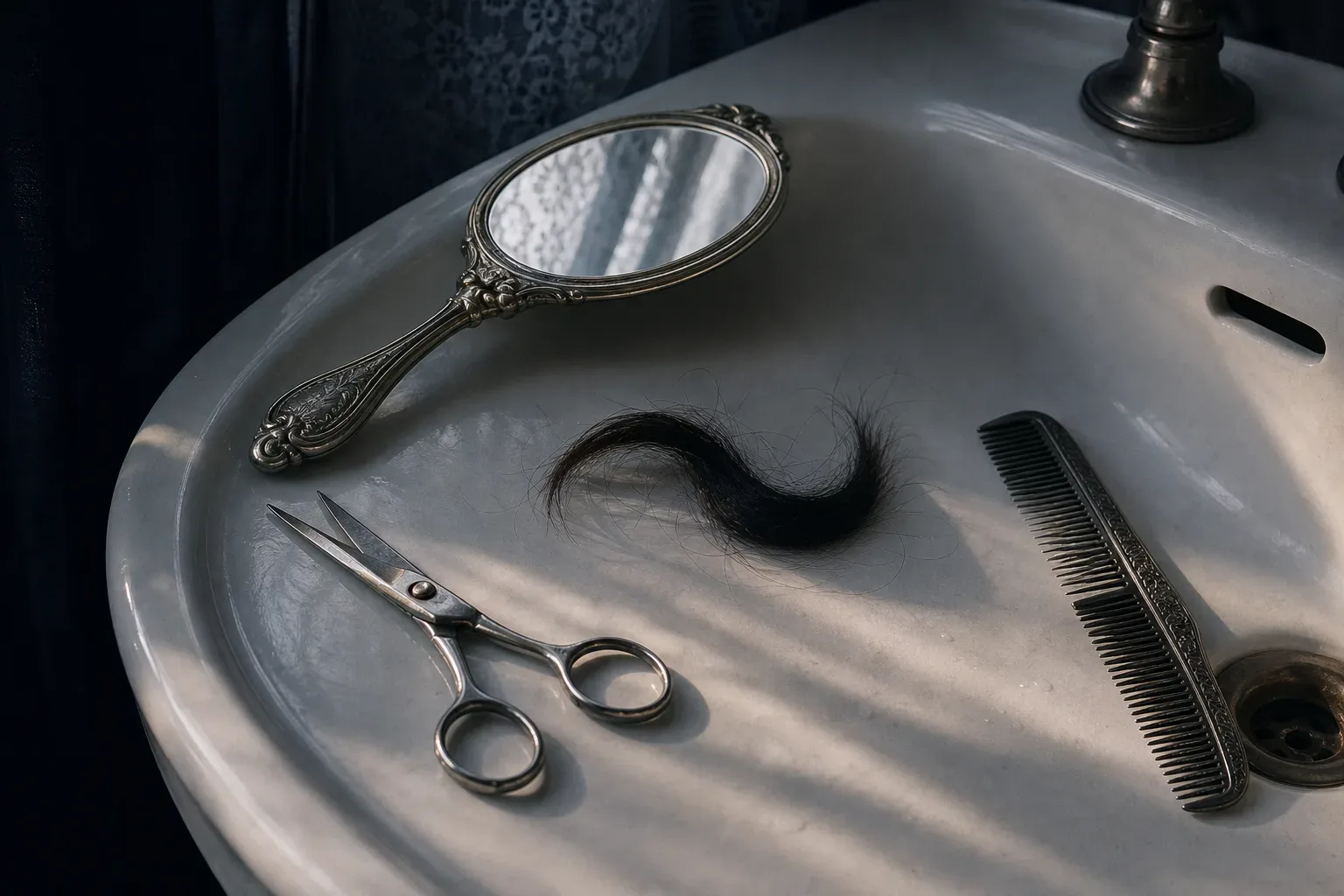
Cutting or losing hair in a dream usually points to identity, control, and visibility. Hair is how the body announces itself to the world. When it changes suddenly at night, the dream often asks where you feel exposed, edited, aged, renewed, or unable to choose how others see you.
what the psychology says
Psychologically, hair dreams tend to sit close to the border between the private self and the public self. Hair is intimate. It grows from the body. It also gets styled, hidden, dyed, shaved, judged, touched, praised, and regulated. So a dream about losing or cutting it often carries questions about appearance, agency, sexuality, aging, shame, health, mourning, or starting over.
The research on dreams supports this kind of reading, but not in the neat way a symbol dictionary might promise. There is no strong clinical evidence that hair loss in dreams always means one fixed thing. Dream research more often supports the continuity hypothesis: dreams tend to continue the concerns, emotions, relationships, and conflicts of waking life. Calvin Hall and Robert Van de Castle helped build systematic content analysis of dreams in the twentieth century. Later researchers, including G. William Domhoff and Michael Schredl, argued that dream content often reflects ordinary waking concerns rather than hidden supernatural messages.
That matters here. If you recently changed your hairstyle, worried about thinning hair, had a medical appointment, entered a workplace where presentation matters, ended a relationship, or felt watched, the dream may be using hair because hair is already charged. The night is not inventing meaning from nowhere. It is working with what your attention has been touching.
Clinical tradition adds another layer. Jung did not treat symbols as fixed code words. He asked what the image meant to the dreamer, then considered older human patterns around it. In a Jung-adjacent reading, hair can belong to the persona, the face we make for society, but also to instinct, vitality, eros, and animal life. Cutting it may mean choosing a new persona. Losing it may mean feeling that the old one is being taken away.
Threat-simulation theory, associated with Antti Revonsuo, suggests that some dreams rehearse dangers or social threats. Hair loss can be a quiet social threat dream. It may not involve a monster or a fall. It may involve standing in a bathroom, seeing strands in your hand, and feeling that something about you has become impossible to hide. The threat is exposure.
A different dream may feel like relief. You cut your hair and feel lighter. You shave your head and feel honest. You remove a style that no longer belongs to you. In that case, the dream is less about fear and more about agency. The same symbol changes depending on the feeling in the room.
The hair-specific dream evidence is thin. Researchers have studied common themes like falling, being chased, teeth loss, sex, school, death, and social embarrassment more than hair. So the honest reading is this: hair dreams are usually best understood through continuity, body image, and personal association, not through a universal rule.
One useful comparison is the dream of teeth falling out. Both images involve the body changing in a visible, unsettling way. Teeth dreams often bring up speech, confidence, aging, or embarrassment. Hair dreams usually lean more toward identity, attractiveness, control, and being recognized.
If you are having sudden hair loss while awake, scalp pain, or other bodily symptoms, talk to a doctor. The dream itself is not a diagnosis, but the waking body deserves ordinary care.
what tradition and folklore say
Folklore gives hair a long memory. These readings are not medical evidence and they do not predict the future. They are old ways people have used hair to think about strength, beauty, grief, and spiritual status.
In the Hebrew Bible, Samson’s hair is bound to his consecrated strength. When Delilah has his hair cut, he loses power and is captured. In folklore shaped by that story, cut hair can mean loss of strength, betrayal, or the cost of giving someone access to what is most private. A modern dream does not have to repeat the story literally. But if someone cuts your hair against your will, Samson is one old shadow behind the image.
In many European and Mediterranean traditions, cutting or loosening the hair has been tied to mourning. Grievers cut hair, cover hair, or let hair hang loose to show that ordinary social order has been interrupted. In this tradition, a dream of lost hair may belong to grief: not only grief after a death, but grief for youth, a role, a home, a version of the self, or a relationship that used to organize your days.
In Buddhist and Hindu traditions, shaving the head can mean renunciation, humility, or devotion. Monastics shave the head as a sign of leaving vanity and worldly attachment behind. At temples such as Tirumala in India, devotees may offer their hair as an act of surrender or gratitude. In this traditional reading, cutting hair in a dream may not be humiliation at all. It may be simplification. Something unnecessary is being laid down.
In some Chinese folk belief, hair is linked with inherited life force because it is received from the parents. Older customs could treat cutting hair at the wrong time as symbolically serious, especially around family duty and respect. Again, this is folklore, not a rule. But it can matter if your own family carried beliefs about hair, modesty, gender, religion, or respectability.
Across traditions, one thread stays consistent: hair is rarely just decoration. It is strength, grief, sexuality, obedience, rebellion, purity, family, and public identity. Your dream may be speaking in one of those older languages, or it may be speaking in the language of your own bathroom mirror.
For other related symbols, the dream-dictionary keeps close readings of ordinary images that become charged at night.
What does it mean to dream your hair is falling out in clumps?
Hair falling out in clumps is usually a dream about loss that feels hard to manage. The key detail is the clump. One strand is ordinary. A handful is alarming. The image says: this is not just change; this is change arriving faster than I can contain.
This dream often appears during periods of stress, overwork, illness worry, hormonal change, postpartum adjustment, aging anxiety, or a public transition. It can also come when you feel your confidence has become fragile. The hair in your hand becomes visible proof of an invisible strain.
Notice whether the dream showed pain. Hair falling out painlessly can suggest shock, sadness, or numbness. Painful loss may point to anger, fear, or a sense that the change is being forced. If the dream focused on the sink, shower drain, pillow, or brush, ask what has been accumulating quietly. Drains and brushes are places where we see evidence after the fact.
If this is the exact image you remember, you may also want the closer entry on hair falling out. It stays with the shedding image rather than the broader theme of cutting and changing hair.
A calmer version of the dream may show you gathering the fallen hair, sweeping it up, or accepting it. That can mean the psyche is already trying to make order. You are noticing the loss rather than denying it.
What if you cut your own hair in a dream?
Cutting your own hair usually brings in choice. Even if the cut is messy, your hand is on the scissors. The dream may be about taking control of how you are seen, ending a phase, making a private decision public, or trying to change before someone else changes you.
Ask about the mood. If you felt calm, the dream may be about readiness. You are simplifying. You are removing an old sign of yourself. You may be done performing a role that once fit and now feels heavy.
If you felt panicked while cutting, the dream may be about impulsive control. Something in waking life may feel so uncertain that any action feels better than waiting. The dream may be asking whether you are making a needed change or punishing yourself for needing one.
A dream of cutting bangs, trimming split ends, or making a small adjustment is different from shaving the whole head. Small cuts often suggest editing. Large cuts suggest identity-level change. Dyeing, chopping, shaving, or radically restyling hair may point to a wish to be unrecognizable to old expectations.
The tool matters too. Scissors suggest precision, choice, and social ritual. A razor suggests severity, clarity, or renunciation. A knife can add fear or aggression. If the cut happens in front of mirrors, the dream is even more likely to be about self-recognition: who you see, who you want to see, and who you fear others see.
What if someone else cuts your hair in a dream?
When someone else cuts your hair, the dream often turns toward power and permission. Who has access to your image? Who is deciding what you should look like, become, or give up?
If the person is a stylist and you trust them, the dream may be about guidance. You may be ready to let someone help you revise your life. A good haircut in a salon can symbolize social preparation: a new job, a new relationship, a return to public life, or a wish to feel put together again.
If the person cuts your hair without consent, the dream is sharper. It may reflect feeling controlled, criticized, shamed, or reduced. This can connect with a parent, partner, boss, religious community, peer group, or any setting where your body or identity feels managed by others.
If the person is someone from the past, ask what version of you they still carry. A former partner cutting your hair may suggest old influence. A parent cutting it may bring back childhood rules around obedience, gender, beauty, or respectability. A stranger cutting it can mean the pressure feels impersonal: culture, age, work, fashion, the internet, the room.
If the dream includes humiliation, being watched, or trying to cover your head, it may be close to a social anxiety dream. The mind is staging a fear of being seen before you are ready.
What if the haircut is beautiful, uneven, or too short?
The result of the haircut is often the interpretation.
A beautiful haircut can be a renewal dream. You may be testing a new self-image safely in sleep before you claim it in waking life. The dream says, quietly, maybe I could look different and still be me.
An uneven haircut often points to ambivalence. Part of you wants change. Part of you fears the cost. It can also reflect a transition that has begun but has not settled. You are between versions. That in-between state can feel awkward, even when the change is right.
A haircut that is too short may suggest regret, vulnerability, or the fear of having gone too far. It can appear after a blunt conversation, a resignation, a breakup, a confession, a purchase, a move, or any action that cannot be quickly undone. The dream may be less about the decision itself and more about the exposed feeling afterward.
If the hair grows back instantly, the dream may be testing resilience. Something changes, and yet the self returns. If it never grows back, the dream may be asking you to grieve a change instead of pretending it is temporary.
Pay attention to whether people in the dream notice. If nobody reacts, the change may be more private than you think. If everyone stares, the dream may be carrying fear of judgment. The image is not only hair. It is hair in a room.
the morning after
Ask yourself one question: where in my life do I feel edited, exposed, or ready to look different?
Write down one line: My hair changed in the dream, and the feeling was ___ .
Then add three plain details: who cut it or what made it fall, where you were, and whether you wanted the change. Those details matter more than any fixed meaning.
If the dream keeps returning, notice what your attention returns to at night. The Dream-Self Moment in the AYA Method is the waking counterpart: a short personalized recording of your future self, made in your own voice, so the morning can answer what the night keeps asking.
You do not need to solve the whole dream before breakfast. Just remember the feeling. Hair grows slowly. So does an honest change.