dream science
Sleep Paralysis Explained: Why It Happens
Sleep paralysis explained calmly: why REM atonia lingers, why the room can feel haunted, and what to do when you wake unable to move.
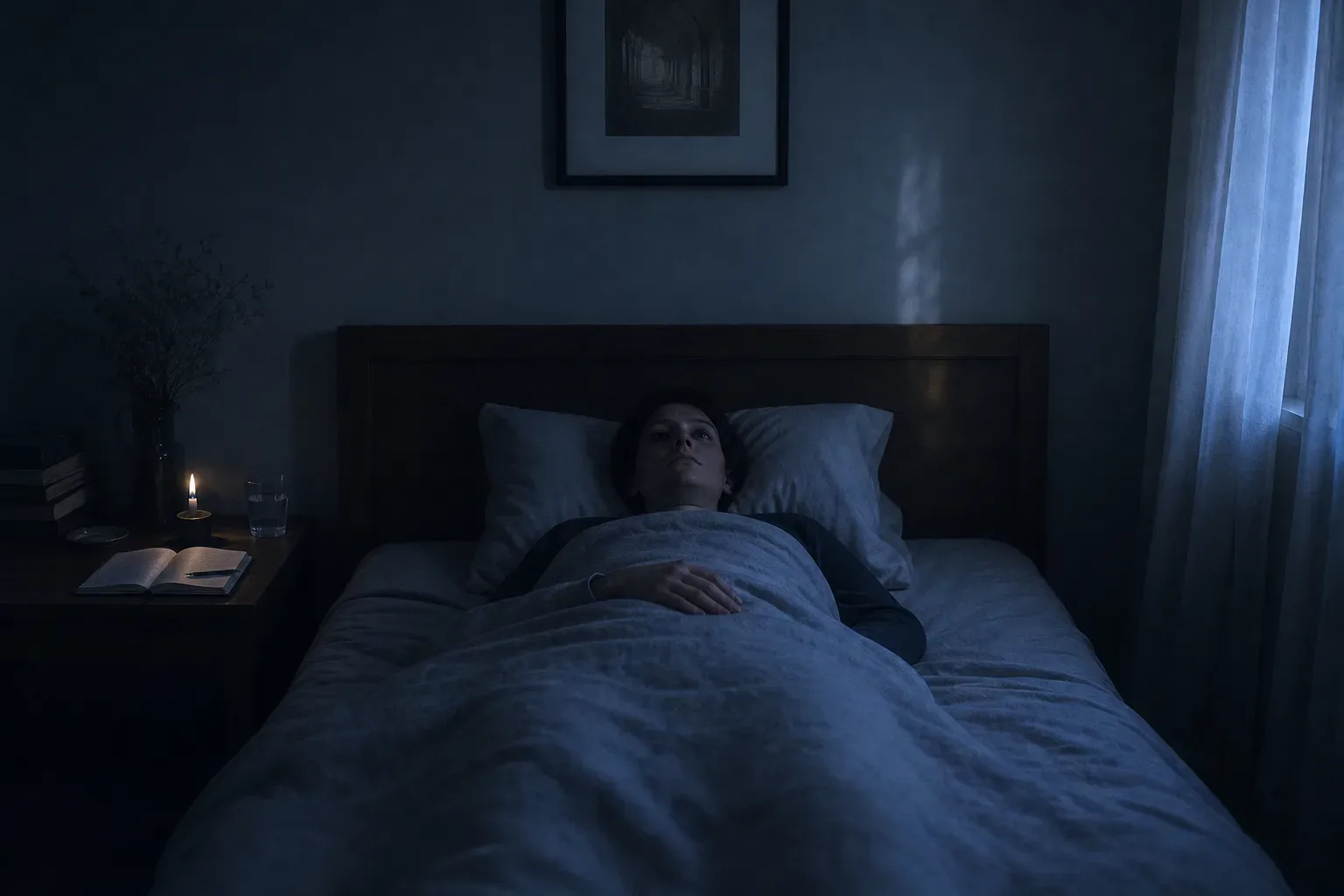
Sleep paralysis explained simply: it’s a brief overlap between waking awareness and REM sleep, when the body’s normal movement lock hasn’t released yet. You may feel awake, unable to move, watched, pressed down, or half inside a dream. It’s usually frightening, common, and not dangerous by itself.
What is sleep paralysis, in plain terms?
Sleep paralysis is waking consciousness with REM muscle paralysis still switched on.
During REM sleep, the brain usually quiets most voluntary muscles. Sleep researchers call this REM atonia. It’s one of the body’s ordinary protections, the reason most of us don’t physically run, punch, or reach while dreaming. In sleep paralysis, the timing is off by seconds or minutes. Your awareness arrives before your movement does.
Sharpless and Barber’s 2011 review in Sleep Medicine Reviews estimated that about 7.6% of the general population has had sleep paralysis at least once. Rates were higher in some groups: about 28.3% among students and 31.9% among psychiatric patients in the studies they analyzed. Those numbers don’t mean the condition is rare or strange. They mean many people don’t talk about it until they’re frightened at 3 a.m.
A typical episode lasts from a few seconds to a few minutes, according to descriptions used by the American Academy of Sleep Medicine and the International Classification of Sleep Disorders. The person can usually breathe. They often can move their eyes. What they can’t do is sit up, call out, or make the room obey the fact that they feel awake.
Sleep paralysis is not the body betraying you. It is a sleep switch turning off late.
If you’re reading this after an episode, notice the order: you woke, you couldn’t move, and then your mind started explaining the danger. That explanation can become the scariest part.
Why does sleep paralysis happen?
Sleep paralysis happens because the border between REM sleep and waking becomes untidy.
Sleep is not a single flat state. Across a typical night, the brain cycles through non-REM and REM sleep roughly every 90 minutes, though the timing varies by person and by night. REM periods get longer toward morning. That’s one reason sleep paralysis often appears near dawn, when vivid dreaming and brief awakenings are more likely.
In REM, your brain is active, your eyes move under closed lids, and dream imagery can be vivid. At the same time, the brainstem helps inhibit many skeletal muscles. When waking awareness comes online while that inhibition remains, you get the strange pairing: clear perception plus immobility. The mismatch can also happen while falling asleep, though many people report it on waking.
Several ordinary conditions seem to raise the odds. Research summaries and clinical reports commonly name sleep deprivation, irregular sleep schedules, jet lag, shift work, and stress. Sleeping on the back is also frequently reported in sleep paralysis accounts, though it’s not the whole cause. In one set of studies led by J. Allan Cheyne in the late 1990s and early 2000s, people often described episodes while supine, with a sensed presence and pressure sensations.
Common risk factors include:
- Losing sleep for several nights in a row
- Sleeping at highly irregular hours
- Napping after poor nighttime sleep
- Sleeping on your back
- Anxiety or acute stress
- Narcolepsy or other sleep-wake disorders
- Alcohol or substances that fragment sleep
The pattern matters more than one night. A single episode after two bad nights and a long nap is different from weekly episodes with daytime sleep attacks.
Is sleep paralysis dangerous, or just frightening?
Sleep paralysis is usually frightening rather than dangerous, but frequent or complex episodes deserve medical attention.
The fear makes sense. Humans don’t like waking in the dark without movement. The threat system can read immobility as danger, and the dreaming brain is still close enough to contribute images. Yet most isolated episodes end without injury. Breathing continues automatically. Movement returns. The room becomes ordinary again.
Clinically, sleep paralysis is often discussed as “isolated sleep paralysis” when it happens without narcolepsy or another major sleep disorder. The American Academy of Sleep Medicine distinguishes recurrent isolated sleep paralysis from sleep paralysis that appears as part of narcolepsy. Narcolepsy is much less common than sleep paralysis; estimates often place it around 1 in 2,000 people, though diagnosis is frequently delayed.
Talk to a doctor or sleep specialist if sleep paralysis is frequent, if you’re very sleepy during the day, if you suddenly lose muscle tone when laughing or feeling strong emotion, or if your sleep is badly disrupted. That isn’t because the episode predicts disaster. It’s because the pattern may point to a treatable sleep condition.
Use this simple distinction:
| Pattern | What it often suggests | What to do |
|---|---|---|
| One episode after poor sleep | Sleep disruption | Restore schedule, observe |
| Episodes during stressful weeks | Stress plus fragmented sleep | Reduce sleep debt, track triggers |
| Weekly episodes for months | Recurrent sleep paralysis | Consider a clinician or sleep clinic |
| Paralysis plus daytime sleep attacks | Possible narcolepsy features | Speak with a doctor |
A scary body state isn’t the same as a dangerous body state. That sentence is worth keeping near the bed.

Why do the shadows, sounds, and chest pressure feel so real?
The sensations feel real because waking perception, dream imagery, and body signals are arriving at the same time.
Sleep paralysis is famous for three clusters of sensations. Cheyne and colleagues described them as intruder, incubus, and vestibular-motor hallucinations. “Intruder” means a sensed presence, footsteps, a figure, or the certainty that someone is in the room. “Incubus” means pressure on the chest, difficulty breathing, or a feeling of being pinned. “Vestibular-motor” means floating, spinning, buzzing, leaving the bed, or moving without moving.
The chest pressure is especially memorable. During REM, breathing can feel different, and lying on the back may make body sensations more noticeable. Add immobility and fear, and the mind reaches for an explanation. Across centuries, cultures supplied explanations too: night hag, djinn, kanashibari, old hag, mare. These are folklore readings, not evidence that something entered the room.
The Dream dictionary (A–Z hub) is useful here because it separates image from event. A shadow figure in sleep paralysis isn’t interpreted the same way as a shadow figure in an ordinary dream. In paralysis, the first reading belongs to sleep science. Only after that should you ask what the image resembled, what it reminded you of, and why that form appeared.
Fear is a fast storyteller. It will give a shape to a sensation before the lights are on.
If the figure felt personal, write that down without treating it as a message from outside you. “Tall man by the door” is data. “Tall man by the door means I’m doomed” is panic writing the dictionary.
What should you do during an episode?
During sleep paralysis, stay still enough to reduce panic and small enough to invite movement back.
The first useful sentence is plain: “This is sleep paralysis.” Naming it changes the event from an attack into a known sleep-state mismatch. In cognitive behavioral work, labeling a fear response is often used to reduce escalation; the same principle applies here, though sleep paralysis-specific trials are limited. You’re giving the waking brain a handle.
Try this sequence:
- Name it. Say internally, “This is sleep paralysis. It will pass.”
- Stop testing the whole body. Repeatedly trying to sit up can increase fear.
- Choose one tiny movement. Wiggle a toe, move the tongue, blink, or press two fingers together.
- Lengthen the exhale. Don’t force deep breaths. Count a slow out-breath if you can.
- Look at one ordinary object. A lamp, a curtain edge, the ceiling line. Anchor the room.
- When movement returns, sit up slowly. Turn on a low light if that helps.
This is not magic. It’s a way to stop feeding the alarm system while the body completes its own transition. Some people find humming impossible; others find they can shift their jaw or tongue first. Keep the movement small.
If you share a bed, you can also agree on a sign when you’re fully awake later. During the episode you may not be able to signal at all, so don’t depend on rescue. Depend on recognition. The episode passes even when you do nothing correctly.
How can you reduce sleep paralysis over time?
You reduce sleep paralysis by reducing the sleep fragmentation that makes REM-waking overlap more likely.
Start with the unglamorous part: sleep timing. Going to bed and waking at roughly consistent hours gives the brain fewer abrupt transitions to manage. The Centers for Disease Control and Prevention reports that about 1 in 3 U.S. adults don’t get enough sleep, using the common benchmark of at least 7 hours for adults. Sleep debt doesn’t cause every episode, but it’s one of the most ordinary triggers.
Useful prevention steps include:
- Keep a stable wake time for 2 weeks, even after a bad night
- Reduce long late naps, especially after sleep loss
- Try side sleeping if episodes often happen on your back
- Keep alcohol close to bedtime modest or absent
- Create a low-stimulation final 30 minutes before bed
- Track episodes with date, sleep time, stress, position, and imagery
Dr. Andrew Huberman often discusses morning light as a circadian cue; the basic sleep-science point is older and broader. Bright light in the morning and dimmer light late at night help the body keep time. You don’t need a perfect routine. You need fewer shocks to the sleep-wake system.
Dreams can also show what the mind keeps rehearsing. If a recurring paralysis image is tied to a waking fear, you might use a daily practice to speak to that fear while awake. The AYA Method is a daily audio manifestation practice: each day you listen to a short personalized recording, your Dream-Self Moment, narrated from the version of you who has already manifested the life you intend. Listening is the practice. Repetition is the work. The audio is the method.

How is sleep paralysis different from lucid dreaming or nightmares?
Sleep paralysis, lucid dreaming, and nightmares can overlap, but they are not the same event.
A nightmare is a frightening dream, usually with movement available once you wake. Sleep paralysis is a waking or falling-asleep state where movement is briefly unavailable. Lucid dreaming means knowing you’re dreaming while the dream continues. Some people pass from sleep paralysis into a lucid dream or from a lucid dream into paralysis, which is why the categories get confused in online accounts.
The practical difference is control. In a lucid dream, the dreamer may be able to influence the dream, though not always. In sleep paralysis, the person is usually trying to regain waking movement. If you’re interested in the border between awareness and dreaming, the Lucid dreaming pillar gives the cleaner map. Sleep paralysis is not a required doorway to lucid dreaming, and trying to force it can make some people more anxious at bedtime.
Here is the short comparison:
| State | Awareness | Movement | Main feeling |
|---|---|---|---|
| Nightmare | Dreaming until wake-up | Returns on waking | Fear from dream plot |
| Sleep paralysis | Awake or nearly awake | Temporarily blocked | Fear from immobility and presence |
| Lucid dream | Aware within dream | Dream-body movement | Recognition inside dream |
| False awakening | Thinks one has woken | Dream movement | Confusion after real waking |
If you want to sort a specific report, use the AI dream interpreter tool as a notebook companion, not a verdict machine. For symbol browsing after the fear settles, return to the Dream dictionary (A–Z hub). The first question is always, “What kind of sleep event was this?” The symbol comes second.
What should you write down the morning after?
Write down the facts first, then the fear story, then one question for waking life.
Morning notes keep the episode from becoming larger each time you remember it. Memory is not a camera. In dream research, reports are shaped by what the dreamer records, when they record it, and what they decide matters. Calvin Hall’s mid-20th-century dream content work relied on written reports for a reason: the wording is part of the evidence.
Use a simple 4-line entry:
- Time and sleep context: “5:40 a.m., slept 6 hours, woke on back.”
- Body facts: “Couldn’t move, breathing felt tight, eyes open.”
- Images or sounds: “Dark figure near wardrobe, buzzing in left ear.”
- Waking link: “Argument yesterday; afraid I didn’t answer honestly.”
Don’t rush to meaning. If the same figure appears across 3 or 4 episodes, then patterns may be worth studying. If it happened once after a broken night, the sleep explanation may be enough. The AI dream interpreter tool can help organize themes, but your body facts should stay at the top of the page.
A dream symbol can be personal. Sleep paralysis physiology is not personal at all.
That distinction is kind. It lets you respect the image without fearing it as an outside force. It also gives you something to do the next night: sleep regularly, name the state, and keep the room ordinary.
Write the first true sentence before the day gets loud.