dream science
Exploding Head Syndrome: Why Sleep Starts With a Bang
Exploding head syndrome is a harmless but startling sleep event. Learn why you hear bangs before sleep, what it means, and when to get checked.
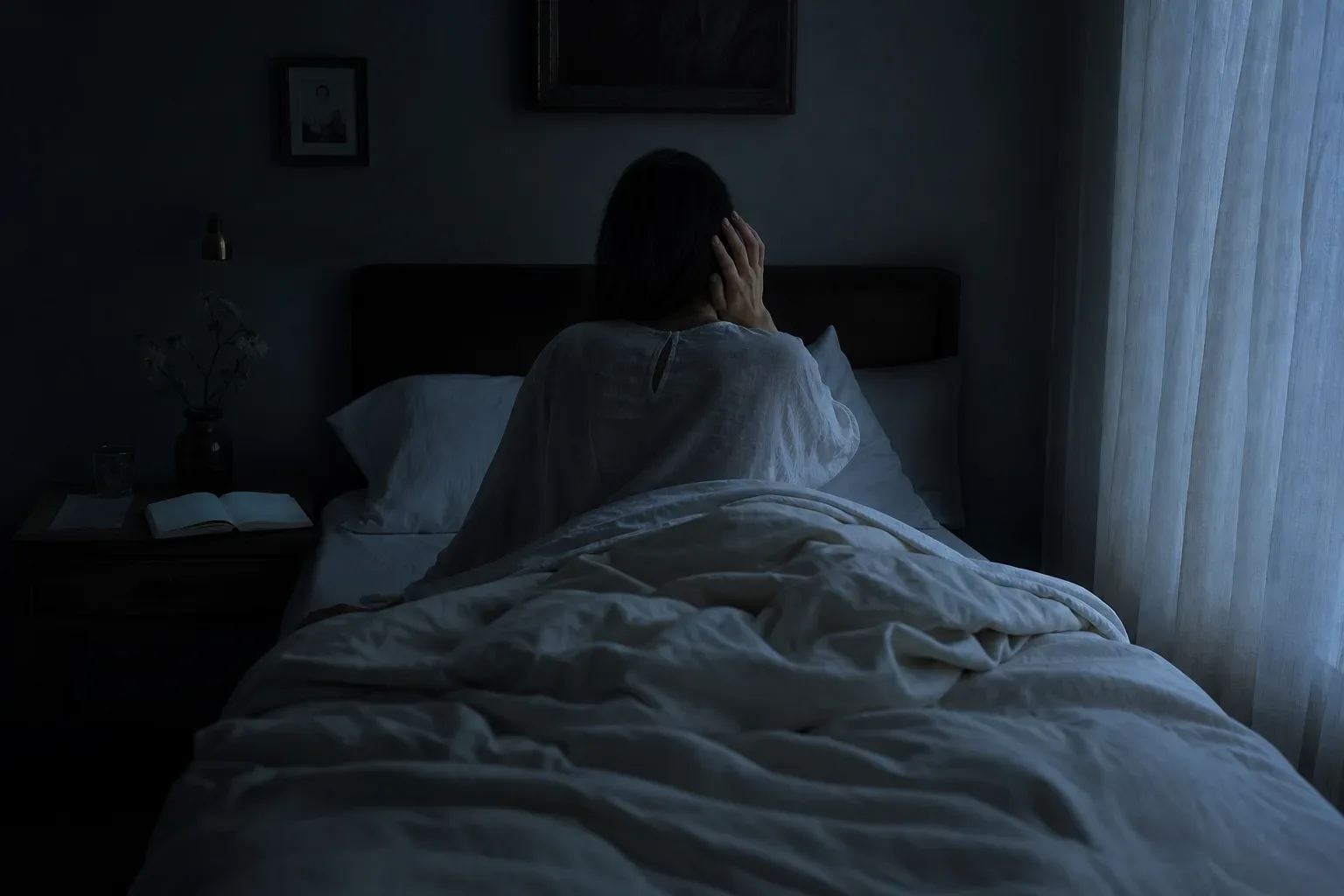
Exploding head syndrome is a sleep-wake transition event where you hear a sudden bang, crash, pop, or electrical snap just before sleep or on waking. It is usually harmless, usually painless, and more common than its dramatic name suggests. The sound feels real because your brain has produced a real perception.
What is exploding head syndrome?
Exploding head syndrome is a parasomnia: a strange event that happens around sleep, not a sign that your head or hearing is damaged.
The International Classification of Sleep Disorders places it among disorders of arousal and sleep-related sensory events. People report a gunshot, cymbal crash, door slam, thunderclap, shouting, or a burst of static. Some see a flash of light at the same moment. Most episodes last less than a second. The name is theatrical, but the event itself is usually brief and ordinary in its timing.
Brian A. Sharpless, one of the main modern researchers on the condition, published a 2014 review noting that exploding head syndrome had been described in medical literature since at least 1876, when physician Silas Weir Mitchell wrote about “sensory discharges” during sleep. In a 2015 study of 211 college students, Sharpless found that about 18% reported at least one lifetime episode. That number surprised clinicians, because the condition had long been treated as rare.
The noise is real as a perception, not real as an event in the room.
It is not usually a dream in the usual story-making sense. A dream gives you a scene: a kitchen, a dead relative, a dog speaking in your father’s voice. Exploding head syndrome tends to be stripped down to one sensation. It arrives at the border, often when thought is becoming less verbal and the body is giving way to sleep. If you want to compare it with other night phenomena, the Lucid dreaming pillar is a useful neighboring map, because lucid dreams also live near questions of awareness and sleep state.
Why do I hear a bang just before sleep?
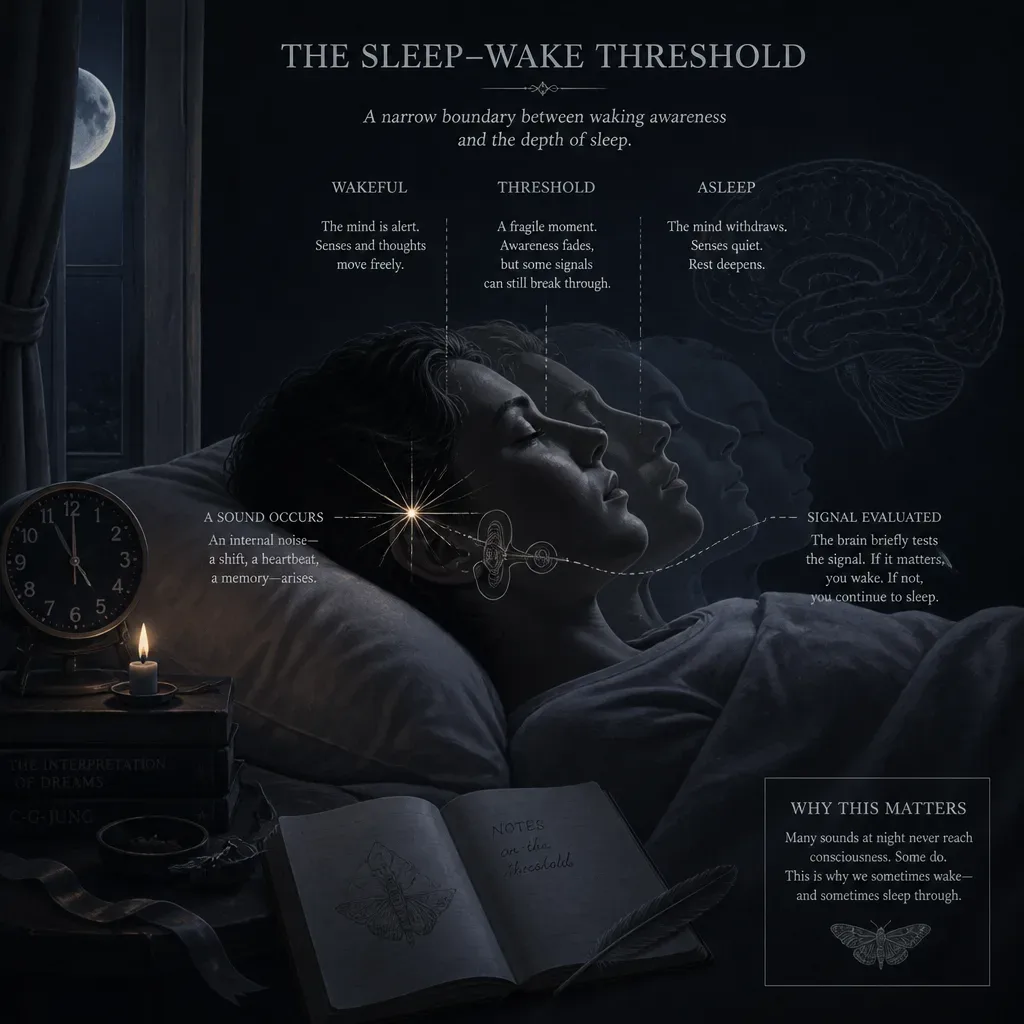
You likely hear the bang because the brain’s sensory systems are shifting unevenly as wakefulness turns into sleep.
Sleep is not a light switch. It is a sequence. In adults, a full sleep cycle often runs about 90 minutes, according to the National Institute of Neurological Disorders and Stroke, but the first descent into sleep can be uneven and delicate. Muscles relax. External awareness fades. The auditory system, however, may not quiet at the same speed as the systems that handle body position, vision, and attention.
One common theory says exploding head syndrome is a brief failure of normal sensory shutdown. Instead of the auditory system lowering its volume gently, the brain may produce a sudden burst that gets interpreted as a sound. This is why many reports are simple and percussive: bang, crack, boom, snap. The event is often described as coming from inside the head, but some people swear it came from the ceiling, street, or next room.
Hypnagogic hallucinations, which occur while falling asleep, are also common. Cleveland Clinic notes that these can include sights, sounds, or bodily sensations. Exploding head syndrome belongs near that family, though it is more abrupt. Dr. Andrew Huberman often describes sleep onset as a coordinated change in autonomic state, temperature, and attention. That general model helps here: when coordination wobbles, perception can become strange for a second.
Exploding head syndrome sounds violent, but the body is usually safe.
The strangeness comes from timing. A sound heard at noon would send you to the window. A sound heard as consciousness loosens its grip may be the nervous system clearing its throat.
Is exploding head syndrome dangerous, or should I worry?
Exploding head syndrome is usually not dangerous, but certain symptoms around it deserve medical attention.
The reassuring part is consistent across sleep medicine sources: the classic event is painless, momentary, and not followed by injury. The American Academy of Sleep Medicine describes it as a loud imagined noise or explosive feeling in the head at sleep onset or awakening. It may cause fear, a racing heart, or a few minutes of alertness afterward. Fear is not the same as danger.
The distinction matters because “a sudden bang in the head” can sound like other conditions. A thunderclap headache, for example, is a severe painful headache that peaks quickly and can signal bleeding or other urgent problems. Exploding head syndrome, by contrast, is usually noise without pain. If there is intense pain, fainting, weakness on one side, confusion, fever, new seizure-like movement, or chest pain, talk to a doctor promptly. That is a plain sentence, not a scare tactic.
| Night event | What it feels like | Usual timing | When to get checked |
|---|---|---|---|
| Exploding head syndrome | Sudden bang, crash, pop, or flash, usually painless | Falling asleep or waking | If new symptoms, pain, fainting, or neurological changes appear |
| Sleep paralysis | Awake but unable to move, sometimes with sensed presence | Falling asleep or waking | If frequent, distressing, or linked with daytime sleepiness |
| Tinnitus | Ringing, buzzing, hissing, or pulsing sound | Any time, often quiet rooms | If one-sided, pulsing, sudden, or with hearing loss |
| Thunderclap headache | Severe head pain peaking within 60 seconds | Any time | Urgent medical evaluation |
| Nocturnal seizure | Confusion, movements, tongue biting, injury, or lost time | During sleep | Medical evaluation |
In case reports, polysomnography often shows no dramatic abnormality, though not every person needs a sleep study. Sharpless’s 2014 review also notes that reassurance and education often reduce distress. Naming the thing can lower its volume. A monster with a medical name is still unpleasant, but it becomes less lonely.
Why does it happen more when I’m stressed, overtired, or irregular?
Stress, sleep loss, and irregular sleep may make exploding head syndrome more likely by making the sleep border less stable.
The evidence here is suggestive rather than final. Exploding head syndrome has not received the kind of funding given to insomnia, sleep apnea, or REM sleep behavior disorder. Still, clinical reports often mention clusters during exam periods, grief, shift work, jet lag, and anxious seasons. In the 2015 student study, exploding head syndrome was associated with isolated sleep paralysis, another border-state event. Association is not proof of cause, but it points toward shared vulnerability in sleep transitions.
The ordinary advice is therefore not glamorous. Keep a regular bedtime when you can. Reduce alcohol near sleep; the Sleep Foundation notes that alcohol can fragment sleep later in the night. Watch late caffeine, especially if you are sensitive. A 2013 study in the Journal of Clinical Sleep Medicine found that caffeine taken 6 hours before bedtime significantly disrupted sleep in participants. If your bangs arrive after three late coffees and a midnight argument, write that down before reaching for stranger explanations.
A few patterns are worth tracking for 2 weeks:
- Time of the event: falling asleep, waking, or after a night awakening
- Sound type: bang, pop, voice, electrical snap, crash, or music
- Body state: heart racing, no pain, headache, numbness, or paralysis
- Sleep debt: fewer than 7 hours, irregular bedtime, shift work, or travel
- Triggers: alcohol, caffeine, stress, new medication, fever, or grief
Write down the pattern, not the panic.
If the entries show a clear relationship with exhaustion, the first treatment may be more ordinary sleep. The Centers for Disease Control and Prevention recommends at least 7 hours for most adults. That number will not explain every bang, but it gives the nervous system a quieter threshold to cross.
What have cultures made of bangs, knocks, and night sounds?
Folklore often treats unexplained night sounds as messages, but that is cultural meaning, not medical proof.
Long before sleep medicine named exploding head syndrome, people made stories around sudden sounds at the edge of sleep. In parts of Slavic and Baltic folk belief, three knocks at night could be read as a death warning. In Irish and Scottish traditions, household sounds sometimes gathered around banshee lore, especially when grief was already near the door. In Scandinavian farm stories, a night crack in the timber might be blamed on the dead, the house spirit, or weather pressing its hand against old wood. These readings belong to folklore. They do not predict your future.
Folklore is not a diagnosis; it is a map of what a community learned to fear.
The same sound can carry different meanings by place. A bang in an urban apartment may become “the upstairs neighbor.” A bang in a rural childhood house may become “someone at the door.” A bang in a family with death-knock stories may arrive already dressed in inherited language. This is why dream dictionaries can be useful and limited at once. The Dream dictionary (A–Z hub) can show how symbols travel, but your grandmother’s kitchen still matters.
Researchers in anomalous sleep, including psychologists studying sleep paralysis, often note that culture shapes the story attached to the sensation. The sensation may be biological; the interpretation is learned. A 2011 review by Jalal and Hinton on sleep paralysis argued that cultural expectation can intensify fear and content. Exploding head syndrome may work similarly. The bang is brief. The story you put around it can keep you awake for an hour.
That does not make the story foolish. It makes it human. The work is to hold both truths at once: the nervous system made a sound, and your history gave it a face.

What should I do the morning after an episode?
The morning after, record the facts, calm the body, and decide whether the pattern needs medical attention.
Do this before the day edits the night into something grander or scarier. A simple note is enough. Date, time, sound, pain level, sleep duration, stress level, and whether you could move. If you use the AI dream interpreter tool, keep the distinction clear: you are not asking it to diagnose you. You are using it to notice emotional associations, symbols, and recurring night patterns.
Here is a quiet 5-minute sequence:
- Name it plainly. Write: “I heard a bang as I was falling asleep. It may have been exploding head syndrome.”
- Check for red flags. Note pain, weakness, confusion, fainting, fever, or seizure-like movement. If present, seek medical advice.
- Record the conditions. How many hours did you sleep? The CDC adult guideline is 7 or more hours. Were caffeine, alcohol, grief, travel, or stress involved?
- Return the body to morning. Open curtains, drink water, stand up, and let ordinary light correct the night’s intensity.
- Ask one honest question. “What threshold am I crossing right now: sleep, work, grief, change, or rest?”
For recurring episodes, the waking counterpart is not to fear the night into silence, but to give attention a steadier place to return. The AYA Method is a daily audio manifestation practice. Each day you listen to a short personalized recording, your Dream-Self Moment, narrated from the version of you who has already manifested the life you intend. Listening is the practice. Repetition is the work. The audio is the method. Used gently, it can sit beside a sleep log as a morning ritual, not as a cure claim.
Sleep gives odd names to ordinary thresholds.
If episodes become frequent, painful, or tangled with severe insomnia, daytime sleepiness, or fear of sleep, speak with a clinician. The Journal of Behavioral Medicine has published many studies linking stress reduction practices with improved sleep quality, but a new neurological symptom still deserves a human doctor, not a symbol hunt.
How can I tell the difference between a dream symbol and a sleep event?
A dream symbol usually has a scene around it; exploding head syndrome is usually a single sensory burst at the border of sleep.
This difference is not perfect, but it helps. If you dreamed you were in a train station and an explosion happened in the story, that belongs to dream interpretation. If you were nearly asleep and heard one impossible crack with no scene, no characters, and no unfolding plot, exploding head syndrome is more likely. The Dream Lexicon approach is to begin with form: what kind of night event was it before asking what it meant?
Sleep researchers separate these states because the brain behaves differently across them. REM sleep, where vivid dreaming is common, cycles through the night and often grows longer toward morning. NREM sleep dominates earlier sleep. Hypnagogic events occur at sleep onset, before the full architecture of the night has settled. A bang at 11:06 p.m. while your book slides from your hand belongs to a different category than a symbolic explosion at 5:40 a.m. inside a long dream.
Still, meaning can attach itself to a body event. If the bang happened during a week of deadlines, after a family argument, or on the first night alone in a new apartment, write that down. Not because the sound foretells anything. Because attention returns to what is unfinished.
A useful line for the page is this: “The sound may be neurological; the fear around it may be biographical.”
Morning question: what did the bang interrupt, and what did it leave behind?
Leave the room in daylight, and let the house be ordinary again.