Dream About Funerals: Meaning and Variations
Dreaming of a funeral usually means your mind is marking an ending, not predicting death. Learn the psychology, folklore, and variations.
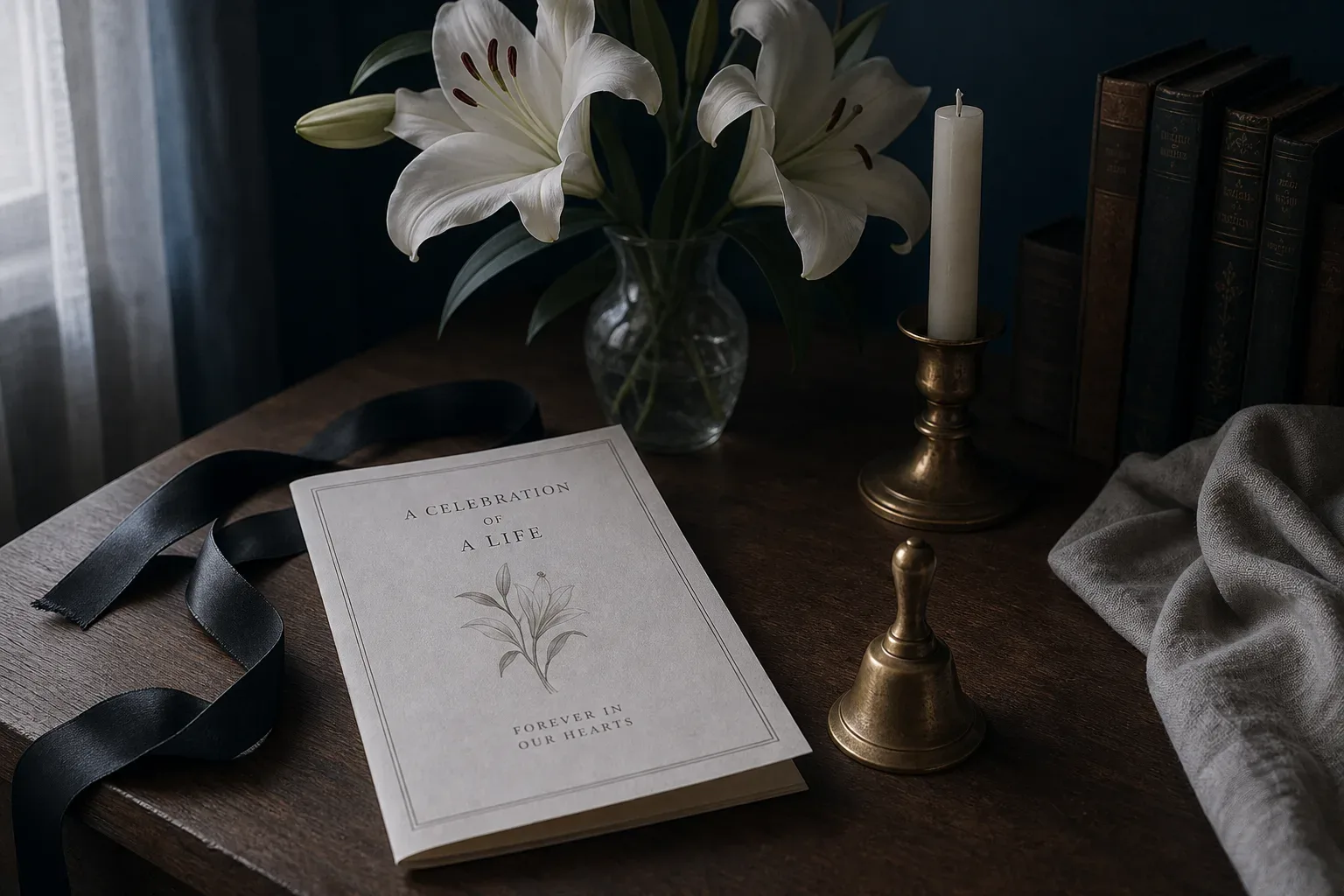
Dreaming of a funeral usually means your mind is marking an ending: a role, relationship, habit, season, or old version of yourself. It doesn’t predict death. The dream tends to ask what needs acknowledgment before you can move on, and who or what you’re quietly learning to release.
A funeral dream can feel heavy in the morning. It may also feel strangely calm. Both are common. Funerals are rituals of attention. In waking life, they gather grief, memory, duty, love, discomfort, and unfinished words into one room. In dreams, the funeral often does the same thing for a change you haven’t fully named yet.
A dream funeral is close to a dream of death, but it has its own emphasis. Death dreams often point to an ending. Funeral dreams point to the meaning of that ending. Who showed up? Who stayed away? What did you feel you were supposed to say? The symbol is not only loss. It is also ceremony.
what the psychology says
Modern dream research doesn’t treat funeral dreams as predictions. The better-supported view is that dreams often draw from waking concerns, emotional memory, and the mind’s ordinary attempt to sort what matters.
The continuity hypothesis, associated with Calvin Hall and later developed in the work of G. William Domhoff, suggests that dreams tend to continue waking life: our preoccupations, conflicts, relationships, fears, and routines appear at night in changed form. From that angle, a funeral dream may be your sleeping mind staging an ending that already exists in waking life. You may be leaving a job, ending a friendship, moving house, aging into a different family role, or saying goodbye to a self-image that once helped you.
Threat-simulation theory, proposed by Antti Revonsuo, argues that dreams can rehearse threatening or emotionally difficult situations. A funeral can be one such rehearsal. Not because the dream is warning you that someone will die, but because separation, public grief, family tension, and irreversible change are all hard things for a social human mind to practice. The dream may be asking: can I face this ending, and who will be with me when I do?
Clinical tradition adds another layer. Jung wrote about death imagery as a symbol of psychic change: not literal death, but the end of one inner arrangement and the beginning of another. A funeral in this tradition is the ritual part of the image. Something in you is not simply ending; it wants to be recognized, mourned, and laid down with dignity. That can sound grand, but it can also be ordinary. You might be done with pleasing everyone. You might be tired of acting unaffected. You might be ready to stop calling a loss small.
Freud often read dreams through wish, fear, and conflict. A funeral dream, in a Freudian sense, might hold mixed feelings you wouldn’t easily admit in daylight: anger at someone you love, relief after a hard caregiving role, guilt about moving on, or rivalry inside a family. This doesn’t make you cruel. Dreams can give shape to feelings without making them your chosen values.
Bereavement dreams deserve special care. Research on dreams after loss, including work by Joshua Black and colleagues, finds that people often dream of deceased loved ones in ways that are comforting, painful, confusing, or all three. The evidence doesn’t prove that such dreams are messages from the dead. It does show that they can matter deeply to mourners. If the funeral in the dream is for someone who has died, your mind may be returning to the bond, not only to the loss. You may want the related entry on deceased loved ones.
There is no good evidence that dreaming of a funeral predicts an actual death. There is good reason to take the feeling seriously. If funeral dreams become frequent nightmares that disturb your sleep or daytime life, it is reasonable to talk with a doctor or therapist.
In this dream-dictionary, funeral dreams are best read as dreams of ending, acknowledgment, social witness, and release.
what tradition and folklore say
Tradition often speaks more plainly than psychology, but it should be read as folklore, not fact. Funeral dreams have gathered meanings wherever people have gathered to bury, remember, and bless the dead.
In some Chinese folk dream books, a funeral can be read by reversal: what looks like death may be taken as a sign of life, status, or a fortunate change. This is folklore, not evidence. Still, the emotional logic is interesting. The dream image is inverted. The black carriage becomes a turning point. The end becomes the place where something else may begin.
In many Christian folk traditions, especially in Catholic households shaped by wakes, Masses, candles, and prayers for the dead, dreaming of a funeral may be understood as a call to remember someone, say a prayer, visit a grave, or make peace within the family. This, too, is tradition rather than proof. The dream is treated less as prediction and more as a nudge toward remembrance.
In Mexican Día de los Muertos tradition, the dead are not only absent. They are remembered, fed, named, and welcomed with affection. A funeral dream seen through that cultural lens may not mean fear of death so much as the need to keep a bond in the open. Memory becomes communal. Grief has a table, flowers, food, and names.
In parts of Irish and wider Celtic folk memory, wakes are social as well as sacred. They hold story, humor, tears, and duty in the same room. A dream of a funeral in that spirit may draw attention to the community around a loss: who carries the coffin, who speaks, who avoids the room, who knows the old stories.
Some West African ancestor traditions read dreams of the dead through relationship and obligation. A funeral image may be taken as a reminder to honor lineage, settle conflict, or remember where you come from. Again, this is folklore and spiritual tradition, not a claim that the dream foretells events.
The useful thing across these traditions is not certainty. It is respect. A funeral dream asks for respect toward an ending, even if the ending is private and no one else has noticed it yet.
what does it mean to dream of your own funeral?
Dreaming of your own funeral is usually about identity, not literal death. It can mean you are watching an old version of yourself be put away. The dream may arrive after a major change: becoming a parent, leaving school, retiring, getting sober, changing faith, ending a marriage, or finally admitting that an ambition no longer fits.
Notice who attends. If everyone you know is there, the dream may be about how you imagine others see you. If no one comes, it may touch a fear of being forgotten, unsupported, or unseen. If people speak kindly, you may be hungry for recognition. If they lie, exaggerate, or ignore the truth of you, the dream may be naming a gap between your public role and your private self.
Your emotional tone matters. If you feel peaceful watching your own funeral, you may be ready to release a burden. If you feel trapped or unheard, the dream may point to a part of your life where you feel written off too soon. If you try to tell people you’re alive and no one listens, ask where in waking life you feel invisible.
A dream of your own funeral can also appear during depression, burnout, or exhaustion. The symbol may be saying, I can’t keep living this way. If the dream comes with waking thoughts of not wanting to live, tell someone you trust and contact a mental health professional or emergency service today.
what if the funeral is for someone who’s alive?
A funeral for a living person often means the relationship is changing. It does not mean you want them dead, and it doesn’t predict their death. More often, your mind is marking the end of a particular version of the bond.
If the funeral is for a parent, you may be grieving the parent you needed, the parent they used to be, or the child role you are leaving. If it is for a partner, the dream may point to distance, resentment, fear of abandonment, or the end of a pattern between you. If it is for a friend, it may be about drifting apart, jealousy, forgiveness, or the quiet sadness of growing in different directions.
Sometimes the living person in the coffin represents a quality you associate with them. A stern teacher may stand for judgment. A former friend may stand for a lost era. A sibling may stand for comparison. The dream borrows a face because the feeling needs a body.
Ask what has ended between you. It may be something painful, like trust. It may be something healthy, like dependence. It may be something bittersweet, like daily closeness after a move.
what if the funeral is for someone who has already died?
If you dream of a funeral for someone already dead, your grief may be returning to a place it hasn’t finished visiting. That doesn’t mean you have failed at mourning. Grief is not a straight line. It is more like weather over familiar ground.
The dream may repeat the real funeral, change it, or give you the funeral you wish had happened. Maybe you missed the actual service. Maybe there was family conflict. Maybe you were too numb then and feel more now. Maybe the dream lets you cry at last. Or maybe it gives you a strangely ordinary scene: folding chairs, a coat over your arm, someone whispering in the back row.
Pay attention to differences from waking memory. Was the person alive in the casket? Was the room full or empty? Did you speak? Did they speak? Did the service take place in a church, a house, a field, or a graveyard? Changes like these often carry the emotional point of the dream.
A funeral dream after loss can be painful and still be meaningful. It may be your mind holding the bond carefully, trying to integrate the fact that love continues while daily access has ended.
what if you’re late, lost, or can’t cry at the funeral?
Being late to a funeral in a dream often suggests a fear of missing your chance to say goodbye. You may feel that you didn’t act soon enough, speak honestly enough, or understand the importance of something while it was happening.
Being lost on the way can mean you don’t yet know how to grieve, end, or accept the change. The roads won’t cooperate because the feeling hasn’t found its route. This is common after ambiguous losses: a friendship fading without a fight, a family member changing through illness, a career ending slowly, a home that no longer feels like home.
Not being able to cry may feel disturbing, but it doesn’t mean you don’t care. Dreams often show emotional blockage in literal form. You may be numb, watched, ashamed, or still in the practical stage of coping. In some funeral dreams, everyone else cries while the dreamer feels blank. That blankness can be a true feeling, too.
If the funeral becomes chaotic, with the wrong body, the wrong music, missing mourners, or a service that never begins, the dream may be about an ending that hasn’t been properly named. Something is over, but no ritual has held it.
the morning after
Ask yourself: what ending in my life needs to be acknowledged, not rushed past?
Write down this line: The funeral was for _____, and what I still need to say is _____.
Then add three details before they fade: who was there, what the room felt like, and whether you wanted to stay or leave. Those details may tell you more than the symbol alone.
If this is a recurring dream, notice what your attention keeps returning to at night; the waking counterpart is the Dream-Self Moment, a short personalized recording of your future self through the AYA Method. For this morning, keep it simple. Name the ending. Give it one honest sentence. Let the day begin quietly.