lucid dreaming
Wake Up From Lucid Dream Without Panic
Learn how to wake up from lucid dream states calmly, using grounding cues, breath, dream exits, and morning notes that reduce fear next time.

To wake up from lucid dream states without panic, stop trying to force the dream open. Name what’s happening, slow your breathing, choose one simple exit cue, and ground yourself when you return. Lucid dreams are usually ordinary REM sleep with awareness added, not a trap or a prediction.
What should you do first when you want to wake up?
The first thing is to tell yourself, clearly and briefly, that you’re dreaming and safe in bed.
This sounds too small to matter, but lucidity can become frightening when the mind gains awareness faster than the body settles. A 2016 meta-analysis in Neuroscience & Biobehavioral Reviews estimated that about 55% of people have had at least one lucid dream, and about 23% have them monthly or more. That means the strange moment of knowing you’re dreaming is not rare. It’s a known state of sleep.
Use one sentence, not a speech. Say: “This is a dream. My body is in bed.” If the dream has become dark, loud, or claustrophobic, add: “I don’t have to solve this inside the dream.” The point isn’t to win against the scene. The point is to reduce the alarm signal.
Panic makes the dream feel like a locked room; naming it makes it a room with a door.
Try this first sequence before any dramatic wake-up technique:
- Say, “This is a dream.”
- Say, “My body is safe in bed.”
- Take four slow breaths inside the dream.
- Choose one exit cue and stay with it for 10 seconds.
The 10-second rule matters. In waking life, anxious switching often keeps the body activated. In a lucid dream, changing methods every second can do the same thing. Dr. Andrew Huberman often explains arousal through the autonomic nervous system: the body needs repeated safety signals, not frantic variety. A dream is not waking life, but the principle still helps.
If you’re new to lucid dreaming, read the broader guide to lucid dreaming when you’re fully awake. Morning learning is steadier than middle-of-the-night improvising.
Which wake-up techniques work best inside a lucid dream?
The best wake-up technique is the one you can repeat calmly, because repetition is more reliable than force.
Lucid dreamers report several common exits: closing dream eyes, blinking hard, falling backward, spinning, calling out to wake up, or focusing on the physical body. None has perfect scientific proof as a universal switch. In lucid dream research, including work by Stephen LaBerge at Stanford in the 1980s, dreamers signaled lucidity with prearranged eye movements during REM sleep. That research showed communication can happen from within the dream, but it didn’t prove one exit method for everyone.
Use the table below to choose one primary method and one backup. Don’t collect ten. Two is enough.
| Method | How to do it | Best for | Caution |
|---|---|---|---|
| Close dream eyes | Shut your eyes in the dream and feel the pillow | Visual overload | May shift scenes instead of waking |
| Focus on breath | Count four slow breaths and locate the chest | Panic or dread | Don’t monitor too hard |
| Fall backward | Let yourself drop as if into bed | Dreams with standing or running | Skip if falling dreams scare you |
| Look at hands | Study palms until the dream blurs | High lucidity | Can deepen lucidity for some |
| Call your name | Say your waking name three times | Confusion about identity | Keep voice calm |
My usual recommendation is this: close the dream eyes and feel for the bed. It’s plain. It doesn’t add more drama to an already charged dream. If that fails, focus on a small physical sensation: the tongue in the mouth, the weight of the blanket, the right hand on the sheet.
A dream exit should be boring on purpose.
If the dream turns symbolic as you’re leaving, don’t stop to interpret it midstream. That’s for morning. You can look up recurring symbols later in the Dream dictionary (A–Z hub), but during the dream, your job is simpler: reduce fear, return to the room, write one line.
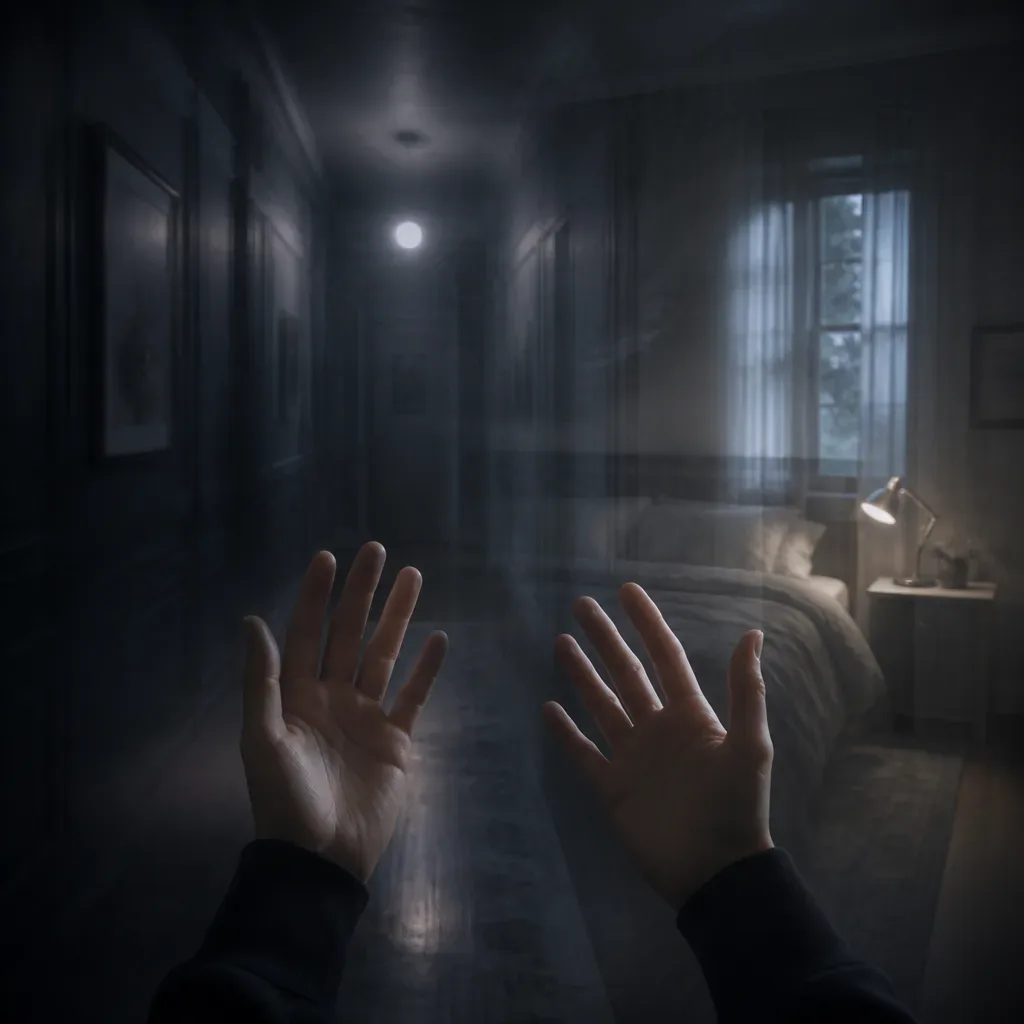
How can you wake up without triggering more fear?
You wake up without triggering more fear by lowering the sense of emergency before you try to exit.
Fear inside dreams behaves like fear anywhere else: it narrows attention. A 2019 review in Frontiers in Psychology described lucid dreaming as a hybrid state with features of both waking awareness and REM dreaming. That helps explain why panic feels so convincing. Part of you knows the scene is made by the sleeping mind. Another part is still responding to a hallway, a figure, a locked door, or a falling sky as if it were immediate.
Use a calming script that’s short enough to remember. Long scripts break apart at night. These three lines are enough:
- “This is REM sleep.”
- “I’m safe in my room.”
- “I can wake slowly.”
Notice the word slowly. Many dreamers panic because waking doesn’t happen instantly. But REM periods can be long, especially later in the night. According to sleep architecture research summarized by the National Institute of Neurological Disorders and Stroke, REM sleep recurs about every 90 minutes and lengthens toward morning. A delay doesn’t mean you’re stuck. It means the body is finishing a sleep state.
If the dream contains a threatening figure, don’t argue with it unless you’re practiced at lucid work. Turn your attention away from the story and toward sensation. Feel the ground under dream feet. Feel the air on dream skin. Then move attention to the bed. The route is: dream body, sleeping body, room.
The dream doesn’t need to become pleasant before you leave; it only needs to become less commanding.
Some readers use the AI dream interpreter tool after waking, especially when the image is too tangled to hold alone. Use it as a notebook with questions, not as an authority over your own memory.
What if you wake into sleep paralysis?
If you wake into sleep paralysis, treat it as REM muscle atonia lingering for a short time, not as a sign that something is wrong.
Sleep paralysis is frightening because awareness returns before easy movement does. The chest may feel heavy. The room may seem altered. Some people sense a presence. In a 2011 review in Sleep Medicine Reviews, Brian Sharpless and Jacques Barber estimated that about 7.6% of the general population has had sleep paralysis at least once, with higher rates in students and psychiatric samples. Common doesn’t mean pleasant, but it does mean you’re not alone.
Use the smallest possible movement. Don’t try to sit up all at once. That often feeds panic. Instead:
- Name it: “This is sleep paralysis.”
- Breathe out longer than you breathe in.
- Move one toe, one finger, or the tongue.
- Keep attention on a real object, such as the edge of a lamp.
- Wait for full movement before checking the room.
The long exhale is a practical cue. Slow breathing is associated with parasympathetic activity in several small studies, including research discussed in Frontiers in Human Neuroscience on paced breathing and autonomic regulation. You don’t need to perfect a technique at 4:12 a.m. You only need to make the next breath less sharp than the last.
Do not use folklore explanations while it’s happening. Many cultures have old stories for sleep paralysis: the old hag, the pressing spirit, the night visitor. Folklore matters as human record, but it’s not the best tool during an episode. Use biology first. Meaning can wait until morning.
If sleep paralysis is frequent, painful, linked with sudden daytime sleep attacks, or causing you to avoid sleep, talk to a doctor in one plain sentence: you deserve help sleeping.
How do you practice this before the next lucid dream?
You practice by rehearsing one calm exit while awake, for less than two minutes a day.
The sleeping mind borrows from waking habits. This is why lucid dream induction methods such as MILD, developed by Stephen LaBerge, use intention and rehearsal before sleep. Studies vary in size, but a 2017 paper in Dreaming found that combining reality testing, wake-back-to-bed, and MILD increased lucid dream frequency in a sample of 169 participants. The exact numbers aren’t a promise. They do show that rehearsal can affect dream behavior.
Here’s a four-minute practice you can do in the evening or after reading this:
- Sit or lie down and soften your jaw for 20 seconds.
- Say: “If I become lucid and want to wake, I’ll close my dream eyes.”
- Picture one mild dream scene, not a nightmare.
- Practice closing your eyes and feeling the bed beneath you.
- Open your eyes and name three objects in the room.
Keep it ordinary. The mind trusts ordinary things. A lamp, a blanket, a doorframe. These are better anchors than dramatic declarations.
This is also where the AYA Method can sit beside dream practice, not inside it. The AYA Method is a daily audio manifestation practice. Each day you listen to a short personalized recording — your Dream-Self Moment — narrated from the version of you who has already manifested the life you intend. Listening is the practice. Repetition is the work. The audio is the method. For recurring lucid fear, the waking counterpart is not to wrestle the night; it’s to give attention a steadier sentence before sleep.
If you keep a dream notebook, add one line at the top of a page: “My exit is closing dream eyes and feeling the pillow.” Repeat the same line for 7 nights. Seven is not magic. It’s simply long enough for the phrase to become familiar.
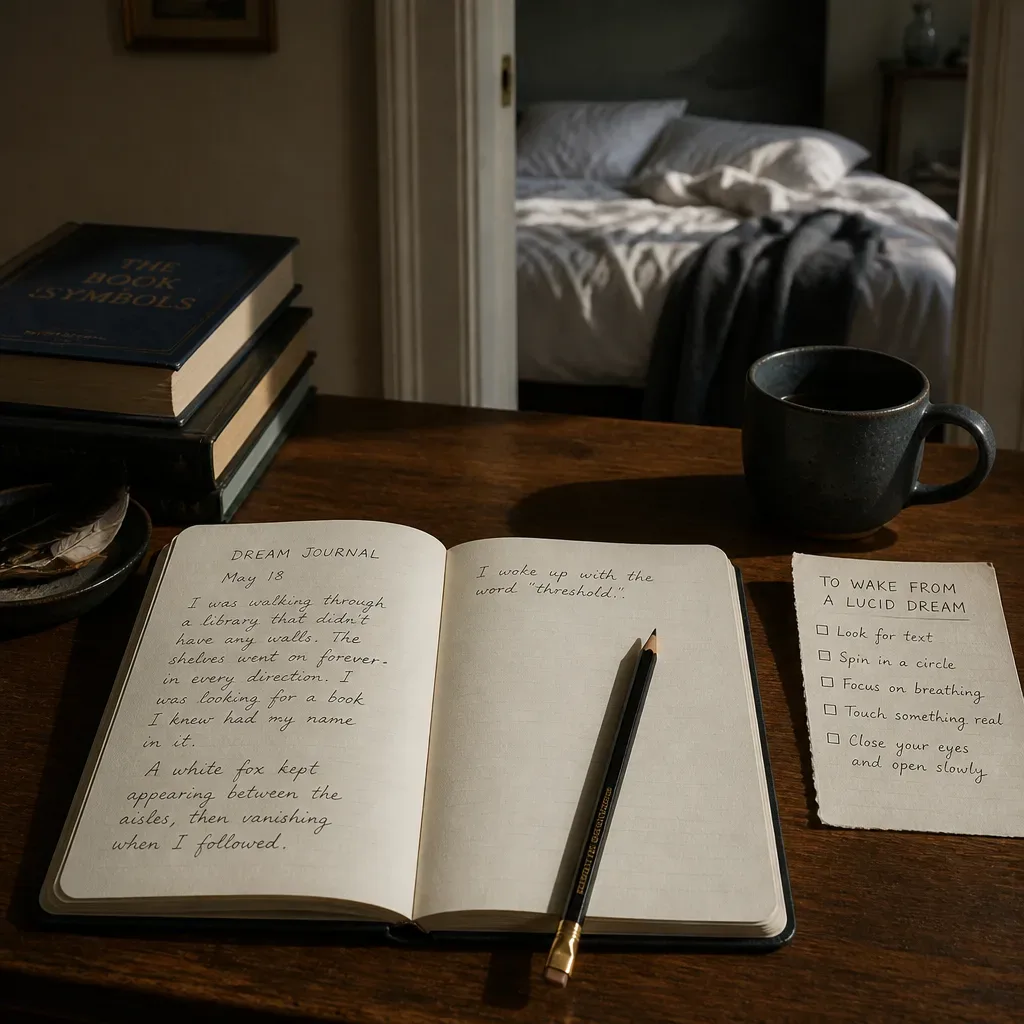
What should you write down the morning after?
Write down what happened, what worked, and what the fear seemed to want from you.
Morning notes prevent the dream from becoming larger than it was. In a 2022 YouGov sleep survey, about 1 in 3 U.S. adults reported poor sleep quality most nights, and anxious awakenings often become stories we carry into the day. A short record keeps the event specific: one room, one figure, one feeling, one exit attempt.
Use this template:
- Time of waking:
- Dream scene:
- Moment I became lucid:
- What I tried:
- What helped by 1%:
- One sentence the dream might be asking:
The “1%” line is important. It stops the all-or-nothing verdict. Maybe you didn’t wake immediately, but you remembered your name. Maybe you still panicked, but you counted two breaths. That counts. Dreams change through small recognitions, not public victories.
A dream practice matures when you stop asking whether you controlled the dream and start asking what you noticed.
If the dream had a strong symbol — teeth, snakes, water, a childhood house — use the Dream dictionary (A–Z hub) later in the day, not while half-awake. If you want to compare personal notes with a structured reading, the AI dream interpreter tool can help you form questions. Keep authority with the dream and with your life.
For lucid dreamers who are still learning, returning to the main lucid dreaming pillar can also help separate normal REM strangeness from the few situations that need support.
When is it more than a lucid dream problem?
It may be more than a lucid dream problem if fear around sleep becomes frequent, daytime functioning suffers, or episodes include other sleep symptoms.
Most lucid dream panic is manageable with practice. But sleep is part of health, not a private test of character. If you’re avoiding bed, losing several nights a week, having repeated sleep paralysis with distress, or experiencing sudden muscle weakness with emotion, bring it to a clinician. Narcolepsy, PTSD nightmares, panic disorder, medication effects, and sleep deprivation can all affect dreaming. The American Academy of Sleep Medicine notes that adults generally need at least 7 hours of sleep per night; chronic short sleep changes mood, attention, and REM pressure.
There’s also a softer threshold. If the same lucid dream returns with the same terror, ask what in waking life has no exit. Jungian work doesn’t require believing the dream predicts anything. It asks a stricter question: what part of you has been speaking in pictures because ordinary language didn’t work?
Use this final checklist after a hard lucid dream:
- Did I sleep fewer than 6 hours?
- Did I use alcohol, cannabis, or a new medication?
- Did I wake during a long morning REM period?
- Did the same image repeat from an earlier stress?
- Did I recover once I grounded in the room?
If the answer points to ordinary sleep disruption, return to the calm exit practice. If the answer points to repeated distress, get help. There is no prize for being alone with a night that keeps injuring your morning.
Write one line before breakfast: “When I wanted to wake, the dream asked me to notice _____.”