Finding or Losing Money Dream Meaning
Finding or losing money usually points to self-worth, security, choice, or fear of waste rather than literal finances.
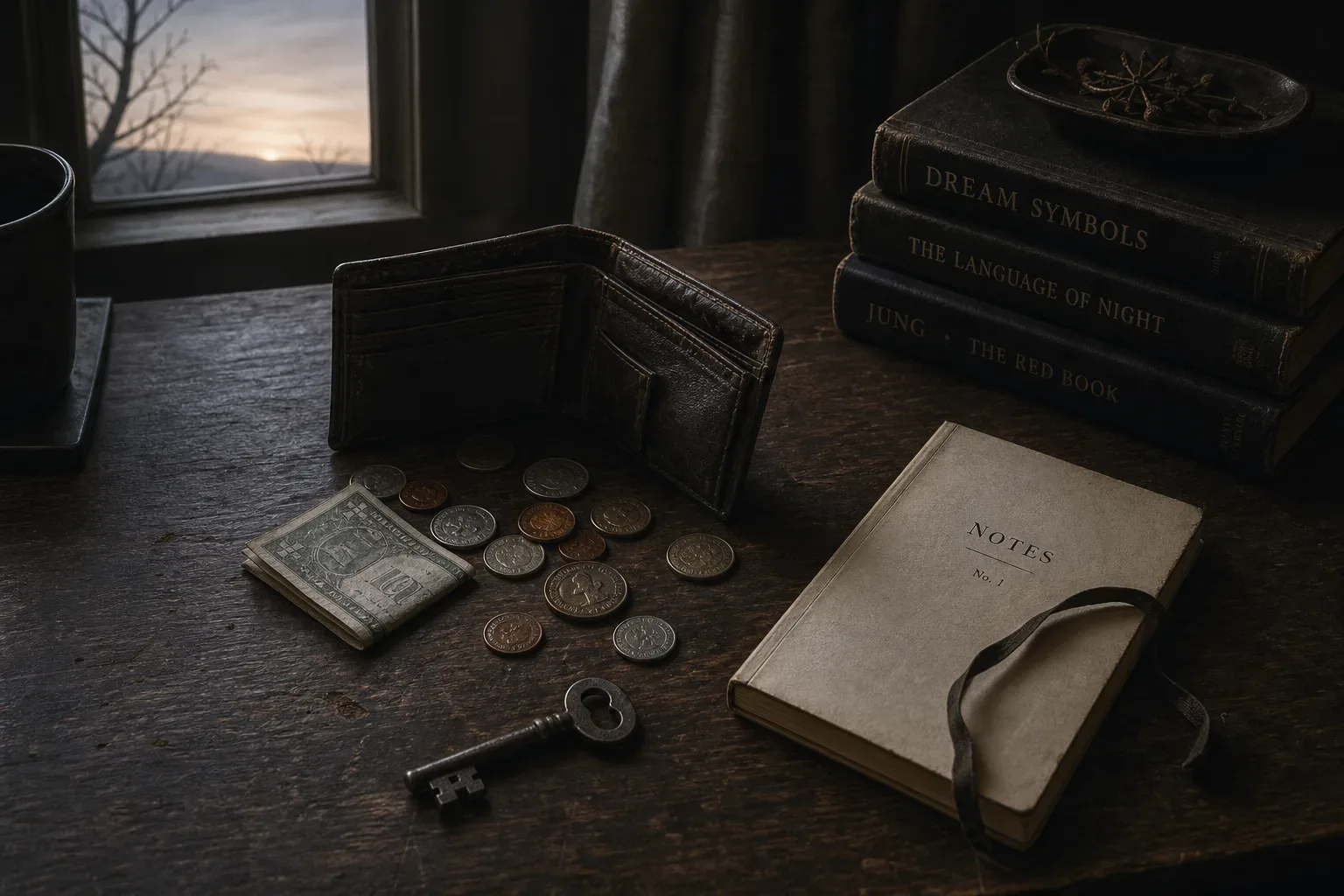
Finding or losing money in a dream usually points to value: your sense of security, self-worth, opportunity, and what you fear wasting. It can be about actual finances, but it just as often concerns time, attention, trust, status, or a choice you can’t quite price in waking life.
what the psychology says
Money is one of the most flexible symbols in dreams because it already works that way in waking life. A coin is metal, but it can stand for food, rent, freedom, debt, shame, kindness, luck, power, or a phone call you don’t want to make. In dreams, money often keeps that double life. It is practical and symbolic at once.
The psychological reading starts with continuity. The continuity hypothesis, associated with Calvin S. Hall and later developed in the work of G. William Domhoff and Michael Schredl, suggests that dreams tend to reflect waking concerns, habits, relationships, and emotions. If money has been on your mind, the dream may be fairly direct. You may be budgeting, waiting for a payment, helping family, starting a job, or feeling the ordinary pressure of living inside a number.
But the dream doesn’t have to be about dollars or coins. In clinical tradition, money frequently stands in for personal value. Jung wrote about symbols as images that carry more meaning than the conscious mind can fully state. A dream wallet, lost purse, hidden bill, or handful of coins may be less about cash and more about psychic currency: what you give, what you keep, what you think you’re owed, and what part of yourself you have undervalued.
Finding money often appears when the dreamer notices a resource that was already near them. It may be confidence, help, skill, time, a forgotten pleasure, or an option that seemed too small to count. The emotional tone matters. If finding money feels calm, it may signal relief or restored capacity. If it feels guilty or frantic, the dream may be asking whether you believe you’re allowed to receive.
Losing money tends to carry anxiety. It can represent fear of making the wrong choice, losing standing, being irresponsible, or not having enough. Threat-simulation theory, proposed by Antti Revonsuo, argues that some dreams rehearse dangers so the mind can practice response. A dream of lost cash, a missing card, or an empty wallet may be a small social-survival threat: What if I can’t pay? What if I’m exposed? What if I miscalculated?
There is no good evidence that dreaming of money predicts financial gain or loss. The honest reading is quieter. Money dreams usually show the feeling around value. They ask where life feels scarce, where it feels generous, and where your inner accounting has become too harsh.
If the dream includes someone taking your money, it may overlap with dreams of theft. If it includes sudden riches, gambling, prizes, or a jackpot, it may sit near dreams of winning. If you lose money while wandering through streets, stations, or a strange building, the symbol may also belong with being lost. You can compare nearby symbols in the dream-dictionary, but start with the feeling in the dream. It usually knows the closest meaning.
what tradition and folklore say
In many folk traditions, finding money is treated as a sign of luck. A coin on the road, a bill in an old coat, or money received unexpectedly can be read as a small blessing. This is folklore, not evidence, but it preserves a tender truth: people have long associated found money with being noticed by fortune.
European and North American folk sayings often give coins special weight. Picking up a penny, especially heads up, is said to bring luck. Losing a purse or dropping coins, in some older household lore, could be read as a warning to be more careful with one’s goods or one’s promises. Again, this doesn’t mean the dream foretells anything. It means the image has carried ideas of luck, care, and consequence for a long time.
In Chinese tradition, money images can be tied to prosperity, exchange, and blessing, especially around red envelopes, New Year customs, and coins used as good-luck objects. A dream of receiving money might be read in that cultural frame as favor, support, or incoming good fortune. A dream of scattered coins might also raise questions about waste or disorder. These are traditional readings, not scientific claims.
In Islamic dream interpretation manuals, including works attributed to Ibn Sirin, money is not always simple wealth. Coins may be linked with words, worries, obligations, or trust, depending on the material, number, and situation. This is useful because it resists the flat reading. Money can be speech. Money can be burden. Money can be a promise someone must keep.
In Hindu and Indian household traditions, receiving money from elders, deities, or in a temple setting may be associated with blessing, duty, and auspicious support. Money near Lakshmi, the goddess associated with prosperity and good fortune, carries a different feeling than money found in mud or stolen from a drawer. The setting changes the symbol.
Folklore tends to ask, Is fortune coming or leaving? Psychology tends to ask, What do you feel you have, lack, owe, or deserve? Both questions can be worth holding for a minute in the morning.
what does it mean to find money in a dream?
Finding money usually suggests discovered value. You may be recognizing a skill, a chance, a reserve of patience, or a form of support you had overlooked. The dream often comes with relief: there it is, under the bed, in the pocket, on the sidewalk, folded inside a book.
Notice where you find it. Money in an old coat may point to something from the past that still has use. Money in dirt may suggest value mixed with effort, shame, or recovery. Money in a childhood room may connect worth with family history. Money in a workplace may be closer to status, pay, competence, or recognition.
Notice whether you keep it. If you pick it up easily, the dream may show readiness to receive. If you hesitate, hide it, or feel you don’t deserve it, the dream may be circling guilt. Many people can work hard and still feel uneasy when something good arrives. A dream can stage that unease very plainly.
If you find a large amount of money, the dream may not mean a large opportunity. Sometimes a large amount simply makes the emotion impossible to ignore. The question becomes: what would change if I trusted that I had more resource than I thought?
what does it mean to lose money in a dream?
Losing money in a dream usually reflects anxiety about waste, responsibility, or vulnerability. You may fear that you’re spending too much, saying too much, giving too much, or making a choice you can’t take back. The lost money may stand for cash, but it may also stand for time, attention, trust, or dignity.
The object matters. Losing a wallet can feel like losing identity as well as funds. A wallet holds cards, names, proof, access. Losing coins may feel smaller, but more scattered, like tiny daily leaks of patience or care. Losing a paycheck or envelope can suggest fear that your work won’t hold value once it’s out of your hands.
Ask what you did after the loss. Did you search calmly? Panic? Blame someone? Pretend it didn’t happen? The response often matters more than the money. A dream may be showing your waking pattern around scarcity. Do you become careful, ashamed, angry, helpless, or strangely relieved?
If you often dream of losing money and wake distressed, look at current pressures first. Bills, unstable work, family obligations, debt, and retirement worries can all enter dreams in ordinary ways. If nightmares are frequent and harming your sleep, it’s reasonable to talk with a doctor or mental health professional.
what if someone steals your money in the dream?
If someone steals your money, the dream often points to boundaries. You may feel used, underpaid, copied, overlooked, or emotionally drained. The thief might be a real person, but dreams also cast parts of the self as other people. The figure may represent a habit that keeps taking from you: avoidance, overgiving, resentment, secrecy, or fear.
If you know the thief, begin with the relationship, but don’t accuse the waking person too quickly. Ask what they represent. A boss might represent judgment or authority. A sibling might represent rivalry or comparison. A stranger might represent a faceless pressure: rent, debt, deadlines, illness, bureaucracy.
If you chase the thief, the dream may show a wish to reclaim agency. If you freeze, it may show how difficult it feels to defend your value. If nobody believes you, the center of the dream may be not money but recognition. You want someone to say: yes, something was taken.
This variation is close to theft, but money gives it a sharper question: where do I feel my value is being removed without consent?
what if the dream money is fake, foreign, old, or impossible to spend?
Strange money often points to uncertainty about worth. Fake bills may suggest impostor feelings, mistrust, or fear that something attractive won’t hold up under scrutiny. You may be wondering whether an offer, role, apology, or achievement is real enough.
Foreign money can appear when you’re in unfamiliar emotional territory. You may have resources, but not in a form you know how to use. This is common during transitions: a new job, new country, new family role, new grief, new freedom. The value is there, but the exchange rate is unclear.
Old coins or antique money may bring in inheritance, ancestry, memory, or values you received from others. The dream may be asking whether an old rule about money still governs you: don’t ask, don’t waste, don’t owe, don’t outshine, don’t need.
Money that crumbles, melts, multiplies, or cannot be spent suggests instability in your inner accounting. Something you thought would secure you may not feel secure now. Or something dismissed as worthless may suddenly seem alive with meaning.
the morning after
Ask yourself one question: where in my life am I measuring value too tightly, or not carefully enough?
Write this line down: “In the dream, the money felt like _____, and in waking life that reminds me of _____.”
Then add the ordinary facts. Was it found or lost? Cash, coins, card, wallet, check? Who was there? What did your body feel when you woke? A money dream is often less about the amount than the sensation: relief, shame, fear, greed, gratitude, suspicion, or calm.
If this dream keeps returning, it may be showing what your attention returns to at night: the fears and wants under your private accounting. The waking counterpart is the Dream-Self Moment in the AYA Method, a short personalized recording in your own voice of who you’re becoming, so the night isn’t the only place your future self gets to speak.
For today, don’t rush to predict. Notice one exchange. Where are you spending yourself? Where are you being paid in respect, rest, honesty, or help? Where is there a small coin of value you keep walking past?