Brakes Not Working Dream Meaning
Brakes not working in a dream usually means life feels too fast to control, with pressure, anger, duty, or a decision gaining speed.
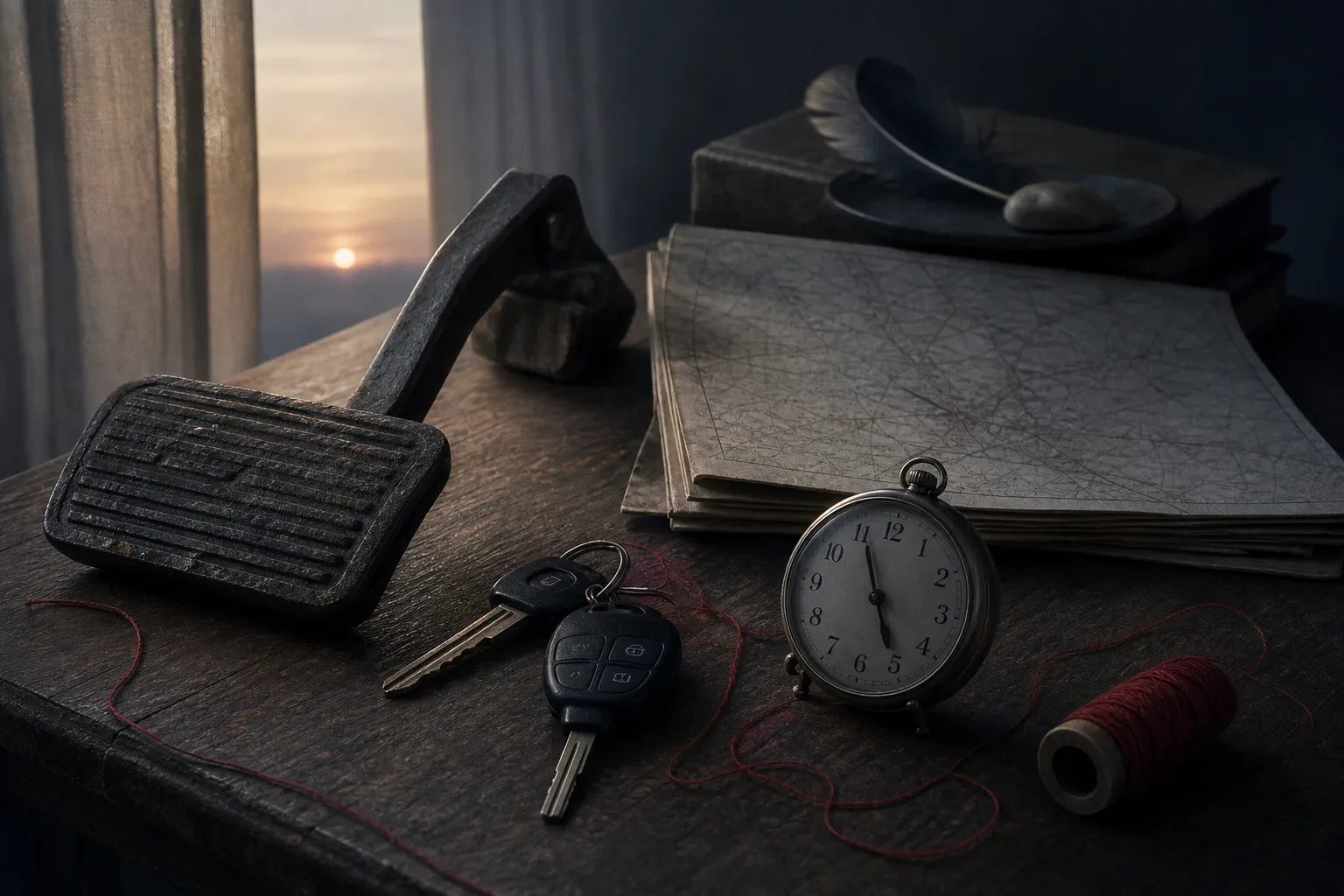
Dreaming that your brakes aren’t working usually points to a fear that something in waking life is moving faster than your ability to control it. It may be about pressure, a decision already in motion, anger you can’t quite stop, or a responsibility that seems to be carrying you downhill.
what the psychology says
A brakes-failing dream is one of the clearest control dreams. The machine is moving. Your body knows what to do. You press the pedal. The world doesn’t answer.
In ordinary terms, the dream tends to appear when you’re trying to slow something down and can’t. A workload. A conflict. Spending. Drinking. A relationship. A move. A deadline. A family role you agreed to before you understood its weight. The dream isn’t saying you’re doomed. It’s saying your nervous system is rehearsing the feeling of lost control.
That reading fits the continuity hypothesis of dreaming, associated with researchers such as Calvin Hall and later G. William Domhoff. The continuity hypothesis says dreams often carry forward waking concerns, emotions, relationships, and habits of thought. Not literally, and not neatly. But a person worried about momentum in the day may dream at night of a car that will not stop.
Threat-simulation theory, proposed by Antti Revonsuo, is also useful here. That theory suggests many dreams simulate threats so the mind can practice perception and response. A car with failed brakes is a clean threat scenario: danger, speed, time pressure, and limited options. You’re forced to notice what you do when stopping no longer works.
Clinical tradition adds another layer. Jung did not offer a fixed dictionary for modern car symbols, and it would be dishonest to pretend he did. But Jungian-influenced therapists often read vehicles as images of direction, agency, and the conscious way a person moves through life. In that frame, the brake pedal is restraint. It’s the capacity to pause, choose, say no, or turn aside. When it fails, the dream may be asking where your restraint feels unavailable.
There’s also a simple body-based possibility. If you drive often, your brain has a detailed map of pedals, traffic, slopes, lights, and near misses. Dreams commonly use familiar settings to stage emotional problems. A brakes-not-working dream after a stressful commute may be mostly about the commute. A brakes-not-working dream during a divorce, deadline season, relapse fear, or escalating argument may be about something larger.
Research on specific symbols is thin. There’s no strong scientific evidence that brake dreams mean one universal thing. Surveys of typical dreams, including work by Tore Nielsen and Michael Schredl on common dream themes, do show that danger, being chased, accidents, and losing control are ordinary dream material. The exact symbol is personal. The emotional pattern is the clue.
Notice the feeling in the dream. Panic means one thing. Irritation means another. Calmly pumping the brakes while looking for a safe shoulder suggests you still believe you have choices. Screaming while the car speeds through traffic suggests the waking issue feels beyond negotiation.
If you woke shaken, you’re still fine. A nightmare can leave the body charged for a while. If dreams like this are frequent, distressing, or disrupting your sleep, talk to a doctor or a licensed therapist in one plain step.
For nearby symbols, see driving, car crash, and being trapped in the wider dream-dictionary.
what tradition and folklore say
Because brakes are modern, older folklore doesn’t have ancient brake lore in the way it has lore for snakes, teeth, water, or birds. A medieval dream book could talk about horses, carts, roads, and reins. It could not talk about hydraulic failure at an intersection.
Still, tradition adapts.
In many Western folk dream books from the twentieth century onward, a car that won’t stop is treated as a warning to slow down. That’s folklore, not prediction. But it’s a fair bit of folk wisdom. The dream says: look at pace. Look at haste. Look at the place where you’ve been saying, “I can handle it,” while your body says, “Not like this.”
In Chinese popular dream interpretation, travel and vehicles are often linked with career direction, status, and the movement of fortune through ordinary life. A vehicle that cannot be controlled may be read as trouble managing progress or reputation. Again, this is tradition, not evidence. It can still be a useful question: where has progress become difficult to steer?
In Christian pastoral readings, losing the ability to stop may be understood as conscience calling for restraint. Not as punishment. More like the old language of “bridle” and “discipline”: what appetite, temper, promise, or habit needs a gentler hand on the reins?
In older horse-and-carriage symbolism, failed brakes translate to broken reins or a bolting horse. Folklore often reads that as passion outrunning judgment. There’s affection in that old image. The horse isn’t evil. It’s strong. The problem is that strength without guidance becomes frightening.
All of these traditions circle the same ordinary human concern: movement is good until it stops listening to you.
what if the brakes fail while you’re driving downhill?
A downhill brakes-failing dream usually adds the theme of momentum. Something has already started. Gravity is helping it along. You’re not only moving; you’re being carried.
This can show up when a situation has passed the easy-correction stage. A small debt has become a pattern. A flirtation has become a complication. A deadline has become a crisis. A mood has become a tone in the house. You may still have choices, but the dream’s hill says they feel narrower now.
Ask what in your life feels easier to continue than to stop. Downhill dreams often involve a shame feeling: “I should have slowed this earlier.” Be careful with that. Shame is not a brake. It usually makes the hill steeper. The useful question is not “How did I let this happen?” It’s “What is the next safe reduction in speed?”
If you found a way to steer, downshift, use the handbrake, aim for grass, or warn others, the dream contains resourcefulness. Your mind didn’t only show you danger. It showed you adaptation.
If the hill never ended, the dream may be about chronic pressure. You may be living without enough pause. In that case, the symbol is less about one dramatic decision and more about a schedule that never lets your nervous system return to level ground.
what if the car won’t stop before a crash?
If the dream ends in a crash, the feeling is usually fear of consequence. Not necessarily fear of an actual accident. More often, it’s the dread that a choice, conflict, secret, or pressure will hit something solid.
A car crash dream can be about collision between parts of life. Work and health. Want and duty. Anger and love. Freedom and money. You may feel that two realities are coming together too fast.
Notice what you hit. Another car may point to a relationship conflict. A wall may suggest a hard limit. Water may suggest emotion. A house may bring the issue into family or identity. A guardrail can be interesting: even in the dream, something is trying to keep you from going over the edge.
Also notice whether the crash actually happens. Many dreams stop just before impact. That suspended moment can be the whole message. You’re living in anticipation. The body is bracing for a consequence that may or may not arrive.
If you survive the crash in the dream, wake up, or climb out, that matters. The dream may be frightening, but it’s not only about disaster. It may be testing a feared ending and finding that life continues after the hit. This is common in nightmares: the mind stages what it fears, sometimes with more force than waking life warrants.
No dream predicts a crash. If you’re anxious about driving because of the dream, take ordinary precautions: rest, check the car if needed, and don’t drive while highly distressed. Keep the interpretation separate from safety.
what if you press the brake pedal and nothing happens?
This version is often about effort not registering. You do the correct thing and receive no response.
That can mirror a waking situation where you’ve tried to set a boundary and someone ignores it. You say you’re tired, and the requests keep coming. You say no, and it’s treated as maybe. You ask for help, and the room moves on. In the dream, your foot is working. The system is not.
This is different from forgetting how to brake. Forgetting suggests uncertainty or inexperience. Pressing the pedal with no result suggests failed authority. Your usual method for slowing life down isn’t working right now.
The pedal itself can symbolize a private act of control. It’s small, hidden under the dashboard, but it determines the whole car. That’s a good image for the quiet things that regulate a life: sleep, money, honesty, time alone, medication routines, food, saying no before resentment starts. If those quiet regulators are failing, everything else feels too fast.
Sometimes the dream has a trapped feeling. You’re inside a moving machine, enclosed by metal and glass, unable to step out. If that was the strongest feeling, the related symbol of being trapped may be closer to the heart of it. The issue may not be speed. It may be confinement.
Ask yourself: what have I already tried that isn’t working? Then ask the harder, kinder question: what different lever do I need? A conversation. A calendar change. A repair. A witness. A refusal. A rest.
what if someone else is driving and the brakes don’t work?
If you’re a passenger while the brakes fail, the dream usually shifts from self-control to trust. Someone else has the wheel. You’re affected by their choices.
The driver matters. A parent may point to old family patterns. A partner may point to shared decisions. A boss may point to work pressure. A stranger may suggest that the force driving your life feels impersonal: the economy, the institution, the medical system, the clock.
If you shout instructions and the driver ignores you, the dream may be about not being heard. If the driver is calm while you panic, it may show a mismatch in risk. You see danger. They don’t. Or they see danger and are hiding it.
If you grab the wheel, the dream may be exploring whether you need more agency. If you can’t reach the wheel, the dream is more helpless. That helplessness is worth respecting. It may be old. It may come from a present situation where you genuinely have limited control.
Not every passenger dream means you should take over. Sometimes trust is the question. Sometimes surrender is appropriate. But failed brakes suggest that something about the current arrangement doesn’t feel safe enough. You may need more information, clearer agreements, or a chance to say what speed you can live with.
the morning after
Ask yourself: where in my life am I trying to slow down, and what isn’t responding?
Write this line down: “The brakes failed when ___, and I needed ___.”
Fill it in plainly. “The brakes failed when the hill got steep, and I needed another way to slow down.” “The brakes failed when my father was driving, and I needed him to listen.” “The brakes failed before the intersection, and I needed more time.”
Then choose one waking brake. Not a life overhaul. One brake. Cancel one thing. Make one honest call. Check the actual car if the dream left you worried. Put a spending pause in place. Stop replying after a certain hour. Say, “I need to slow this down.”
If this dream repeats, it may be showing what your attention keeps returning to at night. A Dream-Self Moment, a short personalized recording of your future self, is one gentle waking counterpart in the AYA Method: instead of waiting for the night to stage the fear, you give your morning mind a steadier sentence to practice.