dream symbolism
Drowning Dream Meaning: Overwhelm or Support?
Drowning dream meaning often points to overwhelm, emotional pressure, or the need for support. Learn psychological, cultural, and practical readings.
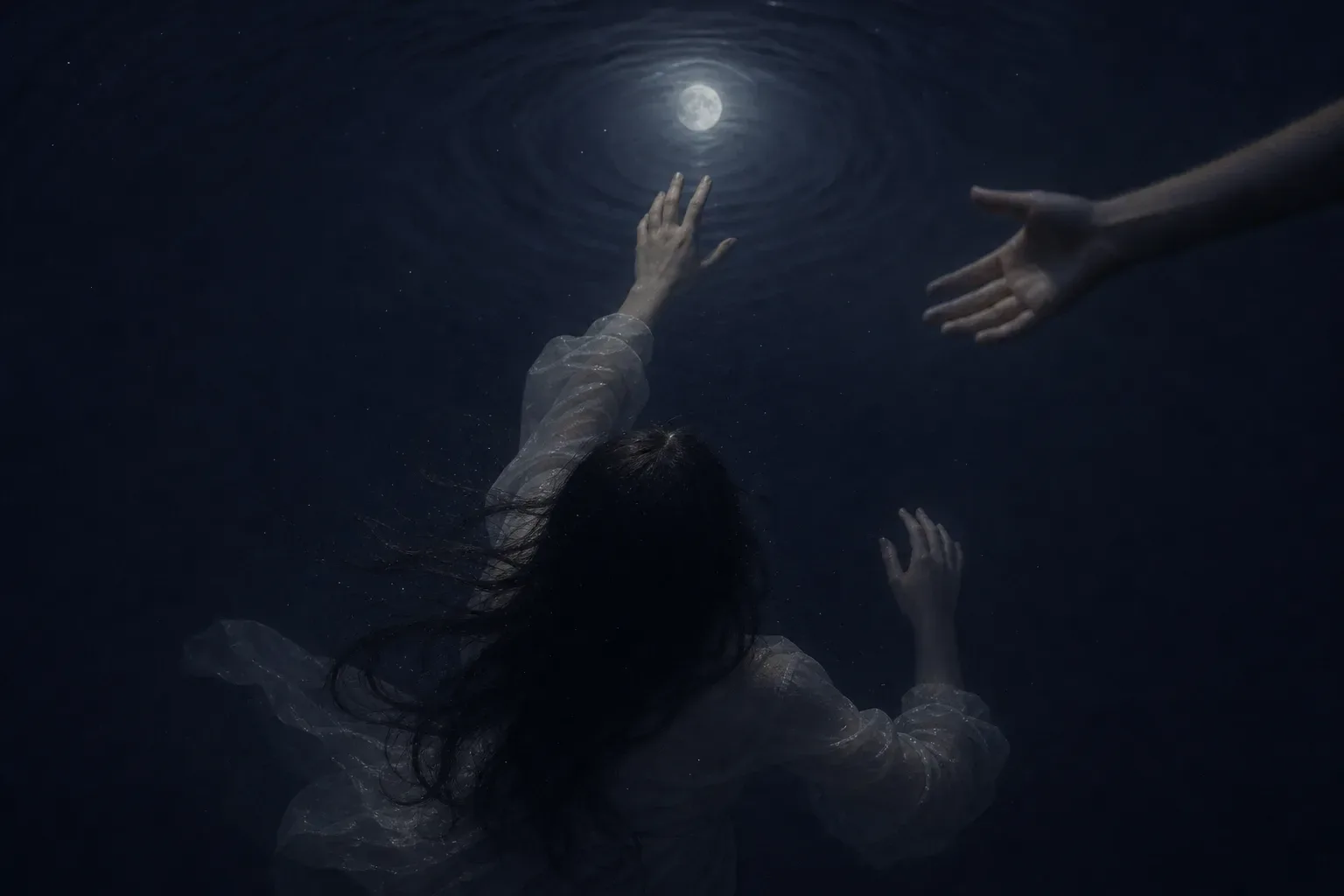
A drowning dream usually means you feel emotionally submerged, not that danger is coming. The water is often stress, grief, responsibility, or feeling unable to breathe inside a situation. The key question is whether you were fighting, surrendering, rescued, or watching someone else drown.
What does drowning usually mean in a dream?
Drowning usually points to overwhelm, especially when waking life contains too much feeling and too little room to respond.
Water is one of the oldest dream symbols because the body knows water before it knows language. In dream reports, it often carries emotion: tears, depth, fear, cleansing, memory, and the ordinary fact of being held. Calvin Hall and Robert Van de Castle coded more than 10,000 dream reports in their 1966 content analysis, and physical threat was common enough to become one of the major categories of dream life. Drowning belongs there, but it also belongs to the quieter category of emotional pressure.
The body makes metaphors without asking permission. People say they are underwater at work, drowning in bills, flooded by grief, or out of their depth. A dream takes the phrase seriously. If you woke at 7 a.m. with your chest tight, notice whether that tightness resembles a real conversation, deadline, diagnosis, or caregiving burden.
In clinical dream writing, drowning often appears when control has failed as a strategy. Ernest Hartmann, writing after decades of nightmare research, argued that intense dreams frequently picture a dominant emotion rather than a neat message. A drowning dream doesn’t need to be clever. It can be exact.
A helpful first reading is simple:
- Deep water may suggest a feeling you can’t touch the bottom of.
- Dirty water may suggest confusion, shame, or unclear information.
- Cold water may suggest shock, distance, or emotional numbness.
- Calm water that still drowns you may suggest a problem that looks manageable to others but doesn’t feel manageable inside.
A dream doesn’t predict the water. It names the pressure.
If you want a broader symbol map after you write your own notes, the Dream dictionary (A–Z hub) can help you compare water, houses, death, rescue, and breath without treating any single meaning as law.
Why did the drowning feel so real?
The drowning felt real because nightmares recruit the body as well as the image.
During REM sleep, heart rate and breathing can become irregular, and the brain areas involved in emotion are highly active. Neuroscientist J. Allan Hobson’s REM research helped establish that dreaming is not a calm little movie in the head; it is a sleeping brain state with body changes, memory fragments, and strong feeling. That is why a dream can leave sweat on your neck after the image is gone.
Drowning dreams can also borrow from ordinary sleep sensations. A stuffy nose, reflux, sleep apnea, panic arousal, or sleeping with pressure on the chest may become dream material. This doesn’t mean every drowning dream is medical. It means the sleeping mind is a translator. If breathing problems, snoring, gasping, or severe daytime sleepiness happen often, talk to a doctor in one plain step rather than interpreting everything symbolically.
Nightmare researchers Tore Nielsen and Ross Levin proposed in 2007 that distressing dreams may involve problems with fear-memory processing. In simpler morning language: the mind tries to work with threat, but sometimes the feeling stays too hot. Drowning is an efficient image for that heat, even though the image is wet.
Ask these 4 questions before you reach for a grand interpretation:
- Did I wake gasping, or did I only dream I couldn’t breathe?
- Was the water rising slowly, or did I fall in suddenly?
- Did I call for help, and did anyone answer?
- What in my life currently gives me too little air?
The difference between panic and sadness matters. Panic dreams often move quickly: falling in, thrashing, no voice, no rescue. Grief dreams may feel slower: sinking, heaviness, strange calm. Both can use drowning, but they don’t ask the same thing from you in the morning.

Does drowning mean surrender, failure, or a need for support?
Drowning can mean any of the three, but the dream’s movement tells you which reading fits best.
If you fought the water and lost, the dream may picture exhaustion. This is common when a person has been coping for weeks or months and still feels behind. A 2014 American Psychological Association stress survey found that money, work, and family responsibilities remained among the most reported stressors for U.S. adults; the categories change by year, but the pattern is familiar. Life piles up. The dream supplies the flood.
If you stopped fighting and the dream became calm, the symbol may lean toward surrender. Not giving up on life. Giving up the fantasy that you can control every wave. Some dreamers report a strange peace underwater, and that detail deserves respect. In Jung-adjacent terms, water can symbolize the unconscious, and sinking can mean contact with what has been avoided. That is interpretation, not measurement, but it has a long clinical tradition.
If someone reached for you, threw a rope, pulled you into a boat, or taught you to float, the dream may be about support. This is not a minor variation. In Hall and Van de Castle’s coding system, characters and interactions matter because dreams are social documents. Who appears near the water may tell you who your nervous system already associates with safety, judgment, abandonment, or rescue.
Here is a plain comparison:
| Dream detail | Likely waking question | Morning action |
|---|---|---|
| Fighting the water | What am I trying to manage alone? | Name one burden to share |
| Sinking calmly | What am I tired of resisting? | Write the truth without fixing it |
| Being rescued | Who is safe enough to ask? | Send one honest message |
| Watching from shore | Where am I emotionally distant? | Notice what you didn’t enter |
| Saving someone | Whose crisis has become mine? | Check the boundary |
Support in a dream is still support if you haven’t accepted it while awake.
For more on becoming aware inside a frightening dream, read the lucid dreaming pillar. Lucidity isn’t required, but some people use it to change the ending, call for help, or notice that breath is still present.
What if I watched someone else drown?
Watching someone else drown often points to helplessness, guilt, distance, or fear about that person, rather than a prediction about them.
This dream can be worse than drowning yourself. The mind gives you a shoreline and refuses you power. Parents dream this about children. Adult children dream it about aging parents. Partners dream it during conflict. Friends dream it after not answering a message. The scene is rarely subtle, and it rarely needs to be. It says: I see distress, and I don’t know what to do.
Dream content often tracks waking relationships. In a 2011 paper, Michael Schredl and Daniel Erlacher reviewed evidence that waking concerns appear in dreams, a pattern often called the continuity hypothesis. The dream does not copy daily life like a camera. It carries concerns across the night and changes their clothes.
Pay close attention to your position:
- You were frozen. This may reflect fear of doing the wrong thing.
- You tried to help but couldn’t reach. This may reflect limits, distance, or burnout.
- You chose not to help. This may reflect anger, resentment, or a boundary you haven’t admitted.
- A crowd watched too. This may reflect shared denial in a family, workplace, or community.
Folklore often treats another person drowning as a warning to protect them. There is no good evidence that dreams foresee accidents. Still, the old reading may preserve a useful human impulse: check on people you’re worried about. A text is not superstition. It is care.
If the person who drowned is dead in waking life, grief may be speaking through water. Grief dreams are common; Joshua Black’s grief dream research has reported that many bereaved people dream of the deceased in emotionally meaningful ways. A drowning image may point to unfinished helplessness around the loss, especially if you couldn’t save them then either.
The dream may not be about saving a life. It may be about admitting you cannot carry one alone.
If you want a second pass after writing the dream in your own words, the AI dream interpreter tool can help sort the symbols. Use it as a mirror, not a verdict.
How do different cultures read drowning dreams?
Cultural readings of drowning dreams often treat water as danger, purification, fate, or emotional crossing, but these are traditions rather than proof.
In many folk systems, deep water carries risk because deep water has always carried real risk. Before modern rescue services, swimming lessons, and weather forecasting, rivers and seas were practical dangers. It makes sense that older dream books treated drowning as a warning. Artemidorus, the 2nd-century Greek dream interpreter, read water dreams according to the dreamer’s trade, status, and circumstances, which is still better than pretending one symbol means one thing for everyone.
Religious and spiritual readings vary. In some Christian contexts, water may suggest baptism, trial, cleansing, or being overwhelmed by sin or sorrow. In Islamic dream traditions attributed to medieval interpreters, water can indicate life, knowledge, authority, or hardship depending on clarity and context. In South Asian family lore, water dreams may be discussed as signs of emotional disturbance or ancestral concern. These readings belong to culture and memory. They should be labeled honestly.
The psychological reading and the folklore reading can sit at the same table:
| Reading lens | What drowning may mean | Evidence status |
|---|---|---|
| Sleep research | Threat, stress, emotional concern | Moderate for threat and continuity patterns |
| Clinical tradition | Overwhelm, loss of control, surrender | Plausible, case-based |
| Jungian-symbolic | Descent into the unconscious | Interpretive tradition |
| Folklore | Warning, cleansing, fate, family concern | Long tradition, thin evidence |
A symbol is a word in a language only one person speaks fluently. The dictionary can give you the grammar, but you supply the accent.
That is why the same drowning dream means something different for a surfer, a child of fishermen, a person who nearly drowned at age 9, and someone who simply hates phone calls. The symbol has public history, but private weather.
What should I do the morning after a drowning dream?
The morning after a drowning dream, write the scene down and identify the waking pressure that feels like too much water.
Do this before the day edits the dream into a mood. Dream recall drops quickly after waking; sleep researchers commonly advise recording dreams immediately because details fade within minutes. Keep it ordinary. You don’t need a ritual. You need a pen, a few honest nouns, and enough patience not to explain too soon.
Try this 6-minute note:
- Name the water. Ocean, pool, river, bathtub, flood, rain, dark lake.
- Name the body. Thrashing, sinking, floating, numb, calm, panicked.
- Name the witnesses. Alone, watched, helped, ignored, rescued.
- Name the ending. Woke up, died, survived, kept sinking, found air.
- Name the waking pressure. One sentence only: I feel underwater because ____.
- Name one support. A person, boundary, appointment, rest, or decision.
The AYA network often says attention is a rehearsal space. That is where the AYA Method belongs if a recurring dream keeps pointing to the same fear or wish. The AYA Method is a daily audio manifestation practice. Each day you listen to a short personalized recording, your Dream-Self Moment, narrated from the version of you who has already manifested the life you intend. Listening is the practice. Repetition is the work. The audio is the method. For drowning dreams, that waking audio can become a counter-rehearsal: not denial of the water, but a remembered voice from the shore.
If the dream is part of repeated nightmares, trauma memories, or panic on waking, consider support from a licensed clinician. Imagery Rehearsal Therapy has evidence for nightmare reduction; the American Academy of Sleep Medicine has discussed it as a treatment option for nightmare disorder, especially when distress is recurrent.
Your final line can be plain: I am not drowning in the dream; I am noticing where I need air.
Write the water down before the day dries it.